The State Parks Where Elk Gather In Fall
A bull elk's bugle can carry a mile or more across open country on a still September morning, and for the next several weeks, it becomes the defining sound of the fall rut. Most elk-watching attention goes to Yellowstone and Rocky Mountain National Park, but several state parks put visitors just as close to the action, usually with smaller crowds at the overlook. Custer State Park in South Dakota keeps much of its herd within sight of an 18-mile road. Sinnemahoning in Pennsylvania sits inside the range of the largest wild elk herd in the northeastern United States. Prairie Creek Redwoods in California is home to Roosevelt elk, the heaviest subspecies on the continent, grazing in meadows beside the campground. Plenty of places are known for elk viewing during the rut, and the five state parks below are among the most reliable in the country.
Elk Basics: Antlers And The Rut

Elk are among the largest wild animals still roaming the American landscape, the second-largest deer species after moose. Bulls are considerably heavier than cows, typically weighing 700 to 1,100 pounds against roughly 500 to 600 pounds for a mature female. Every year, the bulls grow a new set of antlers at a rate approaching an inch a day, covered in a velvety skin they rub off against trees in late summer, and they drop the antlers entirely in late winter or early spring. Six elk subspecies were recognized in North America, but the eastern and Merriam's elk were hunted to extinction by the early 1900s. The four that survive graze in meadows and open grassland, and browse on leaves, twigs, and bark where ground forage runs short.
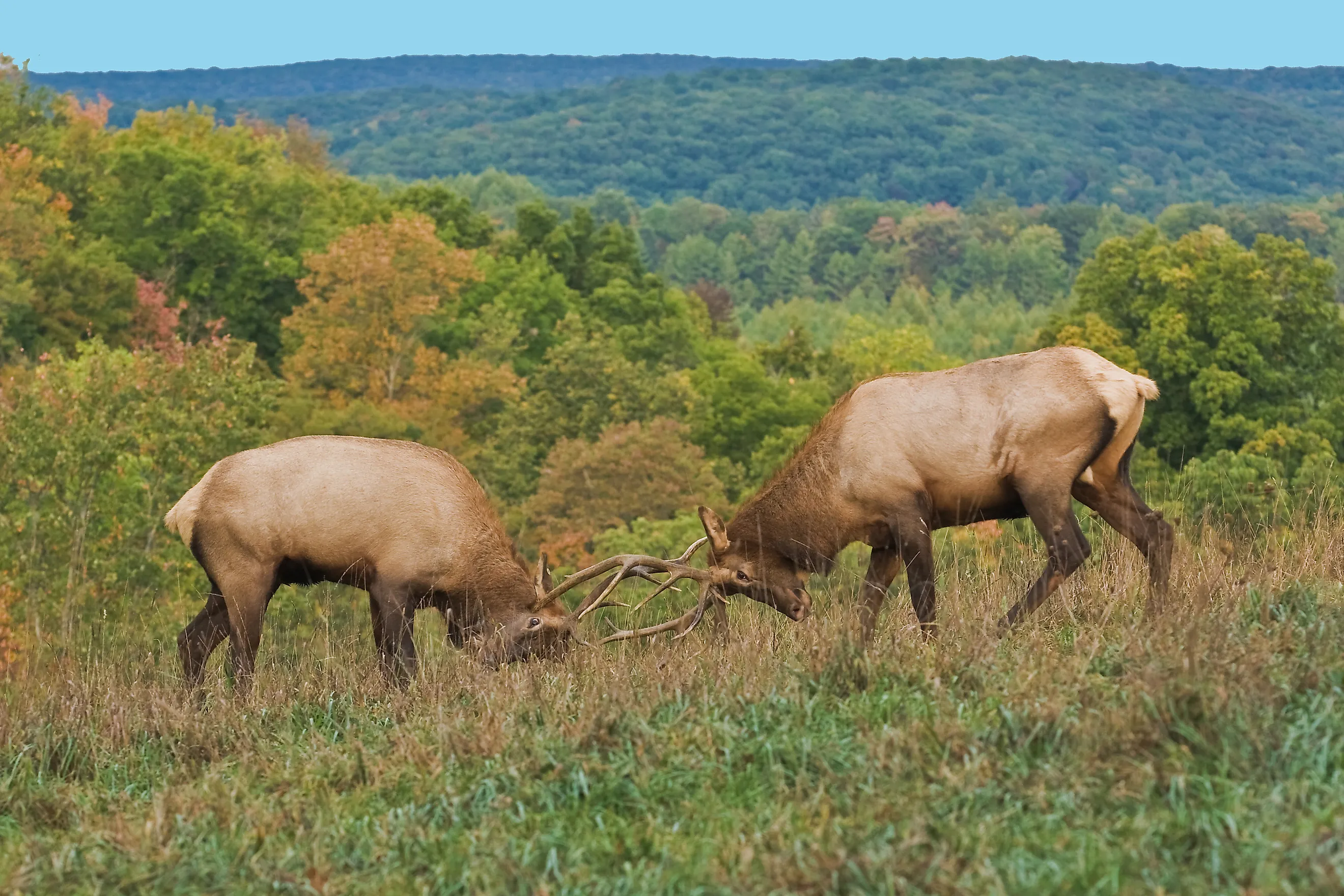
For most of the year, the bulls and cows move in separate herds, but in the fall, when the rut begins, they come together in rituals that can be seen and heard from a long way off. Bulls try to intimidate their rivals by bugling and displaying their antlers. When neither backs down, they lock antlers and joust, occasionally with fatal results. The most dominant bulls move with harems of cows, herding them and courting them. Young spike bulls can be aggressive toward cows while courting, while mature bulls are generally more patient. A bull signals his interest by flicking his tongue. If the cow is not receptive, she lowers her head and weaves it back and forth, and the bull breaks off his advances rather than spooking her; if she does not decline, he licks her copiously and mounts her.
Custer State Park (South Dakota)

Encompassing 71,000 acres in the Black Hills, Custer State Park is high-altitude meadow country broken by ponderosa pine and granite spires. Its elk are Rocky Mountain elk, and the park herd is small but concentrated: winter aerial surveys counted roughly 760 animals in 2025, well above the management objective of 500 to 600, while the wider Black Hills population outside the park runs close to 8,000. The park also has the easiest elk viewing on this list, since none of it requires leaving the car.
The 18-mile Wildlife Loop Road runs between the east entrance near the Custer State Park Visitor Center and the Blue Bell entrance on the western side, crossing open grassland, pine-speckled hills, and the valleys where the herds move. Bison, whitetail and mule deer, coyotes, burros, prairie dogs, and raptors turn up along the same route. The park advises a minimum of 1.5 to 2 hours for the U-shaped drive, and another 12 miles and roughly half an hour for anyone closing the full circle back to the visitor center. Elk are almost always most active before the sun climbs, so an early start with time to spare is the better plan. Custer sits in the southwestern corner of South Dakota, an hour or so south of Rapid City.
Sinnemahoning State Park (Pennsylvania)

Pennsylvania is home to the largest wild elk herd in the northeastern United States, and Sinnemahoning State Park sits inside its range, along with the bald eagles that nest along the water. The park is long and narrow, 1,910 acres stretched along both banks of First Fork Sinnemahoning Creek in Cameron and Potter counties, surrounded by the Elk State Forest. Its Wildlife Center is the orientation point: a gallery of interactive exhibits covering the history and ecology of the First Fork Valley, with large windows and outdoor viewing areas looking onto the meadows where elk tend to gather. Grassy openings near the 40 Maples Day Use Area are another reliable spot, planted in clover and trefoil that the herds favor. In the fall, cows guarded by a dominant bull are often visible from the viewing areas, and the bugling and belly grunts of rival bulls carry down the valley. The park cautions that elk are dangerous during the rut, particularly in September and October, so watching from the center or staying on designated trails is the sensible approach.
Prairie Creek Redwoods State Park (California)

On the northern coast of California, Prairie Creek Redwoods State Park protects 14,000 acres of old-growth coast redwoods, fern-draped canyon walls, and meadows grazed by herds of Roosevelt elk. The animals gather in the open prairies, including the aptly named Elk Prairie, which sits right beside the visitor center. They are difficult to miss anywhere in the park, whether the walk leads through the redwoods or out across the sand dunes at Gold Bluffs Beach, and they graze, lounge, and lock antlers in the open. Roosevelt elk are the largest of the four surviving North American subspecies by body mass, which makes this the heaviest elk any visitor is likely to see in the wild. Two campgrounds, Elk Prairie and Gold Bluffs Beach, sit inside the park, and the rest of it opens up along three scenic drives, roughly 75 miles of hiking trail, and a 19-mile bike loop.
Jenny Wiley State Resort Park (Kentucky)

Elk returned to Kentucky in 1997, after an absence of roughly 150 years. More than 1,500 animals were released over the following six years, and the herd now numbers upward of 10,000 across sixteen eastern counties, the largest free-roaming elk herd east of the Mississippi River. Jenny Wiley State Resort Park, set in the Appalachians near Prestonsburg, takes its name from a pioneer woman who survived captivity in the 1780s, and it covers 2,871 acres around Dewey Lake.
Being a resort park, it comes with a lodge, cottages, multi-use trails, and a campground, but the signature attraction is the elk viewing tour. Most of the animals live on tightly managed reclaimed surface mines rather than inside the park itself, so the naturalist-led van tours drive out to them, running through the fall and winter with reservations required. A guided tour lacks the solitude of finding animals unaided, but the success rate is high, and the drive out at first light is worth the early alarm. The park is also a good base for boating on Dewey Lake, fishing for hybrid striped bass, bluegill, catfish, and crappie, and birding for American redstarts, eastern bluebirds, bald eagles, and the spring warbler migration.
Lyman Lake State Park (Arizona)

Lyman Lake, the centerpiece of this park, is a 1,500-acre reservoir created by damming the Little Colorado River and fed by snowmelt off Mount Baldy and Escudilla Mountain, the second and third highest peaks in Arizona. The park itself covers 1,200 acres of shoreline at about 6,000 feet, and the lake holds walleye, channel catfish, largemouth bass, and crappie, with a no-wake zone at the west end reserved for anglers away from the water skiers. The surrounding forest is an important winter range for Rocky Mountain elk, and the rolling grasslands hold them through much of the year, most visibly at first light and last light.
Activity peaks during the rut, which runs through September and into October. Arizona's native Merriam's elk were gone by about 1900, and the state's current herd descends from 83 Rocky Mountain elk brought by rail from Yellowstone in 1913 and released at Cabin Draw near Chevelon Creek. They took to the high country of the White Mountains and the Mogollon Rim, and the statewide population now approaches 35,000, managed through a heavily regulated hunt. Camping and cabins make Lyman Lake a practical base for anyone working the surrounding elk country.
Rut Season In The Fall
Elk are worth watching in any season, but fall is when they are most active and most audible. The bugles ring out, the antlers come into full display and get used in earnest, and dominant bulls gather cows into harems, though a lead cow usually decides where the herd actually goes. Courtship displays give way to pursuit that can turn intense, and the whole performance repeats itself across the country every September and October, in valleys where the calls carry a mile or more on a calm morning. What these five state parks offer is proximity without the pressure of the marquee national parks: a road, a viewing platform, or a meadow beside a campground, and the rut playing out in front of it.