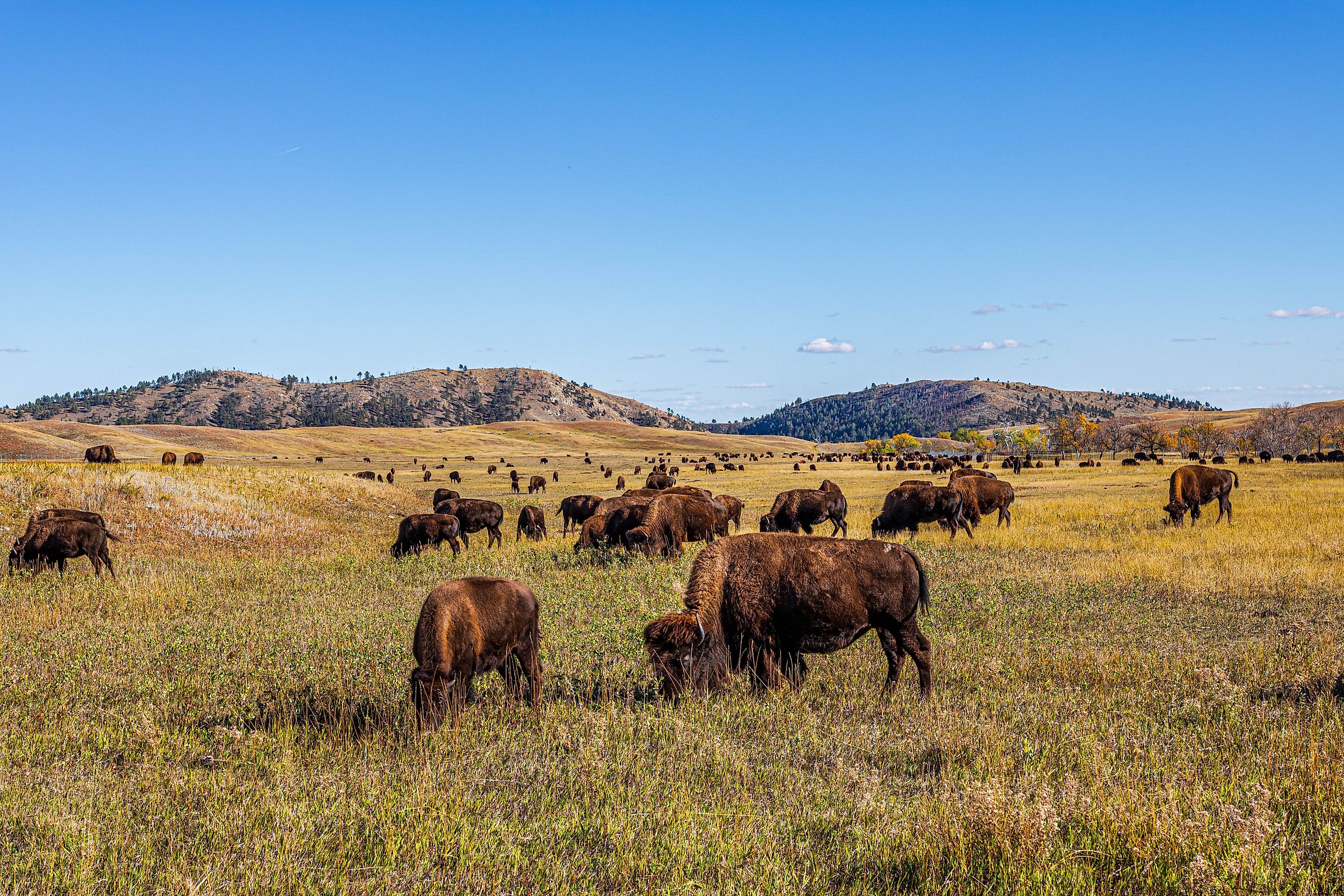
The State Parks Where Bison Still Roam
At one time, vast herds of American Bison roamed freely across North America, as far south as New Mexico, north into Canada, and west to Oregon. Prior to 1800 it is estimated that 30 to 60 million of them covered one third of the continent. By 1888, fewer than 1,000 of them still existed. Now, the American Bison is no longer considered to be endangered, due in no small part to efforts to build new herds and give them protected homes within many state parks. These are the state parks where bison still roam.
History & Facts About Bison
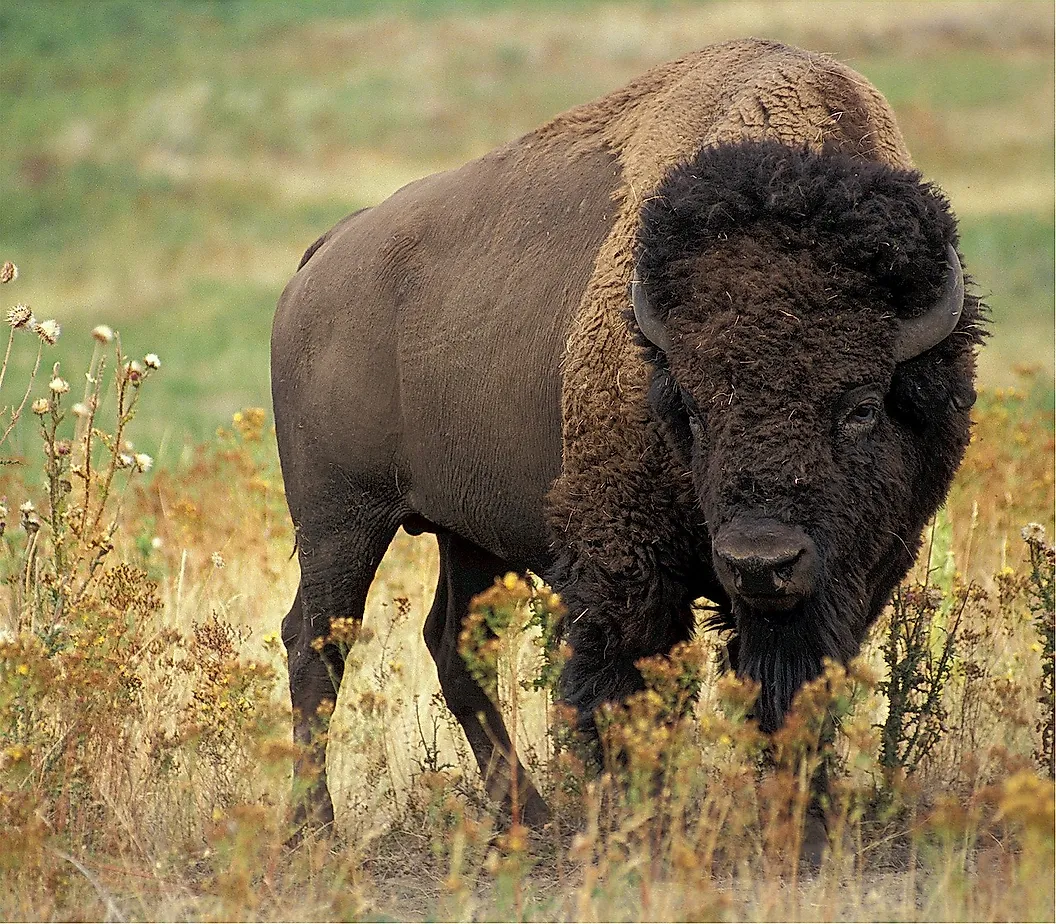
Before 1800, the bison were an integral part of the food chain in North America, consumed by predators and scavengers, and hunted by Native Americans who used every part of the animal for food, clothing, shelter, and tool making.
When explorers from Europe first arrived in North America they described the massive "cows" they'd discovered with wonder. They said that you could hear them roar from miles away and that attempting to count them would be like trying to count the stars in the sky.
Bison are immense animals with adult males as high as six feet tall and 11 feet long. They can spin around faster than a horse, and they accelerate to full speed in a few strides. Both male and female bison grow horns, and those massive heads can be used to plow snow to create paths for roaming in the winter.
Bison are integral to the ecosystem of grasslands. They distribute seeds, which helps with plant diversity and keeps any single plant species from becoming too dominant. The bison, a wallowing animal, create dents in the ground that fill with water and become critical homes to insects and amphibians.
How the American Bison Was Saved

Between the 1870s and 1880s, the number of bison had been decimated by commercial hide hunters, known now as "The Great Slaughter." Unlike the hunting by Native Americans, they would kill dozens of animals in one fell swoop. By 1888, less than 1,000 bison still existed. The National Park Service estimates that by 1902, the last remaining wild bison were down to about 23 in Yellowstone National Park alone.
What saved the bison was a two-fold effort that happened more or less simultaneously by private conservationists and government actions in Yellowstone. The current state park herds developed largely out of donations and purchases from bison that were privately owned.
Charles and Mary Ann Goodnight rescued orphan calves from the southern bison herds in 1878. Those were raised on the JA Ranch in Texas. Their descendants are the basis of the Texas State Bison Herd, now living in Caprock Canyon State Park.
Similarly, James "Scotty" Phillips acquired a small number of animals in 1890. By 1911, when he died, his herd had grown to over 1,000. Those bison were distributed to several national and state parks. In 1914, the state of South Dakota purchased 31 of them. Those animals are the ancestors of Custer State Park's current bison herd, the largest of the herds of the state parks listed below.
Custer State Park

The herd of nearly 1,400 animals at Custer State Park in South Dakota is one of the world's largest publicly owned bison herds. As mentioned, this herd is descended directly from of the animals acquired from Scotty Phillips. The state purchased them for the park just after its official opening.
The bison are free roaming in the 71,000 acres that make up the park. Most of them tend to congregate along the southern grasslands and the Wildlife Loop Road, often creating major traffic jams and surrounding cars. The best way to see the bison is along this 18-mile road, either self-guided in your own car or with a guided tour into the grasslands in a safari jeep. The guided tours are two hours long, but you can also buy an all-day tour or one that combines with a cookout.
Antelope Island State Park

Antelope Island State Park in Utah is home to a herd of between 500 to 700 bison. They freely roam the 28,022 acres that comprise the park, with grasslands and shoreline making up most of the land. The females and calves tend to wander along Fielding Garr Ranch Road on the east side of the island and the mature bulls roam either alone or in small groups on the west side, near the visitor center and campgrounds.
There are no fences anywhere in the park, other than those that keep the bison from wandering off the island and on to the mainland. Not even the campgrounds are cordoned off. This means it isn't impossible that you could wake up in the morning to see one grazing right next to your tent or RV. You can come close to them while hiking, as well. Read the section on bison viewing safety below.
Caprock Canyon State Park

As discussed earlier, the bison herd at Caprock Canyon State Park in Texas, was started in 1878 by the Goodnights and lived on their JA Ranch. In 1994 a wildlife conservationist, Wolfgang Frey, contacted the state after learning that 50 of them were still there. In 1997, JA Ranch donated their bison to the state, and they were then moved to Caprock. A portion of the ranch, though, is still part of their grazing lands. Altogether the park is 17,500 acres and the bison free roam throughout it. There are 250 to 300 animals in the park.
The herd in Caprock is unique due to its genetic purity. Although most bison in North America contain tiny amounts of cattle DNA due to past crossbreeding, these animals are pure descendants of the continent's original Southern Plains herd.
Although you can view the bison on foot, the easiest and safest way to do so is by car along the main park roads or by hiking to one of the canyon rims and seeing them from above.
Blue Mounds State Park

Minnesota's Blue Mounds State Park is home to 80 to 90 bison. Unlike the parks listed before this, they do not free roam but are instead contained inside of a huge 530-acre designated area. They are entirely separate from hiking trails or campgrounds.
To best view the bison, visitors can hike along the fence perimeter trail or see them from the observation deck at the visitor center. Perhaps the best way to see them, however, is by taking a 90-minute guided tour with a ranger. Visitors are driven in a 12-passenger safari vehicle, which is open sided and goes directly into the bison roaming area.
Minneopa State Park

Minneopa State Park, also in Minnesota, protects 30 to 40 bison within a large 330-acre enclosure. They are kept completely separate from the campgrounds and hiking trails. However, visitors can drive into the enclosure, and this is a great way to potentially see them up close. You are strictly prohibited from leaving your car.
Similarly to Blue Mounds, there is also a hikable perimeter trail and an overlook with interpretive information.
San Angelo State Park

The bison herd in San Angelo State Park in Texas consists of about 35 animals. This herd is meant to be "interpretive," a way to learn about the bison. They are enclosed within a 600-acre area, totally separate from the hiking/biking trails and the campgrounds. This herd is also genetically pure, having been directly descended from the Texas State Bison Herd in Caprock.
Right next to the bison enclosed area is another paddock, this one home to the iconic Texas Longhorn Cattle. You can also learn about them through interpretive information.
Although there is a viewing area, the massive size of the enclosure for such a small number of bison means that sometimes they have wandered into areas where they simply can't be seen. On weekends, rangers will feed both them and the Longhorns right by the viewing area, so this can be a good time to visit. Simultaneously, the rangers discuss details about the animals.
Bison Viewing Safety
Inside of parks where visitors can walk or camp within the same areas that bison live in, it is important to follow the park's safety rules to the letter.
Most importantly, keep your distance. A rule of thumb (no pun intended) is to hold up that digit at arm's length in front of you. If you can fit an entire bison behind your thumb, you are at a safe distance. If not, then you need to go further away. Caprock Canyon requires 60 yards of distance.
In general, if you observe a bison changing its behavior in your presence, looking directly at you, or moving towards you, it's time to back away and leave them alone. Remember, they move fast. If you are hiking and see one, slowly back away the direction that you came, or leave the trail in order to give it a very wide berth. Mothers with calves or bulls who are in rut are the most likely to be aggressive.
If an animal is blocking the road in front of your car, do not get out of the vehicle. Do not honk your horn. You must be patient and wait for it to move, as it inevitably will do. If it is on the side of the road, then you may slowly drive past it.
In general, following these rules will keep you safe. Fatalities and injuries do happen upon occasion, though. Some of these occur because of not following the rules. Unfortunately, though, bison are wild animals and injuries, or more rarely fatalities, do happen. In May of 2026, a 70-year-old Canadian woman hiking at Custer State Park with her husband was gored and killed by a bull, South Dakota's first bison-related fatality since 2001. They had encountered five bulls walking along a trail at a blind bend, one of the places to be most cautious. Although they stepped back and let the animals pass, when they started to walk again one of them turned and charged without warning. Her husband took cover behind a tree.
Importantly, although watching bison as they wander and feed is awe inspiring, they are not domesticated. Visitors must enjoy ones that free roam at their own risk.