Why Webb Is Rewriting The Story Of The Early Universe
The James Webb Space Telescope wasn’t built just to take pretty pictures; it was built to change the way we understand the universe itself. Webb is not simply the next Hubble Space Telescope. It’s the telescope designed to answer the questions Hubble couldn’t reach, the ones buried in the universe’s first moments. When the first images appeared in July 2022, astronomers didn’t just see any picture. They saw evidence that the early universe was far busier, brighter, and more complex than anyone expected. Webb’s infrared eyes revealed galaxies so distant that they are also looking back in time to the early life of the universe, as the light has taken time to reach the telescope's mirrors. And what those galaxies looked like left scientists stunned, as it showed galaxies that shouldn't even exist yet, according to previous scientific theories.
Hubble Showed Us the Universe Was Changing, and Webb Will Show Us How It Began

Hubble’s greatest breakthroughs came from looking deeper than anyone thought possible. Its Deep Field images revealed that the “empty” sky was actually packed with galaxies: a discovery that helped confirm that the universe evolves dramatically over time. But even Hubble hit a wall. Its deepest images could only glimpse galaxies from as far back as 400 million years after the Big Bang, and even then, only as faint smudges. To see the universe before that and to witness first light, the moment the first stars ignited, astronomers needed a telescope that could see in infrared, where the earliest galaxies shine brightest. That telescope is Webb.
Galaxies That Shouldn’t Exist Yet

In the earliest Webb data, researchers found far more galaxies, forming far earlier, and shining far brighter than theory predicted. One of the first shocking discoveries was Maisie’s Galaxy, a compact, brilliant object whose existence implied that star formation in the early universe must have begun earlier and more efficiently than previous models allowed. Astronomers tried to disprove it, assuming it was an artifact, a misreading, a trick of the data. But every test confirmed it. The galaxy was real. And it was old. Too old. Webb wasn’t just adding details to the story of the early universe. It was rewriting the opening chapter.
Seeing the Universe in a New Light — Literally

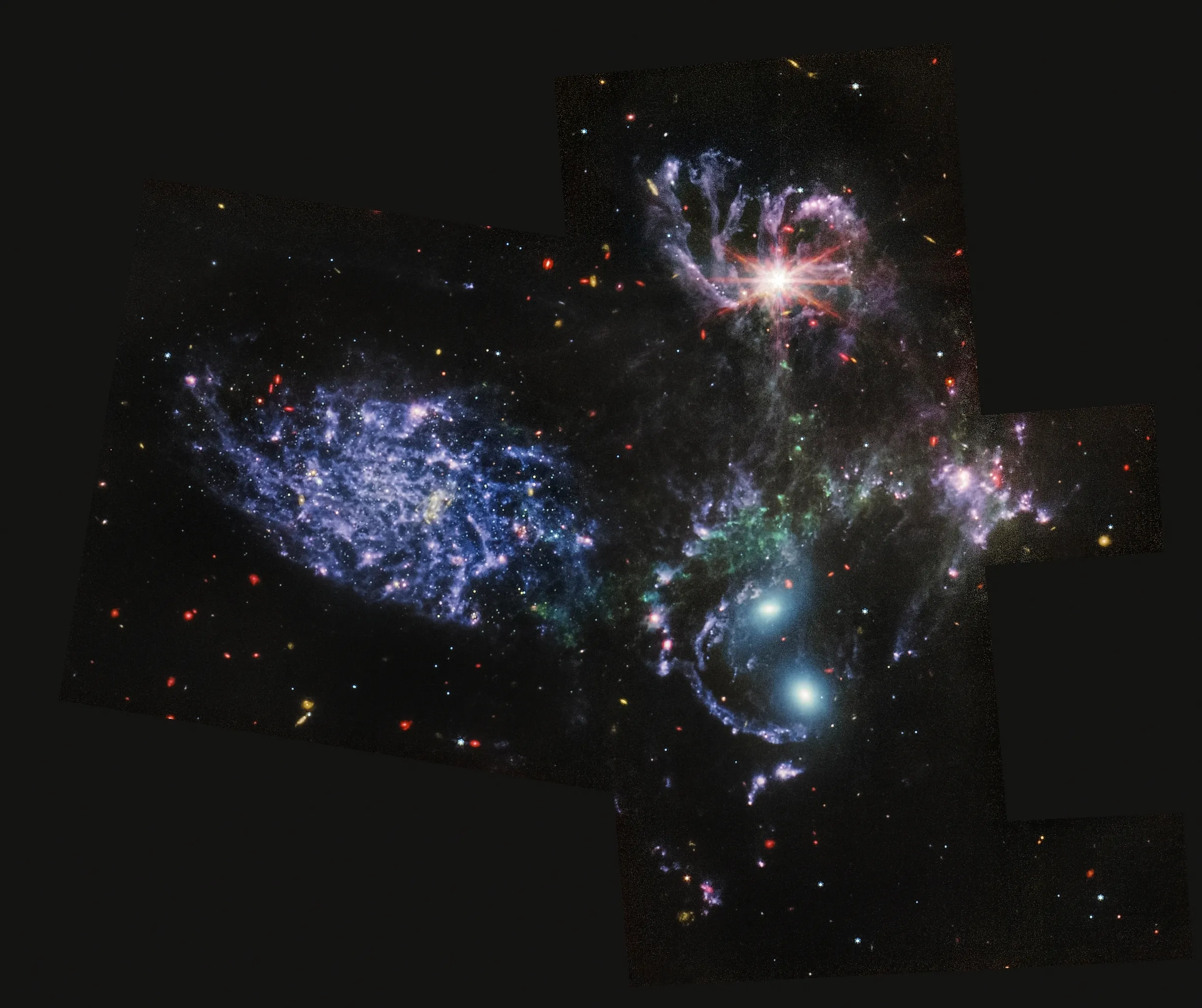
Webb’s detectors don’t capture “pictures” the way a camera does. They collect raw infrared data that has traveled for billions of years across the universe. The raw data looks like static on a TV screen, full of noise, heat signatures, and strange artifacts with names like "dragon’s breath" and "snowballs". Only after careful cleaning, calibration, and stitching together hundreds of exposures do the images emerge, revealing galaxies with structures, star clusters, and faint features that no telescope had ever seen before. This is why Webb is transformational: it doesn’t just see farther. It sees deeper, cleaner, and sharper than any instrument before it. The earliest stars and galaxies are so distant that their light has been stretched into infrared wavelengths. Webb is built specifically to capture that.
A Telescope Powerful Enough to Change Physics

Webb’s early galaxy observations forced astronomers to confront a startling possibility that the universe formed stars and galaxies far more efficiently than our physics predicted. To explain Webb’s galaxies, scientists must now consider earlier star formation, quicker buildup of heavy elements, and the different behavior of dark matter in the early universe. Webb’s data is so rich that researchers describe it as teaching us “everything” about how galaxies form and evolve from the gas and dust swirling inside them to the winds blowing off into newborn stars. At 6.5 meters in diameter, Webb’s mirror has over six times the collecting area of Hubble’s. More mirrors mean more light. More light means deeper time. Together, these features allow Webb to peer into an era when the universe was still wrapped in a fog of hydrogen, just beginning to clear.
Answers We Didn’t Even Know to Ask
Webb is a revolutionary telescope that follows in the footsteps of Hubble and the Kepler Space Telescope. Hubble revealed dark energy, while Kepler revealed a galaxy overflowing with planets. Webb can analyze starlight passing through a planet's atmosphere or, by blocking the star's glare entirely, detect water, carbon dioxide, ammonia, and other molecules needed for a habitable planet. Webb may reveal the first generation of stars, the earliest galaxy formations, and maybe even the first formation of life itself.