Who Invented the Telescope?
On October 2, 1608, the Dutch spectacle maker Hans Lippershey filed the earliest known patent application for a device that combined two lenses to make distant objects appear closer. The application went on record at The Hague, the Dutch States General refused the exclusive patent on grounds that the design was too easy to copy, and within a year the news had crossed Europe. Galileo Galilei built his own version in Padua by mid-1609 and pointed it at the night sky in January 1610. The question of who invented the telescope first has more than one credible answer, and the broader history covers four centuries of optical refinement, ending up at the James Webb Space Telescope and the next generation of ground-based observatories.
Who Invented The Telescope?

Three Dutch claimants emerged in October 1608, and modern historians generally credit Hans Lippershey with the strongest claim because he was first to formally file. Lippershey was born around 1570 in Wesel, in what is now western Germany, and settled in Middelburg in the Dutch province of Zeeland around 1594, where he worked as a master lens grinder and spectacle maker. He filed his patent application with the States General on October 2, 1608, for an instrument he called a kijker (Dutch for "looker") with roughly three-times magnification. The design used a convex objective lens at the front and a concave eyepiece at the back, a configuration that produces an upright image and is still called the Galilean refractor today.
The States General declined to grant the exclusive patent because the same design had emerged from at least two other Dutch spectacle makers within weeks. Jacob Metius of Alkmaar filed a separate patent application in mid-October 1608, only days after the States General began reviewing Lippershey's claim. Zacharias Janssen, also a Middelburg spectacle maker working in the same town as Lippershey, was later credited as the original inventor by his son Sebastiaan in claims made decades after Janssen's death, but modern historians regard those claims as unverified and inconsistent.
What is reasonably settled is that the basic optical concept of using two lenses for magnification had been circulating in European optical workshops since the late 16th century. Lippershey's contribution was the practical refinement and the formal patent application that triggered the rapid spread of the technology across Europe.
How Galileo Galilei Built On The Dutch Design

News of the Dutch perspective glass reached Galileo Galilei in May or June 1609. Without seeing one of the original Dutch instruments, Galileo built his own three-power version within days, then refined the design over the following weeks to eight-power and ultimately to about thirty-power magnification. He presented an eight-power telescope to the Venetian Senate on August 25, 1609, demonstrating its military utility from the top of the Campanile of St. Mark's. The Senate doubled his University of Padua salary and made his lectureship permanent.
Galileo pointed his refined instrument at the night sky in late 1609 and January 1610, and made the observations that fundamentally changed the picture of the solar system. He observed the four largest moons of Jupiter, which he initially named the Medicean Stars after his patron Cosimo II de' Medici but which are now known as the Galilean moons: Io, Europa, Ganymede, and Callisto. He resolved the Milky Way as a vast collection of individual stars rather than a continuous nebulous band, observed the phases of Venus (providing direct evidence that Venus orbits the Sun), documented mountains and craters on the Moon, and tracked sunspots across the Sun's surface. He published the initial results in Sidereus Nuncius (Starry Messenger) in March 1610. The combined observations supported the Copernican heliocentric model and ultimately led to Galileo's trial by the Roman Inquisition in 1633.
The name "telescope" itself did not arrive until 1611, when Prince Federico Cesi, founder of the Accademia dei Lincei, proposed the term from the Greek tēle ("far") and skopein ("to see") at a banquet honoring Galileo.
The Reflector And The 19th Century
![By The Science Museum UK - [1], CC BY 4.0, https://commons.wikimedia.org/w/index.php?curid=133516675](https://www.worldatlas.com/r/w960-q80/upload/8d/f1/49/newton-telescope-replica-1668-s3cdn.jpg)
In 1668, Isaac Newton built the first practical reflecting telescope. Newton's design used a concave primary mirror to gather and focus light, with a flat secondary mirror redirecting the image to an eyepiece on the side of the tube. The reflector design eliminated chromatic aberration, the color-fringing effect that limited the performance of refractor telescopes, and allowed for much larger apertures than the glass-blowing technology of the time could produce in lenses.
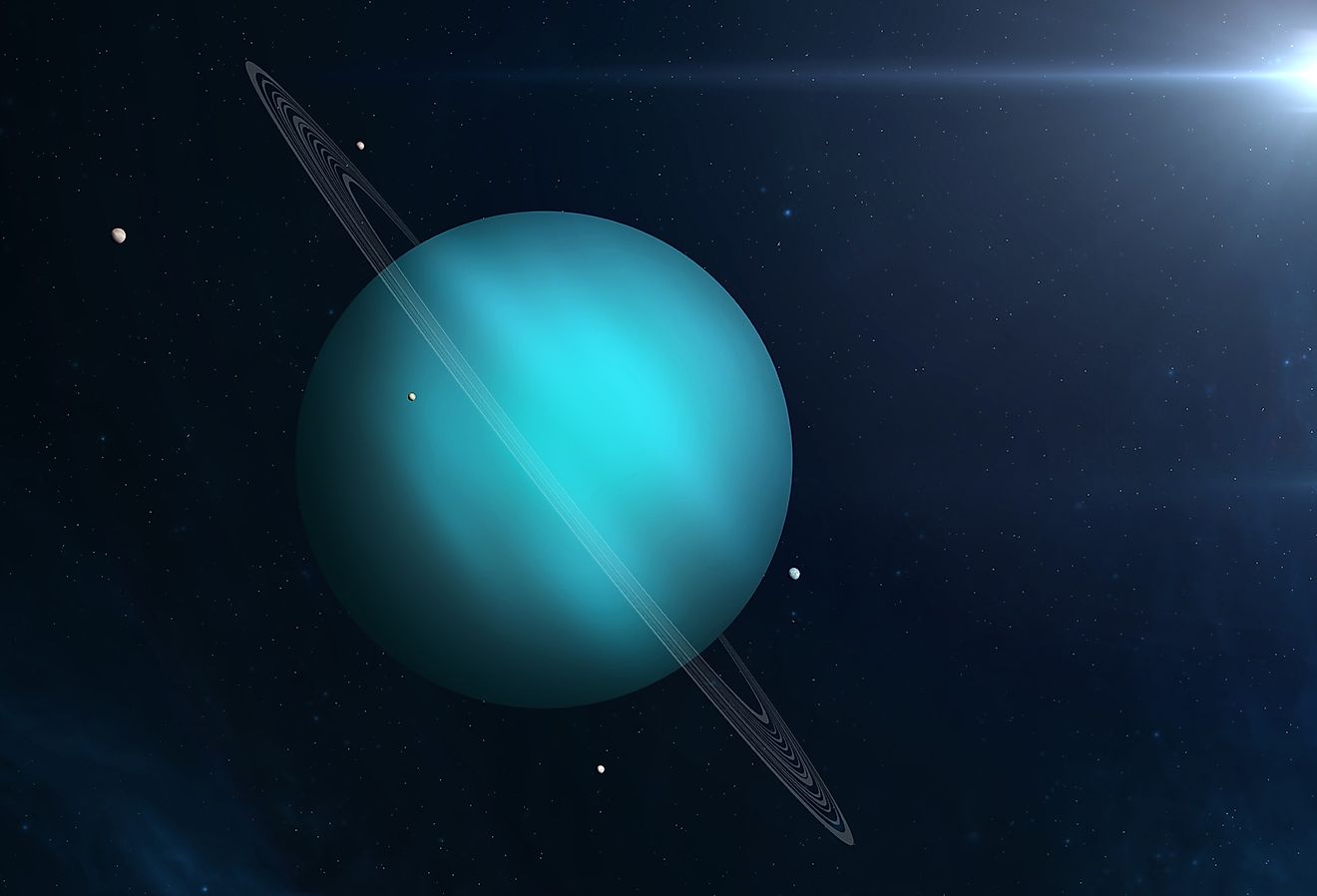
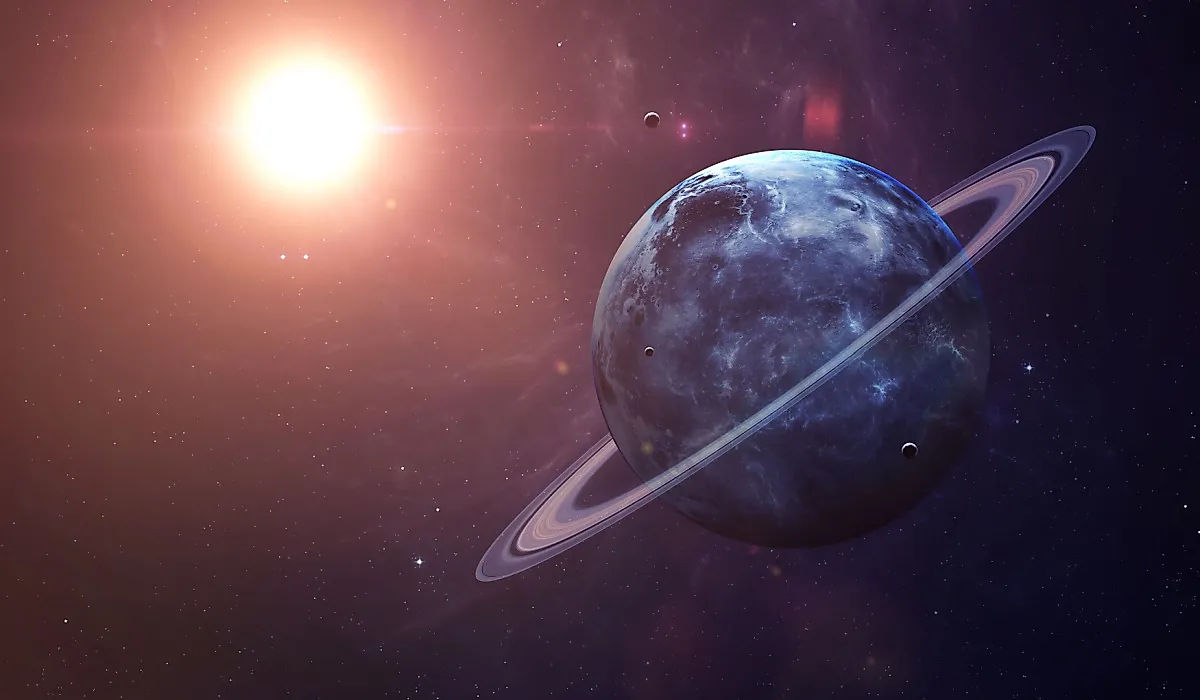
Subsequent variations on the reflector design followed throughout the 17th and 18th centuries. Laurent Cassegrain proposed the Cassegrain design in 1672, using a convex secondary mirror to direct the focal point back through a hole in the primary mirror. William Herschel, working with much larger reflecting telescopes in the late 18th century, discovered the planet Uranus in 1781 from his garden in Bath, England, using a 6.2-inch reflector he had built himself. In the 19th century, large refractors built by firms like Alvan Clark and Sons of Massachusetts pushed lens-based optics to the practical limit, with the 40-inch Yerkes Observatory refractor (completed 1897) still standing as the largest functional refracting telescope ever built for scientific use.
The Space-Telescope Era

The 20th and 21st centuries scaled telescopes well past anything Lippershey or even Herschel could have imagined. The Hubble Space Telescope launched into low Earth orbit on April 24, 1990, with a 2.4-meter primary mirror, and has produced more than 1.6 million observations across more than three decades of operation. Hubble's deep-field exposures have revealed galaxies dating back nearly 13 billion years.
The James Webb Space Telescope, NASA's infrared successor to Hubble built in partnership with the European Space Agency and the Canadian Space Agency, launched on December 25, 2021. Webb operates from the second Lagrange point about 1.5 million kilometers from Earth and carries a 6.5-meter primary mirror made of 18 hexagonal beryllium segments coated in gold. The instrument is engineered specifically to capture infrared light from the most distant galaxies in the observable universe, and since beginning science operations in July 2022 it has imaged exoplanet atmospheres, the earliest galaxies forming after the Big Bang, and the inner workings of stellar nurseries within our own galaxy.
The Ground-Based Frontier

Ground-based observatories have scaled up alongside the space program. The Large Binocular Telescope on Mount Graham in Arizona achieved first light with both 8.4-meter mirrors operating together in 2008, providing a combined collecting area equivalent to an 11.8-meter aperture.
The European Southern Observatory's Extremely Large Telescope, currently under construction on Cerro Armazones in Chile's Atacama Desert, will carry a 39-meter primary mirror assembled from 798 hexagonal segments. First light is scheduled for 2028, with full science operations expected by the end of the decade. The ELT will produce images roughly 15 times sharper than the Hubble Space Telescope and is designed to directly image rocky exoplanets, capture atmospheric spectra of those exoplanets, and probe the structure of the early universe. It will be the largest visible-light telescope ever built.
Why Lippershey's Patent Still Matters
Almost every modern understanding of the universe beyond Earth's atmosphere traces back to telescope observations that began with that October 1608 patent application in The Hague. Galileo's first sweeps of the night sky overturned the geocentric model. Newton's reflector opened the way to larger apertures and the discovery of Uranus, Neptune, and untold numbers of asteroids and comets. Hubble redrew the timeline of galactic evolution. Webb is already adding detail to the formation of the first stars. The Extremely Large Telescope, the Vera C. Rubin Observatory, and the Giant Magellan Telescope are all on track to extend the work over the next decade. The basic combination of two lenses that Lippershey patented has produced more than four centuries of expanding knowledge about the cosmos, and each new generation of instruments raises the next set of questions.