Which Planet Has The Strongest Magnetic Field?
Jupiter has the strongest magnetic field of any planet in the Solar System, with a dipole moment roughly 20,000 times that of Earth and a magnetosphere that extends millions of kilometers into space, making it the largest planetary structure in the Solar System after the Sun's heliosphere. The other three giant planets (Saturn, Uranus, and Neptune) also generate substantial magnetic fields, while Earth and Mercury produce moderate to weak fields from their iron cores. Venus and Mars, in contrast, have no significant globally generated magnetic field at present. Comparing the magnetic fields of the eight planets reveals how a combination of planetary composition, internal structure, and rotation rate produces dramatically different magnetic environments across the Solar System.
What Is a Planetary Magnetic Field?

A magnetic field is a region of magnetic force generated by the motion of electric charges. In planets, magnetic fields are produced by dynamo action: the motion of an electrically conducting fluid in the interior, driven by convection and organized by the planet's rotation, generates electric currents that in turn produce the magnetic field. The three requirements for a planetary dynamo are therefore a large volume of electrically conducting fluid, an energy source that drives convection of that fluid (typically heat released by the core or by chemical differentiation), and rotation to organize the resulting flows.
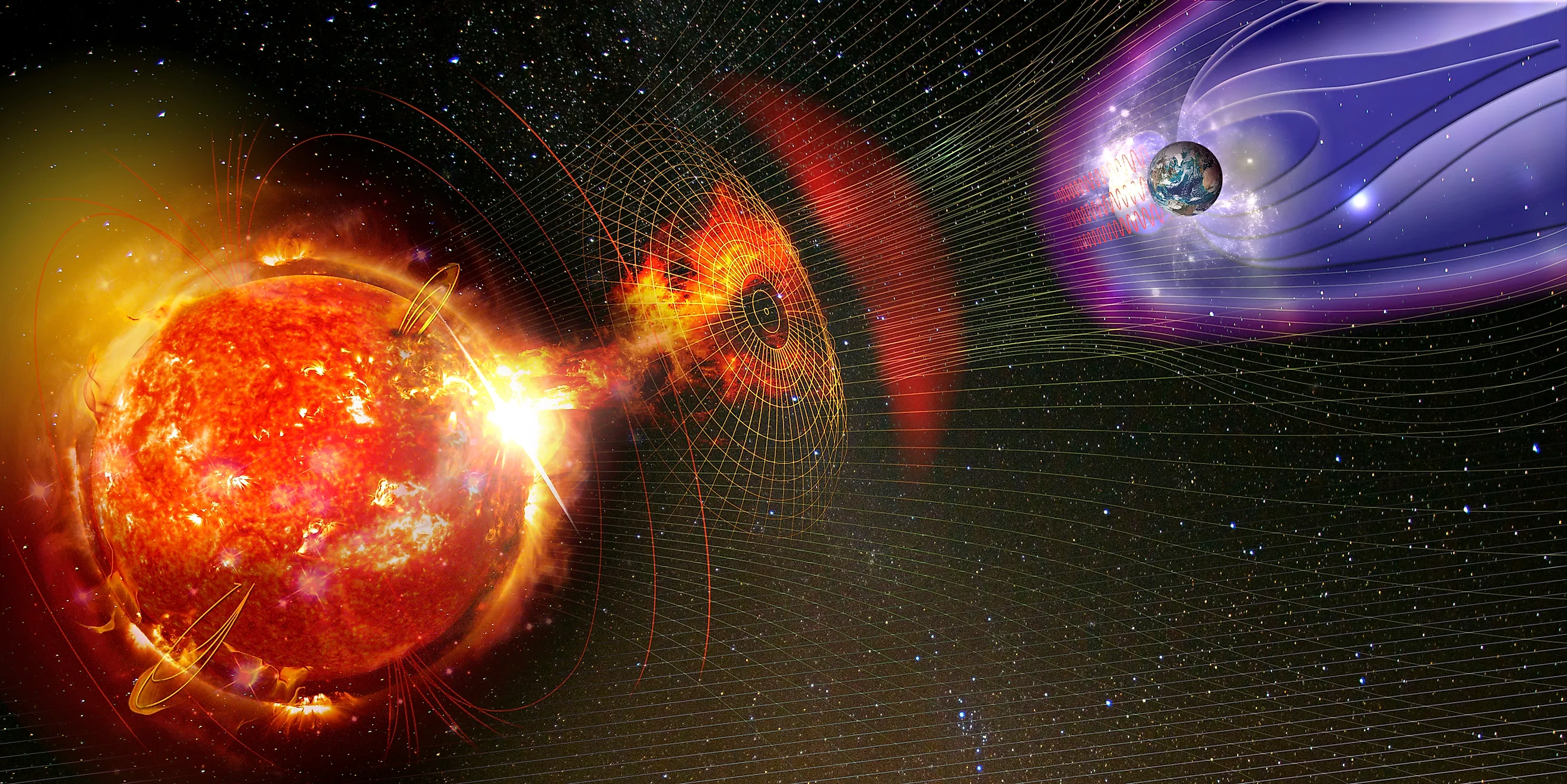
Planetary magnetic fields shield the atmosphere and surface from the solar wind, the stream of charged particles flowing outward from the Sun at several hundred kilometers per second. Without a magnetic field, the solar wind can strip atoms from a planet's upper atmosphere over geological timescales, a process now widely believed to have removed most of the atmosphere of Mars after that planet's dynamo shut down approximately 4 billion years ago. Magnetic field strength is measured in tesla (T) or in the older but still widely used gauss (G), where 1 gauss equals 100 microtesla.
Mercury

Mercury has a weak but globally organized magnetic field, with a surface strength of approximately 0.002 gauss at the equator (about one percent of Earth's). The field was first detected by Mariner 10 in 1974 and was studied in detail by the MESSENGER spacecraft between 2011 and 2015. Mercury and Earth are the only two terrestrial planets with active dynamo-generated fields, but Mercury's is unexpectedly weak given that the planet has a disproportionately large iron core (about 75 percent of its radius).
The leading explanation for the weakness of Mercury's field is that only a thin outer shell of the core is convecting and able to drive dynamo action, while the deeper portion is either solid or chemically stratified in a way that inhibits convection. The magnetic equator is also offset northward of the geographic equator by about 480 kilometers, producing a hemispheric asymmetry in the field that is not seen on Earth.
Venus

Venus has no measurable globally generated magnetic field. The most widely accepted explanation is that Venus's interior lacks the convective overturn required for dynamo action, possibly because the planet has no plate tectonics to remove heat efficiently from the core. The planet's extremely slow rotation (a sidereal day of 243 Earth days, retrograde) is sometimes cited as a contributing factor, although dynamo theory suggests rotation rate alone is not the primary driver.
What Venus does have is an induced magnetosphere, created where the solar wind interacts with the planet's electrically conductive ionosphere. The interaction produces an elongated magnetic tail on the night side of the planet, stretched out by the passing solar wind in a structure that has been compared to a comet's tail. This induced magnetosphere provides some protection to the upper atmosphere but is much weaker than a true planetary dynamo field would be.
Earth

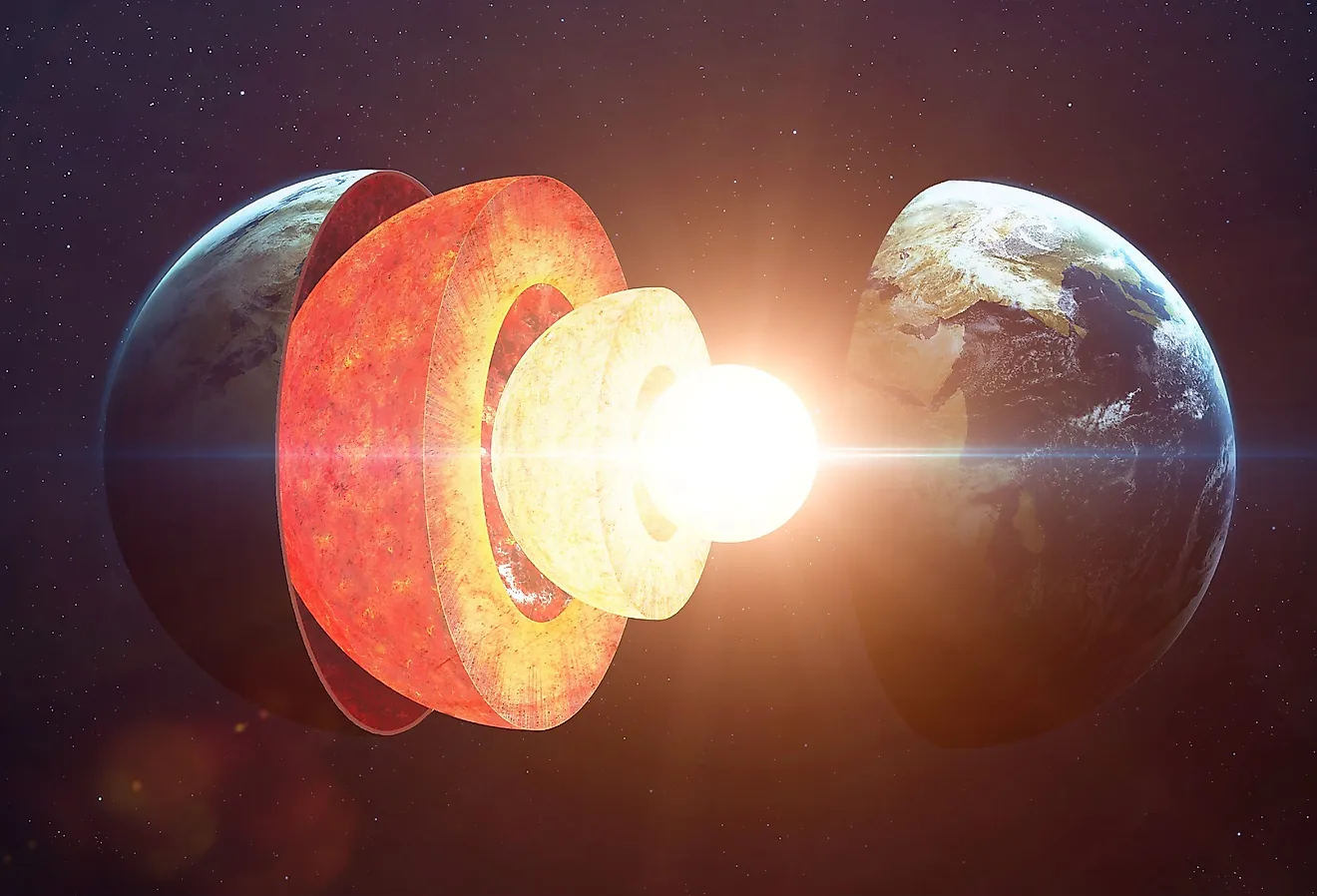
Earth has a surface magnetic field with a strength of about 0.25 to 0.65 gauss (averaging roughly 0.5 gauss), generated by dynamo action in the liquid iron-nickel outer core. The outer core is approximately 2,260 kilometers thick and surrounds a solid inner iron core. Convection in the outer core, driven primarily by the freezing of iron onto the inner core boundary (which releases latent heat and buoyant light elements), produces the electric currents that sustain the field.
The magnetic axis is currently tilted about 11 degrees from the rotation axis, and the position of the magnetic poles drifts measurably over decades. Earth's field has also reversed polarity hundreds of times over the past 200 million years, as recorded in magnetic minerals preserved in sea-floor basalts. The field deflects most of the solar wind around the planet, channeling some of the charged particles toward the polar regions where they produce the aurora borealis and aurora australis.
Mars

Mars has no active globally generated magnetic field, but the planet's crust preserves strong remnant magnetization in regions of the southern highlands. These crustal anomalies, mapped in detail by NASA's Mars Global Surveyor in the late 1990s, are the magnetic fossils of an ancient core dynamo that operated during the first 500 to 700 million years of the planet's history and then shut down. The crustal field strength in some regions reaches several hundred nanotesla at the surface, locally exceeding Earth's field strength, but the pattern is patchy and provides only fragmentary protection to the atmosphere above.
The shutdown of the Martian dynamo is thought to be linked to the cooling of the planet's smaller core, which eventually became unable to sustain the convection needed for dynamo action. Without a global field, the solar wind has been free to strip atoms from the upper atmosphere over the subsequent four billion years, a process that has been directly observed by the MAVEN spacecraft since 2014.
Jupiter

Jupiter has the strongest magnetic field of any planet in the Solar System. The equatorial surface field is approximately 4.2 gauss (about ten times the strength of Earth's surface field), and the dipole magnetic moment is roughly 20,000 times that of Earth. The field is generated not in an iron core but in a vast layer of liquid metallic hydrogen that extends through most of the planet's interior, where hydrogen molecules are compressed to the point that electrons become free to conduct electric current.
Jupiter's rapid rotation (a sidereal day of 9 hours 55 minutes) drives convection in this metallic hydrogen layer and produces the dynamo. The resulting magnetosphere is the largest planetary structure in the Solar System: it extends about 7 million kilometers toward the Sun on the day side and stretches into a magnetotail more than 600 million kilometers long, reaching beyond the orbit of Saturn. Jupiter's magnetic field also traps energetic particles in radiation belts strong enough to damage spacecraft electronics, a hazard that the Juno mission, in orbit since 2016, has been specifically designed to survive.
Saturn

Saturn has a magnetic field with a surface equatorial strength of about 0.2 gauss and a dipole moment roughly 580 times that of Earth. Like Jupiter's, the field is generated in a layer of liquid metallic hydrogen surrounding a denser rocky and icy core. Saturn rotates rapidly (a sidereal day of about 10 hours 33 minutes), which drives the dynamo.
Saturn's most unusual property is the alignment of its magnetic field. The magnetic axis is tilted less than one degree from the rotation axis, making Saturn the only known planet with an essentially axisymmetric magnetic field. This near-perfect alignment is difficult to explain with standard dynamo theory, which generally predicts a tilted dipole. The most widely accepted explanation invokes a stably stratified layer of helium-rich material above the metallic hydrogen dynamo region, produced by helium raining out of the hydrogen mixture under Saturn's interior pressure conditions. This layer is thought to filter out the non-axisymmetric components of the underlying dynamo field, leaving only the axisymmetric component visible from outside.
Uranus

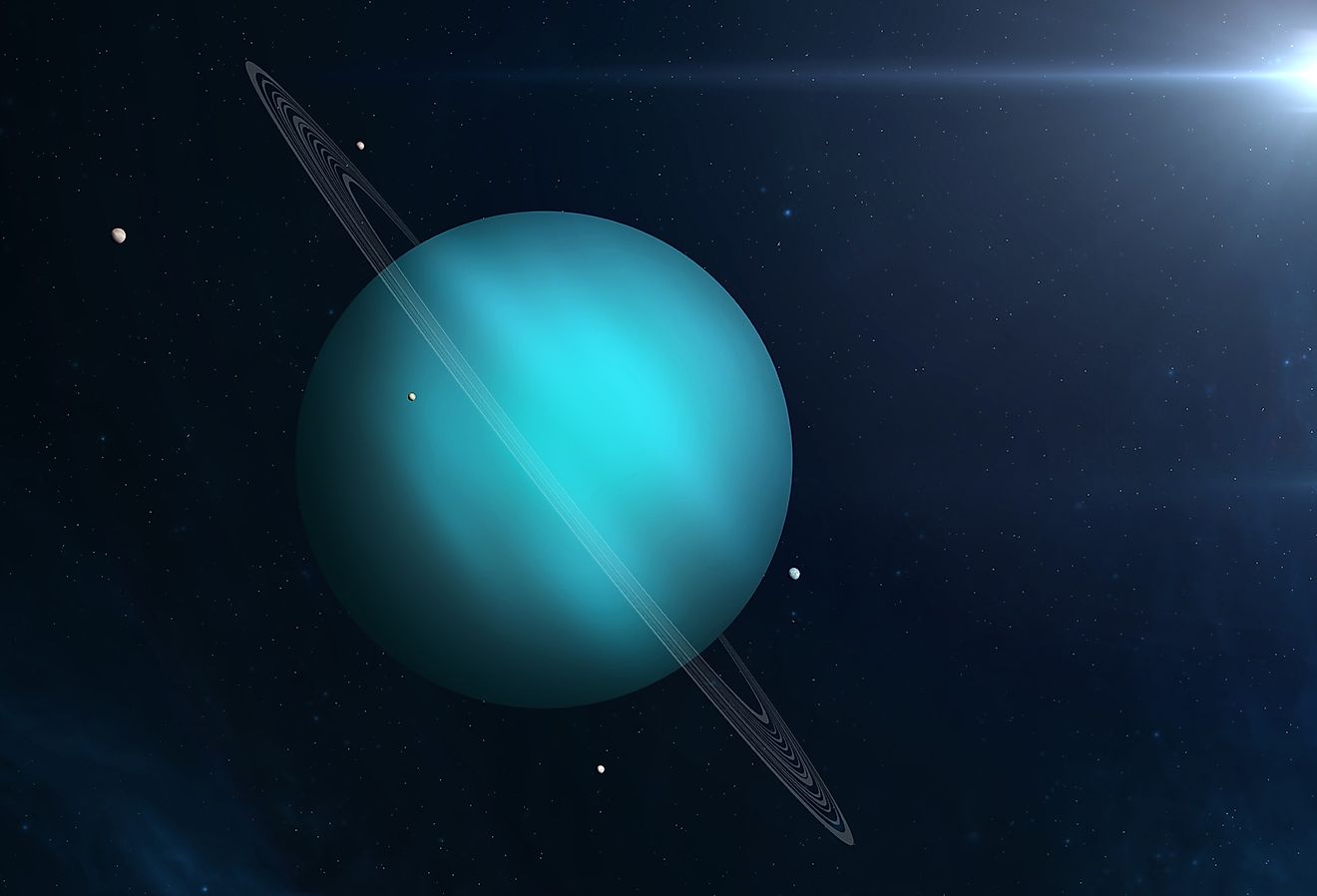
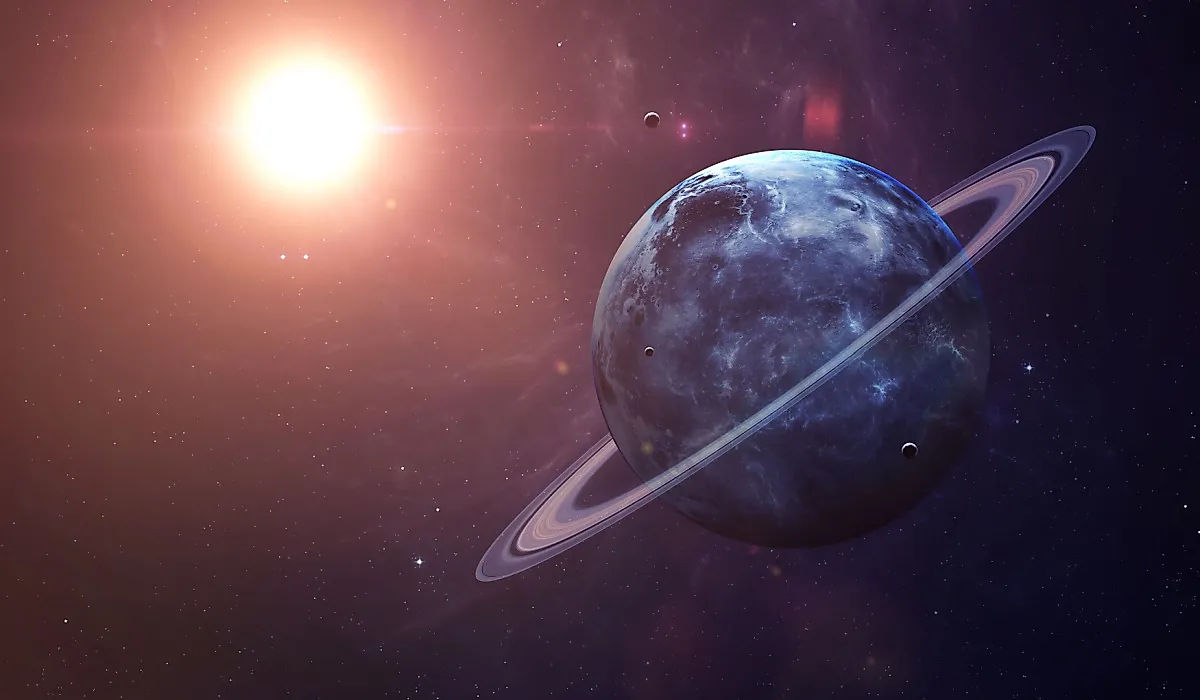
Uranus has a magnetic field that does not resemble those of the other planets. The magnetic axis is tilted approximately 59 degrees from the rotation axis, and the field's center is offset from the planet's geometric center by about one-third of the planetary radius. The result is a highly non-dipolar field whose strength varies dramatically across the planet's surface, ranging from about 0.1 gauss in the southern hemisphere to nearly 1.1 gauss in the northern hemisphere. The dipole moment is approximately 50 times that of Earth.
The field was first measured by Voyager 2 during its 1986 flyby. The current leading hypothesis is that the field is generated not in the planet's core but in a relatively thin shell within the icy mantle, where water, ammonia, and methane under high pressure and temperature become ionic conductors. Convection in this conducting shell produces a multipolar field with significant quadrupole and octupole components, unlike the dipole-dominated fields of Earth, Jupiter, and Saturn.
Neptune

Neptune's magnetic field, like that of Uranus, is highly tilted and offset. The magnetic axis is inclined approximately 47 degrees from the rotation axis, and the field's center is displaced from the geometric center of the planet by about 0.55 planetary radii (roughly 13,500 kilometers). The dipole moment is about 25 to 27 times that of Earth, with a surface field strength averaging about 0.14 gauss.
Neptune's field was measured by Voyager 2 in 1989. Like Uranus, Neptune is believed to generate its field through dynamo action in a thin shell of ionic water, ammonia, and methane within the icy mantle, producing a similarly multipolar geometry. Auroral activity has been detected at Neptune, but unlike on Earth, the aurora is not confined to the polar regions; the extreme tilt and offset of the magnetic field produce auroral emissions scattered across a wide range of latitudes that change rapidly as the planet rotates.
Planetary Magnetic Fields Compared
| Planet | Surface Field (Gauss, equatorial) | Dipole Moment (× Earth) | Tilt from Rotation Axis | Field Generated By |
|---|---|---|---|---|
| Mercury | ~0.002 | 0.0007 | ~0° (offset from equator) | Dynamo in liquid iron core (thin shell) |
| Venus | None (induced only) | None | N/A | No active dynamo; induced magnetosphere from solar wind |
| Earth | 0.25 to 0.65 | 1 (reference) | ~11° | Dynamo in liquid iron-nickel outer core |
| Mars | None globally (crustal anomalies up to ~0.02) | None | N/A | No active dynamo; remnant crustal magnetization from ancient dynamo |
| Jupiter | ~4.2 | ~20,000 | ~10° | Dynamo in liquid metallic hydrogen layer |
| Saturn | ~0.2 | ~580 | Less than 1° (axisymmetric) | Dynamo in liquid metallic hydrogen; helium rain layer filters non-axisymmetric components |
| Uranus | 0.1 to 1.1 (highly variable) | ~50 | ~59° | Dynamo in ionic water-ammonia-methane shell within icy mantle |
| Neptune | ~0.14 average | ~27 | ~47° | Dynamo in ionic water-ammonia-methane shell within icy mantle |
Sources: NASA Planetary Fact Sheets; Bagenal et al. (Space Science Reviews 2010), "Magnetic Fields of the Outer Planets"; Voyager 2 magnetometer data for Uranus (1986) and Neptune (1989); MESSENGER mission results for Mercury.
Why Jupiter's Field Is the Strongest
The two principal factors that determine the strength of a planetary dynamo are the size of the conducting fluid region and the rate of rotation. Jupiter combines both attributes in extreme measure: its liquid metallic hydrogen layer is larger in volume than all the other planets in the Solar System combined, and its sidereal rotation period of just under ten hours is the fastest of any planet. Saturn, with a similar but smaller metallic hydrogen layer and a slightly longer rotation period, produces a field roughly thirty times weaker by dipole moment. The ice giants Uranus and Neptune, lacking a metallic hydrogen layer entirely and relying instead on a thinner ionic-conducting shell within their icy mantles, produce fields weaker still. The terrestrial planets, with their comparatively tiny iron cores, fall further down the scale. Mercury and Earth are the only rocky planets that retain active dynamos; Venus and Mars have lost the conditions necessary to sustain one.