What Is The Kármán Line?
- Karman line is the boundary between the Earth's atmosphere and outer space.
- Its 100km (62 miles) above sea level
- Anything past the Karman line is not subject to control by countries like their airspace
The Kármán line is the most widely cited boundary between Earth's atmosphere and outer space. The Fédération Aéronautique Internationale, or FAI, sets the line at 100 kilometers above mean sea level. United States agencies including NASA and the Air Force use a lower threshold of 80 kilometers. The disagreement matters more now than ever. Commercial flights from Blue Origin and Virgin Galactic both claim to send passengers above the line, yet they reach different altitudes. The agreed altitude sets who counts as an astronaut and where space begins for international agreements.
Where Is the Kármán Line?

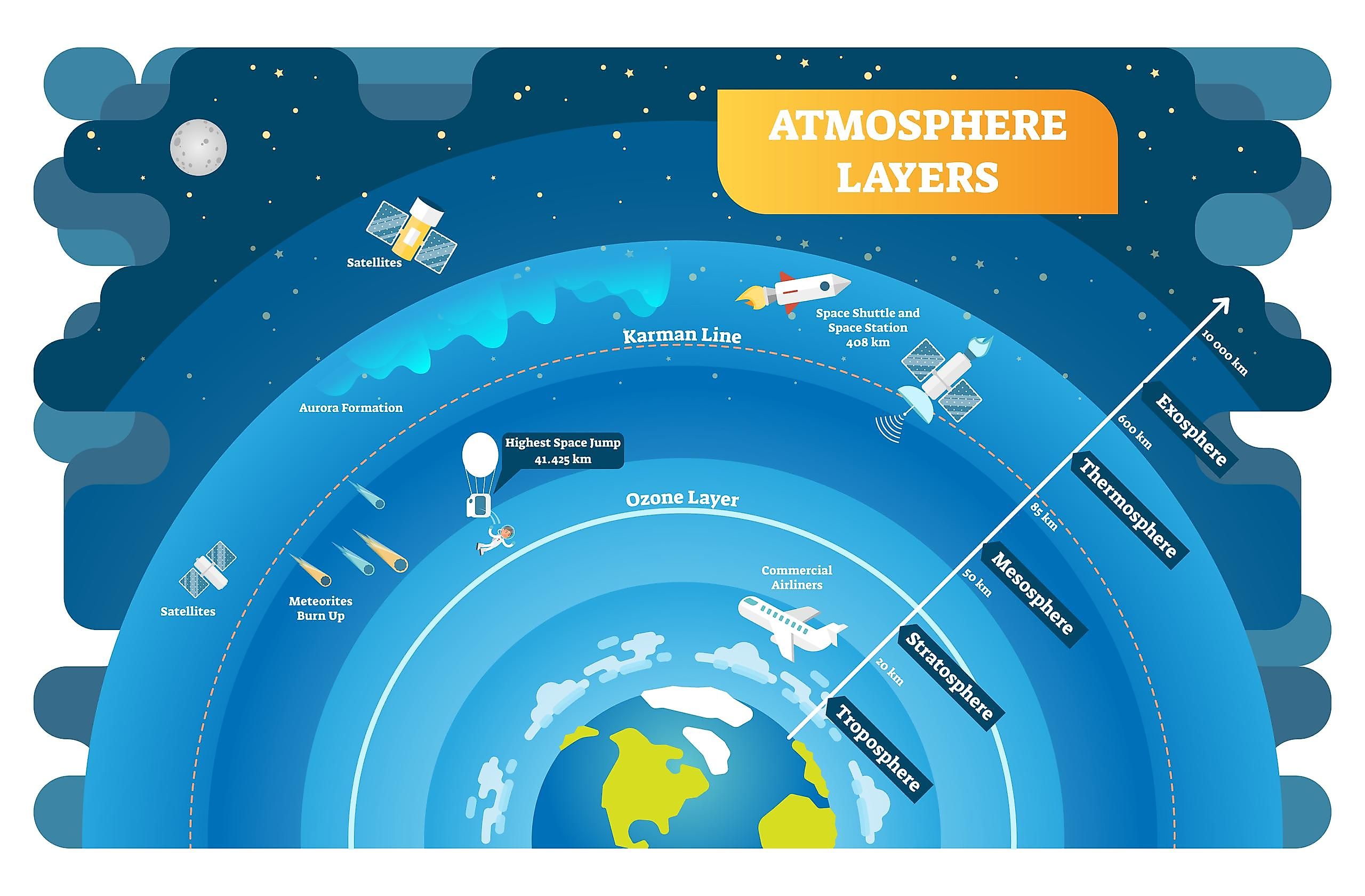
The Earth's atmosphere does not end with a sharp edge. Air thins gradually with altitude until it fades into the near-vacuum of space, and the layers responsible (troposphere, stratosphere, mesosphere, thermosphere, and exosphere) blur into one another at their upper limits. The Kármán line sits inside that gradient at roughly 100 kilometers, or about 62 miles, which is near the mesopause. The mesopause marks the coldest stretch of the atmosphere and forms the boundary between the mesosphere and thermosphere, both of which contain too little air to support conventional aerodynamic flight.
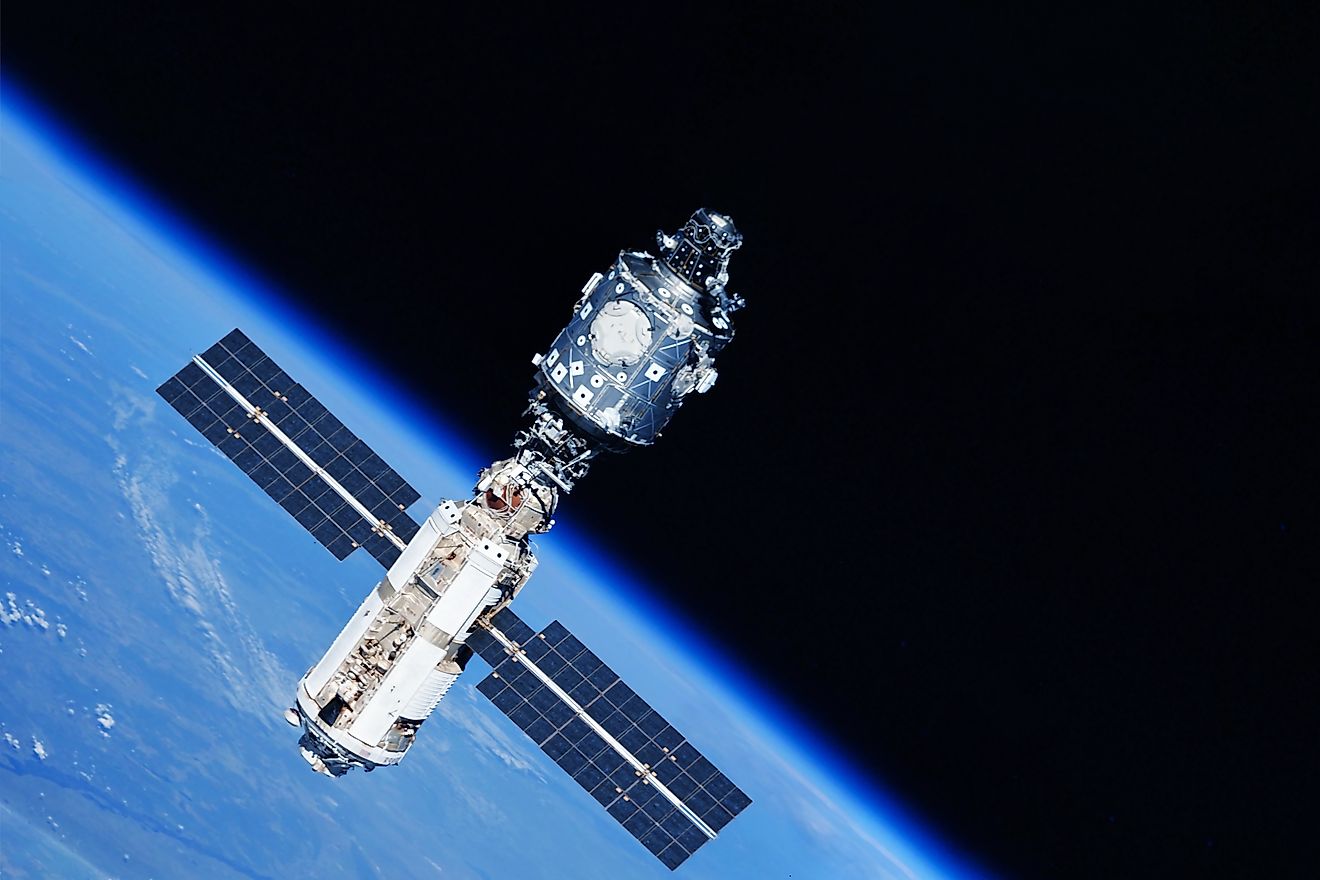
The line's working definition is physical rather than legal. At and above this height, the atmosphere is too thin for the lift generated by an aircraft's wings to support flight at any reasonable speed. To stay airborne above the line, a vehicle would have to move faster than orbital velocity, at which point it is no longer flying as an aircraft but moving as a spacecraft. The Kármán line is, in short, where aeronautics gives way to astronautics. Most satellites and the International Space Station orbit well above this height, with the ISS holding station near 400 kilometers in the thermosphere.
Who Was Theodore von Kármán?

Theodore von Kármán was a Hungarian-American engineer and physicist born on May 11, 1881, in Budapest. He moved to the United States in 1930 and led the Guggenheim Aeronautical Laboratory at the California Institute of Technology, where the rocket research program he founded eventually became NASA's Jet Propulsion Laboratory. Von Kármán worked across the entire field of aerodynamics, from supersonic flight to high-altitude rocketry, and he died on May 6, 1963.
His connection to the line that bears his name comes from a calculation he carried out in the mid-1950s. He set out to determine the altitude at which an aircraft could no longer rely on aerodynamic lift to stay aloft. His rough figure landed near 83.8 kilometers, or about 52 miles above mean sea level. The number 100 kilometers came later. In a 1959 paper, the American space lawyer Andrew G. Haley took up Von Kármán's reasoning, rounded the figure up to a clean metric round number, and named the boundary after his colleague. The FAI adopted the 100-kilometer mark soon after for its aerospace records, and the convention stuck.
Why 100 Kilometers Versus 80 Kilometers
Different organizations draw the line at different altitudes for practical rather than physical reasons. The FAI uses 100 kilometers because it is the long-standing record-keeping standard. The US Air Force, NASA, the FAA, and NOAA all use 80 kilometers, or 50 miles, as their working boundary. The US figure comes out of the early space program. In the 1960s, the Air Force awarded astronaut wings to X-15 pilots who flew above 50 miles, and NASA followed suit. NASA officially switched from the FAI's 100-kilometer figure to the 50-mile standard in 2005 to keep its definition of "astronaut" consistent across civilian and military pilots who flew the same vehicles. NASA's Mission Control also tracks a separate higher altitude, near 122 kilometers, as the point where atmospheric drag becomes noticeable for returning spacecraft.
The 80-kilometer figure also has a physical argument behind it. That altitude lines up roughly with the mesopause and with the height at which meteors typically burn up. It is also the height above which satellites can briefly maintain orbit before atmospheric drag pulls them down. In other words, 80 kilometers is closer to the actual transition between aerodynamic and orbital regimes, while 100 kilometers offers a neat round number that has weight by tradition.
The McDowell Proposal
The 100-kilometer boundary has been contested in recent years. In a 2018 paper published in Acta Astronautica, the astrophysicist Jonathan McDowell of the Harvard-Smithsonian Center for Astrophysics argued that 80 kilometers makes more physical sense than 100. McDowell analyzed orbital data from about 50 satellites in low Earth orbit and found that several had maintained orbital trajectories at altitudes as low as 80 kilometers, while none could sustain orbits below roughly 70 kilometers. He proposed 80 kilometers, plus or minus 10, as a more accurate boundary, noting that it aligns with both Von Kármán's original calculation and the long-standing US definition.
Later in 2018, the FAI announced it was considering changing its own standard to 80 kilometers to match. As of 2025, the FAI has not formally moved its line, but the debate has not died down. McDowell himself has said the 80-versus-100 distinction is somewhat arbitrary in human terms, since a passenger flying to either altitude experiences nearly identical conditions. The physical case for 80 kilometers, the historical case for 100 kilometers, and the regulatory inertia behind both means the two standards continue to coexist.
Why The Line Matters Now

The dispute became more than academic once private companies started flying paying customers above the atmosphere. Blue Origin's New Shepard reaches roughly 105 kilometers, comfortably above both standards. Virgin Galactic's SpaceShipTwo, by contrast, reaches between 80 and 87 kilometers, which clears the US definition but falls short of the FAI's 100-kilometer line. The two operators therefore award their passengers different sets of "astronaut" credentials, and which figure a person chooses to recognize determines whether a Virgin Galactic flight counts as a trip to space at all.
The line also matters for international law. The Outer Space Treaty of 1967 distinguishes between airspace, where each country has sovereignty, and outer space, where no nation can claim territory. The treaty does not, however, name a specific altitude. The Kármán line is the most common reference in practice, but no binding agreement formally adopts it. Aerospace records, astronaut designations, and questions about national jurisdiction over orbital activity all sit on top of a definition that scientists themselves still debate.
One Line, Two Numbers
The Kármán line is one of those rare scientific concepts that is simultaneously famous, useful, and unsettled. Both 80 kilometers and 100 kilometers have defensible arguments, and both continue to be used by serious organizations. For travelers thinking about a future suborbital trip, for record-keepers tracking flight altitudes, and for diplomats writing the next generation of space agreements, the question of where the sky ends has practical consequences. Theodore von Kármán's original calculation, made before any human had reached orbit, still anchors the conversation more than seventy years later.