What Are the Closest Galaxies to Earth?
A galaxy is a gravitationally bound system of stars, gas, dust, and dark matter. The observable universe holds an estimated 200 billion to 2 trillion of them. Earth sits within the Milky Way, a spiral galaxy with between 100 and 400 billion stars including the Sun. The Milky Way's nearest neighbours are mostly small dwarf satellite galaxies invisible to the naked eye. The five galaxies covered below span distances starting at the disputed Canis Major Dwarf at roughly 25,000 light-years and reaching the Andromeda Galaxy at 2.5 million light-years.
Canis Major Dwarf Galaxy (Disputed)

The Canis Major Dwarf Galaxy was reported in 2003 by an international team of French, Italian, British, and Australian astronomers using data from the Two Micron All-Sky Survey (2MASS). At the time of its announcement, it was considered the closest known galaxy to Earth, located approximately 25,000 light-years from the Solar System and around 42,000 light-years from the Galactic Center. The structure contains roughly one billion stars, including a high proportion of red giants, and was originally classified as an irregular dwarf galaxy in the process of being tidally disrupted by the Milky Way.
Its status remains contested. Several follow-up studies have argued that the observed overdensity is not a separate dwarf galaxy at all but instead a stellar feature of the Milky Way's own warped outer disk. As of the mid-2020s, professional databases including SIMBAD continue to list the object as a disputed galaxy. Whether it qualifies as a satellite galaxy or as part of the Milky Way's thick disk remains an open question.
Sagittarius Dwarf Spheroidal Galaxy

If the Canis Major detection is set aside, the Sagittarius Dwarf Spheroidal Galaxy ranks as the closest confirmed neighbour, located about 70,000 light-years from the Sun. It was discovered in 1994 by astronomers Rodrigo Ibata, Mike Irwin, and Gerry Gilmore. The galaxy is in the process of being torn apart by the Milky Way's gravity, with a long tidal stream of stars (the Sagittarius Stream) wrapping around the Galactic Center.
The galaxy holds an unusually high proportion of dark matter, which has helped preserve its core through repeated close passes with the Milky Way over the past several billion years. The Sagittarius Stream remains one of the best-studied examples of galactic cannibalism in the local universe, with the dwarf's stars and globular clusters now distributed across a large arc of the Milky Way's halo.
Segue 1
Segue 1 sits roughly 75,000 light-years from the Sun and ranks among the faintest galaxies ever detected. It was discovered in 2006 by researchers analyzing data from the Sloan Digital Sky Survey. With perhaps 1,000 scattered stars and a total luminosity well below most globular clusters, Segue 1 produces almost no measurable light.
What makes Segue 1 scientifically important is its mass-to-light ratio. The galaxy is dominated by dark matter to an extraordinary degree, with the dark matter component estimated at hundreds of times the mass of its visible stars. The stellar population is also extremely old and metal-poor, which has led some researchers to describe Segue 1 as a near-fossil of the early universe.
Large Magellanic Cloud

The Large Magellanic Cloud (LMC) is the largest and most massive satellite galaxy of the Milky Way, sitting roughly 163,000 light-years away. Southern Hemisphere observers can see it with the naked eye as a faint cloud-like patch, and it has been known to those observers for millennia. It was first described in detail in European astronomy after Ferdinand Magellan's expedition in the early 1500s.
The LMC is an irregular galaxy with traces of a barred-spiral structure and holds an estimated 20 billion stars. It plays a role well beyond its appearance. Recent 2025 modelling of the Local Group dynamics by Sawala and colleagues showed that the LMC's gravitational pull significantly perturbs the Milky Way's motion, which has direct implications for the long-term Milky Way-Andromeda relationship.
Andromeda Galaxy

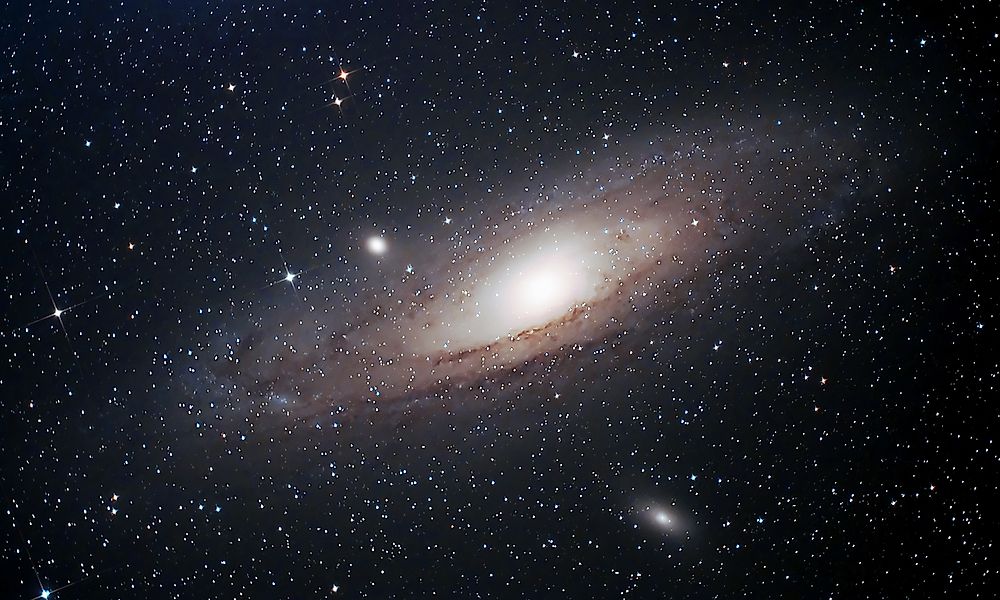
The Andromeda Galaxy (Messier 31) is the closest large spiral galaxy to the Milky Way and the largest galaxy in the Local Group. It sits about 2.5 million light-years from Earth and contains roughly one trillion stars. Andromeda has been observed since at least the 10th century by Persian astronomer Abd al-Rahman al-Sufi, who described it as a "small cloud." Astronomers long assumed it sat inside the Milky Way until 1923, when Edwin Hubble used Cepheid variable stars in M31 to measure its distance and demonstrate it as a separate, distant galaxy.
Andromeda is visible to the naked eye from dark-sky sites on Earth, appearing as a faint elongated smudge. The two galaxies are currently moving toward each other at roughly 100 kilometres per second. The old expectation of a definite collision in around four to five billion years has been revised: a 2025 study published in Nature Astronomy by Sawala et al., incorporating Gaia and Hubble data along with the gravitational effect of the LMC, found only about a 50 percent chance of a Milky Way-Andromeda merger within the next 10 billion years. The two galaxies may instead pass close by each other in a near miss.
The Neighbourhood Around The Milky Way
The Milky Way's nearest galactic neighbours are mostly small, faint, dark-matter-dominated dwarfs that strain the boundaries of what counts as a galaxy at all. Many were unknown until digital sky surveys began turning them up in the late 1990s and 2000s. The larger neighbours including the Magellanic Clouds and Andromeda have been known for far longer. The Local Group itself contains more than 100 galaxies, most of which still wait for detailed study. The closest galaxies to Earth keep changing as new objects are detected and as old classifications get challenged by better data.