Halley's Comet
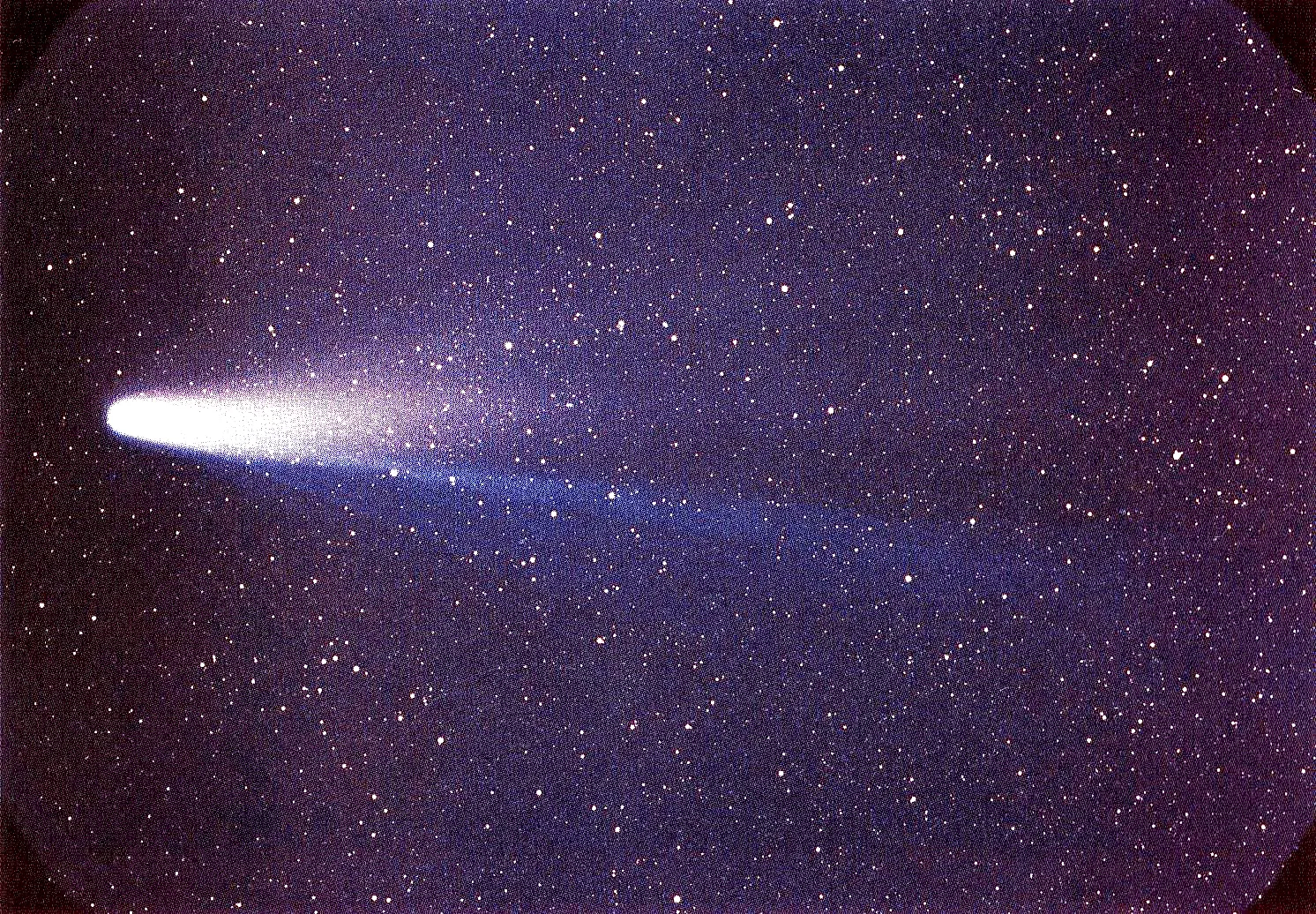
Halley's Comet is the most famous comet in history and the first one ever recognized as a regular visitor to Earth's neighborhood. It loops around the Sun every 74 to 79 years, with the exact timing nudged by the gravity of Jupiter and Saturn. Its last close pass to the Sun came on February 9, 1986. The comet then traveled out past the orbit of Neptune to its farthest point on December 9, 2023. It is now on its way back toward the Sun. The next return is predicted for July 28, 2061, when Halley will once again be bright enough to see with the naked eye from Earth.
The comet draws its name from Edmond Halley, an English astronomer who lived from 1656 to 1742. Halley was Isaac Newton's editor and friend, and he financed the publication of Newton's Principia Mathematica in 1687. He applied Newton's new theory of gravity to historical records of bright comets and concluded that several previously regarded as separate sightings were in fact returns of the same comet. He never lived to see his prediction confirmed.
Halley's Discovery Of The Recurrence

In his 1705 publication A Synopsis of the Astronomy of Comets, Edmond Halley applied Newtonian mechanics to a catalog of 24 comet observations he had compiled. He noticed that the bright comets of 1531, 1607, and 1682 had nearly identical orbital parameters: the same path, the same orbital plane, and consistent spacing in time. Halley concluded that these were not three separate comets but a single object returning roughly every 76 years, and he predicted it would return again in late 1758 or early 1759.
Halley died on January 14, 1742, sixteen years before the predicted return. The comet was first sighted on Christmas Day, December 25, 1758, by the German farmer and amateur astronomer Johann Georg Palitzsch. Its appearance, almost exactly as Halley had calculated, marked the first time a comet had been successfully predicted to return. The discovery established that comets were members of the Solar System bound by gravity rather than transient atmospheric phenomena, and the object was renamed in Halley's honor. Astronomers later cataloged the comet as 1P/Halley, with the "1" marking it as the first periodic comet ever identified and the "P" standing for "periodic."
Ancient And Historical Observations

Records of Halley's Comet's returns extend back at least to 240 BC, when Chinese astronomers recorded a bright comet later included in the Records of the Grand Historian by Sima Qian. Subsequent Chinese, Babylonian, and medieval European chroniclers documented bright comets at intervals consistent with Halley's orbit. The Bayeux Tapestry depicts the 1066 apparition, which was widely interpreted as an omen surrounding the Norman conquest of England. The 1301 return was observed by the Florentine painter Giotto di Bondone and is generally accepted as the model for the Star of Bethlehem in his fresco Adoration of the Magi in the Scrovegni Chapel in Padua. None of these earlier observers recognized that they were seeing the same object on each return; that connection was made only after Halley's 1705 publication.
The 1910 Apparition

The 1910 return produced the first photographs of Halley's Comet. The comet reached perihelion on April 20, 1910, and made its closest approach to Earth on the night of May 18-19, 1910, at a distance of about 22 million kilometers (0.15 AU). Earth passed through the outer reaches of the comet's tail on the same night. Astronomers had detected cyanogen gas in the tail through spectroscopy earlier in the year. Sensationalist press coverage triggered public panic, with merchants selling "comet pills" and gas masks despite repeated scientific reassurances that the tail was far too diffuse to pose any danger. The American writer Mark Twain, who was born in 1835 during the year of the previous apparition, accurately predicted he would die when the comet returned; he died on April 21, 1910, the day after perihelion.
The 1986 Apparition And The Halley Armada

The 1986 return was the first in which spacecraft could be sent to study the comet directly. An international fleet of five probes, informally known as the "Halley Armada," intercepted the comet near its March 1986 inbound passage through the inner Solar System. The European Space Agency's Giotto probe made the closest flyby, passing within approximately 596 kilometers of the nucleus on March 14, 1986, and returned the first close-up images of a cometary nucleus. The Soviet Vega 1 and Vega 2 spacecraft flew by on March 6 and March 9 at distances of about 8,890 and 8,030 kilometers respectively, having released atmospheric probes into Venus on their way. Japan's ISAS contributed two probes, Suisei and Sakigake, which made more distant observations of the hydrogen corona and solar wind interaction. NASA's repurposed International Cometary Explorer (ICE) made a separate, more distant pass at about 40 million kilometers and recorded measurements of the comet's interaction with the solar wind; ICE is sometimes counted as a sixth member of the armada and sometimes treated separately.
Giotto's images revealed that the nucleus is a dark, irregular, peanut- or potato-shaped body measuring approximately 15 by 8 by 8 kilometers. The surface is exceptionally dark, with an albedo of about 0.04, making it one of the darkest objects in the Solar System, darker than coal. The comet loses an estimated 1 to 3 meters of surface material per orbit through sublimation, ejecting dust and gas that form the visible coma and tail.
Meteor Showers From Halley's Debris
Halley's Comet is the parent body of two annual meteor showers caused by Earth's passage through the debris stream the comet has shed over many orbits. The Eta Aquariids peak each year in early May, with rates of roughly 50 to 60 meteors per hour visible from the Southern Hemisphere. The Orionids peak in late October at rates of about 20 meteors per hour and are best viewed from both hemispheres. Both showers will continue to recur each year regardless of whether the comet itself is in the inner Solar System.
The Next Return In 2061

Calculations of Halley's orbit indicate the comet will reach perihelion again on July 28, 2061. The geometry of the 2061 return will be considerably more favorable than 1986: the comet will pass on the same side of the Sun as Earth, with closest approach to Earth predicted for July 29, 2061, at about 0.48 AU. The 1986 return, by contrast, occurred with the comet on the opposite side of the Sun from Earth, making it one of the least observable Halley apparitions in history. Most people alive in 2026 who reach typical life expectancy will have a chance to see Halley's Comet at least once, and many who saw it in 1986 may live to see it return. The subsequent perihelion is calculated for March 27, 2134, when Earth will pass within 0.09 AU of the comet, the closest approach since 837 AD.