Biggest Asteroid Impacts In Earth's History
Asteroid impacts have shaped Earth's surface and biosphere across deep time. When a large enough body crosses Earth's atmosphere and reaches the surface, the kinetic energy released can rival or exceed any natural process on the planet. The Tunguska event of June 30, 1908, flattened roughly 80 million trees across about 2,150 square kilometres (830 square miles) of Siberian forest without leaving a crater (the bolide is thought to have exploded several kilometres above the ground), and it remains the largest recorded impact event in modern history. The largest impacts, the ones that left craters still visible today, hit hundreds of millions or billions of years earlier and reshaped global geology and biology when they did. The ten largest confirmed impact structures below cover that record.
How Impact Craters Form and Survive

An asteroid striking Earth's surface compresses the rock at the impact point, melting and vaporizing material in a fraction of a second and excavating a transient cavity many times the impactor's diameter. The crater that remains visible afterward is shaped by collapse, rebound (which produces the central uplift seen at Vredefort and Sudbury), and subsequent erosion and tectonics. The largest craters are not necessarily the most recent. Most of the impacts in the geological record came on the ancient cratons, the deeply rooted continental cores that have survived billions of years of erosion. Younger crater fields and ocean impacts have largely been eroded or subducted, which biases the surviving record toward big, old, on-land events on stable cratons.
Confirmed impact craters require physical evidence: shocked quartz, shatter cones, tektites, impact breccia, or other shock-metamorphic features. Circular features alone are not enough. The Earth Impact Database (maintained by the Planetary and Space Science Centre at the University of New Brunswick) lists about 200 confirmed structures, with several additional candidates still under study.
The Ten Largest Confirmed Impact Craters
Sizes below are diameters of the original or best-constrained crater rim, not radii. (Earlier versions of this list conflated the two.) Ages are the current scientific consensus estimates from peer-reviewed radiometric dating, expressed as Ga (billions of years ago) or Ma (millions of years ago).

Vredefort, Free State, South Africa (~2.023 Ga, 250 to 300 km diameter). The largest verified impact structure on Earth. The original crater has been eroded for two billion years, and only the central dome (about 70 km across) is preserved as surface relief. A 2022 University of Rochester study revised the impactor estimate upward to 20 to 25 km in diameter.

Sudbury Basin, Ontario, Canada (1.849 Ga, about 250 km original diameter). The visible elliptical basin is a tectonically deformed remnant of what was originally a near-circular structure roughly comparable in size to Vredefort. The impact deposited the Sudbury Igneous Complex, host to one of the world's largest nickel-copper-platinum-group ore bodies.

Acraman, South Australia (about 590 Ma, 85 to 90 km diameter). The crater is buried and largely eroded; a circular topographic feature centred on Lake Acraman preserves the outline. Ejecta from Acraman has been found in the Bunyeroo Formation hundreds of kilometres away.

Woodleigh, Western Australia (estimates 250 to 365 Ma, 60 to 160 km diameter). Both age and size are poorly constrained because the structure is buried under the Carnarvon Basin and known only from drill core and geophysics. The wide diameter range reflects the genuine uncertainty.

Manicouagan, Quebec, Canada (about 214 Ma, originally about 100 km diameter). The ring-shaped Manicouagan Reservoir is a glacially modified expression of the crater. The impact dates to the Late Triassic and has been investigated as a possible contributor to the end-Triassic extinction, though no causal link is established.

Morokweng, North West Province, South Africa (about 145 Ma, around 70 km diameter). The buried structure dates to the Jurassic-Cretaceous boundary. A rare fragment of the impactor itself was recovered from a 2006 drill core, an L chondrite chunk roughly 25 cm across, an unusual survival from a 145-million-year-old event.
Kara, Nenetsia, Russia (about 70 Ma, around 65 km diameter). Located on the Kara Sea coast. Earlier proposals that Kara was part of a larger paired-impact structure with the nearby Ust-Kara feature are no longer favoured.

Chicxulub, Yucatán, Mexico (66.04 Ma, about 180 km diameter). The crater that ended the Mesozoic. Buried beneath the Yucatán Peninsula and Gulf of Mexico, identified through gravity and magnetic anomalies in the late 1970s and confirmed as the Cretaceous-Paleogene impact site in the early 1990s. Discussed in detail below.

Popigai, Siberia, Russia (about 35.7 Ma, around 100 km diameter). The impact deposited a layer of impact diamonds (lonsdaleite and ordinary diamond formed by shock metamorphism of carbon-bearing target rock) that may exceed the entire conventional global diamond reserve in mass. The Eocene event is roughly contemporaneous with the Chesapeake Bay impact.

Chesapeake Bay, Virginia, United States (about 35.5 Ma, around 85 km diameter). Buried under sediments at the mouth of Chesapeake Bay. The impact is thought to have contributed to the present-day shape of the bay and altered regional groundwater chemistry (a deep briny aquifer is associated with the structure).
The Chicxulub Extinction Event
Chicxulub is the only impact in the geological record firmly linked to a global mass extinction. The 66-million-year-old crater coincides precisely with the Cretaceous-Paleogene (K-Pg) boundary that marks the end of the non-avian dinosaurs, the ammonites, and roughly three-quarters of all species on Earth. The impactor is estimated at 10 to 15 km in diameter, most likely a carbonaceous chondrite, striking at about 20 km per second.
The immediate effects included a global firestorm from re-entering ejecta, megatsunamis across the Gulf, and thermal radiation that would have ignited vegetation thousands of kilometres from the impact site. The longer-term effect, and the one that drove the extinction, was a sulfate aerosol veil thrown into the stratosphere by the impact's vaporization of sulfur-rich evaporite rocks at the target site. The resulting "impact winter" suppressed photosynthesis for years to decades, collapsed food webs, and acidified the surface ocean. The link was first proposed by Luis and Walter Alvarez in 1980, based on a globally distributed iridium-rich clay layer at the K-Pg boundary, and confirmed by the crater's discovery and dating in the following decade.
Planetary Defense and Future Impact Tracking
Modern impact monitoring is centred on NASA's Center for Near-Earth Object Studies (CNEOS) at the Jet Propulsion Laboratory, which operates the Sentry impact-risk-monitoring system. Sentry-II, an upgraded algorithm deployed in late 2021, scans the catalogue of known near-Earth asteroids for any possible Earth impact within the next 100 years and updates risk estimates as new observations refine the orbits. The catalogue currently lists over 35,000 near-Earth asteroids.
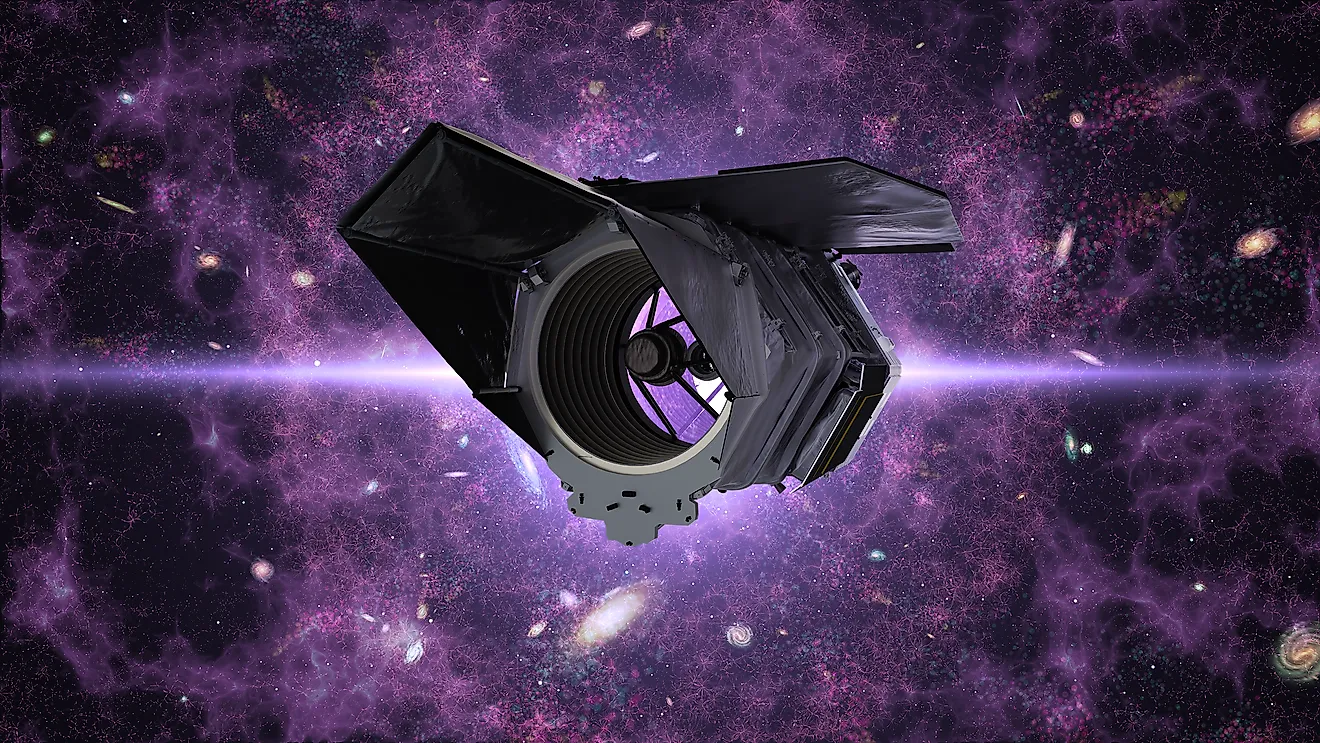
Active planetary defense became a demonstrated capability rather than a theoretical concept with NASA's Double Asteroid Redirection Test (DART), which deliberately collided with the asteroid moonlet Dimorphos on September 26, 2022. The impact shortened Dimorphos's orbital period around its parent asteroid Didymos by about 32 minutes, the first time humans have measurably altered the orbit of a celestial body. ESA's Hera spacecraft, launched October 2024, is now en route to study the post-impact Dimorphos in detail and is scheduled to arrive in 2026. The NEO Surveyor space telescope, scheduled to launch in 2027, will substantially expand the catalogue of near-Earth asteroids in the 140-metre-and-larger range that pose the greatest regional-impact risk.
Biggest Impact Craters on Earth
| Crater | Location | Diameter (km) | Age |
|---|---|---|---|
| Vredefort | Free State, South Africa | 250 to 300 | 2.023 Ga |
| Sudbury Basin | Ontario, Canada | about 250 (original) | 1.849 Ga |
| Acraman | South Australia | 85 to 90 | about 590 Ma |
| Woodleigh | Western Australia | 60 to 160 | 250 to 365 Ma |
| Manicouagan | Quebec, Canada | about 100 | about 214 Ma |
| Morokweng | North West, South Africa | about 70 | about 145 Ma |
| Kara | Nenetsia, Russia | about 65 | about 70 Ma |
| Chicxulub | Yucatán, Mexico | about 180 | 66.04 Ma |
| Popigai | Siberia, Russia | about 100 | about 35.7 Ma |
| Chesapeake Bay | Virginia, United States | about 85 | about 35.5 Ma |
What the Crater Record Tells Us
The list above is biased toward big, old impacts on stable continental cratons. Older ocean impacts have been recycled into the mantle through subduction, and smaller continental impacts have been worn down by erosion. The real record of impacts on Earth is therefore much larger than the 200 confirmed structures known today, but the largest of those (Chicxulub above all) demonstrate that single impact events can rewrite the trajectory of life on the planet. The planetary-defense work now under way at NASA, ESA, and partner agencies is a response to that record.