What are the Terrestrial Planets Of Our Solar System?
Four of the eight planets in the Solar System are built primarily from rock and metal rather than gas: Mercury, Venus, Earth, and Mars. These are the terrestrial planets, sometimes called the inner planets because they orbit closer to the Sun than the four gas and ice giants beyond the asteroid belt. They share a similar layered structure (metallic core, silicate mantle, rocky crust) and a similar early history about 4.5 billion years ago, but the four took radically different paths after formation. The same basic ingredients, arranged in different proportions and at different distances from the Sun, produced a runaway greenhouse furnace, a frozen rust-colored desert, an airless cratered rock, and the only world known to harbor life.

The Four Terrestrial Planets
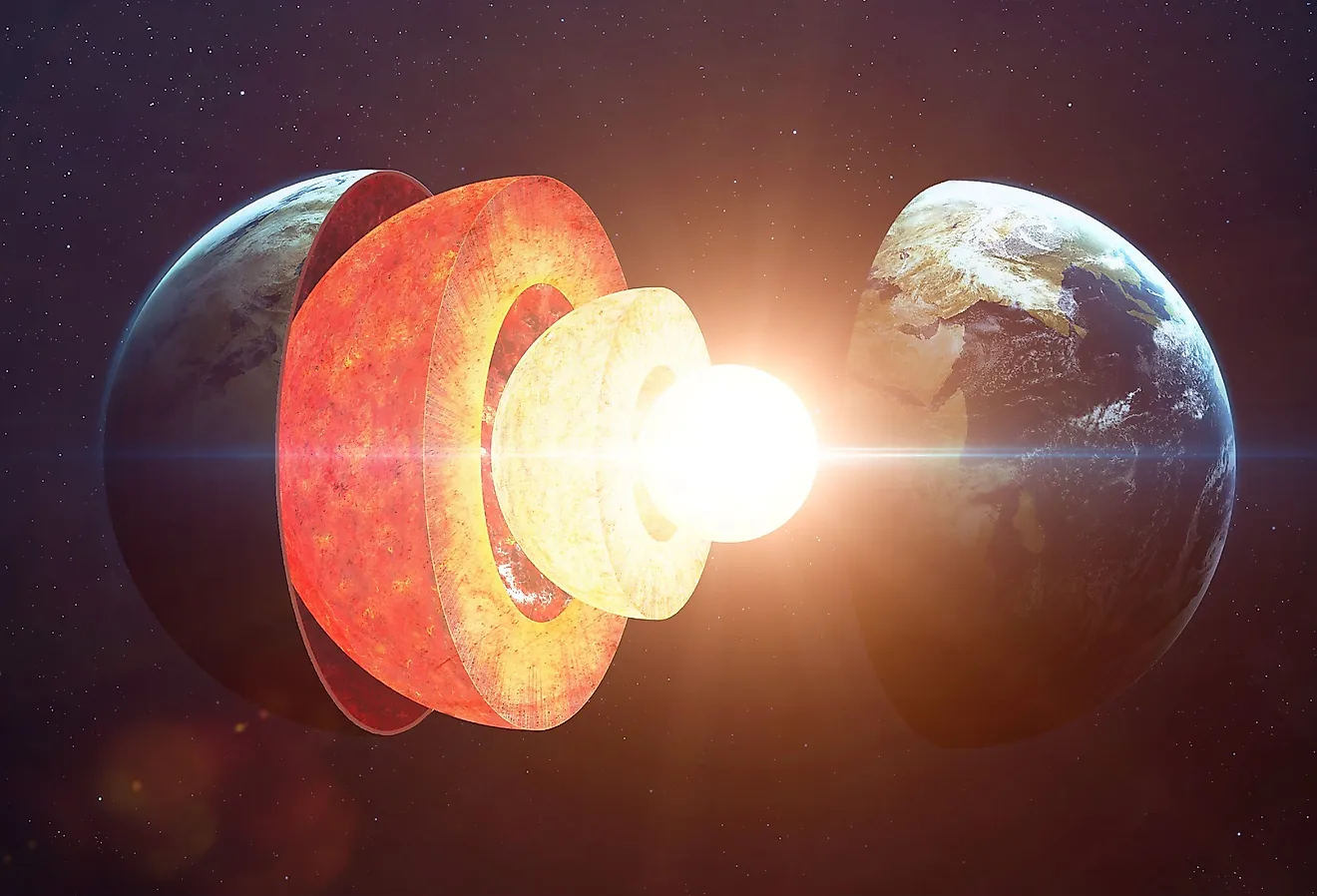
The four rocky planets all formed in the inner Solar System, where the young Sun's heat boiled off most volatile compounds and left behind dense materials like iron, silicon, and magnesium oxides. They differ enormously in size, atmosphere, and surface conditions, but they share the same basic anatomy: a metallic core, a silicate mantle, and a rocky crust.
Mercury

Mercury has an equatorial radius of 1,516 miles (2,440 km) and a diameter of 3,032 miles (4,879 km), making it the smallest planet in the Solar System, only about 40 percent larger than Earth's Moon. It orbits the Sun at an average distance of 36 million miles (58 million km), or 0.39 astronomical units, completing one orbit every 88 Earth days while taking 59 Earth days to rotate once on its axis. Despite its small size, Mercury has the second-highest density of any planet in the Solar System at 5.427 grams per cubic centimeter, surpassed only by Earth's 5.514 g/cm³. The reason is Mercury's enormous iron core, which makes up roughly 57 percent of the planet's volume, far higher than Earth's 17 percent, surrounded by a thin silicate mantle and a crust around 30 miles (50 km) thick.
Mercury has no real atmosphere, only an exosphere of magnesium, silicon, calcium, sodium, and helium kept in place by the solar wind sputtering particles off the surface. Surface temperatures swing more than on any other planet: from about 800°F (427°C) on the daytime side to -290°F (-180°C) at night, with no atmosphere to redistribute the heat. Despite the extreme temperatures, NASA's MESSENGER spacecraft (in Mercury orbit from 2011 to 2015) confirmed substantial water ice in permanently shadowed craters near the poles, where sunlight never reaches and temperatures stay below freezing year-round. Mariner 10 made the first flybys in 1974 and 1975, MESSENGER mapped 100 percent of the surface and returned more than 100,000 images, and the joint ESA/JAXA BepiColombo mission arrived in Mercury orbit in late 2025 and is now conducting its primary science campaign.
Venus

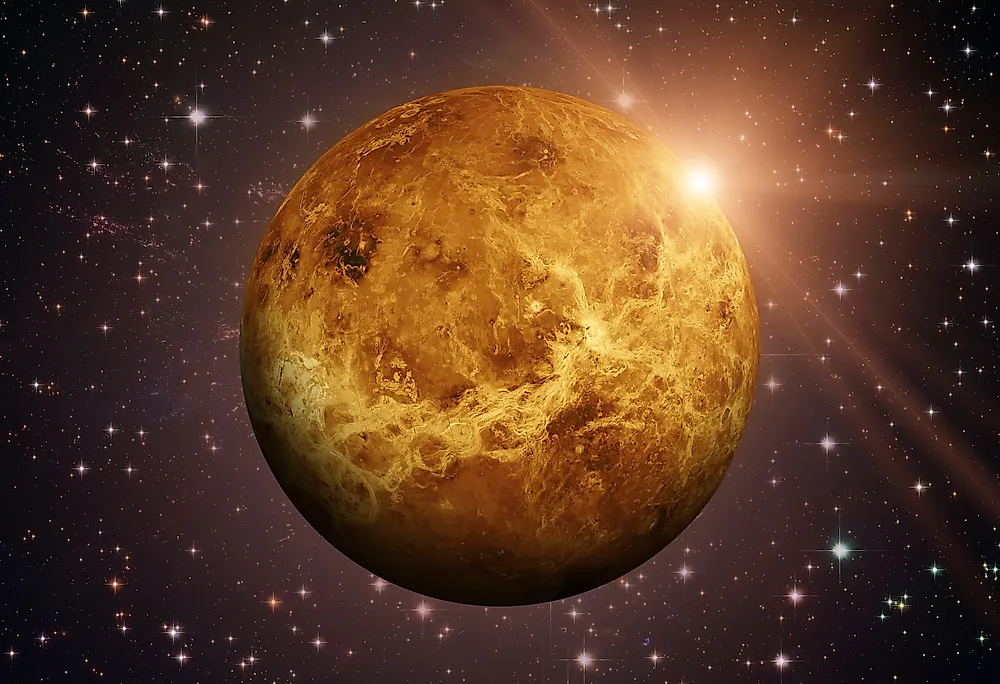
Venus is the second planet from the Sun, orbiting at an average of 67 million miles (108 million km) or 0.72 AU. With an equatorial radius of 3,761 miles (6,052 km) and a diameter of 7,521 miles (12,104 km), it is the closest of any planet in size to Earth, about 95 percent of Earth's diameter and 81 percent of Earth's mass. Despite the rough match in dimensions, Venus is the hottest planet in the Solar System, with a mean surface temperature of about 855°F (462°C), hot enough to melt lead. The cause is a runaway greenhouse effect: the atmosphere is 96.5 percent carbon dioxide with a surface pressure 92 times that of Earth, equivalent to the pressure roughly 3,000 feet underwater on Earth.
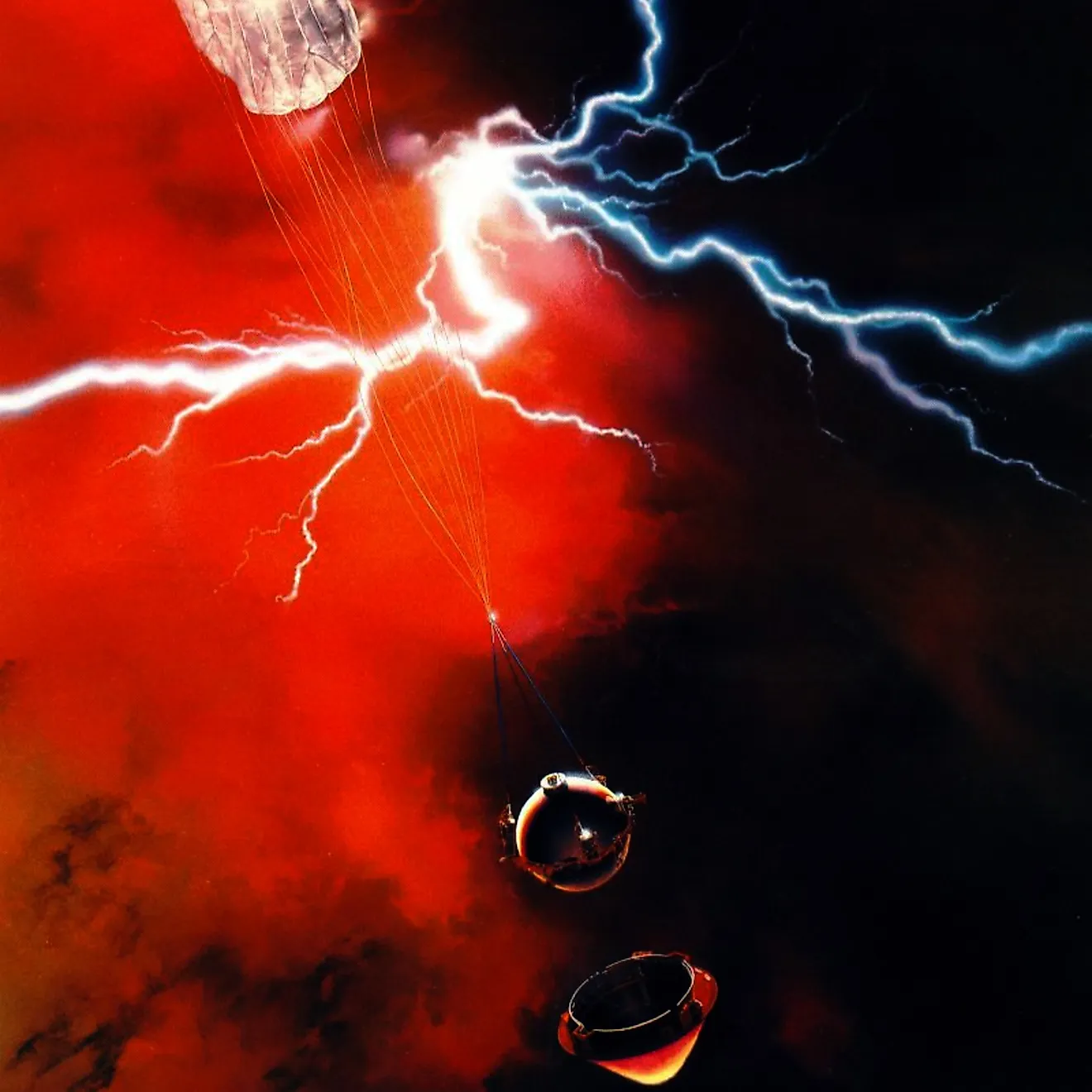
Venus rotates backward (retrograde) and extremely slowly. One day on Venus takes 243 Earth days, longer than its 225-Earth-day orbital period, which makes a single Venusian day longer than a single Venusian year. The surface is dominated by volcanic plains, with more than 1,600 known major volcanoes, the most of any planet. NASA's Magellan spacecraft radar-mapped 98 percent of the surface between 1990 and 1994; reanalysis of those data published in 2023 produced the first evidence of an active volcanic vent on Maat Mons, suggesting Venus remains geologically alive. The Soviet Venera program landed several probes between 1970 and 1982 (the only spacecraft ever to transmit from the surface), and three new missions are planned for the coming decade: NASA's DAVINCI atmospheric probe and VERITAS orbiter, and the European Space Agency's EnVision orbiter.
Earth

Earth is the largest of the four terrestrial planets, with an equatorial radius of 3,959 miles (6,378 km) and a diameter of 7,926 miles (12,756 km). Its average distance from the Sun defines one astronomical unit, or about 93 million miles (150 million km), and a complete orbit takes 365.25 days. Earth has the highest overall density of any planet in the Solar System at 5.514 g/cm³, and it is the only world known to host life, the only one with surface oceans of liquid water (about 71 percent of the surface), and the only terrestrial planet with active plate tectonics. The atmosphere is roughly 78 percent nitrogen, 21 percent oxygen, and 1 percent argon, carbon dioxide, water vapor, and trace gases. Average surface temperature is about 59°F (15°C), kept stable by a moderate greenhouse effect.
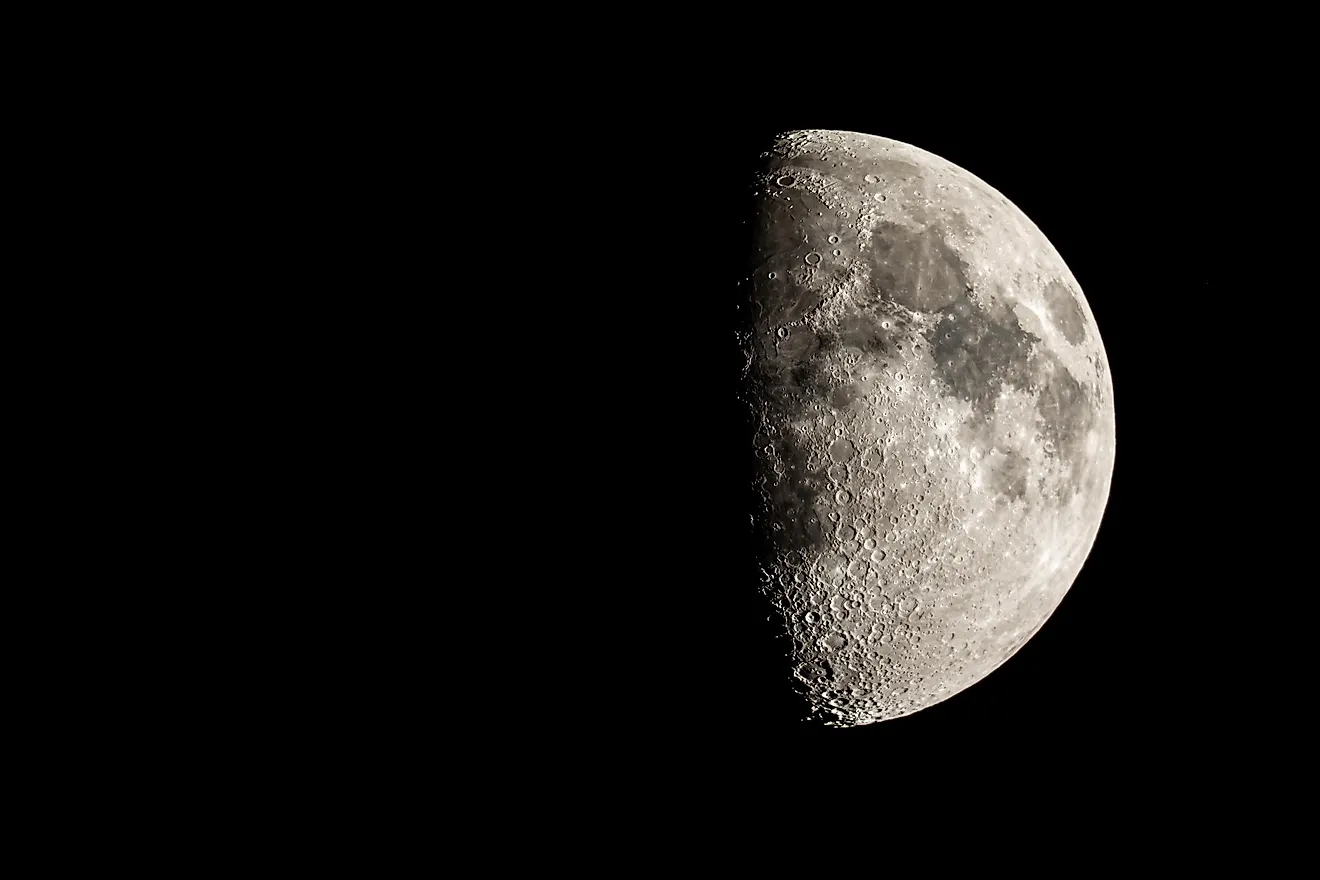
The continental crust averages around 18 miles (30 km) thick; the oceanic crust averages just 3 miles (5 km). Silica (SiO₂) and alumina (Al₂O₃) together account for roughly three-quarters of the continental crust and two-thirds of the oceanic crust. Beneath the crust, the silicate mantle reaches about 1,800 miles (2,900 km) deep, surrounding an outer core of molten iron and nickel and a solid inner core of iron-nickel alloy. Motion of liquid metal in the outer core generates Earth's magnetic field, which deflects the solar wind and helps preserve the atmosphere. The Moon, formed roughly 4.5 billion years ago in a collision between the proto-Earth and a Mars-sized body called Theia, is the largest moon in the Solar System relative to its host planet, and its gravitational influence stabilizes Earth's axial tilt against the long-term wobbles that have made the Martian climate so unstable.
Mars

Mars is the fourth planet from the Sun, orbiting at 1.52 AU (about 142 million miles or 228 million km), with an equatorial radius of 2,106 miles (3,390 km), roughly half Earth's. Its red color comes from iron oxide (essentially rust) in the surface dust. The thin atmosphere is 95 percent carbon dioxide, with surface pressure less than one percent of Earth's, and average surface temperatures around -85°F (-65°C), though equatorial daytime peaks can briefly reach 70°F (20°C). A Martian day (called a sol) is 24 hours 37 minutes, almost identical to Earth's; a Martian year is 687 Earth days.

Mars hosts the most extreme topography of any terrestrial planet. Olympus Mons, the largest known volcano in the Solar System, rises 16 miles (25 km) above the surrounding plains and spans 374 miles (624 km) across the base, roughly the area of the state of Arizona. Valles Marineris, a canyon system running along the Martian equator, stretches more than 2,500 miles long and reaches 4 miles deep, dwarfing Earth's Grand Canyon. Mars has two small irregular moons, Phobos (about 14 miles across) and Deimos (about 8 miles across), thought to be captured asteroids; Phobos is spiraling slowly inward and is expected to either crash into Mars or be torn apart into a ring system within 50 to 100 million years.
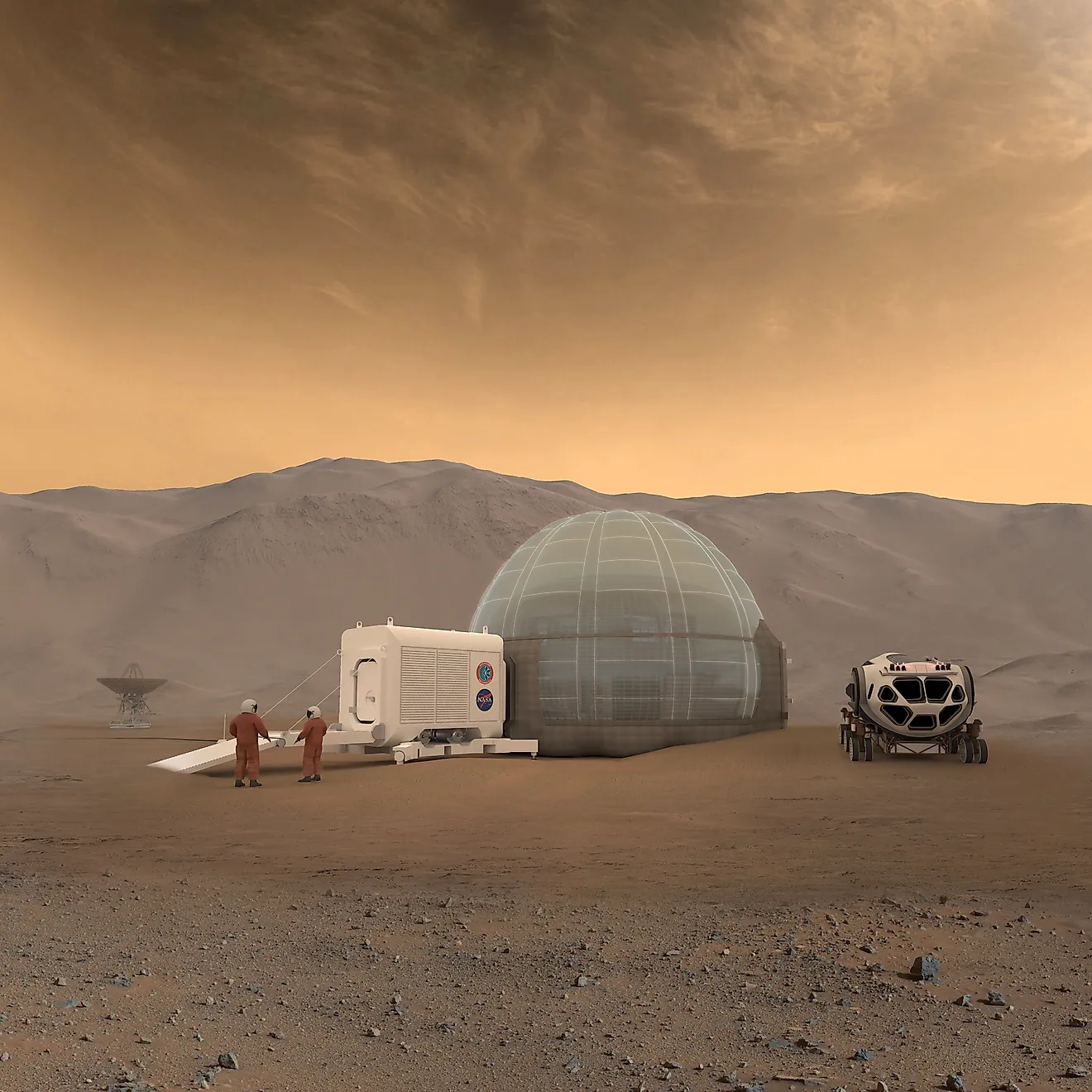
NASA's InSight lander (2018-2022) provided the first direct seismic measurements of Mars's interior. Its data showed the crust to be 15 to 45 miles thick (24 to 72 km), thinner than earlier estimates, and confirmed a partially molten iron core. Mars is the only planet currently populated entirely by robots: NASA's Curiosity rover (landed 2012) and Perseverance rover (landed 2021) continue to operate, the Ingenuity helicopter completed 72 flights between 2021 and 2024 as the first powered aircraft to fly on another planet, and China's Tianwen-1 mission delivered the Zhurong rover in 2021. Evidence of ancient surface water, including river valleys, dried lake beds, and the polar ice caps still present today, is now well established. Perseverance is currently caching rock samples for a future Mars Sample Return mission.
Dwarf Planets and Why They Are Not Terrestrial
Several smaller bodies in the Solar System share certain features with the terrestrial planets, including a solid surface and a roughly spherical shape, but are too small to have cleared their orbital neighborhood of other debris. The International Astronomical Union therefore classifies them as dwarf planets rather than full planets, a category formally established in August 2006 (the same decision that reclassified Pluto). The IAU currently recognizes five dwarf planets: Ceres, Pluto, Haumea, Makemake, and Eris.
Ceres is the only dwarf planet in the inner Solar System, orbiting in the asteroid belt between Mars and Jupiter. At a diameter of 588 miles (945 km), it accounts for roughly one-third of the asteroid belt's total mass. NASA's Dawn spacecraft orbited Ceres from 2015 to 2018 and found bright salt deposits (most famously in Occator Crater) and evidence of a subsurface brine reservoir, suggesting Ceres has more in common with icy outer worlds than with the inner terrestrial planets despite its position.
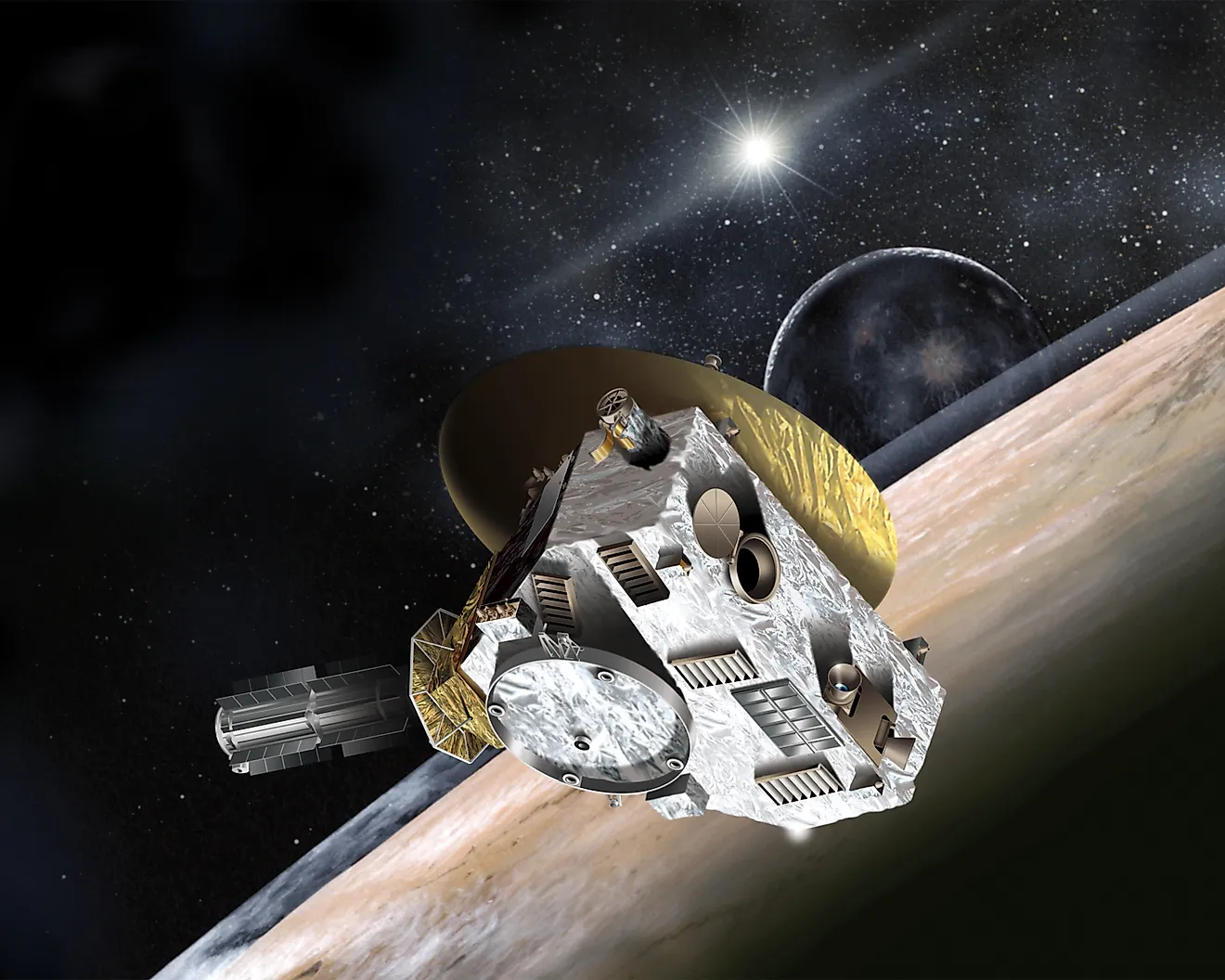
Pluto, Haumea, Makemake, and Eris all orbit beyond Neptune in the Kuiper belt or scattered disc, and all are predominantly icy rather than rocky. Pluto, reclassified from a planet in 2006, was visited by NASA's New Horizons spacecraft during a flyby in July 2015, which revealed an unexpectedly complex world with nitrogen-ice glaciers, water-ice mountains, and a thin nitrogen atmosphere. Eris, discovered in 2005, is roughly the same size as Pluto but more massive, and its discovery was one of the events that prompted the IAU to formalize the new category. Haumea is unusual for its elongated rugby-ball shape, a result of its rapid 4-hour rotation period, and Makemake was the third Kuiper belt object found to host its own moon. None of these bodies fits the rocky-silicate composition that defines the terrestrial planets, which is why the category remains restricted to Mercury, Venus, Earth, and Mars.
Why These Four Stand Apart
What separates the terrestrial planets from everything else in the Solar System is not just rocky composition. Each of the four formed close enough to the early Sun that volatile compounds boiled off before they could be incorporated, leaving behind the iron, silicon, and other refractory elements that produced solid, layered worlds. The differences between Mercury's airless, irradiated surface, Venus's crushing greenhouse atmosphere, Earth's biosphere, and Mars's slowly thinning atmosphere are products of size, distance from the Sun, magnetic protection, and contingent events such as collisions and outgassing across the past 4.5 billion years. Studying all four together is what makes Earth's place in this group as fortunate as it is, and what makes the search for similar conditions among the thousands of known exoplanets so consequential.