How Fast Is The Earth Moving?
You are sitting still. You are also moving in five different ways at once. At this instant, Earth is spinning beneath your feet, orbiting the Sun, riding the Sun's orbit around the Milky Way, drifting with the Milky Way toward the Andromeda Galaxy, and falling with the entire Local Group through the cosmic background radiation that fills the universe. The slowest of these motions is faster than a passenger jet at cruise. The fastest exceeds a million miles per hour. The reason none of it is perceptible is the same reason a smooth flight feels motionless: constant velocity is indistinguishable from rest. Only acceleration is felt. Earth's gravity holds you in place against the spinning surface, and inertia carries you with the rest. Here are the five speeds, scale by scale.
Rotational Speed: 1,670 km/h (1,037 mph)

At the equator, Earth's surface moves eastward at approximately 1,670 km/h (1,037 mph). This is the speed of the ground itself, which is why a person standing at the equator is, technically, supersonic relative to a hypothetical stationary point in space.
The figure is calculated from Earth's equatorial circumference of approximately 40,075 km (24,901 mi) divided by the rotation period. A common misstep is to use 24 hours for that period. The 24-hour day is the solar day, the time between successive solar noons. The actual rotation period, measured against the distant stars, is the sidereal day: 23 hours, 56 minutes, 4 seconds. The four-minute difference exists because Earth is orbiting the Sun while it rotates, so it must turn slightly more than 360 degrees each day to bring the Sun back to the same point in the sky.
Rotational speed is not uniform across the surface. It scales with the cosine of latitude. At the geographic poles, a person rotates in place at zero velocity. At Quito, Ecuador (latitude 0.2 degrees south), surface speed is essentially the full equatorial value. New York City at 40.7 degrees north moves at about 1,260 km/h (785 mph). This is why most major launch sites cluster near the equator: a rocket lifting off in the direction of Earth's rotation gains free velocity. The European Space Agency's Kourou spaceport in French Guiana, at 5.2 degrees north, provides nearly the maximum eastward bonus.
Orbital Speed: 107,200 km/h (66,616 mph)

Earth circles the Sun at an average speed of about 107,200 km/h (66,616 mph), or 29.78 km/s. Over one year, the planet traces a path of approximately 940 million km (584 million mi).
The year is 365.25 days, not 365. The accumulated quarter-day is the reason the Julian calendar (introduced by Julius Caesar in 45 BCE) added one leap day every four years. Pope Gregory XIII's calendar reform in 1582 refined this further by skipping three leap days every 400 years, since the actual orbital period is closer to 365.2422 days.
Earth's orbit is not a perfect circle. It is a slight ellipse with eccentricity 0.0167. Earth's closest approach to the Sun (perihelion) is approximately 147.1 million km, reached in early January. Aphelion, at 152.1 million km, falls in early July. By Kepler's second law, Earth moves about 1 km/s faster at perihelion than at aphelion. This is also why the northern hemisphere winter is slightly shorter than its summer: Earth covers the relevant arc of orbit faster while closer to the Sun.
Solar System Speed: 790,000 km/h (490,000 mph)

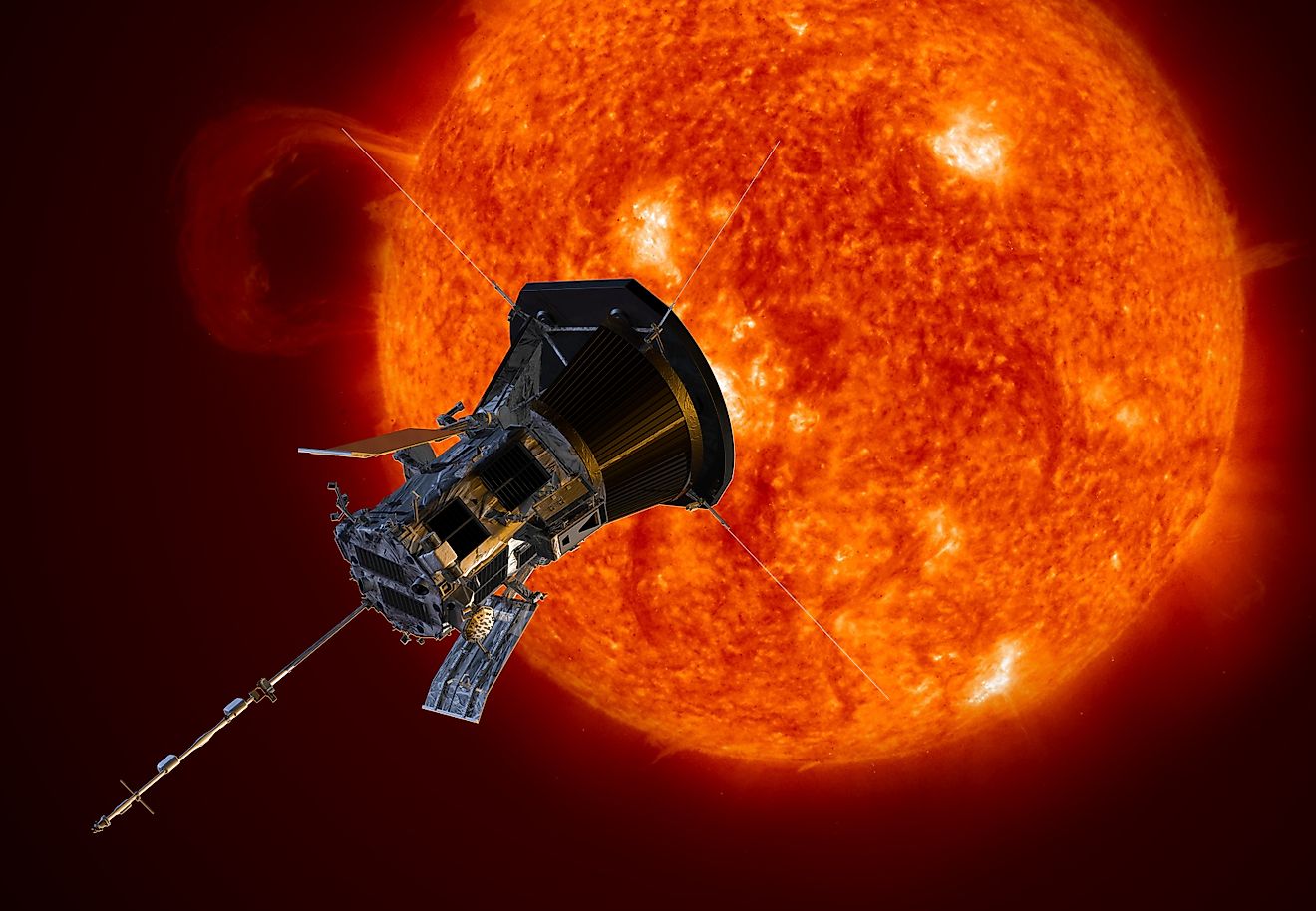
The Sun, carrying Earth and the rest of the solar system, orbits the center of the Milky Way at approximately 220 km/s. That is about 790,000 km/h (490,000 mph). The International Astronomical Union's recommended value for the Local Standard of Rest is 220 km/s, though precision measurements from the European Space Agency's Gaia space telescope (Hunt et al., 2016, and subsequent Gaia DR3 analyses through 2023) suggest the Sun's actual velocity is closer to 234 to 240 km/s, near 540,000 mph. The discrepancy reflects the Sun's small "peculiar" motion relative to the average rotation of stars in its neighborhood.
The Sun's distance from the galactic center is approximately 26,000 light-years (about 8 kiloparsecs), where the supermassive black hole Sagittarius A*, with a mass of approximately 4.3 million solar masses, anchors the rotation of the entire galaxy. The Sun's orbital path is roughly circular but bobs above and below the galactic plane on a vertical period of about 70 million years. One full galactic orbit, the so-called galactic year, takes approximately 225 to 230 million years. The solar system formed about 4.6 billion years ago, which means the Sun has completed roughly 20 orbits since its formation. The last time the Sun was in its current position relative to the galactic center, the late Triassic was ending and the first dinosaurs were beginning to dominate Earth's vertebrate fauna.
Galactic Speed: 396,000 km/h (246,000 mph)

The Milky Way as a whole is racing toward the Andromeda Galaxy at approximately 110 km/s, or roughly 396,000 km/h (246,000 mph) of approach velocity. Andromeda, also known as M31, sits about 2.5 million light-years away and is the largest spiral galaxy in the Local Group.
The radial approach has been known since the early 20th century, when Vesto Slipher measured Andromeda's blueshift in 1912. The question of whether the two galaxies would actually collide remained open for a century, because the tangential component of Andromeda's motion (its sideways drift) was too small to resolve from Earth. That question was settled in 2012 when a team led by Sangmo Tony Sohn at the Space Telescope Science Institute used the Hubble Space Telescope to measure Andromeda's proper motion directly. The result confirmed a near-head-on trajectory and a merger essentially certain to occur.
The first close encounter is expected in approximately 4.5 billion years, with full merger complete by roughly 6 billion years. The combined object has been informally named "Milkomeda." Despite the scale of the event, individual stellar collisions will be vanishingly rare: galaxies are mostly empty space, and stars typically pass one another at distances of light-years. Earth, if it still exists in any recognisable form, will most likely be carried into the merger intact, though by then the Sun will have entered its red giant phase and the inner solar system will have been profoundly altered.
Cosmic Speed: 2.2 million km/h (1.4 million mph)

The fastest motion that includes Earth operates at the largest possible scale. The entire Local Group of galaxies, which contains the Milky Way, Andromeda, the Triangulum Galaxy, and dozens of smaller satellites, is moving at approximately 620 km/s relative to the rest frame of the cosmic microwave background. That is about 2.2 million km/h, or 1.4 million mph.
This is the velocity measured against the radiation left over from the Big Bang 13.8 billion years ago, which fills the entire universe at a near-uniform temperature of 2.725 kelvin. Earth's motion through this background appears as a faint dipole pattern in the microwave sky: one side slightly warmer (blueshifted), the opposite side slightly cooler (redshifted). The COBE satellite confirmed the dipole in the early 1990s, and successive missions, WMAP (operating 2001 to 2010) and the European Space Agency's Planck (2009 to 2013), refined the measurement to a precision of better than one percent.
After subtracting Earth's orbital motion, the Sun's rotation around the Milky Way, and the Milky Way's motion within the Local Group, the remaining velocity is attributed to the Local Group itself. The direction of motion points roughly toward the constellation Hydra and is driven by gravitational pull from the Great Attractor, a mass concentration in the Laniakea supercluster, and beyond it from the more distant Shapley Supercluster.
Adding It All Up
The five speeds operate simultaneously and at angles to one another. They cannot simply be summed, since some partially cancel and others compound depending on the moment of measurement. The Sun's total velocity through the cosmic microwave background, accounting for all contributions, is approximately 370 km/s, or about 1.3 million km/h (830,000 mph). Even this is only a snapshot. The directions of Earth's orbital motion and the Sun's galactic motion will partially cancel six months from now, and the geometric relationships among all five vectors shift continuously.
What makes the entire structure possible to ignore is Newton's first law of motion, published in the 1687 Principia: an object in uniform motion stays in uniform motion unless acted on by a force. Constant velocity is not detectable from within the moving frame. This is the central reason heliocentrism took so long to be accepted: opponents of Copernicus and Galileo argued, correctly within their physics, that if Earth were moving, the motion should be felt. Newton's mechanics explained why it is not. Every part of the structure described above, from the spin of Earth to the fall of the Local Group toward Hydra, is uniform motion at human timescales. Acceleration would be felt. Motion at constant velocity is the natural state of everything in the universe.