Where Tucson Would Get Water If The Colorado Failed
Tucson, the second-largest city in Arizona, sits in the middle of the Sonoran Desert, and much of its water is pumped more than 300 miles across the desert from the Colorado River. For most of the past two decades, though, almost none of that river has reached the city's taps. Tucson Water has pumped the city's entire Colorado River allocation into the ground west of town and left it there, building a buried reserve while residents drank from other sources.
In 2027, for the first time, that stored water will be pumped back out, after the Colorado's two largest reservoirs fell to record lows in August and federal officials cut Arizona's deliveries more than twice as deeply as the old river rules ever required. Fifty years of planning come down to one question: where does Tucson get its water if the Colorado fails for good?
Banked River Water Sits West of the Tucson Mountains

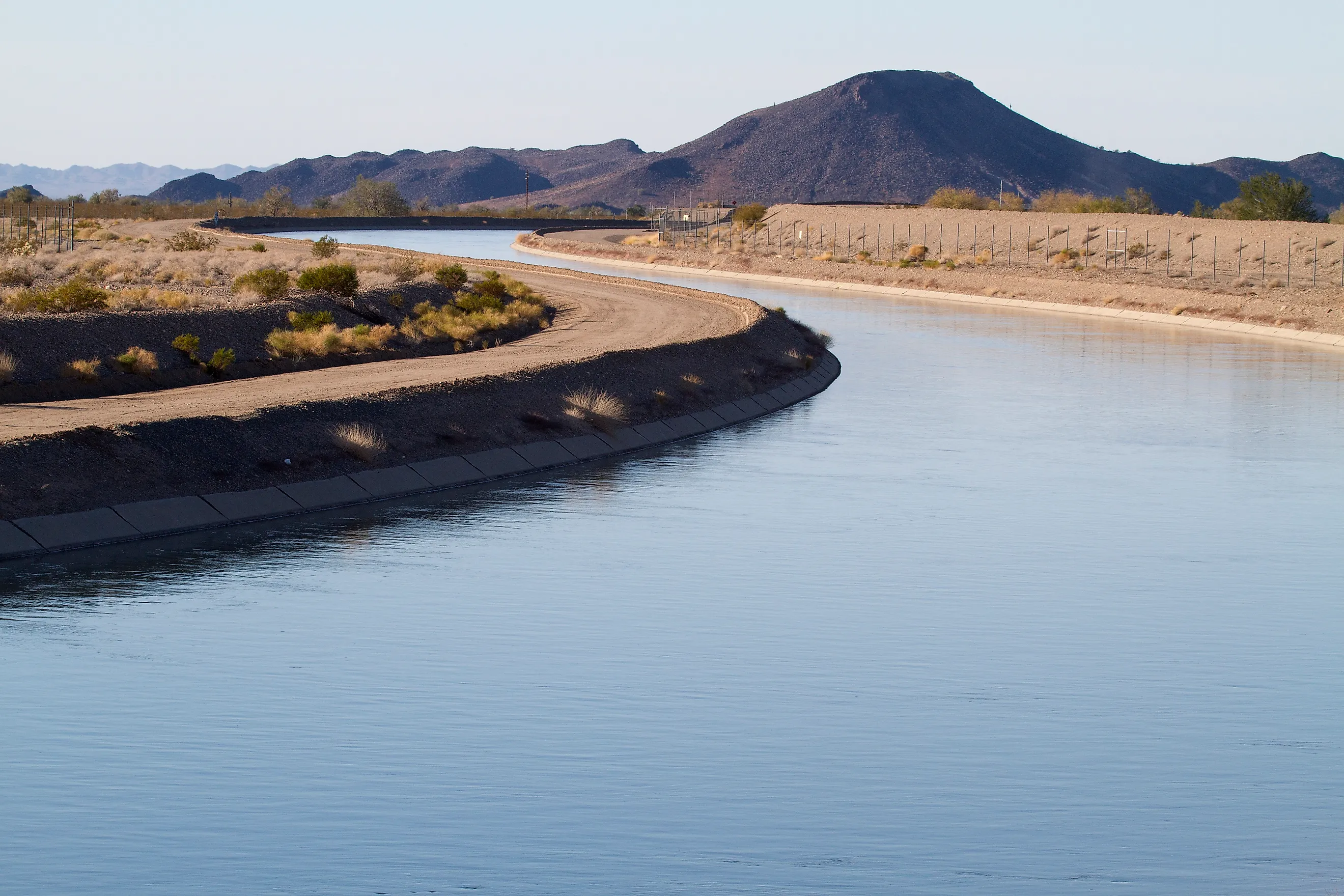
The Central Arizona Project canal leaves Lake Havasu near Parker and runs 336 miles across the desert, ending at the southern edge of the San Xavier Indian Reservation southwest of Tucson. Most of Tucson's share goes to two recharge sites in Avra Valley. At the larger one, the Central Avra Valley Storage and Recovery Project southwest of the intersection of Sandario and Mile Wide roads, 11 basins spread across 317 acres. Canal water sinks through sand and gravel into the aquifer and mixes with native groundwater, then 33 recovery wells pump the blend back up and a pipeline carries it east over the Tucson Mountains into the city's system. The Southern Avra Valley Storage and Recovery Project, a few miles south, added nine more basins in 2009.
Tucson holds the largest CAP allocation of any water utility, with rights to nearly 45 percent more canal water than its customers use in a year, and the extra has been stored underground, much of it in Avra Valley. Counting the city's own credits and the water the state banked in the area, Tucson could draw on at least 10 years of supply even if federal cuts erased the CAP's entire delivery.
The Brown-Water Years Behind the Underground Detour

Colorado River water first went straight to Tucson homes, reaching city taps in late 1992. Within months the treated canal water was loosening corrosion inside older pipes, and brown, foul-smelling water poured into thousands of homes and businesses while pipes and appliances burst. Canal water carried about 750 parts per million of dissolved solids, compared with roughly 300 in local groundwater. The City Council halted the deliveries in 1994, and in 1995 more than 56 percent of voters approved Proposition 200, the Water Consumer Protection Act, which barred delivering canal water to homes unless it matched the quality of local groundwater, a standard the city met by blending the canal water underground in Avra Valley.
The Avra Valley Drawdown Starts in 2027

The federal decision issued in August 2026 requires the Lower Basin states to absorb 1.25 million acre-feet of reductions in each of 2027 and 2028, with about 760,000 acre-feet a year falling on Arizona under the states' proposed sharing plan. The CAP holds junior rights under the 1968 law that authorized it, which puts its deliveries near the front of the line for cuts. Arizona moved in October to join Nevada's lawsuit against the plan.
Tucson Water customers have historically used close to 100,000 acre-feet a year, and its preliminary order from the canal for 2027 is about 71,000 acre-feet, a little less than half its usual allocation. Recovery wells in Avra Valley will pump the difference between that demand and the reduced order. Most of it will come from CAP water the Arizona Water Banking Authority stored underground and has approved for the city's use, with Tucson's own stored credits as a backstop.
Of the water cut from the full allocation, 50,000 acre-feet will stay in Lake Mead under a deal that pays the city roughly $325 an acre-foot, and close to 20,000 more is lost without payment. Customers will see no immediate change in service. Sharon Megdal of the University of Arizona's Water Resources Research Center noted that every acre-foot pumped from storage now leaves less available when additional cuts come.
Native Groundwater Under the Tucson Basin and Avra Valley

Before the canal arrived, Tucson drank only native groundwater pumped from wells beneath the city, and since the 1970s it has also owned groundwater in Avra Valley northwest of town, held largely unused. City water officials have said Tucson holds rights to about 3.3 million acre-feet of that native supply. Counting the banked river water, the underground total comes to about 4.7 million acre-feet, enough for roughly 47 years at the current rate of use.
A 2025 study of the Tucson Basin found that climate swings over the past 20,000 years, back to the last ice age, moved the water table about 105 feet, and pumping since the mid-20th century has lowered it roughly twice that far. Tucson Water's planning counts on only about 50,000 acre-feet a year of natural recharge, and much of the native supply is meant to stay in the ground, since a deeper water table means more land subsidence and poorer water quality.
Wells Across Tucson Have Been Shut Over PFAS

Parts of the aquifer under the city carry PFAS, the so-called forever chemicals, from firefighting foam used at military bases, with problem areas near Davis-Monthan Air Force Base in central Tucson and around the Tucson International Airport Superfund site on the southwest side. About 30 wells in and around the city, including some on the Northwest Side, have been turned off or put on emergency standby over the past decade as PFAS turned up. A treatment well has been used to limit the movement of PFAS toward the Central Wellfield, the primary supply for more than 65,000 people and the sole alternate supply for 600,000. A $25 million ion-exchange system at the Tucson Airport Remediation Project opened in September 2026, and for now its treated water goes into the reclaimed system along the Santa Cruz River.
Treated Wastewater Already Flows South of A Mountain

On June 24, 2019, El Día de San Juan and the traditional start of Tucson's monsoon season, Tucson Water began releasing treated wastewater into the Santa Cruz River just south of A Mountain and downtown. The Santa Cruz River Heritage Project puts about 2.8 million gallons a day into a stretch of riverbed that otherwise carries water only after storms, and the flow soaks into the ground as it moves north, recharging the aquifer.
Since 1984, a separate network of purple pipe has carried reclaimed water to parks, schools, golf courses, street medians, and some homes, now about 14,400 acre-feet a year, or roughly a tenth of the utility's supply.
A Purification Plant Is Planned Near Ina Road and I-10

Tucson Water Director John Kmiec has said a planned advanced water purification plant near Ina Road and Interstate 10 will support the Northwest Side, where wells have been closed because of PFAS. The $86.7 million plant, backed by the Bureau of Reclamation, will sit next to Pima County's Tres Rios Water Reclamation Facility and run treated effluent through reverse osmosis and ultraviolet advanced oxidation.
Arizona's advanced water purification rules, in effect since March 2025, allow purified wastewater to be delivered as drinking water. The plant is designed to produce 2.5 million gallons a day, about 2,800 acre-feet a year, by late 2031, and under the agreement that funds it, about 56,000 acre-feet of the city's river water is set to stay in Lake Mead over 10 years.
Pumping Stays Tucson's Real Backstop
The 47-year estimate assumes today's rate of use, and that rate keeps falling, since Tucson Water customers have cut per-person use by about a third since 2000, to less than 80 gallons a day, while the service area population grew about 18 percent. "I think we're good in the short term," University of Arizona geoscientist Karl Flessa said in August, though he warned of a coming end to cheap water and called water reuse expensive. That expense is easy to see at Ina Road, where the $86.7 million plant is designed to add about 2,800 acre-feet a year, less than 3 percent of the roughly 100,000 acre-feet Tucson customers have historically used in a year. A Colorado River failure would still be met mostly by pumping, first from the river water banked under Avra Valley and then from the native groundwater around it.