The 4 Most Snake-Infested Rivers In Idaho
Idaho has around 107,651 miles of river flowing through its four major physiographic provinces: the Northern Rocky Mountains, the Middle Rocky Mountains, the Columbia Basin, and the Basin and Range Province. These physiographic provinces, accompanied by the rivers that flow through them, are of utmost importance for providing sustainable habitat for many of Idaho’s native species, including a handful of snakes that call the state’s waterways their home. These are the most snake-infested rivers in Idaho.
Snake River

The Snake River is the largest tributary of the Columbia River, and although it originates in Wyoming, it enters Idaho at the Palisades Reservoir. From here, it flows down from the mountains and passes across the lava bed-covered Snake River Plain of southern Idaho. Eventually, it joins the Boise River and forms the border between Idaho and Oregon for 216 miles, and then forms the border between Idaho and Washington until it reaches the city of Lewiston, where, shortly after, it joins the Columbia River.

The Western ground snake (Sonora semiannulata) is limited to southwest Idaho, along the Snake River and surrounding drainage areas. They frequent sandy, grassy areas that have rocks and surface debris that provide ample cover for them, and can grow to a length between 8 and 20 inches, depending on sex. They use their hiding spots to hunt for prey such as insects, spiders, and scorpions.
Clearwater River

The Clearwater River is located in north-central Idaho and flows west along the border between Idaho and Montana before it enters the Snake River. The Clearwater River is the largest tributary of the Snake River, and its basin has one of Idaho’s largest forested landscapes that provides habitat for many animals, including snakes.

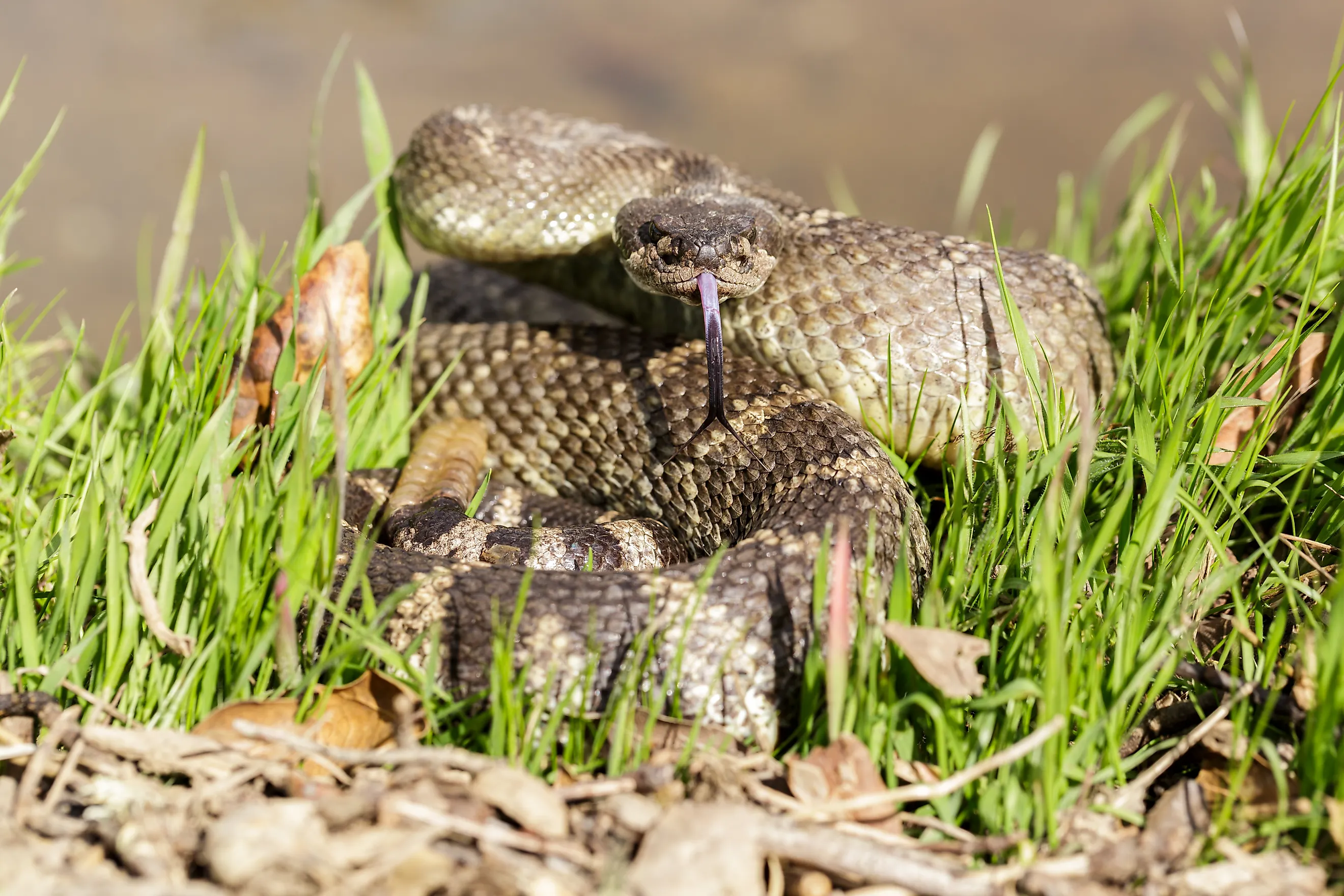
The Western rattlesnake (Crotalus viridis) has three subspecies that call the state home, including the Northern Pacific rattlesnake (Crotalus viridis oreganus), which is found in west-central Idaho, especially along the Clearwater River drainage basin. Although Western rattlesnakes are not the longest species in Idaho, they are the heaviest. They usually occupy dry regions with sparse vegetation that has south-facing rocky outcrops, which make for suitable dens that they will use to hibernate in.
Salmon River

The Salmon River rises in the Sawtooth and Salmon River Mountains in central Idaho and flows northeast, past the city of Salmon. After it flows through the city of Salmon, it is joined by the Lemhi River, and together, they join the Snake River after a course of roughly 420 miles. The Salmon River flows through large wildlife areas of national forests. At the lower course of its flow, the Salmon River carves out a gorge known as Salmon River Canyon. Many species of animals are found in this canyon, including garter snakes.

There are two species of garter snakes found in Idaho, the wandering garter snake (Thamnophis elegans vagrans) and the valley garter snake (Thamnophis sirtalis fitchi). Garter snakes are found in many different habitats and ecosystems, including grasslands, meadows, woodlands, and prairies. One constant in their range is the close proximity to a permanent water source. As small snakes, garter snakes' diet primarily consists of slugs, worms, and amphibians.
Boise River

The Boise River is formed in Boise National Forest, southeast of Idaho City, by the confluence of the Middle and North Fork branches of the river. It flows west through the city of Boise, where it joins the Snake River at the border of Oregon. The geography along the Boise River consists of foothills that span 80,647 acres and separate the valley floor and arid lowlands surrounding the river from the tree-covered peaks of the Boise Ridge.

The gopher snake (Pituophis catenifer) is the most commonly encountered snake in the Boise Foothills, and may be the most commonly encountered snake in Idaho. They can be found all over the state, other than the north region, inhabiting shrub lands and low mountain areas. Gopher snakes are often mistaken for rattlesnakes because, when threatened, they mimic rattlesnakes by flicking their tail and hissing in an attempt to ward off threats or predators. However, they are nonvenomous and largely harmless.
Idaho's Snake-Infested Rivers
Although Idaho is home to both venomous and non-venomous snakes, you are more likely to encounter a harmless non-venomous species of snake, if you encounter any at all. Snakes are shy, solitary, and secretive creatures that, if left alone and undisturbed, pose no harm or threat to people. If you are recreating in the outdoors, especially Idaho’s rivers, be sure to stay away from debris or rock piles that may be hiding snakes.