How Many Barges One Mississippi Towboat Can Push
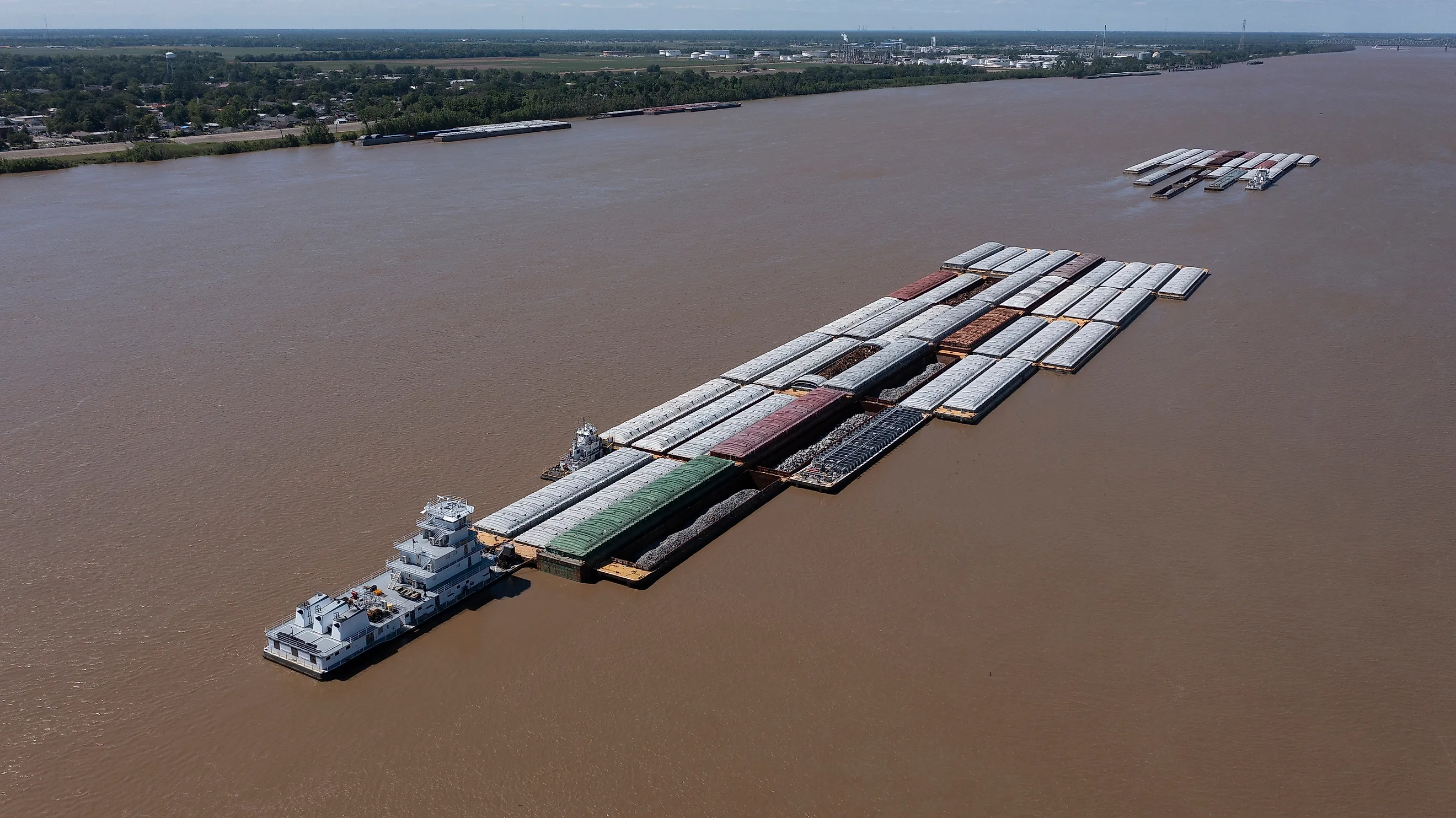
On the lower Mississippi, a single towboat routinely shoves 40 barges lashed into one steel island covering more than six acres. Send that same boat north of St. Louis and it gets capped at about 15. The engines did not get weaker on the trip upstream, because the river changed the rules. Locks, current, bridges, and water depth all get a vote on tow size, and the answer swings from 15 to well past 40, with an all-time record of 72. Which number applies comes down to the stretch of river the boat is working and what the water is doing that week.
The Answer Depends On The Stretch Of River

American Commercial Barge Line (ACBL), one of the biggest carriers on the river, laid out the spread in a 2020 Federal Highway Administration presentation. Its tows on the locking rivers run 15 barges, while its lower Mississippi tows range from 25 to 56 depending on horsepower and direction of travel. Federal accident reports show the same pattern in the field, with tows of 40 and 42 barges logged on the lower river in 2018, 2020, and 2023. The towboat supplies the muscle, but the waterway sets the ceiling.
What Counts As One Barge

The unit being counted is the standard jumbo hopper barge, roughly 195 feet long and 35 feet wide. Fully loaded, a dry-cargo barge carries about 1,750 tons, which the National Waterways Foundation equates to 70 semi-truck loads or 16 rail cars. Barges have no engines and no crew. They become a vessel only once deckhands lash them into rigid strings and face the whole assembly up to a towboat, a setup explained in our look at why Mississippi towboats push their barges instead of pulling them.
Locks Cap The Upper River At 15

Between the Twin Cities and St. Louis, the Mississippi climbs through a chain of locks and dams, and most of the chambers measure 600 by 110 feet. A standard 15-barge tow is three barges wide and five long, about 105 feet across and roughly 1,150 to 1,200 feet from the lead barge to the stern of the towboat. Pilots squeezing one into a 110-foot chamber get about two and a half feet of clearance on each side. Length is the real headache on the river with the most locks in America, since the tow is nearly twice as long as the chamber.
Double Lockage Splits The Tow In Two

At a 600-foot lock, the tow has to come apart. Crews send the front section through first, pull it clear, then bring the towboat and the remaining barges through and reassemble everything on the other side. The Corps of Engineers says the new 1,200-foot chamber being built at Lock and Dam 25 will make that passage more than four times faster by ending the split. Only a few Upper Mississippi locks, including Lock 19 at Keokuk and the Melvin Price Locks near Alton, already have full-length chambers, which the Corps says can hold up to 17 barges plus the towboat.
The Ohio And Illinois Play By Similar Rules

The same 15-barge unit runs the other locking rivers in the system, which ACBL lists as the Upper Mississippi, Illinois, Ohio, Tennessee, Cumberland, and Arkansas. The Ohio River modernized first, with the Corps adding 1,200-foot chambers beginning in the 1960s so a typical tow could pass in a single lockage. The Illinois River still runs on older 600 by 110-foot chambers at many of its dams. That means the split-and-reassemble routine at stop after stop.
Below The Last Lock, Tows Spread Out

The last lock on the Mississippi sits just above St. Louis, and below it the river runs open to the Gulf. With no chamber to fit, tow size is limited by channel width, current, and horsepower instead. Tows grow as they head south, especially past Cairo, Illinois, where the Ohio adds its flow. Ingram Barge Company, one of the largest inland carriers, has described a typical lower Mississippi tow as 40 barges arranged eight wide and five long behind a single 9,000-horsepower boat, carrying about 70,000 tons. The barges alone in that formation cover more than six acres.
Direction And Cargo Change The Count

Upbound and downbound tows are not built alike, which is why ACBL ties its lower-river range to direction as well as horsepower. Empty barges weigh a fraction of loaded ones, and northbound tows often carry plenty of them. The 40-barge tow involved in a fatal 2020 collision near Destrehan, Louisiana, was hauling 22 empties and 18 barges of phosphate rock, according to the National Transportation Safety Board (NTSB). Recent NTSB reports on the lower river describe tows anywhere from 19 to 42 barges, a spread that reflects the boat, the cargo, and the river stage on that particular run.
The Most Powerful Towboat On The River

Horsepower is the other half of the equation, and the top end keeps climbing. ACBL christened the ACBL Mariner in New Orleans in November 2024, billing it as the most powerful towboat ever built for Mississippi River work. The 200-by-50-foot boat puts 11,000 horsepower through two Caterpillar engines, and ACBL rates it to push up to 64 barges carrying more than 75,000 tons. The company says it runs about 20 percent more efficiently per ton-mile than the 6,000-horsepower boats common on mainline routes.
The Record Tow

The biggest tow on record beat the Mariner's rating more than four decades before it launched. In 1981, the towboat Miss Kae-D of Flowers Transportation pushed 72 barges upriver from Baton Rouge to Kentucky, a feat recounted by the Waterways Journal. Giant tows were not new even then. In 1907, the steamer Sprague set a world record by moving 60 coal barges weighing 67,307 tons, a raft Britannica says covered 6.5 acres.
High Water And Bridges Shrink Tows

Floods cut tow sizes fast. During high water at Vicksburg in February 2019, the Coast Guard limited wide southbound tows to daylight passage under the bridges and then dropped the maximum number of loaded barges from 36 to 30, according to the NTSB. Ingram has said extreme flood currents can force an operator to shrink a 40-barge tow to 25 with the same boat, a capacity loss of about 40 percent. The bridges at Vicksburg remain a pinch point, and two separate tows struck the Highway 80 bridge piers there within five days in May 2025.
Low Water Shrinks Them Too

Drought hits from both directions, trimming how many barges a boat can take and how much each one carries. During the 2022 low water, the Corps reported operators cutting tows from 36 barges to 25, and ACBL said its southbound tows shrank by 17 to 38 percent while tonnage per barge fell 20 to 27 percent. In August 2024, the Coast Guard capped some lower-river tows at six barges wide with no more than four of them loaded. The thresholds behind those calls are covered in how low the Mississippi has to drop before barges stop.
What One Tow Adds Up To

The numbers explain why the industry bothers with all this lashing and splitting. The National Waterways Foundation's 2022 modal study, produced by the Texas A&M Transportation Institute, says one 15-barge tow equals 1,050 semi-trucks, or 216 rail cars pulled by six locomotives. Scale that same 25-tons-per-truck math to Ingram's 70,000-ton lower-river tow and one boat is doing the work of about 2,800 trucks. The same study found that shifting all waterway freight onto highways would add 867 trucks per lane per day on a typical rural interstate.
How Many Barges One Towboat Can Push

On the Upper Mississippi, Illinois, and Ohio, the working answer is 15, because that is the tow the locks were built around. Below St. Louis the count climbs to somewhere between 25 and the mid-50s on a normal run, with 40 a common sight and the newest boats rated for 64. The record stands at 72, set in 1981. Then the river gets its say, and floods, droughts, and tight bridge spans can knock any of those numbers down overnight.