The Oldest Taverns In America
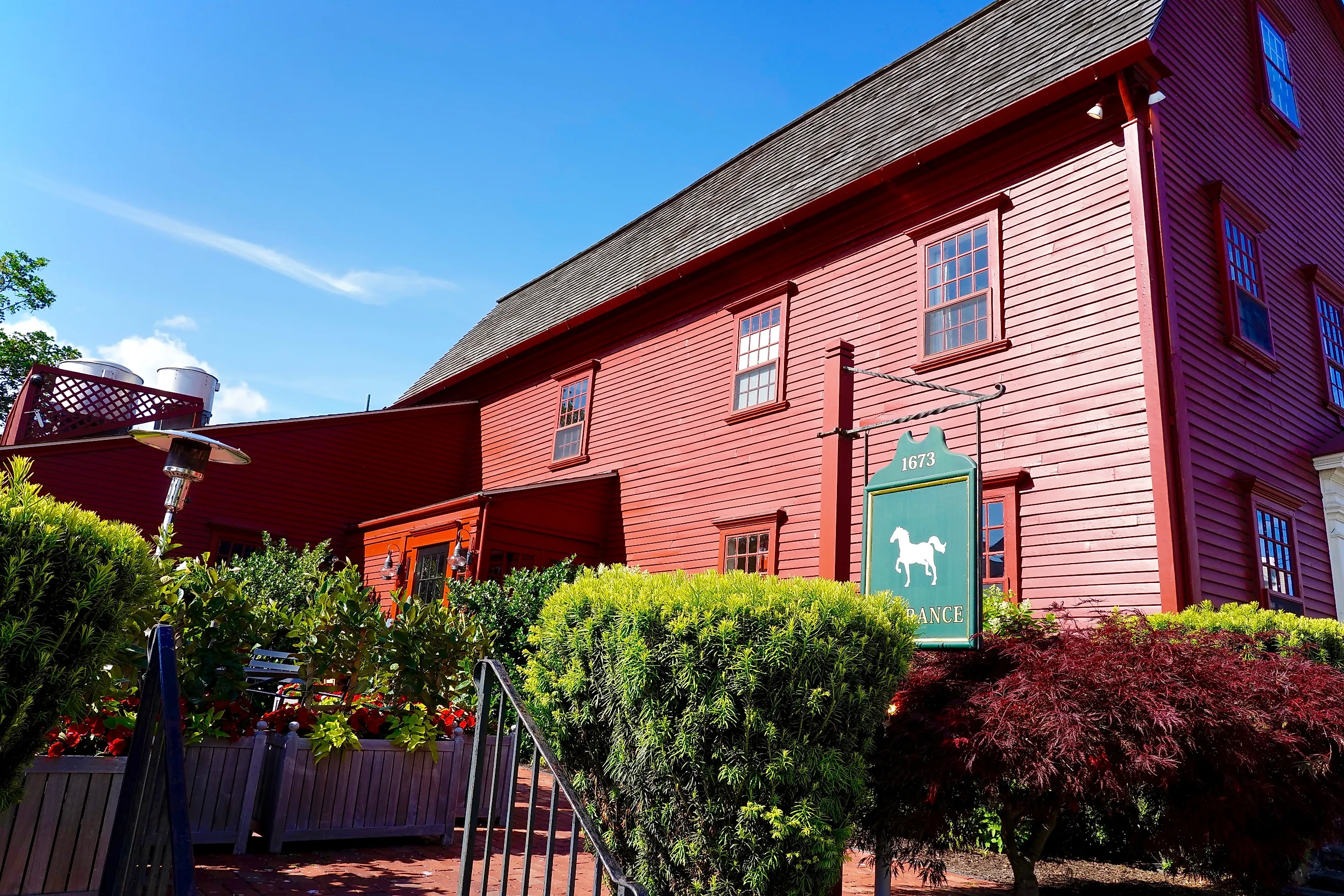
The next time you're in a bar enjoying a drink and the bartender tries to tell you the joint's an old one, ask for the paperwork. It's a tactic that worked at the White Horse Tavern in Newport, Rhode Island, where records showed a liquor license was granted in 1687, despite the fact that the family had been pouring drinks there since 1673.
The White Horse sets the standard for how we've determined who makes it onto our list of the oldest taverns in America: the year that alcohol was first served under license in a building you can still drink in today. And to keep it fair, continuous service isn't a requirement, as almost nobody managed it.
Prohibition shut most taverns across the country, and several of these spent decades after as boarding houses or stores before someone turned the taps back on. So, pull up a stool, order your drink of choice, and see just how many of these classic old American taverns you've visited.
1. White Horse Tavern, Newport, Rhode Island (1673)

The two-room house that William Mayes Sr. turned into a Newport tavern was already 21 years old when he bought and set up business there in 1673. The Marlborough Street establishment was issued a liquor license in 1687, a fact verified by National Register nomination records, and by all accounts, the first innkeepers were a colorful bunch.
William Mayes Jr., the son of the tavern's founder, was a known pirate who had worked the Red Sea before taking over the family business in 1702. The Nichols family followed and kept the tavern for nearly 200 years, giving it the White Horse name in 1730. The colony's General Assembly met here until Colony House, its purpose-built seat on Washington Square, was finished in 1741.
In 1776, innkeeper Walter Nichols moved his family out rather than share the house with the German soldiers the British had hired and billeted there. The Nichols family sold the business in 1895, and by 1911 the building was a rooming house.
The Preservation Society of Newport County bought it in 1954 and reopened it as a tavern in 1957. A Newport-based group, the ninth owner in the tavern's history, has run it since 2014, and it serves dinner seven nights a week.
2. Longfellow's Wayside Inn, Sudbury, Massachusetts (1716)

David Howe received a license for Howe's Tavern on the Boston Post Road from the Concord Court in 1716 after his father, Samuel, built it in 1700. While second on this list, it's also the oldest hotel still taking guests in America.
Ezekiel Howe had renamed it the Red Horse Tavern by 1746, and four generations of Howes kept it until Lyman Howe died in 1861, after which heirs and tenants let it slide into disrepair. Edward Rivers Lemon bought it in 1897 and renamed it for the poet Henry Wadsworth Longfellow, who set his Tales of a Wayside Inn, published in 1863, in its parlor after a visit the year prior.
Henry Ford, founder of the Ford Motor Company, bought the inn in 1923, built the gristmill in 1926, and added the Martha-Mary Chapel in 1929. A fire in 1955 gutted the main building, but it was rebuilt and reopened three years later.
It's now run by the nonprofit Wayside Inn Foundation, with ten guest rooms, and its Old Tap Room serves lunch and dinner Wednesday through Sunday.
3. Middleton Tavern, Annapolis, Maryland (1750)

The Middleton Tavern, first opened in 1750, Editorial credit: Milena Ramirez / Shutterstock.com
Horatio Middleton bought himself a waterfront lot on Market Space in Annapolis in 1750, and the inn he opened on it for seafaring men had a dual purpose: it also served as the landing for his ferry service to Rock Hall on the Eastern Shore. The ferry had its mishaps: George Washington spent an unplanned night aboard when it ran onto a sandbar off Greenbury Point and grumbled about it in his diary. The inn had its famous guests too: Benjamin Franklin left an overcoat behind after a lecture there and even advertised for its return in the local paper.
While the Baltimore Banner dates the tavern's current brick building to 1754, its 19th-century history is hazier. It spent time as a store and a hotel before it was renovated to serve food and drink again in 1939. Jerry Hardesty bought it in 1968 and restored the Middleton name.
Hardesty, who died in 2021, is remembered as the creator of the Oyster Shooter. Consisting of a freshly shucked oyster in a shot glass with the house cocktail sauce, it's traditionally chased down with beer. Not surprisingly, his family, who continue to run the tavern, sell them by the truckload. The tavern is located in the Colonial Annapolis Historic District and is open daily with a live piano bar on Friday and Saturday nights.
4. Fraunces Tavern, New York, New York (1762)

Built in 1719 for Etienne DeLancey, a Huguenot merchant whose name survives on New York's Delancey Street, the brick house at Pearl and Broad streets is the earliest 18th-century building still standing in Manhattan. Samuel Fraunces bought it and opened the Queen's Head Tavern in 1762.
On December 4, 1783, a few days after the last British troops left the city, George Washington gathered his officers in the Long Room upstairs to tell them he was resigning his command and going home to Mount Vernon.
Under the Confederation government, the building housed the Department of Foreign Affairs from 1785 and the Treasury and War departments from 1787, and after they moved out in 1788, it became a boarding house and later a saloon. Fires in 1845 and 1852 were followed by rebuilding that left it two stories taller.
The Sons of the Revolution, a society for descendants of those who served in the American Revolution, bought the building in 1904 and reopened it in 1907 as a tavern with a museum upstairs. The society still runs the museum, and the Long Room has been set up as it is believed to have looked on the day of Washington's farewell (there's even a lock of his hair and a fragment of a tooth on permanent display).
A bomb planted by the FALN, a Puerto Rican nationalist group, killed four diners in January 1975, and you can still see the scars on the building's facade. Downstairs, the restaurant, leased to Eddie Travers and partners since 2010, has five bars, including a whiskey bar.
5. King George II Inn, Bristol, Pennsylvania (1765)

The King George II Inn calls itself "America's oldest continuously operating inn," a claim that goes back to 1681. It was that year that Samuel Clift received 262 acres on the Delaware River on condition that he run a ferry and a public house. He opened the Ferry House on this spot at the same time the town of Bristol was being founded.
While Clift's original building is gone, the one you'll see these days was built in 1765 by Charles Bessonett, who replaced the ferry house with a larger inn and named it after the British monarch who had died five years earlier. Not everyone liked the new name, including the Continental troops that shot the royal sign down, and American Colonel John Cadwalader made it his headquarters in December 1776.
It spent years as both the Fountain House and the Delaware House before the King George name came back in the 1970s. The inn closed abruptly in May 2010 when its owners fell behind on taxes and loan payments, was sold, and reopened in 2011. It serves Wednesday through Sunday, with a patio above the river.
6. Publick House Historic Inn, Sturbridge, Massachusetts (1771)

Crafts Tavern opened on the common in Sturbridge, Massachusetts, in 1771. Its founder, Colonel Ebenezer Crafts, raised a cavalry company from Sturbridge and three neighboring towns in 1775 and rode with it until the British evacuated Boston in March 1776, ending an 11-month siege by American forces. He was forced to sell in the postwar slump of 1784 and went north to found Craftsbury, Vermont.
Later keepers called it the Central House and The Elms, and in 1923 it became a boarding house for women. That ended when Richard Paige, said to have won the building for a dollar in a card game, restored it in 1938 and gave it its present name.
Now a sister property to Concord's Colonial Inn and the Hawthorne Hotel in Salem, the tavern's Historic Tap Room offers lunches and dinners seven days a week (ask to sit near its large open hearth). Ebenezer's Tavern, named after its founder, stays open late. And yes, Yankee pot roast is still on the menu.
7. The Griswold Inn, Essex, Connecticut (1776)

Of all the taverns on this list, only The Griswold Inn has never shut for longer than a police raid. Sala Griswold opened it near the Essex wharves in June 1776 to serve the town's shipbuilders. Richard Hayden later bought the tavern and moved it up to Main Street, joining it to his own house, built in 1801 and one of the first three-story buildings in the region.
The Tap Room, where guests drink today, began as a schoolhouse built in 1735 and was rolled along Main Street on logs by a team of oxen in 1801. On April 8, 1814, during the War of 1812, a British raiding party burned 28 ships at Essex and commandeered the inn for a day, demanding a hunt breakfast, the large English-style breakfast the inn still serves on Sundays.
During Prohibition, rumrunners on the Connecticut River kept it supplied. Federal agents raided it more than once, the inn paid its fines, and the doors reopened each time. The Paul family has owned it since 1995 and marked its 250th anniversary in 2026 with a Revolutionary Ale.
The Tap Room serves tavern fare seven days a week, with a singalong of sea chanteys, the old sailors' work songs, on Monday nights.
8. Old Talbott Tavern, Bardstown, Kentucky (1779)

The stone stagecoach inn on the courthouse square in Bardstown opened in 1779 as the Hynes House, a year before the town was laid out, and the Talbott family gave it its name after buying it in 1886. Among its most famous guests (and there have been many), French prince Louis Philippe, later King of the French, is a standout.
Members of Louis Philippe's party painted murals on an upstairs wall when he stayed in 1797, during the years he spent in exile in America. An electrical fire in March 1998 closed the tavern until November 1999, but part of the mural survived, complete with holes that local legend says outlaw Jesse James left after mistaking the painted birds for real ones.
Jack Kelley was a co-owner when the tavern was listed on the National Register in 1973, and his family still owns it. Bardstown calls itself the Bourbon Capital of the World, and the tavern bills its bar as the oldest bourbon bar in the world. Six guest rooms upstairs are each named for a famous visitor, including the Jesse James room, and there's live music on weekends.
Ask For The Paperwork
Between them, these eight historic taverns have been run by a pirate, raided by federal agents, and visited by George Washington and a future king of France. All eight are still open and pouring drinks.
So, the next time a bartender says their bar's an old one, ask to see the paperwork. And if you get there before me, mine's an Old Fashioned. Cheers!