9 Of The Most Captivating Small Towns In UK
The UK's most captivating towns are found in regions from the Scottish Highlands to England's Lake District and Northern Ireland's waterside communities. Offering diverse landscapes and scenery, like the candy-coloured waterfront of Tobermory and the honey-stone cottages of Castle Combe, the UK’s most captivating towns earn their appeal in very different ways. Found in regions from the Scottish Highlands to England's Lake District and Northern Ireland's waterside communities, they share common characteristics. One town is known for the limestone buildings, thatched-roof cottages, and rolling hills of the Cotswolds. Another town pairs outdoor recreation with the literary history of Samuel Taylor Coleridge in the Lake District. Taken together, these nine UK communities offer multiple ways to suit residents and welcome visitors, whether by winning them over with scenic views and traditional festivals or by adding a challenging element to their hiking trails and watersports.
Pitlochry, Scotland

The Scottish Highlands town of Pitlochry is sometimes referred to as the "Switzerland of Scotland" for its Swiss Alps-inspired mountain peaks, the River Tummel valley, and its status as a wellness resort town during the Victorian era. Rising above the town, Ben Vrackie mountain provides hiking and scenic views. The town center has local restaurants, small shops, and whiskey distilleries such as the Blair Athol Distillery, dating to 1798. Adding unique ties to ecology and engineering, the Pitlochry Dam and Fish Ladder, at about 1,017 feet long with 34 chamber-like pools, allows migrating salmon to pass the hydroelectric dam. This interesting spectacle can be seen from the dam wall, near the Pitlochry Dam Visitor Centre. Aquatic biologist John Berry designed the structure, and it was completed in 1951.
Tobermory, Scotland

On Scotland's west coast, Tobermory lines its waterfront on Tobermory Bay with a curved path of colorful buildings, traditional pubs, and small shops. This Inner Hebrides town was founded as a fishing port and continues its connection to the sea with seafood restaurants, sightseeing boat tours, and a scenic beach at Calgary Bay. Hiking trails at Aros Park lead to waterfalls and other scenic views. One of Scotland's oldest distilleries, Tobermory Distillery, dates to 1798 and welcomes visitors to sample single malt whiskey and learn about the distilling process.
Melrose, Scotland

Set in the Scottish Borders, at the foot of the Eildon Hills, Melrose is marked by its natural beauty, historic landmarks, and literary history. The town's main street offers a market setting with narrow stone lanes, traditional pubs, and small cafés. The red sandstone ruins of Melrose Abbey, which reportedly hold the embalmed heart of Robert the Bruce, are a striking sight. Located on the River Tweed, Abbotsford House is the 19th-century home of Sir Walter Scott, Scottish poet and novelist known for "inventing" the historical novel with books such as Ivanhoe and Rob Roy and the narrative poem The Lady of the Lake. Landscaped grounds at Harmony Garden feature 3.5 acres of lawns, scented borders, and fruit and vegetable beds, as well as views of the Eildon Hills.
Castle Combe, England

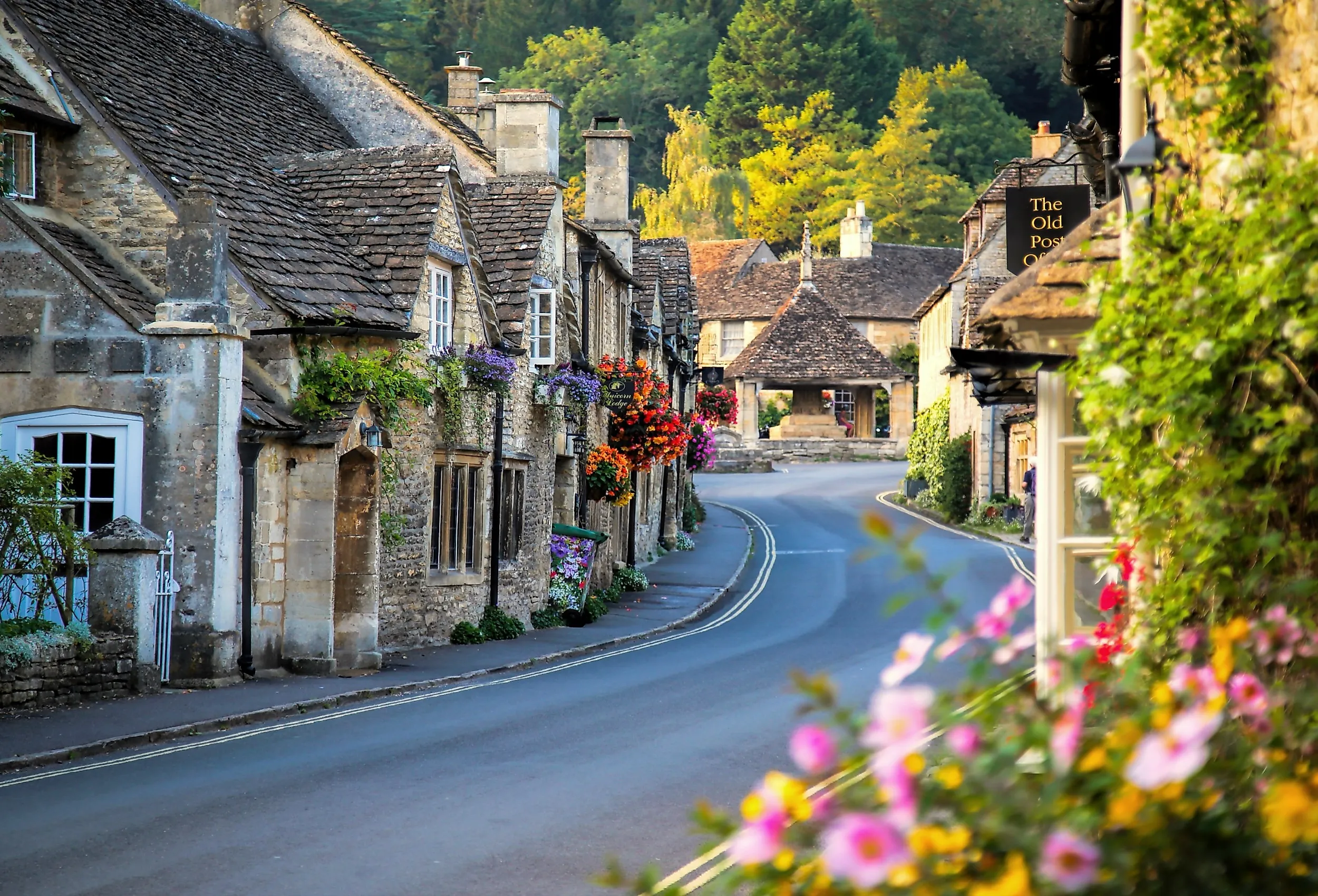
Castle Combe is part of the Cotswolds Area of Outstanding Natural Beauty, well known for gold-colored stone cottages, thatched roofs, and winding lanes. A medieval wool village, Castle Combe was a hub for broadcloth weaving in the 14th and 15th centuries. No modern houses have been built since around the 1600s, keeping the historic aspect and storybook aesthetic alive. Made up of a Lower and Upper village, the town core is in the lower valley by the By Brook River. Spanning the river, the By Brook Bridge is a popular photography site. Market Cross, a 14th-century stone structure, stands in the town center, a reminder of the spot where traders once sold goods. St. Andrew's Church is a medieval structure with a faceless clock, reportedly one of the oldest working clocks in Great Britain.
Keswick, England

Keswick, located in a glacier-carved valley within Lake District National Park, has been called the adventure capital of the Lake District, a UNESCO World Heritage Site that combines outdoor recreation with natural beauty. The town is surrounded by mountains and lakes, including Derwentwater, and sits beneath Skiddaw and Blencathra, which are popular with hikers. The town center has narrow, cobblestone streets with small shops, pubs, and gear outfitters. Keswick is associated with poets Samuel Taylor Coleridge and Robert Southey, who lived in the area, Coleridge for a few years and Southey for four decades, and were part of the English Romantic movement, becoming known, along with others, as the Lake Poets. The Derwent Pencil Museum preserves the town's lead and graphite mining history through exhibits on the pencil manufacturing industry.
Hay-on-Wye, Wales

At the border of England and Wales, on the River Wye, Hay-on-Wye combines literary culture and medieval history with Welsh countryside scenery. The walkable town center is filled with more than 20 second-hand and independent bookshops and holds an annual literary festival. The Hay Festival, held every spring, is devoted to art, literature, music, comedy, and more, bringing musicians, authors, and poets to town. The restored Hay Castle, originally built for protection during the Norman invasion, is marked by medieval and 17th-century architecture. Today, it is a center for art, education, and local events. Moving on to the outdoor side of life, Hay Bluff or the peaceful Wye Valley Walk are popular for hiking, in addition to canoeing on the River Wye.
Betws-y-Coed, Wales

Betws-y-Coed is a village in northern Wales situated within Eryri National Park, formerly known as Snowdonia, and surrounded by forests and waterfalls. To add to the storybook setting, the valley lies beneath the peak of Moel Siabod, near the tall oaks and conifers of the Gwydyr Forest. The nearby confluence of the River Conwy and the River Llugwy offers outdoor recreation in the form of kayaking and whitewater rafting. The town's main street has 19th-century stone architecture with slate roofs and colorful flower boxes, alongside traditional pubs and coffee shops. Pont-y-Pair is a five-arched 15th-century stone bridge spanning the River Llugwy in the town's center. Fairy Glen is a moss-covered river ravine, quiet and peaceful for walking and nature viewing.
Enniskillen, Northern Ireland

Enniskillen, in the southwestern region of Northern Ireland, retains its historic past and appealing atmosphere with 19th-century architecture and traditional pubs. The town center is on a natural island on the River Erne, between the Upper and Lower Lough Erne, making it a popular area for fishing, boating, and watersports. The historic Buttermarket craft courtyard has about 16 studios and shops, reflecting the town's artisan background. First built in the 15th century, Enniskillen Castle is home to two museums: Fermanagh County Museum and the Inniskillings Museum, which cover topics such as rural life, local crafts, and regional military history.
Portstewart, Northern Ireland

Northern Ireland's Portstewart combines a Victorian resort town atmosphere with the dramatic seascape of the Atlantic Ocean's Causeway Coast. The town's lively walkway, the Portstewart Promenade, is famous for traditional pubs and local ice cream shops, including Morelli's Ice Cream, which has been a favorite since 1911. The walkway overlooks the scenic beachfront at Portstewart Strand, a two-mile stretch that cars can drive on. Large sand dunes form a protected conservation site and have been named an Area of Special Scientific Interest, along with the Bann Estuary. Locally known as "the castle on the hill," the Gothic Dominican College, formerly O'Hara Castle and originally built in 1834, offers one-of-a-kind views of the Atlantic Ocean.
Captivating UK Towns
These towns in the UK offer more than scenic beauty; they also share access to outdoor recreation while taking cultural history into consideration. Each area highlights a diverse set of assets, balancing each to complement the individual personalities of the town. Enniskillen uses the Upper and Lower Lough Erne to its advantage as a watersports hub. In contrast, Portstewart slows the pace with Victorian ambiance and a resort town history. Both Northern Ireland towns share the welcoming atmosphere of a small town. In other regions, views of the Skiddaw and Blencathra Mountains can be seen while hiking and boating in the Lake District of Keswick, England, while scenic waterfalls flow from rocky cliffs in Eryri National Park, near Betws-y-Coed, Wales, providing a backdrop for hiking and nature viewing. These towns illustrate the range of recreation and natural landmarks found across the UK, from Northern Ireland and Scotland to England and Wales.