The Oldest Continuously Occupied Buildings In America
Across the United States, a small number of buildings have stayed in use long enough to witness colonial rule, rebellion, and the rise of a young country into a world power. Some have remained homes. Others have served as courthouses, taverns, churches, theaters, and seats of government. The standard applied across this list is that a building must still stand on its original site, in substantially its original fabric, and have been in use without abandonment since the day it was built.
By that standard, ruins, reconstructions, and buildings left empty for decades before restoration are ruled out, which is why several better-known candidates appear here only as runners-up. Every entry below holds a national record for a particular function, whether that is sheltering a family, hearing a court case, serving a drink, or seating a legislature. They are ordered by date of construction rather than ranked against one another. Several have been altered, extended, or partly rebuilt across three centuries, and where that is the case, it is stated plainly.
Taos Pueblo North & South

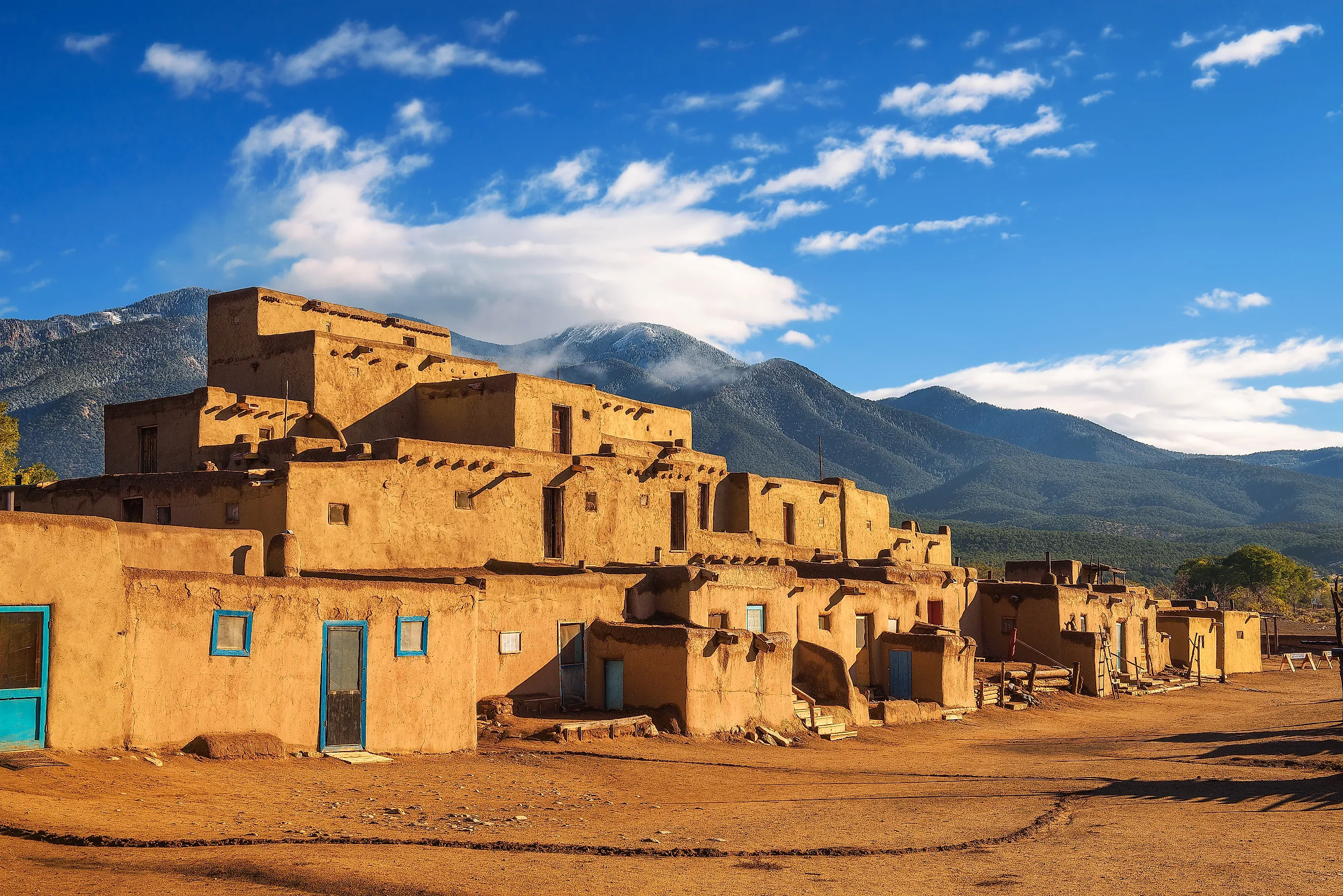
The oldest inhabited buildings in the country sit below the Taos Mountains, part of the Sangre de Cristo range in northern New Mexico, and have held families since roughly 1400 CE. Taos Pueblo North (Hlauuma) and Taos Pueblo South (Hlaukwima) belong to Taos Pueblo, the only living Native American community designated both a UNESCO World Heritage Site and a National Historic Landmark. The two multi-storied adobe complexes of stacked, apartment-like rooms stand on either side of Red Willow Creek, which carries drinking water down from Blue Lake, three miles northeast of the plaza in Taos.
The main structures were most likely raised between 1000 and 1450 CE, and when Francisco Vasquez de Coronado's expedition reached northern New Mexico in 1540, the pueblo already looked much as it does now. Its people resisted Spanish and then American authority across three centuries, and the land passed into the United States under the 1848 Treaty of Guadalupe Hidalgo. The federal government seized Blue Lake in 1906. In 1970, Congress returned it, with about 48,000 acres of ancestral land. Today, Taos Pueblo's government is one of 575 federally recognized tribes.
Palace of the Governors, Santa Fe

Begun in 1610 on the north side of the central plaza in Santa Fe, New Mexico, the Palace of the Governors is generally recognized as the oldest continuously occupied public building in the United States. It has been repeatedly repaired and rebuilt, however, so the adobe a visitor touches today is not all 17th-century fabric. It began as the administrative wing of the "Casas Reales" (Royal Houses). The province's first Spanish capital sat at San Gabriel del Yunque, near present-day Ohkay Owingeh, where the Rio Grande meets the Rio Chama. In 1609, the second royal governor, Pedro de Peralta, was instructed to move it about 25 miles south. That site became Santa Fe, capital of New Mexico and northern terminus of the Camino Real (Royal Road), the roughly 1,600-mile route to Mexico City. The building marries Spanish Colonial planning to Native American adobe construction.
It was invaded during the Pueblo Revolt of 1680, when Native Americans drove the Spanish from Santa Fe for 12 years. The Spanish reclaimed it and adopted a more tolerant relationship with the Pueblos. Mexico took the Palace in 1821 after winning independence from Spain, and the United States took it in 1848. Territorial governor Lew Wallace wrote much of his novel Ben-Hur, later the basis of an epic Hollywood film, here between 1878 and 1880. Restoration beginning in 1909 added the current portico and turned the building into a museum of New Mexico history.
White Horse Tavern, Newport

The White Horse Tavern in the colonial district of Newport, Rhode Island, bills itself as "America's Oldest Tavern" on a sign at the entrance, and by the standard used here, it is also the country's oldest bar and restaurant. Competing claims exist, and the definitions behind them vary, but the building has stood at the corner of Farewell and Marlborough Streets since 1652 and has served food and drink without interruption since 1673. It began as a two-story, two-room dwelling built for the English immigrant Francis Brinley, framed around a central chimney serving several fireplaces. William Mayes Sr. bought the house in 1673, enlarged it into a tavern and inn, and obtained a formal license in 1687. His son William Mayes Jr. succeeded him as innkeeper in 1702 and was granted the license to sell "all sorts of strong drink." For roughly a century, the building doubled as the meeting place of the colony's General Assembly, criminal court, and city council, a role it kept until the American Revolution.
The white horse on the sign followed an older British convention marking a public house of good repute, legible to travelers when many could not read. Jonathan Nichols gave the building its present name in 1730. British and Hessian troops occupied Newport from December 1776 until 1779 and used the tavern as quarters. The younger Mayes had been a working pirate in the Red Sea, shielded by Newport when he came home with his takings. By 1954, the building was near demolition. Van Beuren family funding let the Preservation Society of Newport County restore it, and it reopened as a restaurant in 1957.
Bacon's Castle, Surry County

Bacon's Castle, in Surry County, Virginia, is the oldest documented brick dwelling in North America. It was completed in 1665 for Arthur Allen, a wealthy merchant and justice of the peace who had bought the land near the James River four years earlier. The house is the only surviving example of High Jacobean architecture in British North America. Its cruciform plan, curved Dutch gables, slate roof, and clustered diamond chimneys belong to an idiom already out of fashion in England under Charles II. Allen died in 1669, and his son Arthur Allen II lived there until 1710.
The name dates to 1676, when roughly 70 followers of Nathaniel Bacon seized the house and held it as a fortified garrison. Their rebellion targeted Governor William Berkeley's colonial administration, which had refused to authorize frontier campaigns against Native peoples. Bacon himself never set foot inside. They looted the house and stayed until December 27, when marines aboard the ship Young Prince forced them out. It stayed a private dwelling for nearly three centuries. Its formal garden, uncovered by archaeology, may be the earliest documented in North America. Preservation Virginia bought the property in 1972 and runs it as a museum.
Old Ship Meeting House, Hingham

Raised in 1681 at Hingham, Massachusetts, the Old Ship Meeting House is the oldest wooden church building in continuous ecclesiastical use in the United States, and the only surviving 17th-century Puritan meetinghouse in the country. Its congregation gathered in 1635 and now worships as a Unitarian Universalist parish, and for the building's first century, it doubled as the town meeting hall of the First Parish of Hingham. Side galleries were added in 1730 and 1755, along with a carved wooden pulpit and box pews.
Two Lincoln families settled early here, and the meetinghouse is tied to both. Samuel Lincoln, the immigrant ancestor of Abraham Lincoln, worshipped here regularly. Major General Benjamin Lincoln, George Washington's second in command at Yorktown, descended from a separate Hingham line and was not an ancestor of the president. Neither man saw the building's best-known feature. Its hammerbeam roof, framed with tie beams of red oak said to be six centuries old at felling, sat hidden above a plaster ceiling until the 1870s. The exposed timbers resembled the ribs of an inverted hull, and the "Old Ship" name stuck.
King William County Courthouse, King William

No courthouse in the United States has been in judicial use longer than the one at King William, Virginia, which has heard cases since 1725. It stands about 35 miles northeast of Richmond, between the Mattaponi and Pamunkey Rivers, and its Circuit Court still sits there, though the county opened a separate modern courthouse in 2005 for most other business. That unbroken run separates it from the older Queen Anne's County Courthouse at Queenstown, Maryland, built in 1708, which stopped hearing cases by 1782. The T-shaped brick building is fronted by an arcade of five arches modeled on the first colonial capitol at Williamsburg.
A low brick wall enclosing the court green was put up in 1840 to keep wandering livestock off the grounds. The Virginia Department of Historic Resources considers the courthouse the best preserved of the state's eleven colonial court buildings. George Washington noted in his diary in 1768 and again in 1769 that he dined and lodged "at King Wm Court Ho." He most likely stayed at the Quarles Public House in the adjoining complex rather than in the courtroom itself, though the courthouse was the landmark he named.
Maryland State House, Annapolis

Designed by Joseph Horatio Anderson and built between 1772 and 1779, through the Revolutionary War, the Maryland State House in Annapolis is the oldest state capitol in continuous legislative use, and the only one to have also housed the national government. Every session of the Maryland legislature since 1779 has met somewhere in the building. The Continental Congress sat here between November 26, 1783, and August 13, 1784, ratifying the Treaty of Paris that January. Ninety-five pounds of candles were ordered for the ball the night before George Washington resigned his commission as commander-in-chief of the Continental Army, on December 23, 1783.
Women were barred from the Senate floor for the resignation, but the gallery and adjoining chambers were reported "full of ladies." The original cupola leaked badly, and in 1785 the state contracted the Annapolis architect Joseph Clark to replace it. His dome is the largest wooden dome in the country, built without nails, framed from cypress hauled out of Eastern Shore swamps and held together with wooden pegs and wrought-iron straps. The exterior was finished by 1788, the interior not until 1797. A copper-sheathed acorn at the summit anchors a lightning rod built to Benjamin Franklin's specifications.
Walnut Street Theatre, Philadelphia

The oldest theatre still in operation in the country opened on February 2, 1809, under a different name and with a slightly different purpose: the New Circus. The equestrians Victor Pepin and Jean Baptiste Breschard put it up in Philadelphia, Pennsylvania, as a riding house, with a sawdust ring where the stage would later go. Public appetite for horse spectacle faded quickly, and the architect William Strickland inserted a stage and orchestra pit in 1811 and 1812, reopening the venue as the Olympic. Its first dramatic production was Richard Brinsley Sheridan's The Rivals in 1812.
The theatre's own history places Thomas Jefferson and the Marquis de Lafayette in the audience that night, a story repeated almost everywhere, though Lafayette is not recorded in the United States between 1784 and his celebrated return in 1824. John Haviland reworked the interior and the Neoclassical front in 1828, a steel-framed auditorium followed in 1920, and the interior was modernized again in 1971. Each layer sits on top of the last rather than erasing it.
The Walnut introduced a run of firsts, among them gas footlights replacing candles in 1837 and a theatre air conditioning system in 1855. Edwin Booth, brother of John Wilkes Booth, the Marx Brothers, Marlon Brando, Audrey Hepburn, and Sidney Poitier all worked here. In September 1976, it hosted the first televised presidential debate since Kennedy and Nixon met in 1960. Midway through the exchange between Gerald Ford and Jimmy Carter, the audio feed failed, and both men stood in silence at their lecterns for 27 minutes while the network carried it live.
History At Work
Continuous occupation is a demanding criterion because it depends on a building staying useful for three or four centuries at a stretch. The ones that failed that test are the vacant lots and museum reconstructions that did not qualify here. The eight that passed are the product of commitment and hard work, such as a tavern that had to keep selling dinners, a courthouse that had to keep a docket, and a parish that had to keep a congregation coming to keep the doors from closing.