9 Best Natural Wonders To Visit In New South Wales This Year
New South Wales boasts an exceptional range of natural wonders, with sandstone headlands on the coast, alpine peaks in the south, and rain-sculpted sand formations in the Outback. Hike to the summit of Mount Kosciuszko, the highest mountain on mainland Australia. Explore the eroded ridges of the Walls of China, carved by rain over thousands of years. Dive beside Balls Pyramid, the tallest basalt sea stack on Earth. Then switch off your torch to watch thousands of glow worms light up a disused railway tunnel. These nine natural wonders are the best to visit in New South Wales this year.
Sydney Harbour

Officially named Port Jackson, the harbour at the centre of Sydney is one of the largest natural harbours in the world and a classic example of a drowned river valley. Ancient rivers cut deep valleys into the region's sandstone, and when sea levels rose between 18,000 and 6,000 years ago, the ocean flooded them, forming the harbour, which stretches for 19 kilometres (12 miles) and covers 55 square kilometres (21 square miles). Its eastern shores are made of Hawkesbury sandstone, formed about 220 million years ago, which breaks away in large blocks, leaving the cliffs and boulders that line the shore.
North Head and South Head, which guard the harbour entrance, were once islands and are now joined to the mainland by sand spits. Sydney Harbour National Park protects these headlands along with several islands and bushwalking tracks, and ferries and sightseeing cruises offer close views of the shoreline. Spring and autumn generally have comfortable temperatures, clearer views, and fewer crowds than summer and winter.
Mount Kosciuszko

Mount Kosciuszko is the highest mountain on mainland Australia, standing at 2,228 metres (7,310 feet), making it the shortest of the Seven Summits. It is located in the Snowy Mountains of the Australian Alps, inside Kosciuszko National Park. The mountain does not require technical mountaineering skills and is accessible from two different routes: one beginning in Thredbo, the other from Charlotte Pass. The best time for both trails is between December and March when the snow has melted and the alpine wildflowers have started to bloom. Although the mountain is covered in snow between June and October, it is still accessible via cross-country ski or snowshoe.
Figure Eight Pools

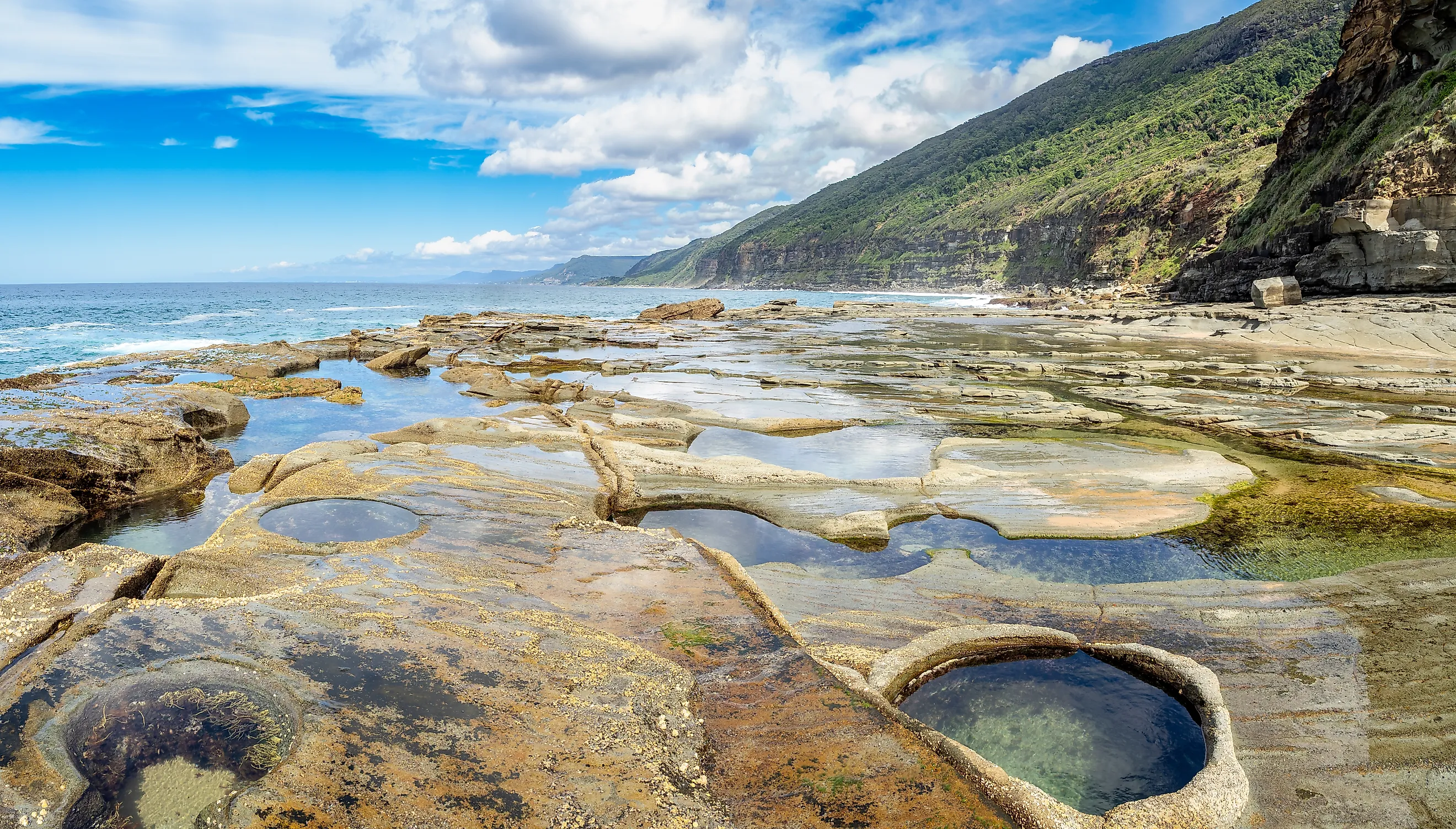
Figure Eight Pools are a group of naturally formed rock pools in the shape of the number eight. They are located on a rock shelf in Royal National Park, established in 1879 and the second-oldest national park in the world. The figure-eight shape formed where two circular sinkholes in the rock platform merged. The pools are in a remote area of the park, accessible via a steep, uneven trail that crosses rocks that are often wet and slippery. The usual route is a walk of about 6 kilometres (3.7 miles) return from the Garrawarra Farm car park, passing Burning Palms Beach before following the coast south to the pools. People have been dragged across the rock shelf by waves, resulting in head injuries, broken bones, cuts, and bruises. Due to this, the pools are best visited at low tide, ideally one that falls before midday. At high tide, the pools sit underwater and cannot be reached, so check both the tide and the swell forecast before setting out. This also avoids having to navigate the uphill trail in the dark.
Wollomombi Falls

Wollomombi Falls is the highest waterfall in New South Wales and the second-highest waterfall in Australia. It is located in Oxley Wild Rivers National Park, where it plunges 220 metres (722 feet) from a gently rolling plateau into Wollomombi Gorge, where the Wollomombi River flows below. The falls sit about 40 kilometres (25 miles) east of Armidale, just off the Waterfall Way, near the point where the Wollomombi River meets the Chandler River.
The Wollomombi walking track follows the gorge rim and crosses the river on a steel bridge before ending at a lookout over neighbouring Chandler Falls. Wollomombi Falls is likely flowing at its heaviest in the summer, after the rains. Wollomombi Lookout is on the western side of the falls. On clear days, the setting sun casts over the cliffs and cascading water, temporarily tinting the rock faces pink.
Walls of China

The Walls of China rise up along the southeastern edge of Lake Mungo. The walls were formed when rain washed the soft sand and mud of the Lake Mungo lunette, creating the ridges and cracks on the wall. The walls extend for 33 kilometres (21 miles) and were carved by thousands of years of erosion. The oldest of their sediment layers formed between 100,000 and 120,000 years ago. The Walls of China Viewing Platform is the first stop on the self-guided driving tour of Mungo National Park. However, as the walls are located in the Australian Outback, summer temperatures can exceed 40 degrees Celsius (104 degrees Fahrenheit). Consequently, visiting the walls in autumn and spring is cooler.
Capertee Valley

The Capertee Valley is the widest canyon in the world, surpassing the Grand Canyon by 1 kilometre (0.6 miles). Roughly 30 kilometres (19 miles) wide, it follows the course of the Capertee River west of the Blue Mountains. The valley is framed by sandstone cliffs that rise above the escarpment and drop into the gorge below. Although accessible year-round, spring and autumn bring milder temperatures to the valley, while spring and summer are prime birdwatching season for its more than 240 species of birds.
BirdLife International lists the valley as an Important Bird Area, largely because it is a primary breeding ground for the endangered regent honeyeater. The mild temperatures make hiking and cycling in the valley more comfortable, and visiting prominent rock formations like Pantoneys Crown, a large mesa on the valley floor.
Kiama Blowhole

With an 2.5-metre (8-foot) opening on the rock face, Kiama Blowhole is the largest natural blowhole in the world. It sits beside the Kiama Lighthouse on Blowhole Point, and explorer George Bass was the first to write about it in 1797. It was formed by volcanic lava flows approximately 260 million years ago. During high tide and strong southeastern ocean swells, water sprays are at their most powerful, with recorded heights exceeding 30 metres (98 feet). This is most likely to occur between May and September, when ocean swells are most active. The best time of day to view the blowhole is in the early morning or later afternoon when there are fewer crowds. The smaller Little Blowhole, about 2 kilometres (1.2 miles) south of the main blowhole, erupts more consistently and performs best in a northeasterly swell.
Balls Pyramid

Rising 551 metres (1,808 feet) out of the Pacific Ocean, Balls Pyramid is the tallest sea stack of basalt rock on Earth. It is the remnant of an ancient shield volcano that formed over a magma hotspot. The sea stack is 23 kilometres (14 miles) southeast of Lord Howe Island. While the sea stack itself is impressive, it also offers some of the best diving in Australia. The waters around Balls Pyramid are home to rare marine life, like the Ballina angelfish, while the rock itself is where the Lord Howe Island stick insect, nicknamed the land lobster, was rediscovered in 2001 after decades presumed extinct. Although the most popular time to visit is generally between September and May, the climate is mild year-round.
Glow Worm Tunnel

Although the Glow Worm Tunnel is a disused railway tunnel in Wollemi National Park, it is now home to a natural phenomenon. It is home to thousands of glow worms, which are the larvae of fungus gnats. Since the tunnel is 387 metres (1,270 feet) long, it gets dark enough during the day. Using a red-light torch is the least disruptive to the glow worms. By turning off your torch and remaining quiet, the glow worms will start to glow blue as a result of a chemical reaction in their body. This also helps lure prey, such as mosquitoes, closer to them. Although glow worms are visible year-round, they are most active during the warmer months, particularly between December and March.
A Wilder Side of New South Wales
If you're looking to see the wild side of New South Wales, plan this year's travels around the state's natural wonders. Sydney Harbour's sandstone headlands and the Kiama Blowhole show off the coast, the Walls of China and the Capertee Valley reveal the rugged interior. For anyone hoping to hike the highest mountain on mainland Australia, watch glow worms light up a dark tunnel, or dive beside the tallest basalt sea stack on Earth, these are the best natural wonders to visit in New South Wales this year.