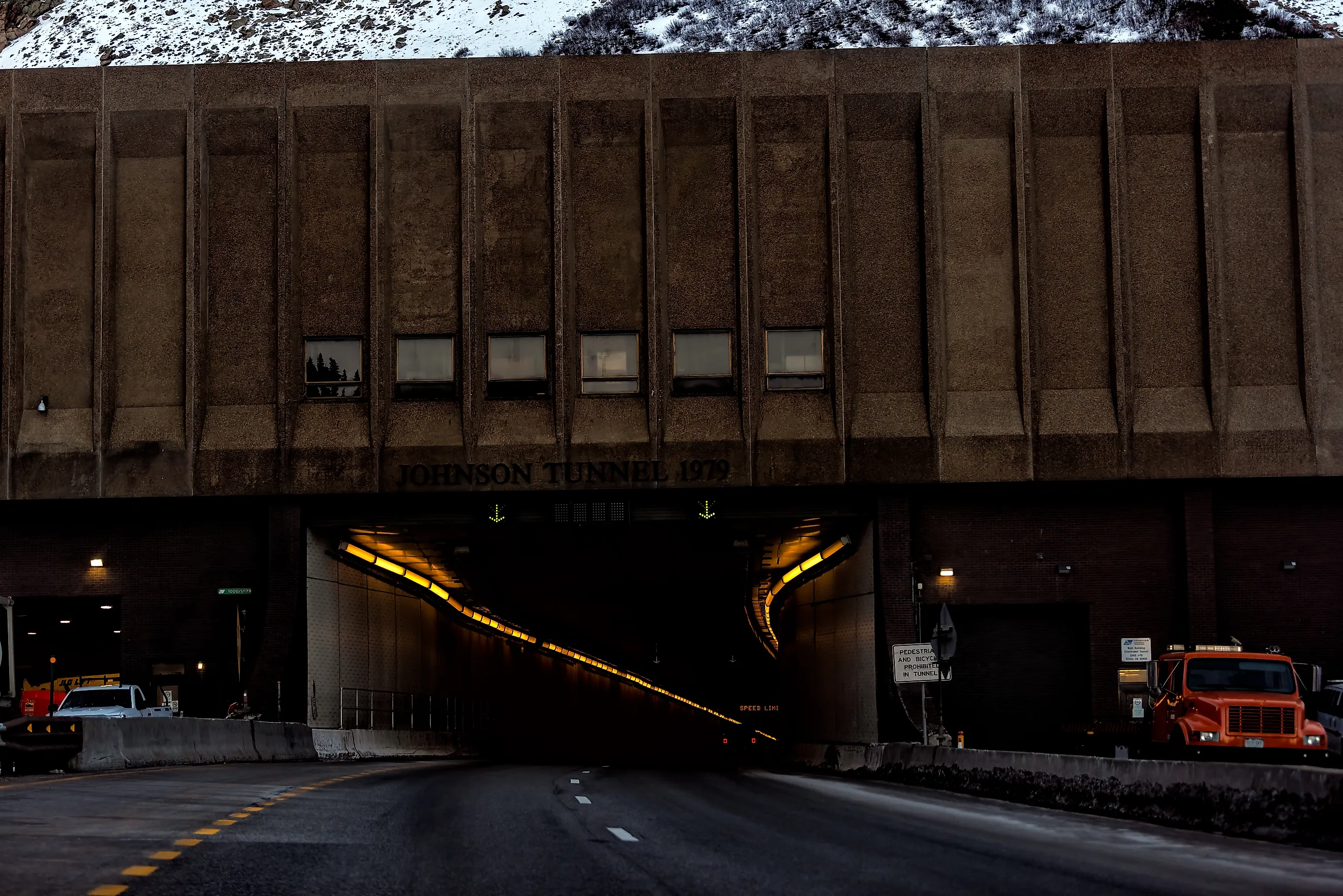
The Highest Tunnel In The United States
The highest tunnel in the United States is the Eisenhower-Johnson Memorial Tunnel, which carries Interstate 70 beneath the Continental Divide about 60 miles west of Denver, Colorado. The Colorado Department of Transportation gives its average elevation as 11,112 feet. The bores are graded, running from 11,013 feet at the east portal to 11,158 feet at the west, and that higher figure is the one most often quoted.
It is also the highest point anywhere on the Interstate Highway System.
This article measures height as elevation above sea level, not the physical height of the bore, and counts only tunnels still carrying traffic as the highest tunnel ever driven in the country is not the answer here. Water and mining tunnels are excluded with the comparison only including tunnels people travel through.
Thirty Years of Argument Before Anyone Dug

The Colorado Department of Highways first proposed a passage beneath the Continental Divide in 1941. A pioneer bore went in under Loveland Pass in May 1943 and the department advertised for bids. However, the project was stalled for more than twenty years while routes were heavily debated.
Finally, a Straight Creek alignment was put forward in May 1960 with bids opening in October 1967, going to Straight Creek Constructors.
Work started on the westbound bore in March 1968, under the name Straight Creek Tunnel. In 1969, Governor John Love proposed renaming it for Dwight D. Eisenhower, who had died that April and was made official in 1972 by the state legislature.
The rock, however, did not cooperate. Crews hit fault lines that slipped as they worked, and three men died building the first bore. The Eisenhower bore opened on March 8, 1973, at a cost of $108 million, 92 percent of its federal money.
The Second Bore

The eastbound bore did not begin until August 18, 1975, more than two years after its twin opened. The Division of Highways took bids that year for ventilation fans, generators, an elevator, and the tunnel work itself, and the main contract went to a Kiewit/Brown & Root joint venture.
In January 1978, Colorado passed a resolution naming it for Edwin C. Johnson, a former governor and U.S. senator who had pushed hard for an interstate route across the state.
Four more workers died on the second bore, bringing the project's toll to seven. It opened on December 21, 1979, having been estimated at $110 million and finished at more than $145 million.
Accounts of the combined total run from roughly $253 million to more than $257 million. The work removed close to a million cubic yards of material and took 190,000 cubic yards of concrete for each lining. Over roughly five years, the Colorado Department of Transportation (CDOT) counts 6,000 people and 4.9 million working hours.
The Typo That Opened the Tunnel to Women
In November 1970, Janet Bonnema applied for an engineering technician post on the Straight Creek project. She passed the tests and received a job offer addressed to "Mr. Jamet P. Bonnema" — a misspelling that concealed the fact that she was a woman. When that became clear, a state employment officer advised her not to take it, warning that the crews would walk out and never come back that stemmed from a ninteenth-century Welsh superstition that said a woman underground brought bad luck.
She took the job anyway and spent 18 months recording measurements, collecting rock samples, and producing technical drawings without ever being allowed inside the bore. In July 1972, the U.S. Department of Transportation concluded a year-long investigation by ruling that barring her was gender discrimination.
When the department would not comply, she sued with the state settling out of court that November, days after Colorado voters approved a state equal rights amendment.
Bonnema walked into the tunnel on November 9, 1972. Sixty-six workers walked off the job in protest and all but one came back the next day. She kept working in the bores afterward, often in loose coveralls to conceal her identity.
The Tunnel Today

Each bore is 40 feet wide and 48 feet high, with 13 feet 11 inches of clearance for traffic. The Eisenhower bore runs 1.693 miles and the Johnson bore at 1.697. It is the longest mountain tunnel on the interstate system, as well as, the highest point on it.
The tunnel is open around the clock and spares drivers the alternative of U.S. 6 over Loveland Pass, a switchbacked climb to 11,990 feet that closes in bad weather.
In 2025 the eastbound bore carried 6.26 million vehicles and the westbound 6.313 million, about 12.57 million in total, or roughly 35,000 a day with peaks run past 50,000. More than 30 full-time staff work the site, handling surveillance, ventilation, snow removal, water treatment, and firefighting.
There have been no fatalities in either bore since opening. Annual snowfall at the portals averages 315 inches between November and April.
Contenders

Colorado supplies the biggest tunnel and its greatest competitors. The Alpine Tunnel is the higher of the two, and the higher of any tunnel ever bored in the country, at 11,523 feet.
It opened in 1882 northeast of Gunnison, near Pitkin, carrying the Denver, South Park and Pacific Railroad across the Continental Divide. It was also the first tunnel through the divide in Colorado and the highest railroad tunnel in North America when it was built. It fails the test here on use: the line was abandoned in 1910 after a run of accidents and problems, and the bore is now sealed.
The site sits within the Grand Mesa, Uncompahgre and Gunnison National Forests and is listed on the National Register as the Alpine Tunnel Historic District. The old trackbed is now used as a trail.
The Moffat Tunnel is still working but sits far lower, topping out at 9,239 feet. Built between 1923 and 1927 and opened to rail traffic in February 1928, its 6.2 miles made it the longest railroad tunnel in the Western Hemisphere at the time.
Eight hundred men worked around the clock for three and a half years, moving three billion pounds of rock. It shortened the run from Denver to Salt Lake City by 173 miles, and its pioneer bore was converted into a permanent aqueduct that still carries water to Denver.
Union Pacific freight and Amtrak's California Zephyr still use it to date.
Eisenhower's Other Highway
The name fits better than it first appears. Eisenhower signed the Federal-Aid Highway Act of 1956, the law that built the Interstate System, and the tunnel that carries his name is the highest point on the network he created — a road running two miles above sea level through granite that killed seven men to cut.
It took 32 years to get from proposal to first blast and another eleven to finish both bores. When it opened it was the highest vehicular tunnel in the world. While that has been passed by tunnels in Peru and China, within the United States, nothing in use has come close since.