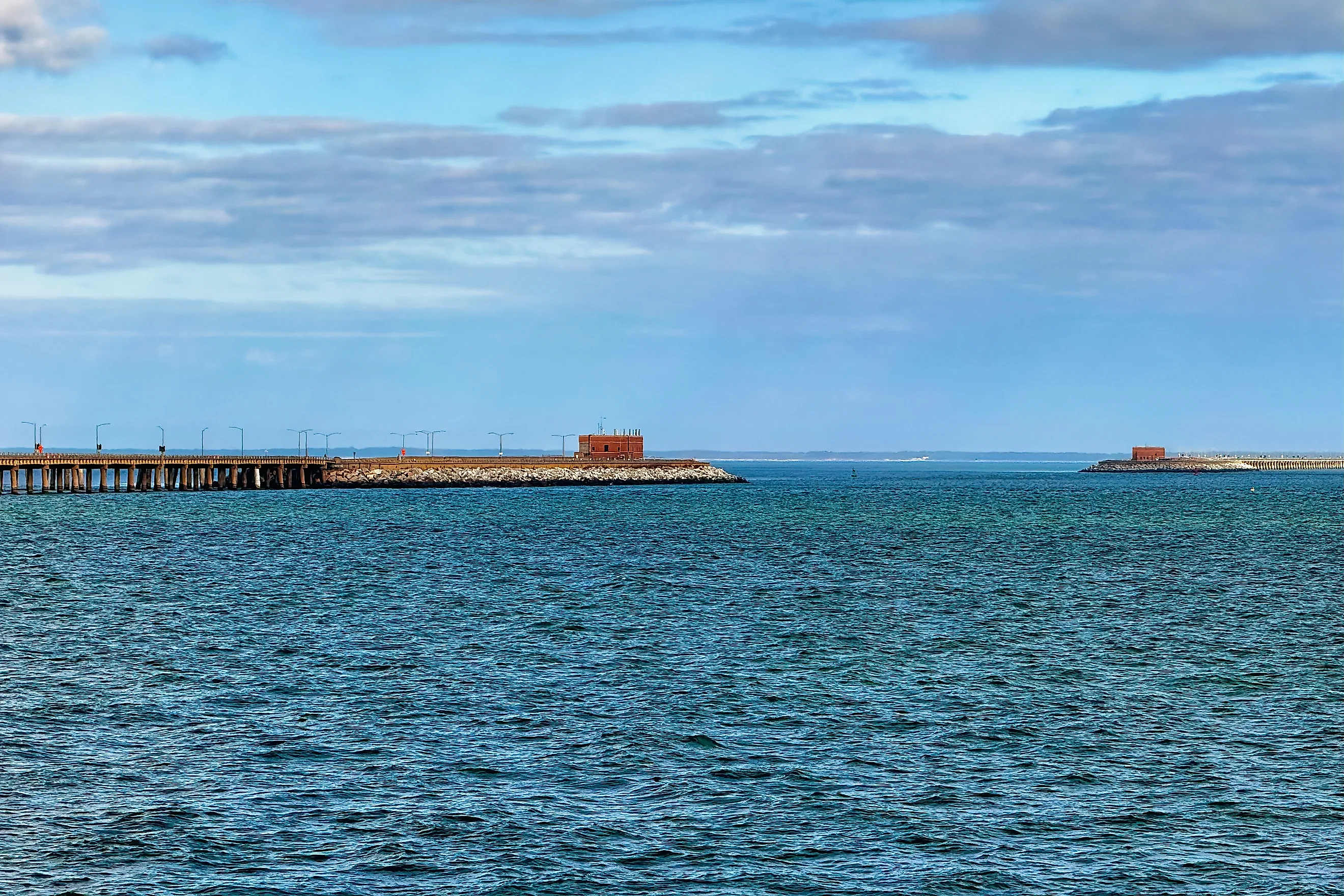
The Longest Bridge Tunnel In The United States
The Chesapeake Bay Bridge-Tunnel is the longest bridge-tunnel complex in the US, spanning 17.6 miles (28.3 kilometers) over the mouth of the Chesapeake Bay to link Virginia Beach with the Eastern Shore near Cape Charles. Just under 12 miles of that is low trestle, and the two tunnels run 5,738 and 5,424 feet. Trestle C alone, at 4.57 miles, is the longest single bridge structure in Virginia.
That title depends on the criteria, because the complex is a hybrid measured from land portal to land portal rather than as one continuous bridge or tunnel. Federal records split it accordingly, cataloguing the trestles in the National Bridge Inventory and the two 1964 tunnels in the National Tunnel Inventory instead. The tunnels solved a problem no bridge could, since the bay had to stay open to Navy ships while a highway crossed it.
Building the Longest Bridge-Tunnel in the US

Aerial view of the Chesapeake Bay Bridge-Tunnel
In the 1930s, a ferry service transported people between the Eastern Shore in Virginia and the Virginia Beach area. It was only in 1954 that the Chesapeake Bay Ferry District and the Chesapeake Bay Ferry Commission were established, taking over ferry operations. Operations continued for two years before the General Assembly authorized the Ferry Commission to research and plan a permanent crossing to replace the ferry service.
To facilitate the project that would become the Chesapeake Bay Bridge-Tunnel, the Commission sold $200 million in revenue bonds. The bonds were purchased by private investors, which meant no state money was used for construction. It took 42 months to build the bridge-tunnel complex, and it opened to traffic in 1964. The complex was named the Lucius J. Kellam, Jr Bridge-Tunnel in 1987, commemorating the man who led the construction project and formed the Commission. The crossing celebrated its 60th birthday in 2024 and is considered one of the Seven Engineering Wonders of the Modern World.
Doubling the Crossing

In 1999, Phase I of the parallel crossing was completed, creating four lanes where two had been. The tunnels, however, were left as they were, so each still carries one lane in each direction. In 2013, the Commission issued an instruction to build a parallel tunnel in the Thimble Shoal Channel.
Chesapeake Tunnel Joint Venture was awarded Phase II of the parallel crossing project in 2016, and construction began the following year. The shoal tunnel project involves building a two-lane bored tunnel from #1 Island (the bridge-tunnel's southernmost island) under Thimble Shoal Channel to #2 Island. When it opens, the new tunnel will carry two lanes southbound while the existing tunnel takes two lanes northbound. The project is expected to be completed in 2028.
Experiencing the Chesapeake Bay Bridge-Tunnel Today

In 2026, it takes around 25 minutes to cross the Chesapeake Bay Bridge-Tunnel. There are water views all the way, no traffic lights, stop signs, or intersections. Drivers should keep in mind that the bridge charges a toll based on vehicle class, and that an E-ZPass is available for convenience. Peak Season Pricing is in effect May through September, while Off-Peak Season applies the rest of the year.
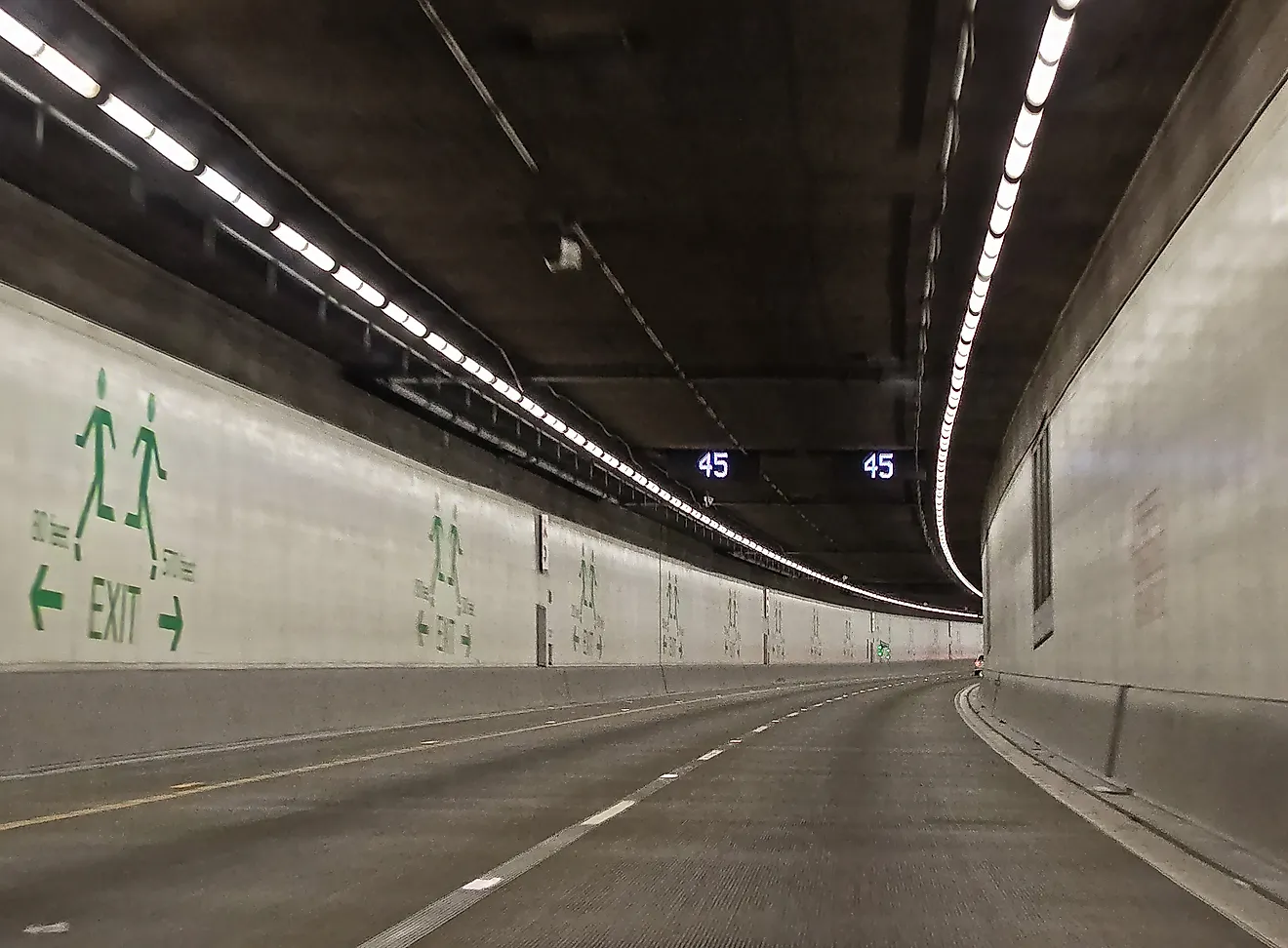
For some drivers, the scariest part of driving the bridge-tunnel is going through the tunnels and facing oncoming traffic. The parallel crossing project will help alleviate this fear by providing a two-lane tunnel that parallels the existing one on the south side of the route. For now, the bridge-tunnel includes two one-mile-long tunnels, 12 miles of low-level trestle bridge, two miles of causeways, two bridges, and 5.5 miles of approach roads.
Other Contenders for "Longest Bridge"

The Chesapeake Bay Bridge-Tunnel remains the longest hybrid facility of its type. But other major structures can also be cited under different criteria, and two other true bridge-tunnels deserve mention.
Lake Pontchartrain Causeway
If the definition changes to continuous bridge structures over water without underwater tunnels, the Lake Pontchartrain Causeway in Louisiana claims the longest title. It measures 23.83 miles (38.35 kilometers) in continuous length, and this twin-parallel structure holds the record for the longest continuous bridge over water in the US. But it relies on surface trestles and drawbridges, lacking underwater tunnels or artificial islands.
BART Transbay Tube
The 3.6-mile (5.8 kilometer) sub-sea BART Transbay Tube is much longer than the individual 1-mile tunnel tubes of the Chesapeake Bay Bridge-Tunnel. However, it is an underwater transit tunnel and does not have bridge trestles or artificial islands. This underwater rail tunnel connects San Francisco and Oakland.
Monitor-Merrimac Memorial Bridge-Tunnel
The Monitor-Merrimac Memorial Bridge-Tunnel spans 4.6 miles (7.4 kilometers) across the James River harbor between Newport News and Suffolk, Virginia. The bridge-tunnel carries Interstate 664 and opened in 1992. It features twin-tube underwater tunnels connecting to two artificial islands and low-level trestles. While it is not nearly as long as the CBBT, it holds a place of honor, having been named in commemoration of the historic 1862 Battle of Hampton Roads. The name itself comes from the USS Monitor and the CSS Virginia (the Virginia was rebuilt from the USS Merrimack).
Hampton Roads Bridge-Tunnel
The Hampton Roads Bridge-Tunnel holds the record as the first complex to connect an underwater tunnel to artificial islands. This bridge-tunnel carries Interstate 64 between Hampton and Norfolk, Virginia, for a length of 3.5 miles (5.6 kilometers) and opened its first two-lane span in 1957. A second parallel span was added in 1976. The site is currently undergoing an expansion project to add twin-bore bored tunnels. This project will increase the capacity from four lanes to eight.
Operating a Man-Made Wonder in a Challenging Environment

Operating a 17.6-mile highway complex across the mouth of the Chesapeake Bay does not come without structural and operational demands. The CBBT complex is exposed to winds, storm surges, maritime traffic, and corrosion. As such, maintenance crews perform ongoing structural inspections and wash down the concrete pilings to prevent salt damage.
They also maintain pumping systems inside the underwater tubes to prevent flooding during major storms. Traffic safety protocols require strict speed limits and vehicle spacing inside the tunnel tubes. Wind restrictions are enforced whenever gale-force winds hit the bay. At such times, empty tractor-trailers and high-profile vehicles are not allowed to cross.
Why the Crossing Still Has No Equal

Sixty years on, nothing in the US has replaced the basic idea behind the crossing. The engineering problem was never distance alone, but how to carry a highway across the mouth of a working harbor without closing it to Navy ships and cargo traffic. Dropping the roadway into tubes beneath the main channels solved that, and the artificial islands made the transition possible in open water. The federal inventories still show the results as separate pieces, a set of trestles in one database and two tunnels in another, and no other American crossing assembles the same combination at the same scale. Every longer structure in the country is either all bridge or all tunnel.