The Longest Tunnels in the United States
The United States holds more long tunnels than any other country except China, and the longest tunnels in the US are not the ones drivers and rail passengers travel through. They are water supply tunnels, blasted hundreds of feet beneath bedrock and pressurized to push hundreds of millions of gallons of drinking water under cities every day. The Delaware Aqueduct, which supplies roughly half of New York City's water, is the longest continuous tunnel in the world at 85 miles. New York is now finishing a second major tunnel, the City Water Tunnel No. 3, which has been under construction since 1970 and will exceed 60 miles when fully connected. Massachusetts holds the next cluster of long tunnels: four aqueducts running between 16 and 25 miles serving Greater Boston through the Massachusetts Water Resources Authority system. Railroad tunnels make up the next category, with the 7.79-mile Cascade Tunnel in Washington State leading the rail list. Mining and wastewater tunnels round out the top tier, with the Henderson mining conveyor tunnel in Colorado and the Deer Island sewage outfall tunnel in Boston Harbor both running close to 10 miles. The twelve tunnels below cover the longest in each major category and are ranked strictly by length.
Delaware Aqueduct (85 miles)

The Delaware Aqueduct is the longest continuous tunnel in the world, running 85 miles (137 kilometers) underground between the Rondout Reservoir in the Catskill Mountains and the Hillview Reservoir in Yonkers. Construction ran from 1937 to 1944, with extensions later pushing the system's total reach to 105 miles by 1965. The tunnel is 13.5 feet (4.1 meters) in diameter for most of its length and widens to 19.5 feet in the final 13 miles to handle higher flow rates. It descends to depths of more than 2,000 feet below the surface in places. The aqueduct can carry up to 1.3 billion gallons per day and typically delivers around 600 million gallons, which accounts for roughly half of New York City's daily water supply. A $1 billion Rondout-West Branch Bypass Tunnel, connected to the aqueduct in 2023, runs 2.5 miles below the Hudson River between Newburgh and Wappinger to address leaks of up to 35 million gallons per day. The Delaware Aqueduct still moves water by gravity alone, without pumps, end-to-end.
New York City Water Tunnel No. 3 (60+ miles when complete)

New York City Water Tunnel No. 3 is the largest capital construction project in New York City's history. Authorized in 1954 and started in 1970, the tunnel will run more than 60 miles when fully complete, with sections reaching 500 feet below street level. The project provides redundancy for the city's existing Water Tunnels No. 1 (completed 1917) and No. 2 (completed 1936), which had never been shut down for inspection because there was no backup. Stage One opened in 1998 and carries water from the Hillview Reservoir into the Bronx and Manhattan. The Manhattan portion (8.5 miles, 12-foot diameter) opened in 2013. The Brooklyn-Queens section (16- to 20-foot diameter) is partially in service. The remaining shaft work for Queens is scheduled for completion in 2032. Total project cost is expected to exceed $6 billion. Once finished, the tunnel will finally allow inspection of Tunnels No. 1 and No. 2 for the first time in more than a century.
Quabbin Aqueduct (24.6 miles)

The Quabbin Aqueduct runs 24.6 miles between the Quabbin Reservoir in central Massachusetts and the Wachusett Reservoir, the next link in the chain that supplies water to Boston. Construction began in 1926 and the aqueduct was placed in service in 1933, six years before the Quabbin Reservoir behind the new Winsor Dam began filling in 1939. The tunnel is 11 feet wide and 12.75 feet tall and carries up to 400 cubic feet per second, driven by gravity head rather than pumps. Thirteen shaft buildings rise above ground along its route. It was the first pressurized, full-flowing tunnel in the metropolitan Boston water supply system, replacing the open gravity conduits used earlier. The Quabbin Reservoir behind it holds 412 billion gallons and is the largest inland water body in Massachusetts, formed by flooding the Swift River Valley and the four towns of Dana, Enfield, Greenwich, and Prescott.
Hultman Aqueduct (17.8 miles)
The Hultman Aqueduct runs about 17.8 miles across eastern Massachusetts, carrying water east between an intake at Southborough and the Norumbega Reservoir in Weston to supply the Greater Boston area. It was built between 1938 and 1940 by the Metropolitan District Commission (predecessor to today's Massachusetts Water Resources Authority) and later named for Eugene C. Hultman, the commission's longtime chairman. The Hultman is a pressurized pipe rather than the bedrock-tunnel construction of the Quabbin, moving water under pressure rather than by gravity, with associated gatehouses, valve chambers, and surface dams. It serves as the redundant parallel to the newer MetroWest Water Supply Tunnel, so either line can be taken out of service for inspection without interrupting the system. A renovation between 2003 and 2017 replaced or relined most of the original 1940 segments.
MetroWest Water Supply Tunnel (17.6 miles)
The MetroWest Water Supply Tunnel is a 17.6-mile deep-rock aqueduct that opened in 2003 to redirect Boston's water supply away from the open surface reservoirs of the previous era. It runs east between the John J. Carroll Water Treatment Plant in Marlborough and Shaft W in Weston, where it ties into the existing distribution system. The tunnel is 14 feet in diameter and runs through bedrock at depths of 200 to 500 feet below the surface. Construction cost approximately $750 million and took roughly seven years. The MetroWest replaced the surface-flowing Weston, Sudbury, and Cochituate aqueducts as the principal eastern conveyance, eliminating the contamination risk associated with open water travel through populated areas. The Massachusetts Water Resources Authority delivers about 200 million gallons per day through the tunnel to roughly 2.5 million people in 53 communities.
Sudbury Aqueduct (16 miles)

The Sudbury Aqueduct is the oldest tunnel still in standby service for the Boston water supply, completed in 1878 after five years of construction. It runs 16 miles between Farm Pond in Framingham and the Chestnut Hill Reservoir in Brookline, with branches that once supplied much of metropolitan Boston. The aqueduct is a brick-lined, horseshoe-shaped conduit and includes the Echo Bridge over the Charles River at Hemlock Gorge in Newton; the bridge's 130-foot main span was the second-largest masonry arch in the country when it was completed in the 1870s. The Sudbury Aqueduct was placed on the National Register of Historic Places in 1990 as part of the Boston Metropolitan Water System multiple property submission. The MWRA still keeps the Sudbury available as an emergency backup in case the MetroWest Water Supply Tunnel and Hultman Aqueduct both need to be taken offline at the same time.
Henderson Tunnel (9.6 miles)
The Henderson Tunnel is an industrial conveyor tunnel running 9.6 miles beneath the Continental Divide in Colorado, linking the Henderson Mine, an underground molybdenum operation near Empire, with the surface mill near Parshall on the Western Slope. The tunnel opened in 1976 to carry ore beneath the divide by rail, sparing the long surface haul over Berthoud Pass, which can close in winter snow. Electric trains moved the ore until the late 1990s, when a continuous conveyor belt took over; extended to roughly 15 miles, it became the longest conveyor in the world by 1999. The belt runs at about 7 miles per hour, and the full mine-to-mill passage takes around two hours. Henderson is one of the largest underground mining operations in North America by tonnage and one of the largest primary molybdenum producers in the world; molybdenum is used principally as an alloying element in stainless and structural steel.
Deer Island Outfall Tunnel (9.5 miles)
The Deer Island Outfall Tunnel is the world's longest deep-rock sewage outfall, carrying treated effluent 9.5 miles out beneath the seabed of Boston Harbor to a discharge point in Massachusetts Bay. The tunnel was completed in 1998 and placed in service in September 2000 after extensive permitting review by the EPA and the Massachusetts Department of Environmental Protection. It is 24 feet in diameter and runs at depths of 250 to 400 feet below the seabed. The tunnel discharges treated effluent through 55 diffuser heads spaced along its last 1.2 miles, releasing the wastewater at a depth of about 100 feet in the bay to maximize mixing and dilution. The Deer Island plant handles wastewater for Boston and 42 surrounding communities, with the outfall delivering an average of 350 million gallons per day. The system was the centerpiece of the Boston Harbor cleanup that transformed what had been one of the dirtiest harbors in the country.
Cascade Tunnel (7.79 miles)

The Cascade Tunnel is the longest railroad tunnel in the United States, running 7.79 miles beneath Stevens Pass in Washington's Cascade Range. It was completed in 1929 by the Great Northern Railway to replace an earlier 2.6-mile tunnel that sat at a higher elevation and was repeatedly hit by avalanches, including the 1910 Wellington disaster that killed 96 people. The current tunnel is owned and operated by BNSF Railway and carries roughly 40 trains a day, including the Amtrak Empire Builder passenger service between Chicago and Seattle. The single-track bore requires a ventilation system at the east portal to clear locomotive exhaust between train movements, which adds approximately 20 to 30 minutes to each train's transit. The tunnel runs at elevations near 2,880 feet and crosses beneath the Pacific Crest National Scenic Trail.
Flathead Tunnel (7.0 miles)

The Flathead Tunnel runs 7 miles beneath the Salish Mountains in northwestern Montana, making it the second-longest railroad tunnel in the United States. It was completed in 1970 by Burlington Northern (now BNSF Railway) to reroute the line away from territory that was being flooded by the new Lake Koocanusa reservoir behind the Libby Dam on the Kootenai River. The tunnel runs in a nearly straight line and includes one of the few rail tunnels in North America designed for two-way ventilation, with massive fans at each portal that pressurize the bore to clear locomotive exhaust during heavy freight traffic. The Flathead handles roughly 30 trains per day, carrying primarily coal, grain, and intermodal cargo on the BNSF Hi-Line route between Chicago and the Pacific Northwest.
Moffat Tunnel (6.21 miles)

The Moffat Tunnel runs 6.21 miles beneath the Continental Divide in Colorado, completed in 1928 after six years of construction. It carries the Union Pacific Railroad's Central Corridor route and the Amtrak California Zephyr passenger service, and provided the first rail crossing of the Continental Divide that did not require switchbacks or extreme grades. The tunnel reaches a maximum elevation of 9,239 feet at its midpoint, which makes it the highest standard-gauge mainline railroad tunnel in the United States. The west portal sits directly beneath the Winter Park ski area, and the ski train from Denver runs through the tunnel during the ski season. Adjacent to the rail bore runs the smaller Moffat water tunnel, which carries Western Slope water beneath the divide to Colorado's Front Range and the Denver Water system, one of the trans-mountain diversion projects that supply most of Front Range Colorado with its drinking water.
Hoosac Tunnel (4.75 miles)

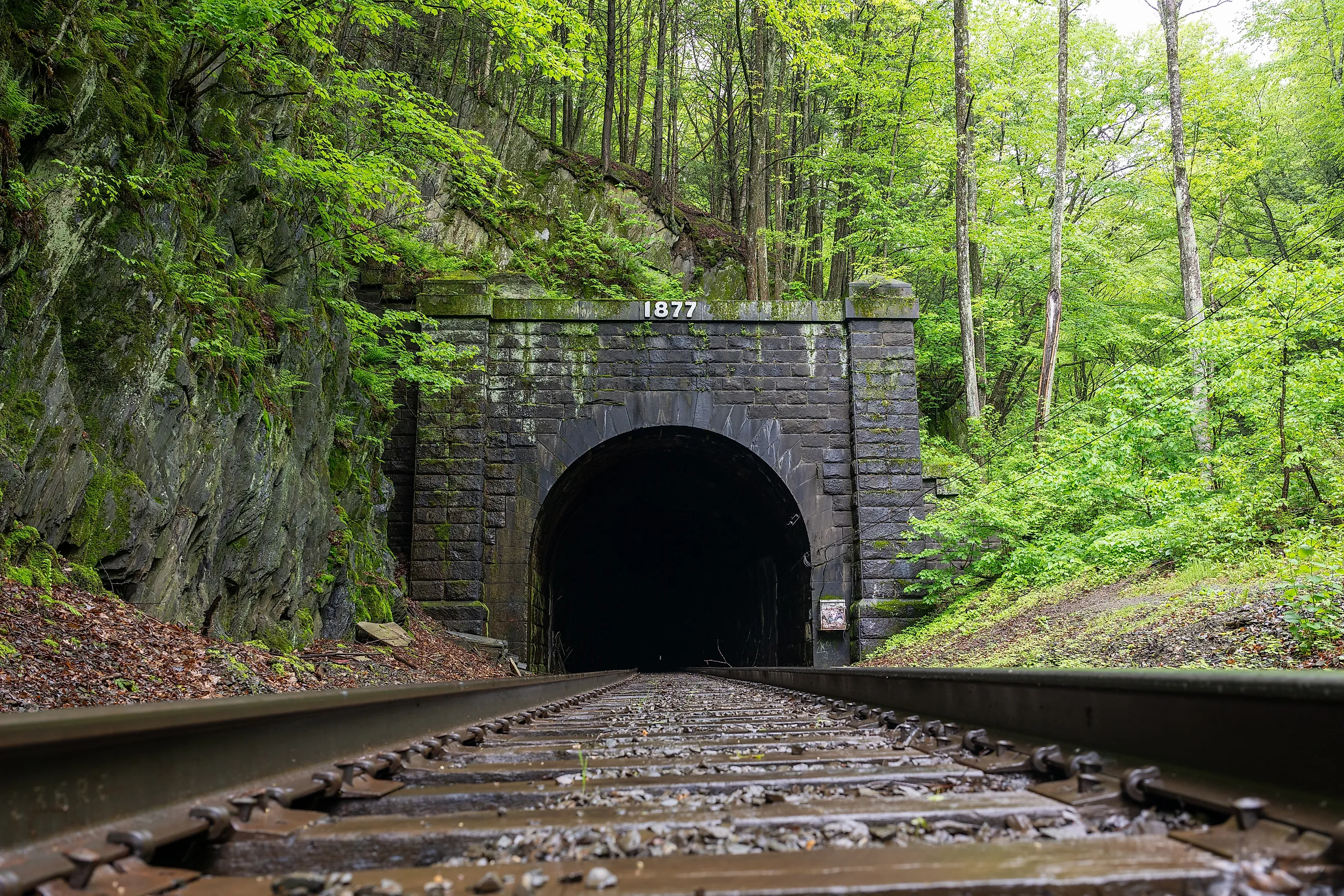
The Hoosac Tunnel was the longest tunnel in North America when it opened in 1875, running 4.75 miles through Hoosac Mountain in the Berkshires of western Massachusetts. Construction took 24 years and cost an estimated 195 lives, including the 1867 incident at the central shaft where 13 men died after a fire and shaft collapse. The Hoosac was the first major American tunnel project to use compressed-air drilling and was the first to deploy nitroglycerin manufactured at the site itself, after the explosive's importation was banned following several rail-car accidents. The tunnel is still in active freight service today. It is owned by Pan Am Southern, a joint venture of Norfolk Southern and CSX, and has been operated since 2023 by the Berkshire & Eastern Railroad, a Genesee & Wyoming subsidiary. Roughly four to six freight trains a day use the route between Mechanicville, New York and Ayer, Massachusetts.
American Tunnel Infrastructure
Highway tunnels in the United States are far shorter than the water and rail tunnels above. The 2.5-mile Anton Anderson Memorial Tunnel in Whittier, Alaska is the longest highway tunnel in North America, and it is shared with the Alaska Railroad on a single-lane bore controlled by computer to alternate between road traffic, rail traffic, and ventilation cycles. The Eisenhower-Edwin C. Johnson Memorial Tunnel in Colorado is the highest vehicular tunnel in the country at 11,158 feet elevation, carrying Interstate 70 under the Continental Divide for 1.7 miles. Other major highway tunnels include the Holland Tunnel (1.6 miles, 1927) and Lincoln Tunnel (1.5 miles, 1937) under the Hudson River between New York City and New Jersey, the Fort McHenry Tunnel (1.4 miles, 1985) carrying I-95 under Baltimore Harbor, and the Ted Williams Tunnel (1.6 miles, 2003) carrying I-90 under Boston Harbor. The National Tunnel Inspection Standards, administered by the Federal Highway Administration under the U.S. Department of Transportation, require all highway tunnels to be inspected at intervals of no more than 24 months. Most of the major American water and transportation tunnels are now over 50 years old, and ongoing capital projects include the Delaware Aqueduct bypass, the completion of New York City Water Tunnel No. 3 by 2032, and major boring and lining work in the Chicago Tunnel and Reservoir Plan (TARP), which has more than 100 miles of stormwater tunnels in various stages of completion across the Chicago metropolitan area.