11 Best Attractions To Visit In Southern California
Southern California fits an impressive amount of attractions into its corner of the map. Within a few hours' drive, a visitor can stand in a desert where two ecosystems meet, ride a Ferris wheel powered by the sun, look through a telescope that millions of people have used, and ride a tram through a working movie studio. The region also has real history, with a Spanish mission founded in 1776 and a wooden beach resort that opened in 1888 and still receives guests today.
The 11 attractions below were chosen for their popularity as much as for their staying power. They mix natural landmarks, historic sites and commercial draws across Los Angeles, Orange, San Diego, Ventura, Santa Barbara, Riverside and San Bernardino counties. Ticket prices, reservation rules and hours change often, so make sure to check each attraction's official site before you go.
Disneyland Park

Disneyland Park in Anaheim is where the modern theme park began. Walt Disney opened it on July 17, 1955, and it remains the only Disney park designed and built under Walt Disney's direct supervision. The park occupied 160 acres of former orange groves and cost about $17 million. Opening day was messy, with forged invitations, a gas leak, unset concrete and temperatures above 100 degrees, and company officials called the day "Black Sunday" for years afterward.
Much of what opened that summer remains. Sleeping Beauty Castle still stands near the hub of the park, and Peter Pan's Flight still flies, and the Jungle Cruise and the King Arthur Carousel both date to 1955. The Henry Ford Museum notes that Disney traced the idea for the park to watching his daughters ride the carousel at Griffith Park, which ties neatly into another stop on this list.
Joshua Tree National Park

Joshua Tree National Park sits in the Southern California desert, at the meeting point of two desert ecosystems. The Colorado Desert, a western extension of the Sonoran Desert, occupies the southern and eastern parts of the park and is known for ocotillo, ironwood, palo verde trees and teddy bear cholla. The southern boundary of the Mojave Desert reaches across the northern part of the park, and that higher desert is the habitat of the Joshua tree itself. The park protects about 795,156 acres, more than 80 percent managed as wilderness.
Minerva Hamilton Hoyt, a South Pasadena resident, helped establish Joshua Tree National Monument in 1936. Congress raised the monument to national park status in 1994 through the California Desert Protection Act, which also added about 234,000 acres, according to the National Park Service.
The park is known worldwide as a rock climbing destination, with more than 4,500 established routes concentrated in the western section. Non-climbers can hike among the park's exposed granite monoliths, and the National Park Service lists Skull Rock and Keys View among the must-see spots. About 3 million people visited in 2024. Temperatures are most comfortable in spring and fall, though the park can be extremely busy on weekends, holidays and spring break. There are no grocery stores, restaurants or lodging inside the park, and no water in the interior, so bring your own food, water and supplies.
Griffith Observatory

Griffith Observatory opened on May 14, 1935, on the south-facing slope of Mount Hollywood in Los Angeles's Griffith Park. Griffith J. Griffith had donated 3,015 acres to the city in 1896 and later left funds in his will for an observatory, with the condition that admission stay free. The city has kept that promise, and the observatory says more than 85 million people have visited since 1935.
The centerpiece for many visitors is the 12-inch Zeiss refracting telescope. The observatory reports that about 8 million people have looked through it, more than any other telescope on Earth, and free public viewing runs on every clear evening the building is open. Indoors, the Samuel Oschin Planetarium puts on live shows, and the planetarium's 1964 star projector was replaced with a Zeiss Mark IX Universarium in 2006.
The observatory also describes itself as the best vantage point for viewing the Hollywood Sign, and its terraces look out over the Los Angeles Basin, from downtown to the Pacific Ocean. An evening visit pairs the telescopes with a view of the city lights.
Universal Studios Hollywood

Universal Studios Hollywood in Universal City is the rare theme park that sits on a working film lot. Carl Laemmle first opened the studio grounds to visitors on March 15, 1915, but the arrival of sound film ended those early tours. The modern attraction opened on July 15, 1964, as the Universal Studios Tour, a tram ride through the backlot.
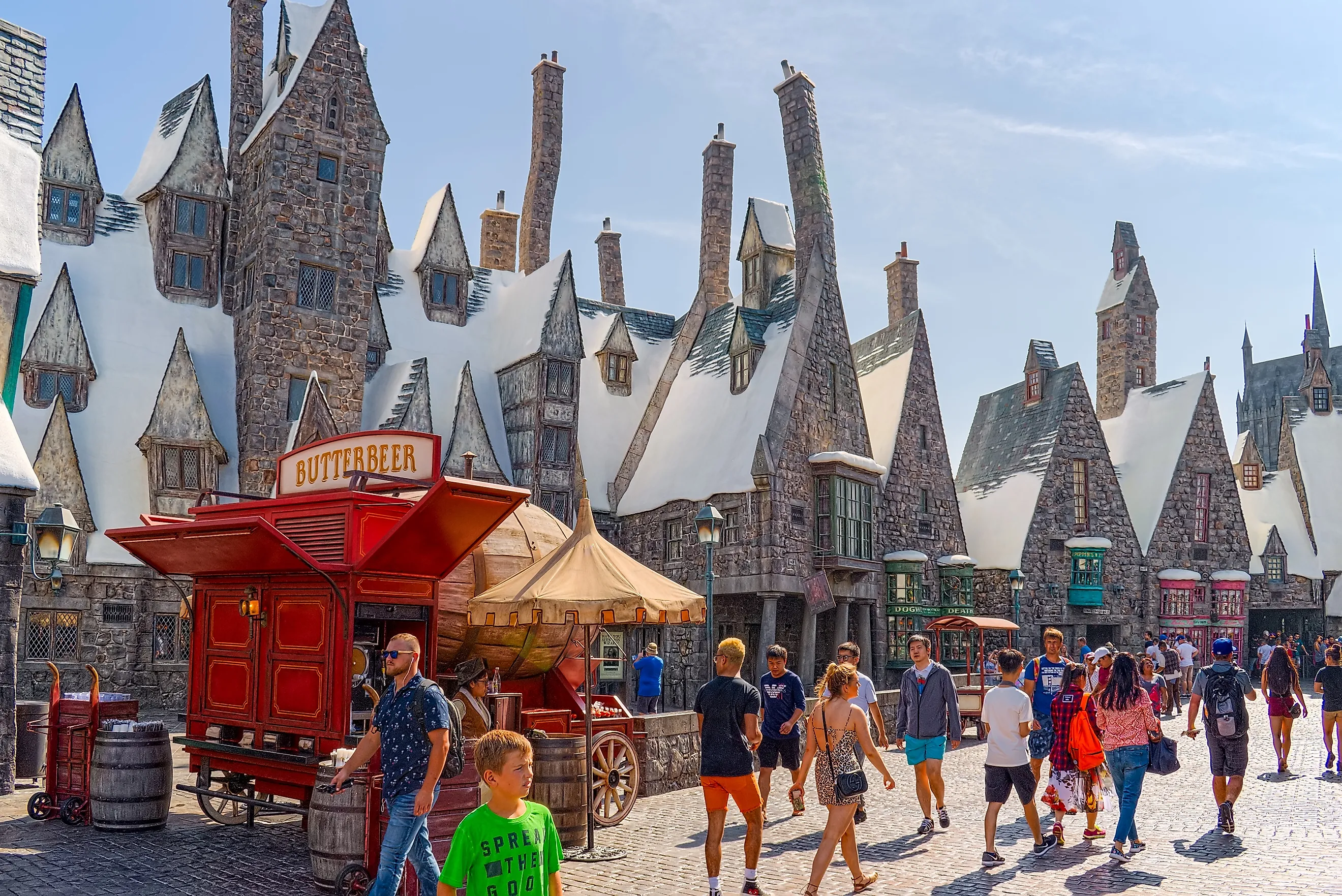
Theme Park Insider calls the Studio Tour the reason Universal's theme parks exist, and it now carries riders through set pieces such as King Kong 360 3-D and the Fast & Furious finale, according to ThrillZing. Around it, the park has grown into a full resort. The Wizarding World of Harry Potter opened on the Upper Lot in 2016, while the Lower Lot now holds Jurassic World: The Ride and Super Nintendo World.
San Diego Zoo

The San Diego Zoo grew out of the leftovers of a world's fair. After the 1915 to 1916 Panama-California Exposition ended in Balboa Park, physician Harry Wegeforth gathered the abandoned exotic animals and founded the Zoological Society of San Diego on October 2, 1916. Today the zoo covers 100 acres and houses more than 3,500 animals representing over 650 species and subspecies, along with more than 700,000 plants.
The zoo was an early adopter of cageless, open-air exhibits. It's also known for giant pandas. Two pandas, Bai Yun and Shi Shi, arrived in 1996 on a research loan, and the zoo has been the most successful panda breeding site outside China. A new pair, Yun Chuan and Xin Bao, took up residence in June 2024. The zoo's sister site, the San Diego Zoo Safari Park, spreads across 1,800 acres about 30 miles to the northeast and makes a good second day for animal lovers.
Santa Monica Pier

The Santa Monica Pier reaches out from the end of Colorado Avenue, and its oldest section, the Municipal Pier, opened on September 9, 1909. The city describes it as the first concrete pier on the West Coast. Pacific Park, the amusement park on the pier, arrived in 1996 and is home to the Pacific Wheel, which is billed as the world's only solar-powered Ferris wheel.
The Looff Hippodrome Carousel dates to 1922, and the pier was dedicated as the official western terminus of Route 66 in 2009, marked by an "End of the Trail" sign that is one of the most photographed spots on the pier. Several other Santa Monica locations have claimed the Route 66 ending over the years, so treat the sign as the official marker rather than the only claim. Muscle Beach, an outdoor gym established in the 1930s, sits beside the pier. Walking the pier costs nothing, and people still fish from the outer deck. Rides, games and restaurants charge separately.
Hollywood Walk Of Fame

The Hollywood Walk of Fame is a sidewalk museum that anyone can walk for free. It holds more than 2,800 terrazzo and brass stars along 15 blocks of Hollywood Boulevard and three blocks of Vine Street, covering about 1.3 miles on the boulevard itself. The Hollywood Chamber of Commerce says construction began on February 8, 1960, and the first star, for Stanley Kramer, was laid on March 28, and that the Walk was dedicated that November.
Stars are grouped into categories that include film, television, music, radio and live performance. Gene Autry is the only entertainer with a star in all five categories, according to his official website. At Hollywood and Vine, four moon-shaped plaques honor the Apollo XI mission, and the Chamber, which continues to add stars on behalf of the City of Los Angeles, means a stroll can double as a chance to catch an induction ceremony.
The Getty Center

The Getty Center is a hilltop art campus in Brentwood, and the building draws as much attention as the collection. It opened on December 16, 1997, at a cost of $1.3 billion, on a 110-acre site in the Santa Monica Mountains. Architect Richard Meier designed the 24-acre complex, most of it clad in travertine, and visitors ride a tram up from the parking area.
The Central Garden, designed by artist Robert Irwin, covers 134,000 square feet and works as an artwork in its own right, with a zigzagging stream leading to an azalea maze in a reflecting pool. Inside the galleries, the collection includes Vincent van Gogh's "Irises." Admission is free, though parking is charged and the Getty has at times required timed-entry reservations, so confirm the current rules online before you drive up.
Mission San Juan Capistrano

Mission San Juan Capistrano, in Orange County, was the seventh of California's 21 missions. It was founded by Father Junípero Serra on November 1, 1776, after an earlier founding attempt in 1775 was abandoned because of unrest. The Serra Chapel, completed in 1782, is believed to be the oldest standing building in California and the only surviving chapel where Serra said Mass.
The grounds include the ruins of the Great Stone Church, started in 1797 and finished in 1806 before an earthquake destroyed it in 1812. Lonely Planet notes that the first vineyards were planted here in 1779, making the mission an early chapter in California wine history. Across the railway tracks, the Los Rios district holds more than 30 landmarked structures, some dating to 1794.
The mission is best known for its swallows. Cliff swallows traditionally return to nest here around March 19, the feast of Saint Joseph, a story made famous by Leon René's song "When the Swallows Come Back to Capistrano."
Channel Islands National Park

Channel Islands National Park is the wild counterpart to the region's theme parks. It protects five islands off the Ventura coast: Anacapa, Santa Cruz, Santa Rosa, San Miguel and Santa Barbara. Anacapa and Santa Barbara came under National Park Service management as a national monument in 1938, and legislation in 1980 created the national park and added the three remaining northern islands. The chain is often called the "Galapagos of North America," a nickname NASA also uses. The National Park Service says isolation has produced animals, plants and archaeological resources found nowhere else on Earth, including the island fox, a dwarf form of the mainland gray fox. The park's own brochure counts 145 species found nowhere else on Earth.
Getting there takes planning, since the islands are reachable only by park boat or plane, or by private boat. Island Packers runs the public boats, and the National Park Service lists the trip from Ventura Harbor to Santa Cruz Island at one hour. Santa Cruz is the largest island, and visitors there can hike, kayak and explore sea caves. Santa Rosa has a deeper human story: remains found at Arlington Springs in 1959 have been dated to more than 13,000 years, among the oldest dated human remains in North America.
The crowds are thin by Southern California standards. The park recorded 227,186 recreation visits in 2025, and Secret Los Angeles describes it as the least visited national park in California. Island Packers confirms there is no entrance fee, though the boat ride is paid.
Hotel del Coronado

The Hotel del Coronado, known as The Del, stands on the beach in Coronado, just across the bay from downtown San Diego. It opened on February 19, 1888 and was the largest resort hotel in the world at the time. Today it is the second-largest wooden structure in the United States, a rare surviving wooden Victorian beach resort that became a California Historical Landmark in 1970 and a National Historic Landmark in 1977.
The hotel was a technology showcase in its day. It had one of the state's largest electrical power plants, and in 1904 it introduced what was described as the world's first electrically lighted outdoor Christmas tree. Hollywood followed. Billy Wilder shot the exterior scenes for Some Like It Hot at the hotel in September 1958, with the hotel standing in for a Florida resort. The Ice House Museum on the grounds has recently hosted a Marilyn Monroe exhibition tied to that film.
Planning Your Trip
Geography does a lot of the planning here. Five of these attractions are in Los Angeles County: Griffith Observatory, Universal Studios Hollywood, the Santa Monica Pier, the Hollywood Walk of Fame and the Getty Center. Disneyland and Mission San Juan Capistrano are in Orange County, the San Diego Zoo and Hotel del Coronado are in San Diego County, and the Channel Islands lie off the Ventura coast. Joshua Tree sits inland in the desert and needs a day of its own.
Together they cover most of what makes Southern California famous, from the movie industry and theme parks to desert wilderness, Spanish colonial history and Pacific beaches. Even a first-time visitor with only a week can build a trip around three or four of them and see why the region keeps its reputation.