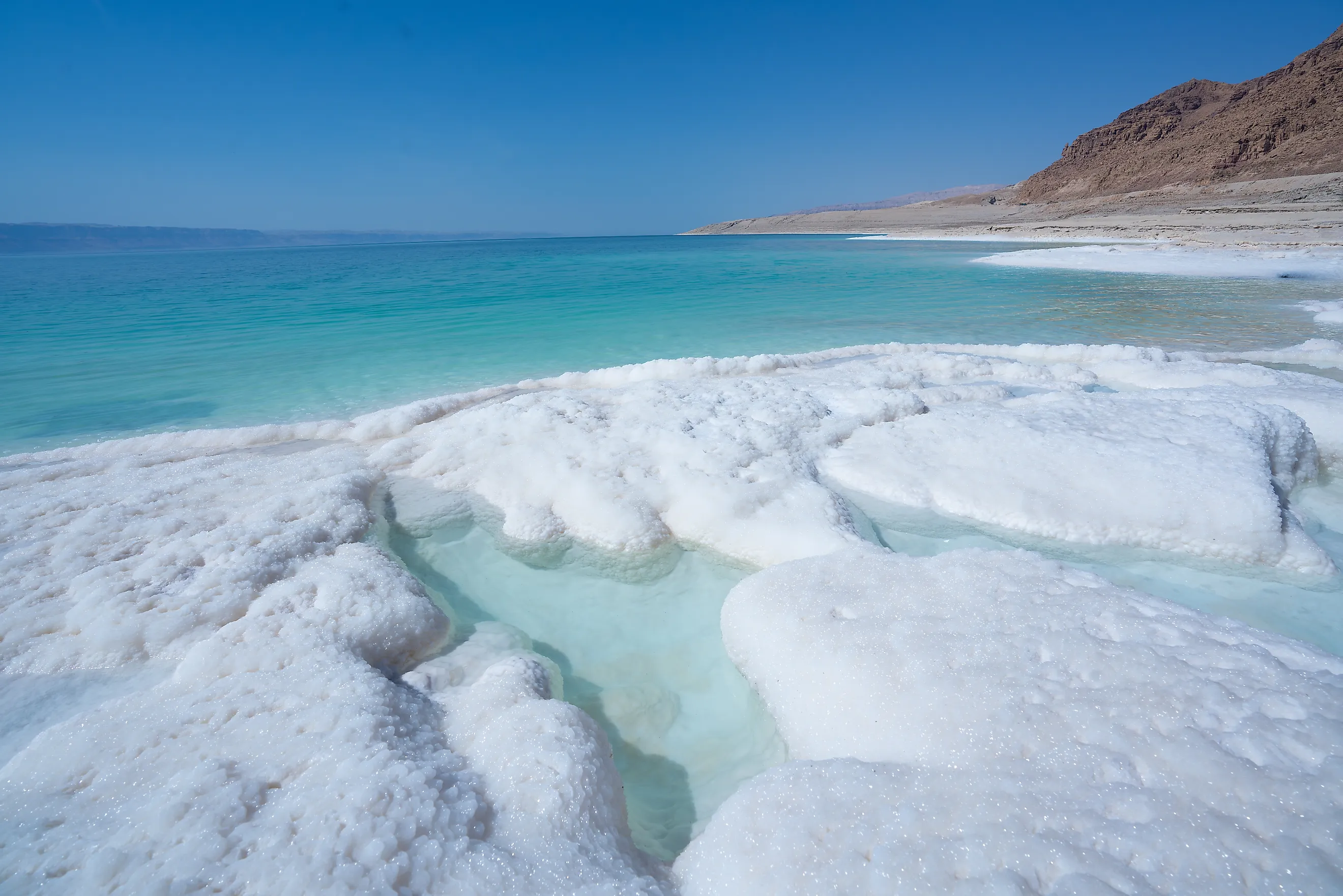
Why The Dead Sea Has Almost No Life In It
Some lakes hold so much salt that ordinary plants and animals cannot survive in them. These are known as saline lakes. The best-known US example is the Great Salt Lake of Utah, the largest saline lake in the Western Hemisphere and the eighth-largest terminal lake in the world. Its waters still support brine shrimp and birds. Another saline lake is so hostile that it earned the moniker "the Dead Sea." As one of the saltiest bodies of water on Earth, the Dead Sea supports almost no life, a preview of what any lake becomes when its salt keeps climbing. Its salinity is the cause.
A Deep and Deathly Lake

Located between Jordan and Israel, the Dead Sea takes its name from the scarcity of life in its waters. Like the Great Salt Lake, the Dead Sea is a terminal lake, meaning it has water flowing into it, but the water does not flow out, a contributing factor in the Dead Sea's salinity. Unlike the Great Salt Lake, however, the Dead Sea is fed by only one river, the Jordan River. With only an average of two-to-four inches of rain annually, the Jordan fills the Dead Sea. By older measurements, the Dead Sea was approximately forty-seven miles long and eleven miles wide, though the diverting of water from the Jordan for industrial purposes has since reduced its length, width, and depth. The Dead Sea is shrinking like the Great Salt Lake. The Dead Sea rests in the deepest valley of the Great Rift Valley fault, with an elevation of about 1,400 feet below sea level, and while this depth is also affected by the changes to the flow of the Jordan River, it still makes the Dead Sea the body of water with the lowest land-based elevation in the world. The Dead Sea's location makes it a frequent tourist destination, and has attracted even one of America's greatest writers, but its geography also leads to its deadly salinity.
Salt and Mark Twain

As a terminal lake, the Dead Sea has water flow into it, but the water doesn't flow out again. It can only escape the lake through evaporation, and with the arid climate, seven million tons of water evaporate from the Dead Sea daily. Every drop that evaporates leaves behind any impurities, such as salt. This makes the Dead Sea one of the saltiest and most mineral-laden bodies of water in the world. The Dead Sea has a salinity of around 342 ppt (parts per thousand), roughly ten times the salinity of sea water, which typically runs 33-37 ppt. Its deep waters are largely well mixed rather than layered, and the salinity is so extreme that the water is essentially saturated with salt, leaving the excess to crystallize and settle on the lake bottom. These particulates form large columns of salt which rise above the waters in some areas. This high salinity gives the waters some special qualities. For example, the waters have a greasy feel to them. The high salinity also makes swimming difficult, as it increases a body's buoyancy. This makes floating in the water near-effortless, an experience famed author Mark Twain recounted in his book Innocents Abroad after bathing in the Dead Sea. However, the Dead Sea's high salinity is far less pleasant for anything trying to live within it.
The Deadly Nature of the Dead Sea

Unlike the Great Salt Lake, which only has a salinity ranging from two-to-nine times that of ocean water, there is almost no life in the Dead Sea. One cannot find aquatic reptiles such as some snakes or turtles within its waters, or amphibians such as frogs. Even Brine Shrimp, which can be found in the Great Salt Lake, are nowhere to be found. Any fish which happen to enter from the Jordan River quickly perish, and no plants can survive in the water. While it is safe to swim in, nothing bigger than a bacteria can survive in the salt, and bacteria makes up the majority of what life can be found in the Dead Sea. Called Halophilic bacteria, these microbes thrive in high-salinity-environments and can often be found mixed into the sediments of the lake bottom and shore. While the Great Salt Lake has some plants growing in the shallower areas, there is sparse plant life only around the Dead Sea's shores, namely halophytes such as suaeda, salicornia, and tamarix, and a green algae called Dunaliella. These are some of the only examples of native flora and fauna to be found around the Dead Sea, despite there being several nature reserves nearby. Migrating birds pass over it on their seasonal journeys, but they do not rely on the Dead Sea for water.
What It Means for America's Lakes
So what would happen if American lakes became saltier? Would they still support some life like Utah's Great Salt Lake, or would they become the Western Hemisphere's equivalent of the Dead Sea? The Dead Sea has several major differences from the Great Salt Lake which make it uniquely deadly to most forms of life. While both are terminal lakes, the Dead Sea has only one river feeding it and a much lower elevation, as well as much less rainfall, giving it a higher salinity. The Dead Sea's greater and more consistent salinity makes it much less hospitable to even salt-adapted forms of life. So even if American lakes became saltier, they likely would still be able to support life.