The Longest Migrations In The Ocean
The world's oceans can be seen as one continuous body of water. Oceanographers often refer to the oceans collectively as the Global Ocean because they function as a single, unified body of water with an interconnected thermodynamic system. For migrating marine life, this means far greater distances that can be travelled than those on land. The longest land migration is made by the caribou, which have been tracked over 2,500 miles (4,000 km) annually in a round trip across the Arctic. In contrast, the gray whale migrates 14,000 miles (22,500 km) between the Arctic and Baja, Mexico. Migrating marine animals will use such things as the Earth's magnetic field, the sun and stars, underwater topography or landmarks, ocean currents and temperatures, or olfactory cues to move great distances in or across the ocean.
Why Animals Migrate Great Distances
The core drivers of ocean migration are that the locations for breeding and feeding are often great distances from each other. Food availability is crucial as Arctic waters are rich in food and nutrients during the summer, while tropical ocean water is nutrient-poor during that time of year. In contrast, warm and shallow waters found in tropical regions provide safety for hatchlings and newborns, away from freezing temperatures and predators. When animals migrate en masse or find isolated areas for breeding, the risk to their young from apex predators is lower. Cold-blooded, or ectothermic, animals such as sea turtles travel between large areas of oceans to maintain stable body temperatures. The moving weather systems and shifting ocean currents are used by migrating marine animals to maximize energy efficiency. These seasonal shifts are part of the migratory instincts of many marine animals, resulting in migration patterns remaining fairly stable and routine.
Gray Whale

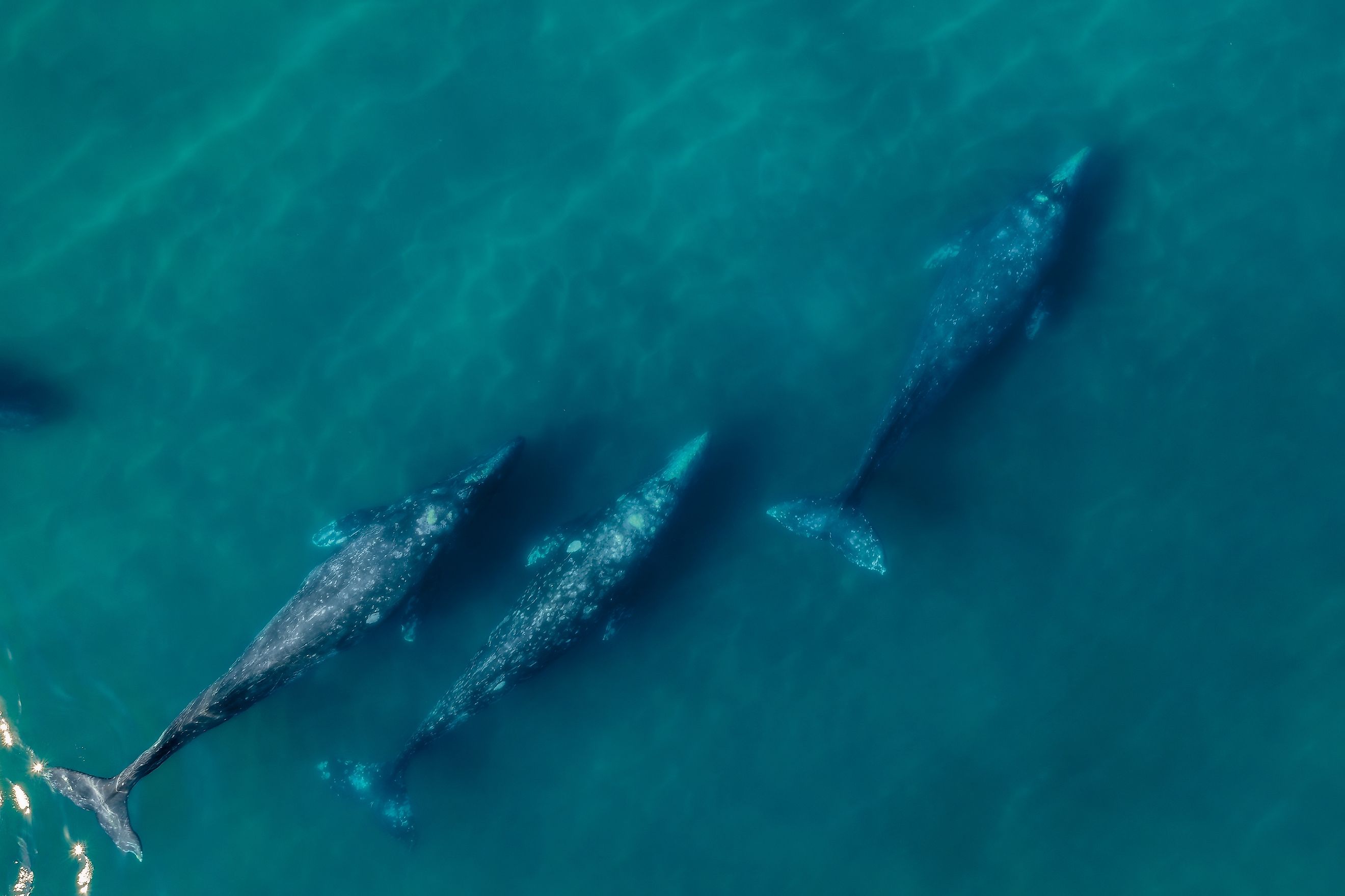
The gray whale (Eschrichtius robustus) has the longest tracked species-wide migrations of any mammal. The entire population of gray whales, found in the Eastern North Pacific, travels up to 14,000 miles (22,500 km) along the West Coast of North America. The all-time record was a single female, tracked by satellite, who traveled over 14,000 miles between Russia and Mexico in 172 days. With the advancing of Arctic ice in November through February, the gray whales leave the Bering, Chukchi, and Beaufort Seas near Alaska, moving south. They swim continuously, day and night, for up to 80 miles per day, staying close to the coastline. They arrive in time for winter in the shallow lagoons of Baja California, Mexico, to mate and give birth in the hypersaline waters.
From February through May, they reverse the journey, heading for the food-rich Arctic waters. Mothers with their calves will travel with great speed, staying as close as possible to the shoreline. They will often move through the coastal kelp forests, shielding calves from orcas. The gray whale feeds primarily on shrimp-like amphipods on the cold Arctic ocean floor and gorges all summer to build up massive layers of blubber. While migrating, they mostly fast and will lose anywhere from 16% to 30% of their total body mass. To build insulating fat quickly, gray whale mothers produce some of the richest and fattiest milk of any cetacean, allowing their calves to survive the harsh journey to the Arctic. While in the warm waters of Mexico, gray whales are known to be exceptionally friendly to humans, despite humans having nearly hunted them to extinction in the 19th century. Gray whales are known to approach small ecotourism boats to interact with the humans on board.
Humpback Whale
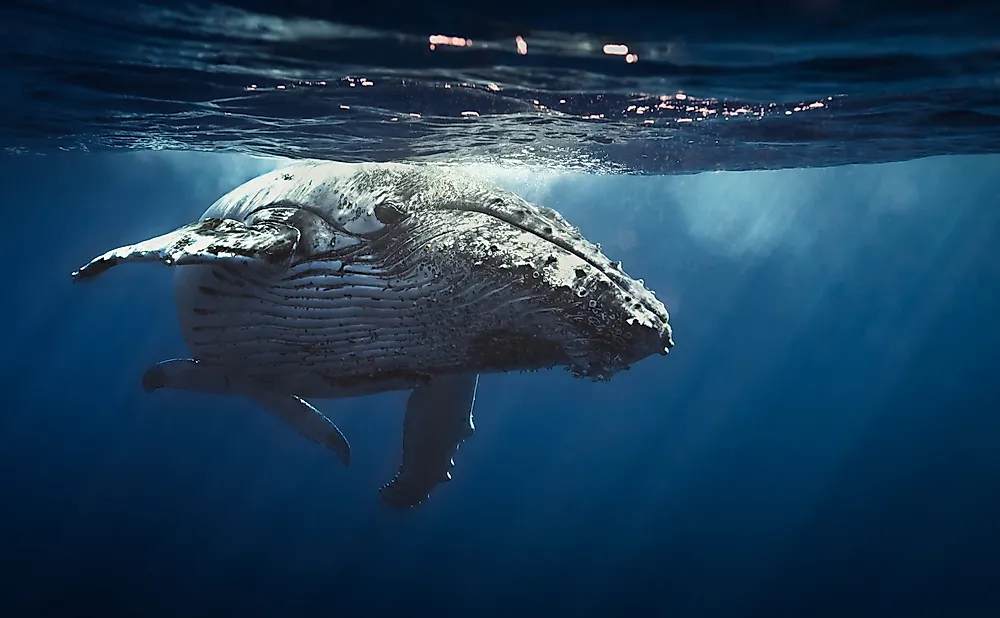
The humpback whale (Megaptera novaeangliae) migrates approximately 5,100 miles (8,300 km) each way between polar feeding grounds and the tropical waters used for breeding. While gray whales hold the record for migration distance for the whole species, individual populations of humpbacks have been observed traveling up to 16,000 miles (25,700 km) round-trip on occasion. While gray whales travel up the North American west coast, humpback whales feed on krill in open water and travel through deep ocean basins. The humpbacks tend to take shorter and direct routes between polar waters and the equator, requiring less distance to travel. Humpback whales live in all the oceans, and in both the Northern and Southern Hemispheres. This means that the seasons are flipped for the north and south populations, and the two groups rarely, if ever, mix at the equator.
The North Pacific populations spend the summers gorging on krill and small schools of fish in the waters off Alaska, British Columbia, and Russia. In the winter, from November through January, they travel up to 3,500 miles south to the Hawaiian Islands, Mexico, and Japan for mating and giving birth. The northern return to the Arctic feeding areas takes place March through May. The Southern Ocean populations feed on Antarctic krill along the Antarctic continent, migrating north from April through August to breed along the coasts of South America, East and West Africa, and Australia, as well as Pacific islands such as Fiji and Tonga. The trip south to feeding waters takes place between September and November. The North Atlantic population feeds in the waters of New England, Eastern Canada, Greenland, Iceland, and Norway in the summer. They travel south to the shallow coral reefs of the Caribbean, particularly the Silver Bank off the Dominican Republic. They remain in the warmer waters from January through April before heading back to the north.
Leatherback Sea Turtle
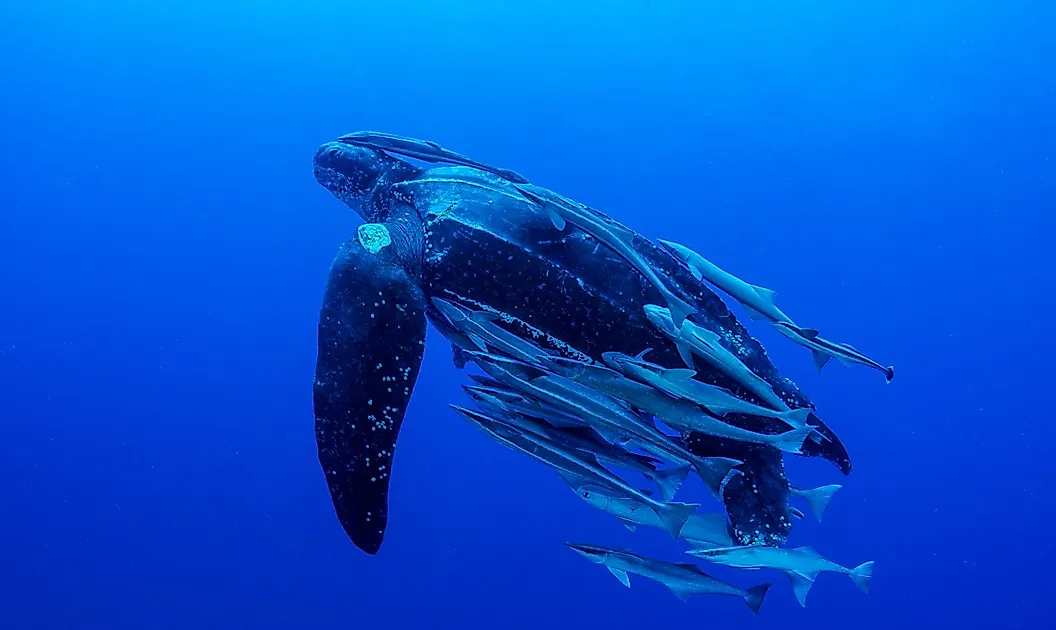
The leatherback sea turtle (Dermochelys coriacea) can travel over 10,000 miles (16,000 km) each year, across whole ocean basins. The record is held by a female Western Pacific leatherback, who was tracked by satellite for 647 days, traveling 12,774 miles (20,558 km) from her nesting beach in Papua, Indonesia, to the coast of Oregon for foraging. Compared to other sea turtles, leatherbacks have a higher tolerance to cold water, and their migration routes can extend across tropical waters and into sub-polar regions. The Trans-Pacific Route of the western Pacific population begins in the nesting grounds in the Coral Triangle of Indonesia, Papua New Guinea, and the Solomon Islands. They then spend 10 to 12 months swimming across the open Pacific to the US West Coast, feeding on jellyfish off California, Oregon, and Washington. In the Atlantic, leatherbacks migrate from the nesting beaches in the Caribbean and South America, following the Gulf Stream up the North American East Coast to forage off New England and Nova Scotia.
The Eastern Pacific population nests off the Pacific coasts of Mexico and Costa Rica and migrates south to the Galapagos Islands, Peru, and Chile. Weighing up to 2,000 pounds (900 kg), leatherback sea turtles survive on low-calorie prey like jellyfish and salps, which are planktonic tunicates. To maintain energy, they eat their weight in jellyfish every day while migrating. A lightly pigmented spot on the top of the heads of leatherbacks, directly above the pineal gland, allows the leatherbacks to sense changes in seasonal day length, triggering the instinct to leave the waters in the north before winter. With no rigid bony shell, the flexible and oil-saturated skin of the leatherback, as well as its teardrop shape, allows for cutting through water resistance, making it the fastest-swimming sea turtle species.
Northern Elephant Seal
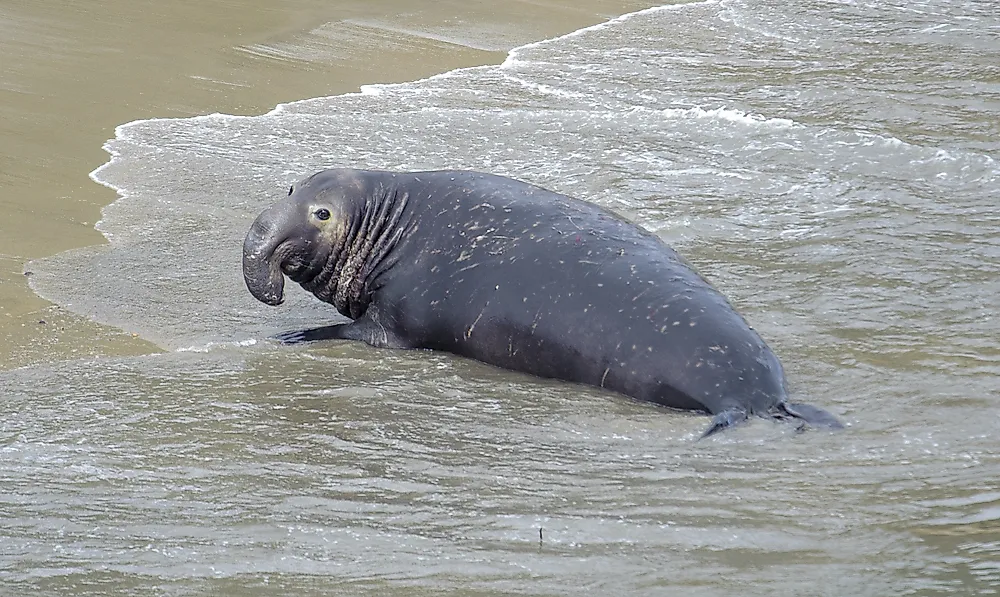
The northern elephant seal (Mirounga angustirostris) is notable for a double migration, making two separate round trips from California and Baja California out into the North Pacific Ocean, up to 13,000 miles (21,000 km) annually, and spending 250 to 300 days a year entirely at sea. Elephant seals return to land twice a year, once to breed and then again to molt. Their migration schedule is very specific. On the first trip, February through May, after fasting on land while mating and giving birth, the seals head out into the ocean to feed. Females tend to hunt in the open ocean, with males traveling north into the Gulf of Alaska and the Aleutian Islands. In the spring, they return to the coastal rookeries to molt, spending about a month there. The second migration is June through December. With new outer skin, they travel to the open ocean for a longer feeding trip. This will build fat for the coming winter. In December, they return to land and start the breeding cycle once again.
Elephant seals do not sleep while on land, nor do they float on the surface when out in the ocean. For up to eight months, elephant seals dive continuously, 24 hours a day, to average depths of up to 2,500 feet (760 meters) for 20 to 30 minutes at a time. Elephant seals have been recorded going as deep as 5,788 feet (1,764 meters), lasting two hours underwater. With so little time on the surface, scientists have discovered that elephant seals sleep for 10 minutes at a time while drifting downward during their deep dives. At those depths, they are safe from great white sharks and orcas, who stay near the surface. To survive at such depths, they store vast amounts of oxygen in their blood and muscles and can slow their heart rates down to a few beats a minute while collapsing their lungs, preventing decompression sickness.
Long Distance Champions
With the vast ocean expanses at their disposal, marine animals will sometimes travel great distances to secure the ideal conditions needed for mating and feeding. Because they are large, these marine animals require large amounts of food, and their specific diets tend to be found far from the safe and warm areas they need for breeding. This cycle continues each year, sometimes traveling extraordinary distances for which they have evolved. Marine animals will often travel thousands of miles and return to the same location they started, using Earth's magnetic field as a natural GPS to navigate between birthplace and feeding waters, and back again.