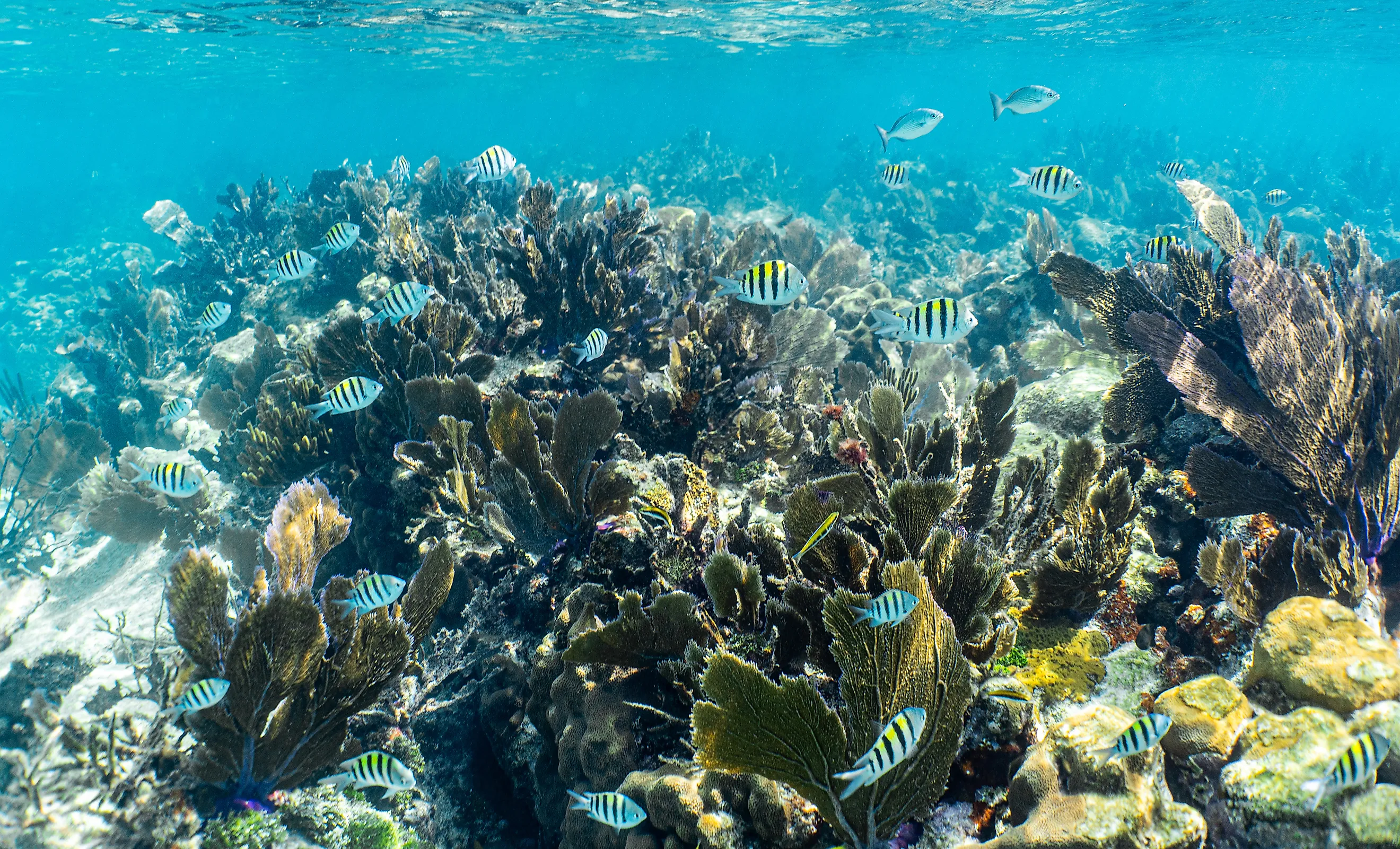
The Only Coral Reef In The Continental United States
Most of the United States coast is too cold, too cloudy, or too dark for reef-building coral. Southern Florida is the exception. The Gulf Stream keeps its water warm and clear year-round, so stony corals grow there and nowhere else on the mainland. That is why the continent's only living coral barrier reef lies off the state's southern edge, running for hundreds of miles past Miami and the Florida Keys, with the St. Lucie Inlet at its northern end and the Dry Tortugas at its western tip.
Size matches the setting. At roughly 350 miles, it is one of the largest barrier reef system on Earth. It is ancient, too. The first corals settled here more than 8,000 years ago, and their descendants still build the framework that thousands of fish, five species of sea turtle, and hundreds of coral species rely on today. What follows are six facts about how it got that way, and what it will take to keep it.
It Ranks As The World's Third-Largest Barrier Reef

By most rankings, only two barrier reef systems in the world are larger. Florida's Coral Reef ranks behind Australia's Great Barrier Reef and the Mesoamerican Reef off Central America, which makes it third among the great living coral reef systems on Earth. It is also the only living barrier coral reef along the coast of the continental United States, a claim no other mainland state can make. Scale and rarity in one place are what make it worth understanding.
The Reef Runs Roughly 350 Miles Down Florida's Coast

The reef runs roughly 350 miles down Florida's southern coast. It starts near the St. Lucie Inlet in Martin County, runs past Miami and the length of the Florida Keys, and ends at the Dry Tortugas west of Key West. Scientists usually split it into three stretches. The remote Dry Tortugas lie at the western end, the Florida Keys fall in the middle, and the Coral ECA lies off the southeast mainland, with Biscayne National Park at the northern end. Unlike the Great Barrier Reef, it lies close to shore and lacks the wide, deep lagoon of a classic barrier reef, so it is best described as a bank-barrier reef. The Gulf Stream carries warm Atlantic water along its length, so ocean temperatures stay within the range its corals can survive.
It Began Forming More Than 8,000 Years Ago

Florida's Coral Reef dates to the early Holocene, more than 8,000 years ago. As glaciers melted and sea levels rose after the last ice age, warm water flooded the ancient limestone flats off southern Florida, and corals carried up from the Caribbean settled onto them. Over thousands of years, those colonies built the reef framework that exists today, most of it within about 66 feet of the surface. The massive corals grow only a few millimeters a year, so even a modest patch of reef stands for an enormous span of time within this ecosystem.
More Than 6,000 Species Live On The Reef

More than 6,000 species of plants and animals live on and around Florida's Coral Reef. The hard framework comes from over 45 species of stony coral, including brain and staghorn, along with 35 species of octocoral such as sea fans and sea whips, and more than 70 kinds of marine sponge. Fish account for over 500 species, with sharks and moray eels among the far smaller residents. Snails, urchins, spiny lobsters, and queen conch do the grazing and scavenging that keeps the system in balance. Larger animals pass through as well. Five species of sea turtle use the reef, including loggerhead and hawksbill, and bottlenose dolphins hunt its outer edges.
A Deadly Coral Disease Appeared Off Miami In 2014

The reef's most serious modern threat first appeared in 2014, when stony coral tissue loss disease was found off Virginia Key near Miami. Hard corals lose their soft tissue to it, often fatally. The disease affects more than 20 of Florida's roughly 45 stony coral species, and the most vulnerable die within weeks. From that first sighting the outbreak spread north to Martin County and south through the Keys, reaching the Dry Tortugas by 2021. Heat has made matters worse, as record ocean temperatures in recent summers have bleached corals across the Keys. Runoff and pollution are added pressures on an already strained system.
Scientists Are Working To Rebuild It

Efforts to save the reef now rank among the largest of their kind. In 2019, the National Oceanic and Atmospheric Administration (NOAA) and its partners launched Mission: Iconic Reefs, a decades-long plan to restore seven key reef sites within the Florida Keys National Marine Sanctuary, beginning with fast-growing elkhorn and staghorn corals, with a goal of 25 percent coral cover by 2040. Under a parallel effort, the Florida Coral Rescue, biologists collect healthy corals ahead of the disease and house them in land-based facilities across the country to protect their genetic diversity. Florida has also set aside the Kristin Jacobs Coral Aquatic Reserve to safeguard reef habitat off the southeast coast. None of this reverses the losses overnight, but the reef's outlook is better for it.
The Only One Of Its Kind

No other reef like it exists in the continental United States, which is exactly what makes its condition matter. A fishing and tourism economy worth billions depends on it, it blunts the force of storms before they reach the coast, and part of the country's marine biodiversity survives here and nowhere else on the mainland. Its future now depends less on the natural forces that shaped it over 8,000 years than on the choices people make about it over the next few decades. As the only living coral barrier reef in the contiguous United States, it is worth watching closely.