6 Strange Discoveries About the Bermuda Triangle
The Bermuda Triangle, also known as the Devil's Triangle, is a vast expanse in the Atlantic Ocean, heavily traveled by mariners due to its strategic location. Many verified and unsubstantiated claims of disasters have emerged in the oceanic region, including a score of naval and civilian planes and ships sinking. The stories have captivated the public's imagination since Christopher Columbus's first voyage to the New World in 1492, and many of the strange happenings remain a mystery today. Ships and planes disappearing without a trace, magnetic anomalies, and even reports of alien encounters arise from the Bermuda Triangle like a phoenix, along with bizarre discoveries.
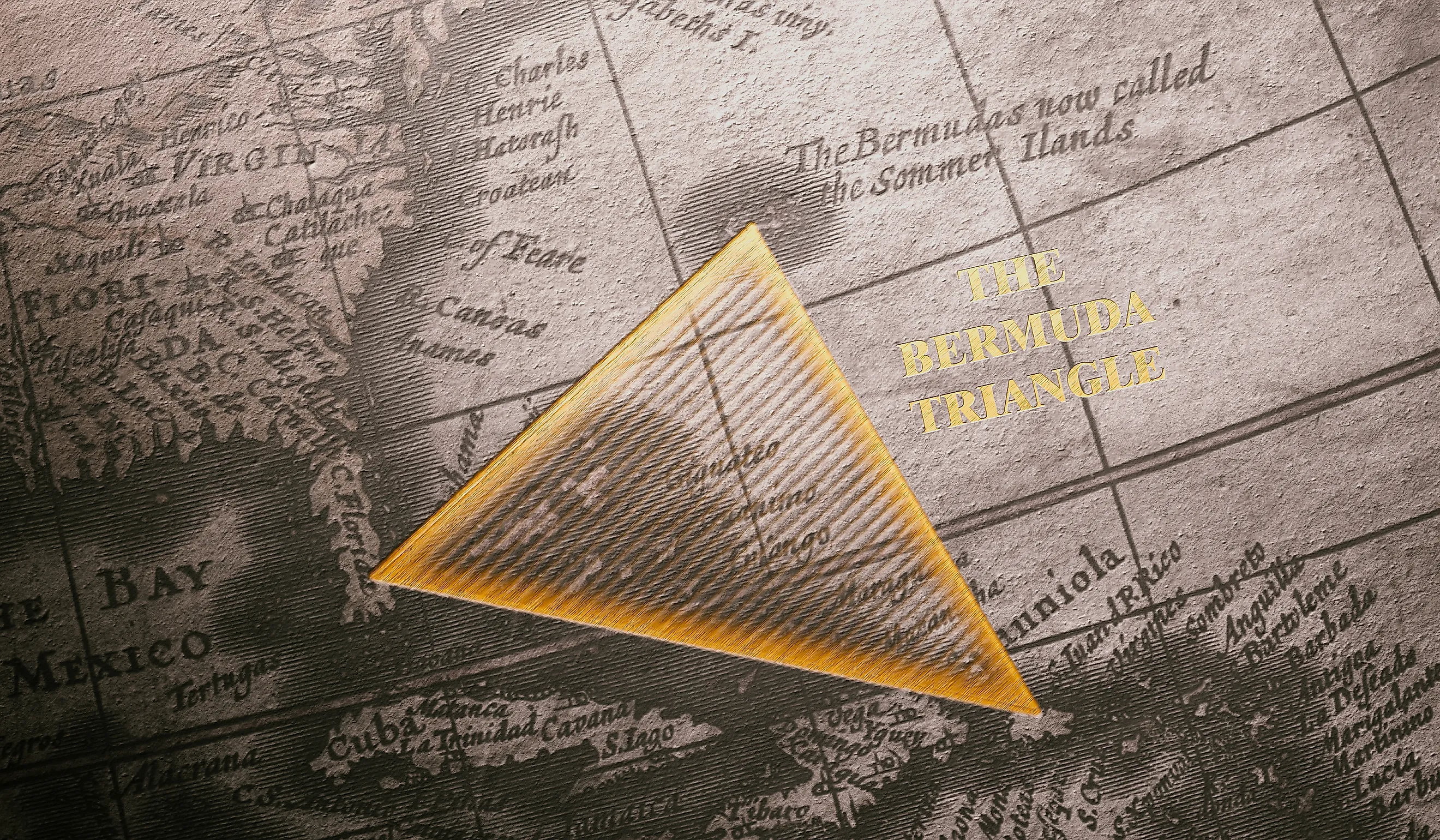
The Bermuda Triangle is in the North Atlantic Ocean, bounded by the Southeastern United States, Bermuda, and the Greater Antilles Islands. The exact boundaries are not agreed upon, but the region spans 500,000 to 1,510,000 square miles (1,300,000 to 3,900,000 square kilometers). Its name was derived in 1964 by pulp writer, Vincent Gaddis, who wrote about a triangular region where hundreds of ships and airplanes disappeared without a trace, generally accepted to encompass Bermuda, Miami, and San Juan, Puerto Rico. Here are six bizarre discoveries about the Bermuda Triangle.
A Patch of Ocean Where Compasses Randomly Spin and Point the Wrong Way

Although many discount the Bermuda Triangle stories as lore, the patch of ocean has been reported to be a significant cause of compass malfunctions and other phenomena reported by the military, aviators, and mariners. The navigational hazards have led to the prevailing theory that electromagnetic interference is the root cause of compasses going haywire and compass needles randomly spinning.
Numerous reports of malfunctioning compasses in the Bermuda Triangle have been reported over the years, including the loss of an entire squadron of TBM Avengers that had just taken off from Fort Lauderdale, Florida. Many studies into the disturbances have been conducted, and it has been shown that they are no different than those in other parts of the world. Many theories have arisen about magnetic flux in the Bermuda Triangle. Still, studies have shown that there are no magnetic anomalies in the area that would harm a vessel.
Giant Exploding Gas Bubbles That Could Make Ships Suddenly Drop Like Stones

One of the more interesting theories about vessels sinking in the Bermuda Triangle is that giant methane bubbles rocket to the surface from the seabed. According to National Geographic, these "burps of death" are waxy materials that coat the sea floor near continental shelves, similar to the odorless gas bubbles found in swamps and mines.
Methane bubbles harden on the sea floor due to the tremendous pressure at those depths, and if they break off, they become gaseous as they rise to the surface, creating detrimental methane bubbles for ships. The bubbles can cause vessels to lose buoyancy and, due to their flammability, could disrupt airplane engines, even causing mid-air explosions. Even though this theory is sound, all results are lab-driven, so real-world results are inconclusive.
Rogue Waves and White Squalls

Rogue waves are a leading scientific explanation for many of the disasters in the Bermuda Triangle, with some reaching heights of up to 100 feet. Rogue waves are massive walls of water that seemingly appear out of nowhere in areas prone to multiple storm systems at once, such as the tip of South Africa. The Bermuda Triangle is another prime location, and after years of research, leading scientists and research groups are leaning toward these walls of water as a definable cause of ships sinking in this part of the North Atlantic.

This area is prone to storms from Mexico, the equator, and farther east in the Atlantic Ocean. Engineers in England built ship models, including one that replicates the dimensions of the USS Cyclops. The vessel went down in the Bermuda Triangle in 1918, killing all 306 people on board. Simulations have repeatedly proved that ships can sink rapidly when confronted with unexpected, massive waves. The bigger the vessel, the harder it is to stay afloat in these conditions, which is concrete evidence of the perils any vessel faces when traversing this area of the Atlantic Ocean.
How the Gulf Stream Affects the Bermuda Triangle: Could Its Presence Solve the Mystery?

The Gulf Stream works in tandem with rogue waves to wreak havoc in the Bermuda Triangle, causing rapid, violent storms and waterspouts. These rapid changes can cause rogue waves, putting any vessel in their path in danger. The Atlantic Meridional Overturning Circulation uses several streams that converge to act as a "global conveyor belt" that brings heat from the tropics to higher latitudes.
Heat transfer is critical to sustaining organisms and maintaining global balance, but it also poses significant dangers to vessels in the immediate vicinity. It not only provides a natural explanation for so many ships sinking in the area, but it can also rapidly disperse the wreckage from the site, which may explain why so many have not been found. Conditions can quickly deteriorate and potentially give way to white squalls, a massive amount of water that can encapsulate a vessel and bring it down through violent winds and waves.
Unexplained Disappearances

Unexplained disappearances in the Bermuda Triangle have produced conspiracy theories and driven scientific research into their causes. The USS Cyclops is the first notable ship of the 20th century to sink in the Bermuda Triangle. Several theories have emerged about the cause of the sinking, including being overloaded with cargo, although no wreckage has ever been found. However, some sunken ships, such as the Cotopaxi, have been recovered, giving credence to some scientific hypotheses.

The Cotopaxi sank in 1925 and was found 90 years later off the coast of St. Augustine, validating the Gulf Stream theory. One of the most baffling cases is the disappearance of Flight 19, a platoon of five bombers on a training mission from Fort Lauderdale, Florida, on December 5, 1945. All five bombers became severely disoriented and strayed off course, and have never been seen again.
A rescue crew of 13 looking for the lost bombers also disappeared, fueling the mystique of the Devil's Triangle. In 2022, divers searching for the lost airmen and rescue crew discovered a 20-foot section of the doomed 1986 Space Shuttle Challenger, revealing one more tantalizing clue to what lies beneath the ocean's surface.
The Area Is No More Dangerous Than Comparable Regions Statistically

The fact that the Bermuda Triangle is no more dangerous than other well-traveled shipping lanes is bizarre, given all the weird phenomena documented there. Famed astronomer Carl Sagan concluded, “Statistically, it’s a fallacy. Compared with other places in the world, as well-traveled as that area of the Atlantic, do airplanes and ships go down more? The answer is no. Why are it always planes and ships that get lost? It’s because they can sink in water. If we started losing trains; if we had a Duluth Triangle in which trains began disappearing, that would be interesting.”
The National Oceanic and Atmospheric Association (NOAA) underscores this point by stating, “The majority of Atlantic tropical storms and hurricanes pass through the Bermuda Triangle, and in the days before improved weather forecasting, these dangerous storms claimed many ships. Also, the Gulf Stream can cause rapid, sometimes violent, changes in weather. Additionally, the large number of islands in the Caribbean Sea creates many areas of shallow water that can be treacherous to ship navigation.”

Australian scientist Karl Kruszelnicki has doubled down on the idea that there is no mystery surrounding the disappearances in the Bermuda Triangle. He made his ideas public in 2017 when he said that there are no more accidents in that region than any other in the world on a percentage basi,s and the accidents are based on probability. According to Kruszelnicki, Lloyd's of London has been saying the same thing since the 1970s.
The Bermuda Triangle has captivated people's imaginations for hundreds of years because of navigational hazards to vessels and numerous disappearances. Unexplained disappearances in the region, including at least two military incidents, have led many to conclude that something nefarious is to blame. Theories spanning rogue waves to giant gas bubbles forming below the surface have led notable organizations to conclude that the answer lies in scientific and natural phenomena. Among the discoveries about the Bermuda Triangle, these six are the most bizarre and, collectively, paint a broader picture of the root causes.
Whether by mysterious circumstances, natural phenomena like the Gulf Stream, or statistics on travel through a heavily trafficked sea lane, there is no doubt that strange occurrences seem to happen more frequently in the Bermuda Triangle than anywhere else, leaving many to speculate on the root causes. However, years of research have debunked many conspiracy theories and concluded that human error and natural events are to blame. Logical solutions to the many reported mysteries may be the most significant discovery of all.