The National Parks Built Around Caves
The types of nature preserved by America's national parks span the swamps of the Everglades, the peaks of Rocky Mountain National Park, and the deserts of Joshua Tree. However, for some of the system's most unique experiences, you'll need to head underground. That means venturing into some of the nation's most breathtaking caves. Three spots in particular are specifically built around caves. They're worth a visit for anyone who wants to understand the true diversity of America's natural landscapes.
Mammoth Cave National Park, Kentucky

Mammoth Cave truly lives up to its name, with its over 426 miles of mapped passageways making it the longest known cave system in the world by a wide margin. Located in south-central Kentucky, there's evidence of local peoples entering the cave as far back as 5,000 years ago. Enslaved Stephen Bishop played an important role in early modern cave exploration, helping provide some of the first maps of parts of the system. Settlers mined the cave in the early 19th century before it became a popular tourist destination, which it remained until it was made a national park in 1941.
The main activity for visitors is taking a guided tour of the caves, as free exploration into the potentially dangerous passageways isn't allowed. They span easily accessible walks that show off some of the most striking geologic formations within the cave and strenuous, multi-hour treks to relatively little-seen areas. Visitors also shouldn't miss the above-ground portions of the park, which offer hiking, fishing, and camping opportunities that help better explain the unique karst landscape that produced these caves.
Carlsbad Caverns National Park, New Mexico

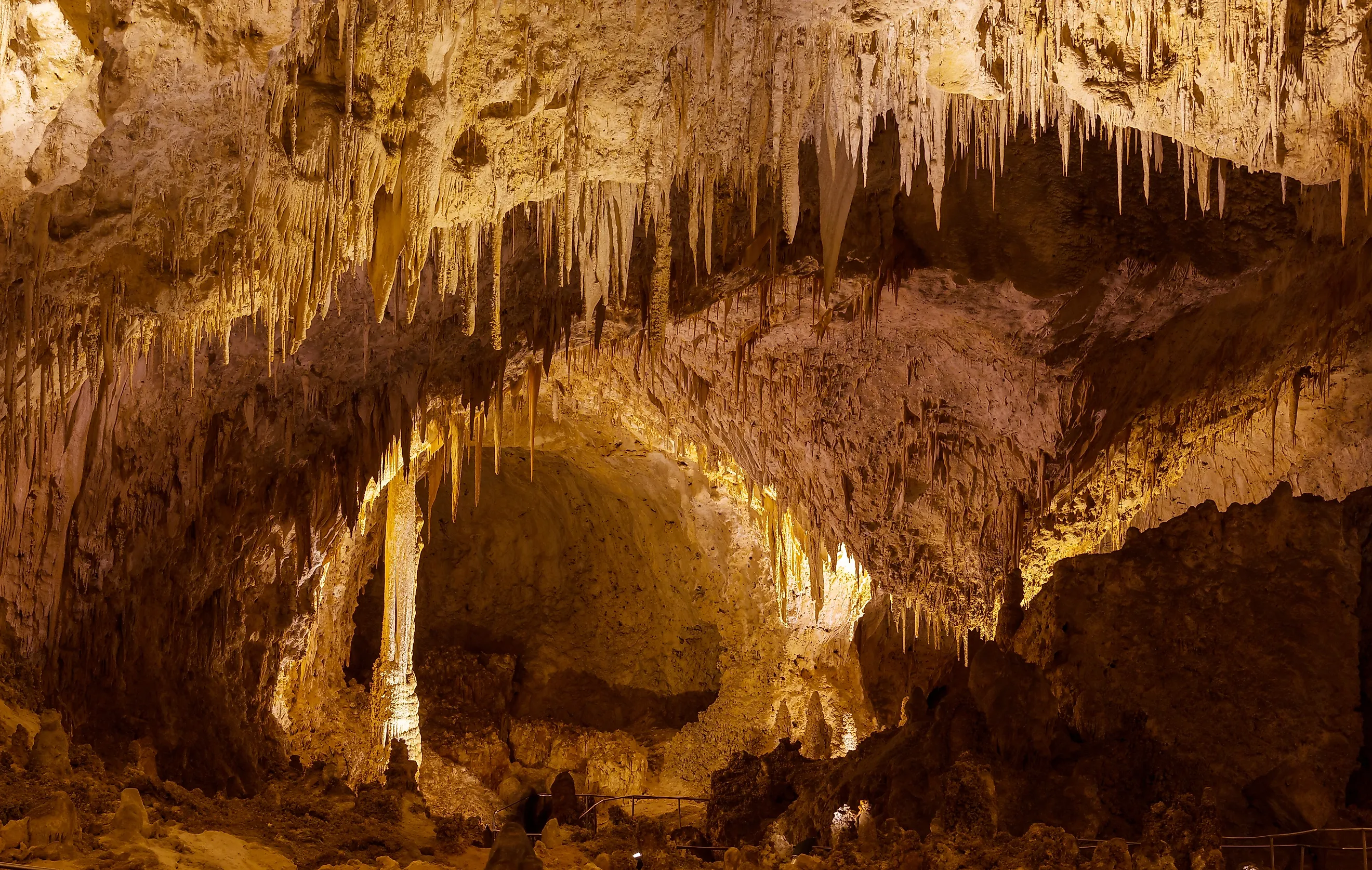
Carlsbad Caverns National Park is located in southeastern New Mexico, part of the geologic formation of the nearby Guadalupe Mountains. Like Mammoth Cave, there's evidence indigenous people knew of the cave for hundreds of years or longer, but its existence was highlighted in modern times after teenage cowboy Jim White, investigating what he thought was a plume of smoke in 1898, discovered it was actually thousands of bats emerging from the cave entrance. White conducted the first modern exploration and mapping of parts of the cave, including naming some still-visited portions like the Big Room and King's Palace. After a time being mined for bat guano, the cave was protected first as a national monument in 1923, then designated as a national park seven years later.
Visitors can descend via an elevator or undertake the unique but challenging Natural Entrance Trail, which descends steeply into the cave over the course of just over a mile. Once there, ranger-led tours offer glimpses into the deeper parts of the cave and provide context about the natural and human history of the space. To cap off their day, they can catch a glimpse of some of the creatures that first led Jim White to the cavern, with the seasonal bat flight ranger program that provides a view of thousands of bats streaming out of the cave at sunset.
Wind Cave National Park, South Dakota

For generations, Wind Cave was known and revered by the Lakota indigenous people of this part of southwestern South Dakota, who viewed the small "natural entrance" as an important part of their emergence story. It was given its modern name after two brothers found the cave in 1881 as a result of the sound of rushing air escaping from one of the few exits to the system. Just 22 years later, it was protected as a national park, partially as a result of the findings of early explorers like Alvin McDonald, who named several rooms and routes.
From a geologic perspective, Wind Cave is distinct for its sheer density. At least 167 miles of passageways are known to exist under a surface footprint of just 1.25 square miles. It also offers striking examples of the phenomenon known as boxwork, where calcite fin formations intersect to create a grid or honeycomb-like structure. Visitors can enjoy several different cave tours that explore different portions and depths of the formation, as well as above-ground activities such as scenic drives, camping, and watching the abundant local wildlife in the southern Black Hills and surrounding prairie.
Other Notable National Park Caves

Several other national parks preserve worthwhile cave features, even if caves aren't their primary focus. Great Basin National Park in Nevada is home to Lehman Caves, a marble cave known for its abundant formations. It was protected as Lehman Caves National Monument decades before being incorporated into the national park in 1986, with limited ranger-led tours now available.
In California, Sequoia National Park contains Crystal Cave, another marble cavern decorated with stalactites, stalagmites, and other formations. It's one of dozens of caves documented within the area, although most aren't open for public visitation, unlike the guided tours available of Crystal.
Hawaiʻi Volcanoes National Park offers a completely different underground experience at Nahuku, also known as the Thurston Lava Tube. The tunnel formed when the surface of a lava flow hardened while molten lava continued moving underneath it. It can be accessed with a 1.5-mile hike of moderate difficulty.
Head Underground to See Some of America's Most Unique National Parks
Although they might not be immediately apparent to those passing by, the cave-focused units of the National Park System are among the most striking and unique in the nation. With rich histories, unique geology, and a variety of activities, both accessible and challenging, they're worth a closer look for those who don't mind a little time underground.