Where People Are Moving To In The Poconos In 2026
Deaths outnumbered births in all four Pocono counties between 2020 and mid-2025, yet the latest census estimates show the region gaining 4,799 people through migration. Pike County alone accounted for 4,248 of that gain, and Monroe County lost 1,113 people. Pike's 7.3% growth led every county in Pennsylvania, a state that grew just 0.4% overall. Most of the fastest gains landed in townships rather than boroughs, often in private lake communities first built for seasonal use. Carbon County carries the strongest in-state current, drawing most of its movers from inside the state, with the Lehigh Valley in the lead. Pike County's planners point to a pandemic that reshaped housing demand and where people work.
Penn Forest Township, Pennsylvania

Lehigh County sent 525 people to Carbon County in a single tax year, more than any other county did. Northampton County added another 350. Penn Forest Township, the largest municipality in Carbon County, grew to 10,434 people by July 2025, up from 9,930 in 2020. That 5.1% gain was three times the county rate of 1.7%.
A typical owner-occupied home in Penn Forest is worth $250,100, compared with $300,400 in Lehigh County and $308,600 in Northampton County. The statewide median is $254,500. The average commute takes 42.1 minutes, against 32.5 across Carbon County. The Pennsylvania Turnpike has its own Route 903 interchange, Exit 87, inside the township.
Many homes belong to large private communities such as Towamensing Trails, with 2,402 homes in 2020, and Bear Creek Lakes. Supervisor Patrick Holland raised the lack of sidewalks during budget discussions. In November 2025, the Jim Thorpe Area School District cleared the way for a township trail linking Penn Forest Park to the Bear Creek Lakes entrance.
Lehman Township, Pennsylvania

Like Penn Forest, Lehman Township touches Monroe County, sharing a line with Middle Smithfield Township. Lehman added 506 people between April 2020 and July 2025 to reach 11,366, a 4.7% gain. Traffic runs both ways, though, since Pike County drew 235 movers from Monroe County in one tax year and sent 315 back.
The bigger pull comes from across the state line. Saw Creek Estates, a lake community of more than 2,200 homes, spans the line between Lehman and Middle Smithfield. Pike County's community development plan says it has long been marketed to New York and New Jersey households as an affordable place to live. The same plan notes that many seasonal homes in the county's lake communities became year-round homes.
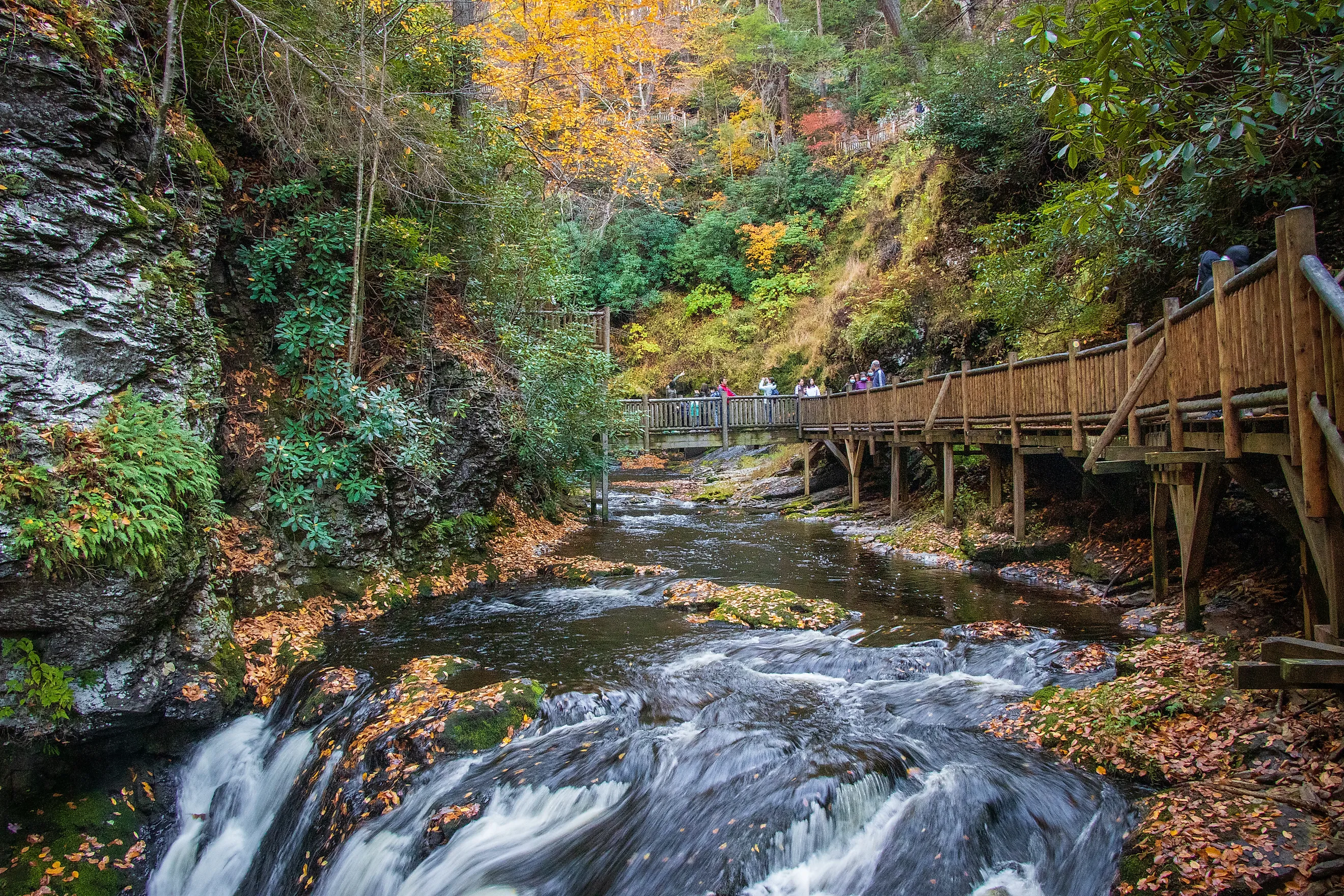
Commutes here average 53.1 minutes, against 42.3 for Pike County. Lehman and Dingman are the only two Pike municipalities where state recycling law requires curbside pickup. Bushkill Falls, the township's best-known landmark, closes each year December through March.
Dingman Township, Pennsylvania

No Pike County municipality added more people than Dingman Township. It reached 13,467 people in July 2025, up from 12,490 in 2020, a 7.8% gain. Pike County logged 1,149 more deaths than births over that period, and net domestic migration added 5,080. Sussex County, New Jersey, sent Pike 209 movers in one filing year.
Dingman has been filling in for decades. A 2006 Milford-area comprehensive plan counted its housing units climbing to 5,689, up from 1,387 in 1980. It suggested lake communities like Sunrise Lake, Conashaugh Lakes, and Gold Key Lake helped drive that rise. Dingman issued 64 of the county's 254 new single-family home permits in 2024, the most of any Pike municipality.
School enrollment has moved the other way. Delaware Valley School District, the district serving Dingman, counted 4,934 students at the close of the 2012-2013 school year and 4,251 in 2024-2025. The township is now rewriting its comprehensive plan for the first time since 1999. Raymondskill Falls, three stacked waterfalls dropping about 126 feet, is within the township.
Westfall Township, Pennsylvania

Westfall Township's population estimate jumped to 3,365 in 2023, up from 2,630 in 2021. By mid-2025 it reached 3,423, up 34.8% on the 2020 base of 2,540. That rate placed Westfall among the five fastest-growing municipalities in Pennsylvania.
The township looks across the Delaware River at New Jersey and New York. Most of Pike County's newcomers come from beyond Pennsylvania. In one year of tax filings, 2,869 people moved into Pike from other states, compared with 928 from elsewhere in Pennsylvania. Orange County, New York, was the largest single source at 426.
Westfall has been building, too. Township supervisors approved the developer's agreement for the Paddlers Point Garden Apartments in February 2020. A new nursing home on Rivers Edge Drive, built with an assisted-living center beside it, welcomed its first occupants in early 2021. Westfall shares Dingman's school district. Looking ahead, Pike County's 2024 comprehensive plan expects Westfall to post the highest compound annual growth rate of any municipality in the county.
Lackawaxen Township, Pennsylvania

Roebling's Delaware Aqueduct, the oldest existing wire suspension bridge in the United States, crosses the Delaware at Lackawaxen Township's eastern edge. Pike County's largest and northernmost township now counts 5,486 people, up 7.6% on its 2020 count of 5,100.
Wayne County is Pike's largest in-state source of movers. It sent 263 people into Pike during the most recent filing year, ahead of Monroe County's 235. The township skews older than the state. People 65 and over make up 38.9% of Lackawaxen's population, compared with 21.4% across Pennsylvania.
A 2009 joint plan with Shohola Township counted nearly half of Lackawaxen's housing as seasonal and reported many of those units converting to year-round use. Owners now occupy 96.4% of Lackawaxen's occupied homes, against 69.3% statewide. The township describes Masthope Mountain as a fast-growing, four-season private community of single homes.
Blooming Grove Township, Pennsylvania

Some 3,500 of the 3,800 lots in Hemlock Farms are in Blooming Grove Township. The township's 2008 comprehensive plan called Hemlock Farms the largest planned residential subdivision in Pike. Pike's central township reached 5,751 people in the 2025 estimate, against 5,387 in April 2020, a 6.8% gain.
Interstate 84 crosses the township, and the 2008 plan credits the highway with a central role in local growth. The plan tracked second homes falling to 1,680 in 2000, down from 2,230 in 1990, a drop its authors read as evidence of a growing permanent population. Lackawanna County, at 109 movers, ranks among Pike's other in-state sources.
Homes here carry a premium. The median owner-occupied value of $323,600 tops the Pike County figure of $272,600 and the statewide $254,500. Blooming Grove is the one Pike township that borders no other county. State game lands, state forest, and Promised Land State Park take up about 21,700 acres, more than two-fifths of the township.
Paupack Township, Pennsylvania

Second homes made up 2,530 of Paupack Township's 4,293 housing units in 2020. That count had risen by 283 since 2010, outpacing the township's total housing growth of 263 units. The population climbed anyway, reaching 3,738 in the July 2025 estimate, up from 3,654 in 2020.
That 2.3% gain doubled Wayne County's 1.1%. Wayne, Pike's top in-state supplier, counts Lackawanna County as its own top origin, with 410 movers in the latest year of migration data. A state study of sales between January 2020 and June 2021 found home sales rising sharply in Wayne, Pike, and Monroe counties, and many buyers in that study hailed from New York or New Jersey.
Lake Wallenpaupack forms the township's entire southeastern boundary. Lacawac Sanctuary spans 500 acres across Paupack and Salem townships, and its Lake Lacawac has held National Natural Landmark status since 1968.
Where The Lake Country Goes Next
The Poconos' growth has moved up the Delaware into Pike County's lake townships, and Carbon County keeps drawing movers from the Lehigh Valley. Monroe County has posted two small gains in a row, 56 people and then 361, after losing ground earlier in the decade. Pike County's plan sees Westfall growing fastest in the years ahead, and it blames out-of-state demand for inflated home sales and rental prices. Planned communities there are raising annual dues as well, and commutes in Lehman, Dingman, and Penn Forest already average more than 40 minutes.