Maps of Missouri
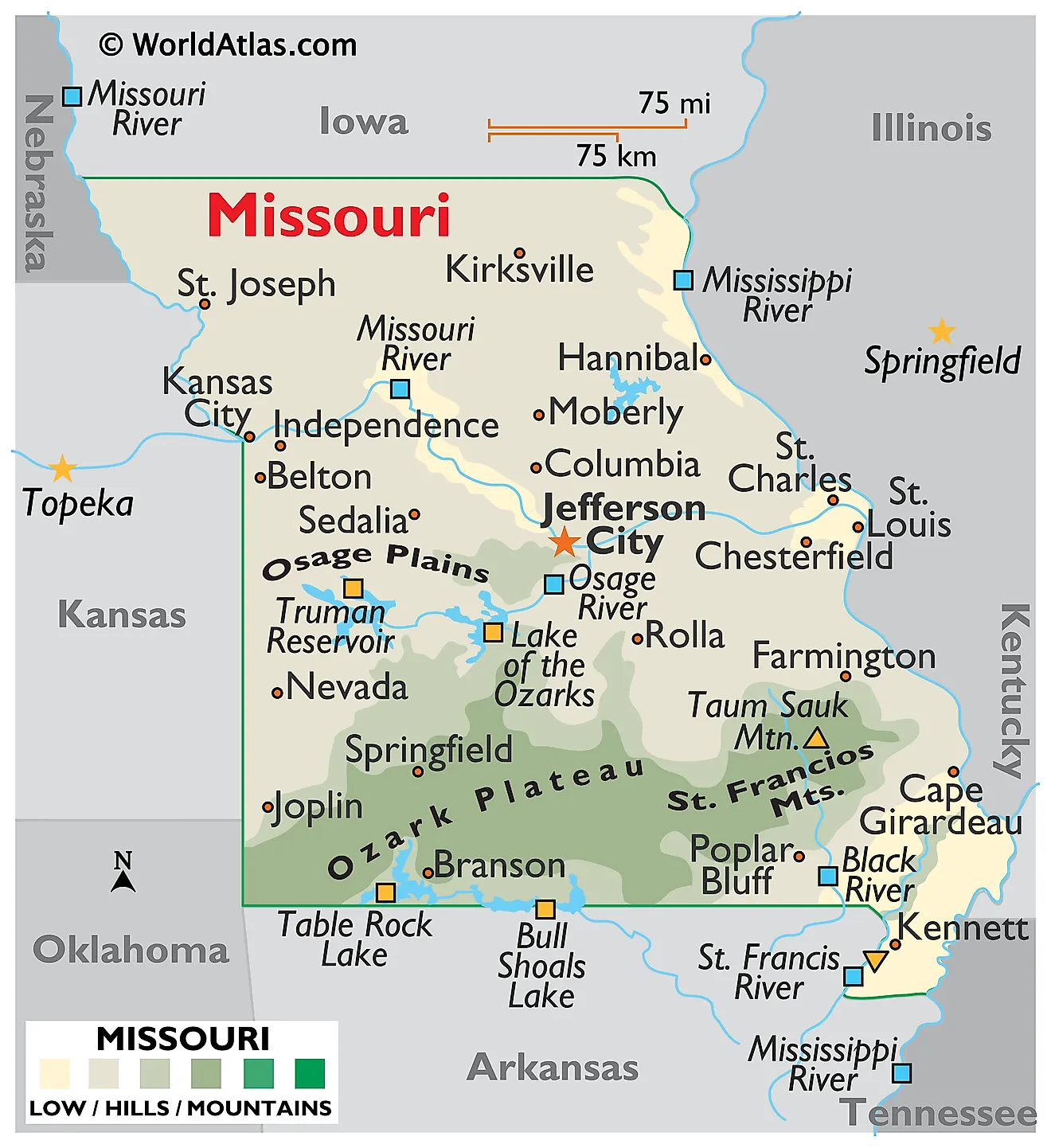
Missouri sits near the geographic center of the United States and shares borders with eight states — more than any state except Tennessee, which also borders eight. Iowa lies to the north; Illinois, Kentucky, and Tennessee to the east across the Mississippi; Arkansas to the south; and Oklahoma, Kansas, and Nebraska to the west. The state is landlocked, covering approximately 69,707 square miles (180,540 square kilometers), which makes it the 21st largest state.

Missouri's landscape is organized by two things above all: the two great rivers that meet within its borders, and the boundary of the last continental ice sheet. Everything north of the Missouri River was glaciated and left flat to gently rolling. Everything south of it escaped the ice and remains an old, deeply eroded upland of hills, caves, and springs. The two halves of the state look and feel almost nothing alike.
Where Is Missouri?
Missouri stretches about 284 miles east to west and roughly 308 miles north to south at its greatest extent. Its outline is unusual in two respects. The northern boundary with Iowa is a straight surveyed line, but the southeastern corner drops away into the Bootheel, a rectangular projection reaching some 30 miles further south than the rest of the state — the result of a landowner's successful lobbying when the boundary was drawn in 1820.
With roughly 6.25 million residents, Missouri is the 19th most populous state. Jefferson City, on the Missouri River, is the capital. Kansas City, on the western border, is the largest city at around 510,000 residents, while St. Louis anchors the east. The state is divided into 114 counties plus the independent City of St. Louis.
The Glaciated Plains

Northern Missouri lies within the Dissected Till Plains, the region left behind when Pre-Illinoian ice sheets advanced over the area more than 500,000 years ago and then melted away. The ice flattened the pre-existing hills and buried the bedrock beneath a thick blanket of glacial till, which later weathering and stream erosion cut into the gently rolling farmland seen today. The soils here are the deepest and most productive in the state.
The region has three distinct subdivisions. The Western Glaciated Plains, along the Missouri River, feature steep river bluffs and terraces. The Grand River Glaciated Plains run north toward Iowa and are capped with loess — windblown silt deposited by winds sweeping off glacial outwash plains, which forms distinctive steep-sided hills near the river valleys. In the Eastern Glaciated Plains, the land rises into the Lincoln Hills near the Mississippi River, a more rugged and heavily forested belt where older bedrock stands above the till.
Hannibal, Mark Twain's boyhood home, sits on the Mississippi bluffs at the eastern edge of this region.
The Osage Plains

The Osage Plains occupy west-central Missouri and represent the easternmost reach of the Great Plains. This is prairie country: broad, level to gently rolling grassland underlain by flat-lying sandstone, shale, and coal-bearing rock, interrupted by scattered woodland along the stream courses. It escaped glaciation but was never uplifted like the Ozarks, so it lacks both the deep till of the north and the rugged relief of the south.
Before European settlement this region carried tallgrass prairie. Most has since been converted to cropland and pasture, though remnants survive at Prairie State Park and a handful of other preserves. Shallow coal seams here supported strip mining for much of the 20th century.
The Ozark Border

Between the plains to the north and west and the Ozark uplift to the south runs a transitional belt known as the Ozark Border. It follows the Missouri River valley across the center of the state and then swings south along the Mississippi.
The Missouri Ozark Border is a mix of rolling hills, bluffs, and small valleys where the river has cut into the northern edge of the Ozark dome. The Mississippi Ozark Border, to the east, has more pronounced relief and is dissected by numerous streams draining toward the Mississippi. Jefferson City, Columbia, and the wine country around Hermann and Augusta all fall within this belt, which benefits from both the richer soils of the valley and the shelter of the hills.
The Ozark Plateau

The Ozarks dominate southern Missouri and are the state's defining landform. Despite often being called mountains, the Ozarks are a broad structural dome that was pushed upward and has since been carved into hills and valleys by running water. The ridgetops are remnants of a once-continuous surface, which is why they rise to roughly the same height across large distances.
Because the bedrock is largely limestone and dolomite, the region is classic karst country. Groundwater has dissolved the rock into caves, sinkholes, losing streams, and enormous springs. Missouri is nicknamed "The Cave State" and contains more than 7,500 recorded caves, second only to Tennessee. Big Spring, near Van Buren, discharges an average of around 286 million gallons a day, among the largest single-outlet springs in the country.

The Ozarks break into several distinct sections. The Springfield Plateau in the southwest is a relatively level upland riddled with springs and sinkholes. The Upper Ozarks to the northeast have steep valleys and narrow ridges. The Lower Ozarks are the most deeply dissected, running toward the Arkansas line, while the White River and Elk River sections in the far southwest are known for their bluff-lined valleys.
At the northeastern edge of the dome stand the St. Francois Mountains, and these are genuinely different from everything around them. They are made of Precambrian rhyolite and granite roughly 1.5 billion years old — the ancient igneous core of the uplift, exposed where erosion stripped away the overlying sedimentary rock. They rank among the oldest exposed rock in North America. Taum Sauk Mountain, at 1,772 feet (540 meters), is the highest point in Missouri, and nearby Mina Sauk Falls drops about 132 feet, the tallest waterfall in the state.
The Mississippi Lowlands

Southeastern Missouri, including the Bootheel, belongs to the Mississippi Alluvial Plain — a flat expanse of river-deposited silt and clay that is geologically and visually unlike any other part of the state. Elevations fall to around 230 feet at the state's lowest point, on the St. Francis River in Dunklin County.
Much of this area was swamp and bottomland forest until a vast drainage effort in the early 20th century converted it to farmland. The resulting soils are the richest in Missouri and support cotton, rice, and soybeans — crops grown nowhere else in the state. Crowley's Ridge, a narrow band of wind- and water-deposited sediment rising 100 to 200 feet above the plain, runs south from near Cape Girardeau into Arkansas and stands out sharply in an otherwise level landscape.
This region also sits atop the New Madrid Seismic Zone. Between December 1811 and February 1812, a sequence of powerful earthquakes centered near New Madrid reshaped the landscape, altering the course of the Mississippi and creating sand blows still visible in the fields today. The zone remains the most seismically active area in the central United States.
Rivers

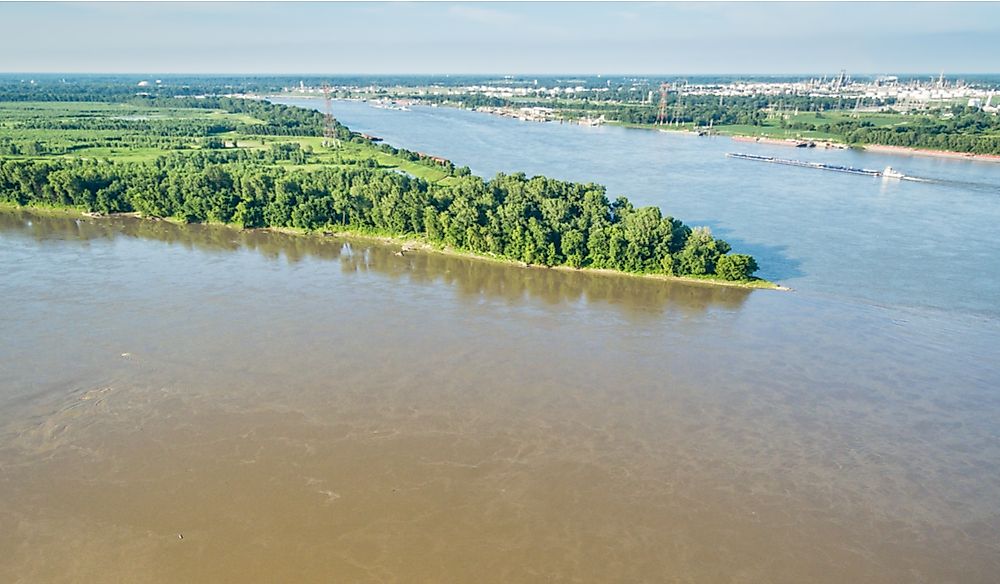
The Missouri River is the longest river in North America at roughly 2,341 miles. Its role in shaping the state is often described inaccurately, so it is worth being precise: the Missouri forms part of the state's northwestern boundary with Nebraska and Kansas, running south from the Iowa corner to the Kansas City area. It does not form the northern border with Iowa, which is a straight surveyed line. At Kansas City the river turns east and flows roughly 550 miles through the middle of Missouri before joining the Mississippi just north of St. Louis.
The Mississippi forms the entire eastern border, from the Iowa line down to the Arkansas state line, a distance of about 480 miles. Their confluence above St. Louis is one of the most significant river junctions in North America and was the staging ground for the Lewis and Clark expedition.

Interior rivers include the Osage, the Gasconade, the Meramec, and the spring-fed Current and Jacks Fork, which together form the Ozark National Scenic Riverways — established in 1964 as the first national park unit created to protect a river system. The Des Moines River defines a short stretch of the boundary in the extreme northeast.
Lakes and Reservoirs

Missouri has no large natural lakes. The glaciers that reached the northern counties were too old and too thin to leave the lake basins found in the upper Midwest, and the Ozarks drain too efficiently through their own limestone to hold standing water. Every major lake in the state is a reservoir.
Lake of the Ozarks was formed in 1931 when Bagnell Dam impounded the Osage River. Its serpentine shape follows the drowned river valley so closely that it has roughly 1,150 miles of shoreline despite covering about 54,000 acres. Truman Lake, upstream on the same river, is larger in surface area at around 55,600 acres.

Table Rock Lake, completed in 1958 on the White River, backs up against the Arkansas line near Branson. Downstream lies Lake Taneycomo, a narrow, cold-water lake whose temperature is controlled by releases from Table Rock Dam. Mark Twain Lake in the northeast and Stockton Lake in the southwest round out the state's major impoundments.
Climate

Missouri has a humid continental climate in the north and a humid subtropical climate in the south, with no mountain barrier in any direction. That openness is the defining feature: cold Canadian air, warm Gulf moisture, and dry air off the plains all reach the state freely, producing large temperature swings and volatile weather.
Precipitation increases from around 34 inches a year in the northwest to more than 50 inches in the Bootheel. Snowfall follows the reverse gradient, from roughly 24 inches in the north to under 10 inches in the southeast. Missouri lies within the broader tornado-prone corridor of the central United States; the Tri-State Tornado of March 1925, the deadliest in American history, began in southeastern Missouri before crossing into Illinois and Indiana.
Missouri Geography at a Glance
| Feature | Detail |
|---|---|
| Total area | Approx. 69,707 sq mi (180,540 sq km) — 21st largest state |
| Highest point | Taum Sauk Mountain, 1,772 ft (540 m) |
| Lowest point | St. Francis River, approx. 230 ft |
| Bordering states | Eight: Iowa, Illinois, Kentucky, Tennessee, Arkansas, Oklahoma, Kansas, Nebraska |
| Eastern border | Mississippi River, approx. 480 mi |
| Northwestern border | Missouri River (with Nebraska and Kansas) |
| Major regions | Glaciated Plains, Osage Plains, Ozark Border, Ozark Plateau, Mississippi Lowlands |
| Recorded caves | More than 7,500 — second only to Tennessee |
| Largest lake | Truman Lake, approx. 55,600 acres (reservoir) |
| Capital / largest city | Jefferson City / Kansas City |
Counties Map
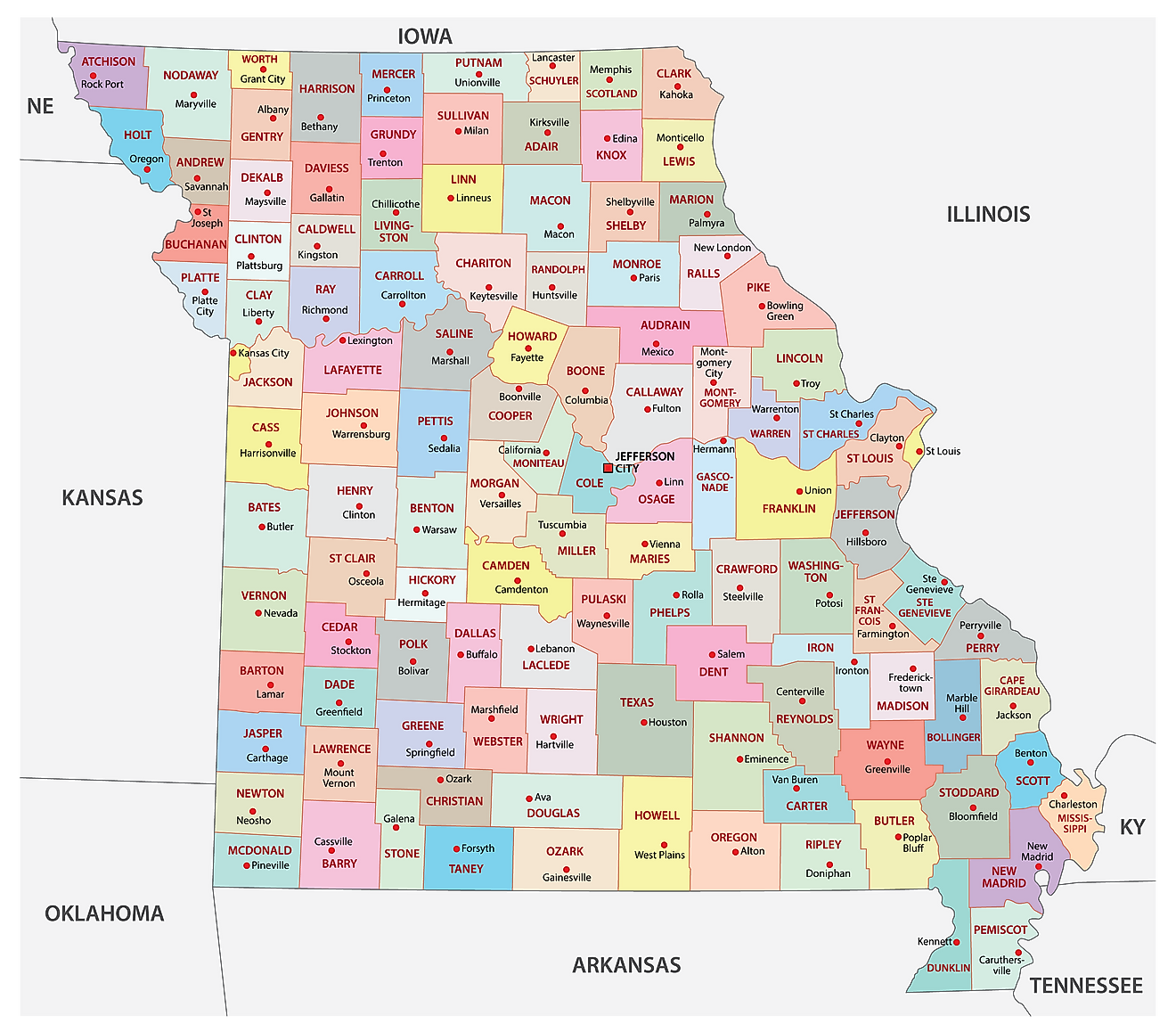
The State of Missouri is divided into 114 counties, along with the independent City of St. Louis, which lies outside the county system but functions as a county equivalent. In alphabetical order, the counties are: Adair, Andrew, Atchison, Audrain, Barry, Barton, Bates, Benton, Bollinger, Boone, Buchanan, Butler, Caldwell, Callaway, Camden, Cape Girardeau, Carroll, Carter, Cass, Cedar, Chariton, Christian, Clark, Clay, Clinton, Cole, Cooper, Crawford, Dade, Dallas, Daviess, DeKalb, Dent, Douglas, Dunklin, Franklin, Gasconade, Gentry, Greene, Grundy, Harrison, Henry, Hickory, Holt, Howard, Howell, Iron, Jackson, Jasper, Jefferson, Johnson, Knox, Laclede, Lafayette, Lawrence, Lewis, Lincoln, Linn, Livingston, Macon, Madison, Maries, Marion, McDonald, Mercer, Miller, Mississippi, Moniteau, Monroe, Montgomery, Morgan, New Madrid, Newton, Nodaway, Oregon, Osage, Ozark, Pemiscot, Perry, Pettis, Phelps, Pike, Platte, Polk, Pulaski, Putnam, Ralls, Randolph, Ray, Reynolds, Ripley, St. Charles, St. Clair, St. Francois, St. Louis, Ste. Genevieve, Saline, Schuyler, Scotland, Scott, Shannon, Shelby, Stoddard, Stone, Sullivan, Taney, Texas, Vernon, Warren, Washington, Wayne, Webster, Worth, and Wright.
With an area of 180,540 sq. km, Missouri is the 21st largest state in the USA and the 19th most populous. Located at the northern edge of the Ozark Plateau and on the south bank of the Missouri River, in Cole County, is Jefferson City (officially, the City of Jefferson) – the capital city of Missouri. Situated in the western part of the state, near the confluence of the Missouri and Kansas Rivers, is Kansas City – the most populous city of Missouri. Kansas City serves as an important shipping and marketing center for a vast agricultural region and is one of the largest rail hubs in the United States.
Where is Missouri?
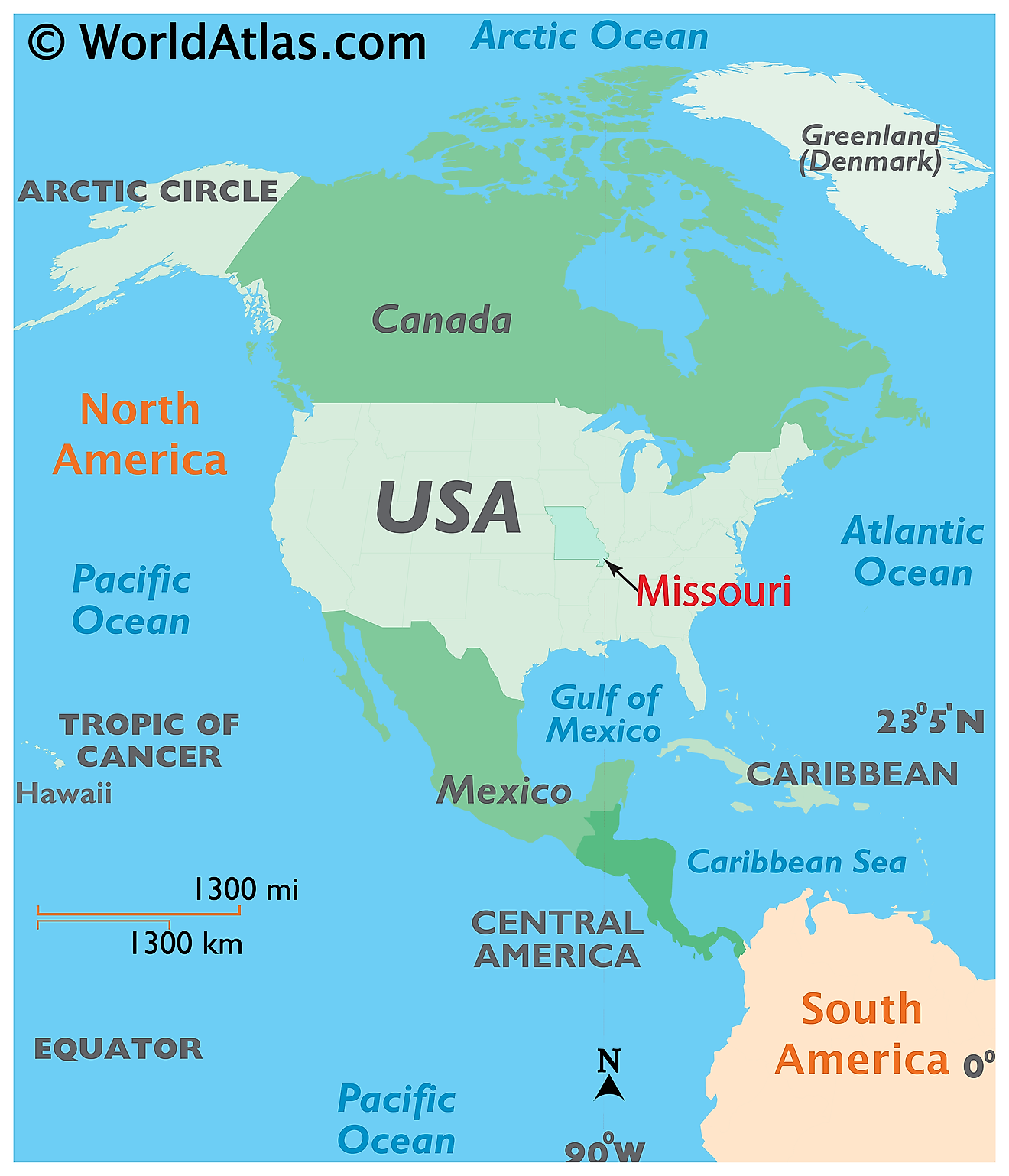
The State of Missouri is located in the central or Midwest region of the United States. Missouri is a land-locked state that is bordered on all sides by eight different states. It is bounded by Kansas, Nebraska, and Oklahoma in the west; by Arkansas in the south; by Illinois, Kentucky, and Tennessee in the east, and by Iowa in the north.
Regional Maps: Map of North America
Outline Map of Missouri
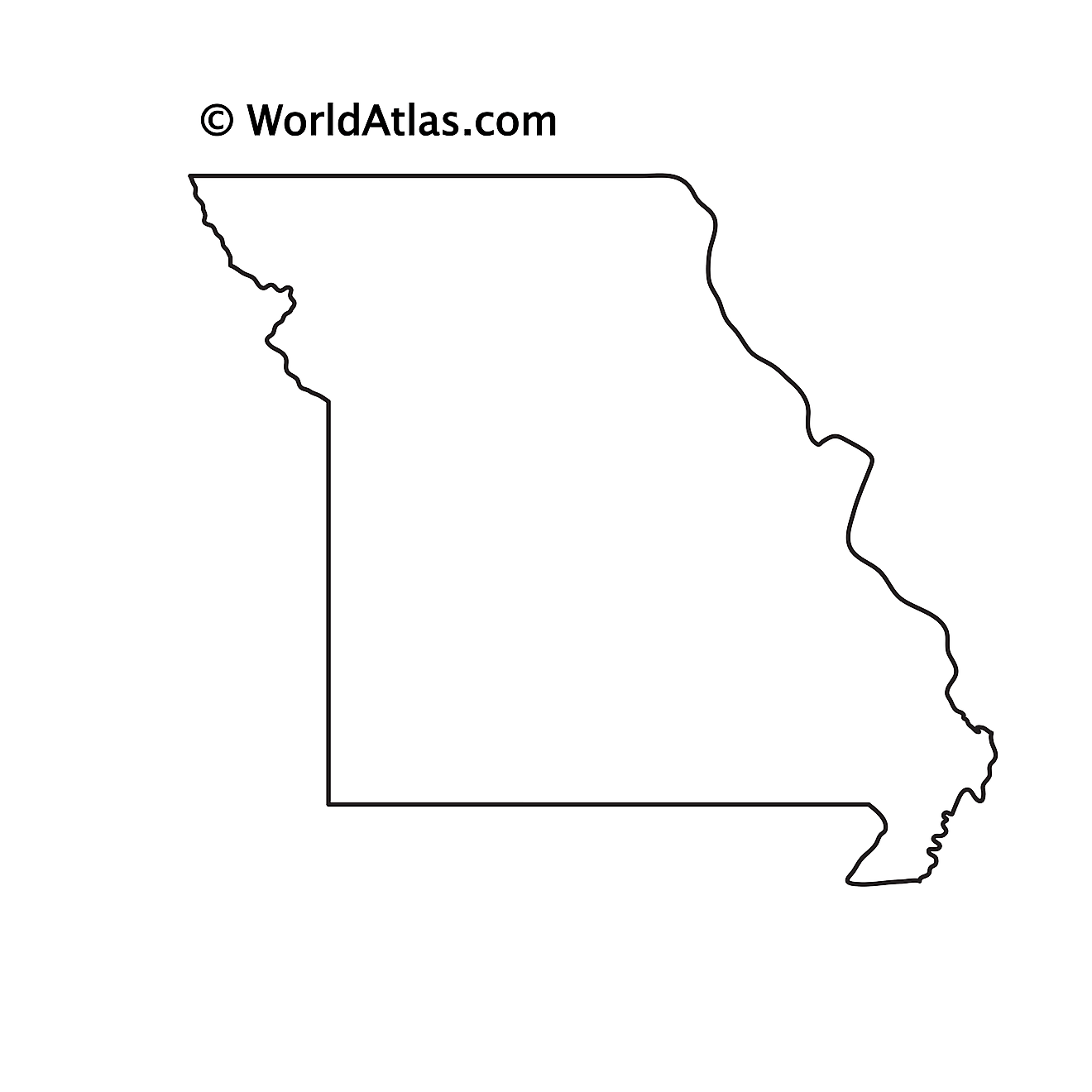
The above blank map represents the State of Missouri, located in the central or Midwest region of the United States. The above map can be downloaded, printed and used for geography education purposes like map-pointing and coloring activities.
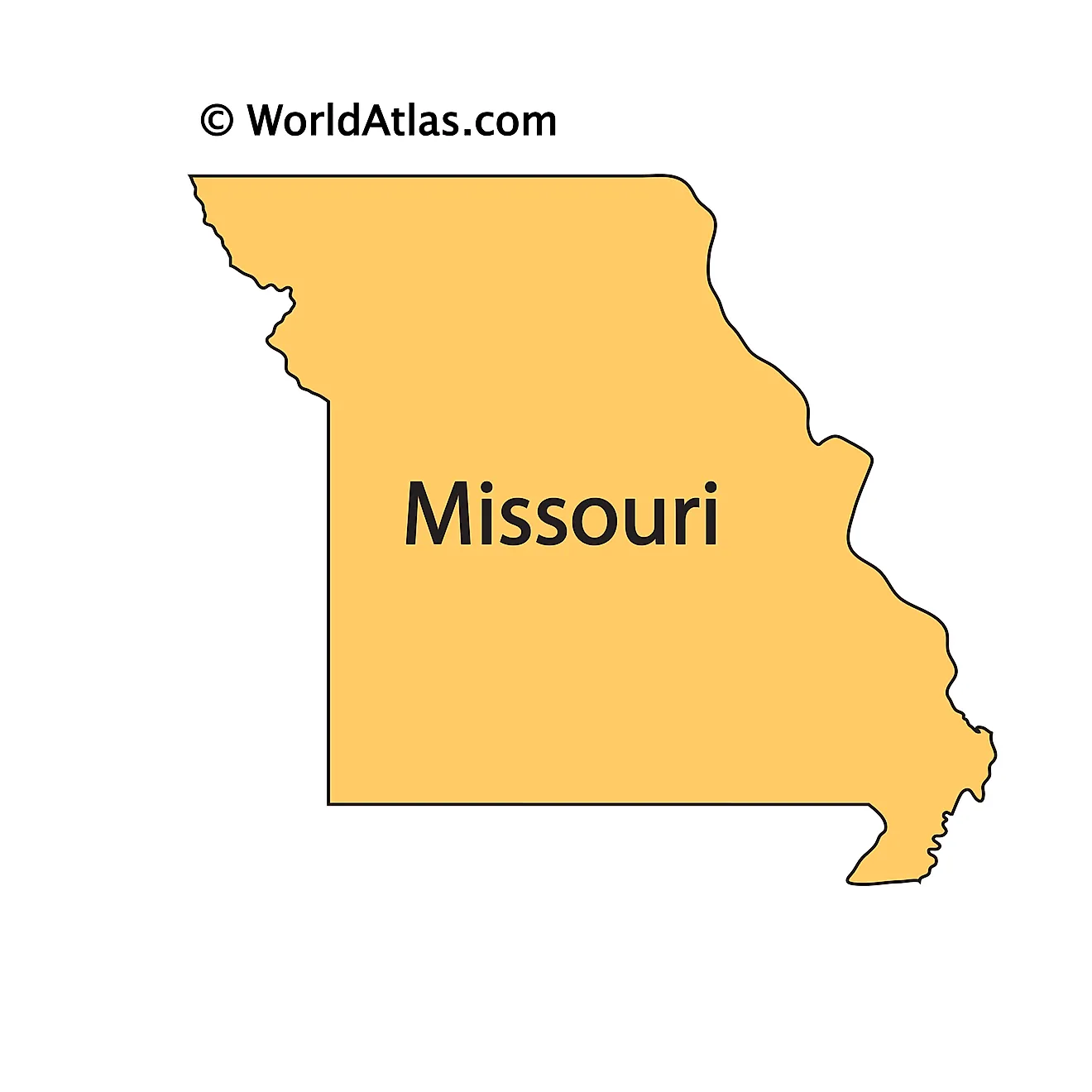
The above outline map represents the State of Missouri, located in the central or Midwest region of the United States.
Key Facts
| Legal Name | State of Missouri |
|---|---|
| ISO 3166 Code | US-MO |
| Capital City | Jefferson City |
| Major Cities |
|
This page was last updated on September 17, 2026