6 Tiny Off-Grid Towns In Northern Ireland
Located in the north-eastern part of the island of Ireland, Northern Ireland has a tourism sector well known to visitors from around the world. Places like the spectacular Giant’s Causeway, the Titanic Quarter in Belfast, and a growing roster of Game of Thrones film locations are all must-dos for those here for a vacation. A distinct part of the United Kingdom since 1921, Northern Ireland is also sprinkled with tiny offbeat postcard-perfect towns. So rent a car, order an Uber, or even use public transit to a countryside village for an authentic Irish experience. Visit a 17th-century distillery in Bushmills, explore ancient sea-carved caves in Cushendun, and admire the historic Gilford Castle in Gilford. For more ideas and inspiration, check out these six towns in Northern Ireland that are a must-visit.
Bushmills, County Antrim

On the route from Belfast to the UNESCO World Heritage Site that is the Giant’s Causeway, Bushmills is well worth getting off the bus for. Set along the River Bush just two miles from the Giant’s Causeway, a walking tour starting in the town’s modest Market Square is an ideal introduction to rural life in this part of the world.
You’ll first notice the Bushmills Clock Tower, one of around 90 buildings in town that have been deemed conservation priorities. Built in 1874, it was gifted to the town by the affluent Macnaghtens, a local family who also financed the construction of the Bushmills Courthouse in 1834 (it’s now a restaurant and arts and crafts center). The Macnaghtens’ home, Dundarave House, dates from 1847 and hosts country experiences such as hunting and fishing.
The big draw here, though, is the Old Bushmills Distillery. In operation since 1608, the world’s oldest licensed whiskey maker is famous for using water from a tributary of the River Bush known as Saint Columb’s Rill. Guided tours are available and last between one to two hours, depending on how much you wish to see… and taste.
If you can make an overnight stay of it, check into The Bushmills Inn. This 4-star boutique hotel started off as a coaching inn in the 1600s and keeps its interior lit by gas lamps and cozy fireplaces.
Cushendall, County Antrim

One of the more interesting tiny towns in Northern Ireland in terms of geography, the village of Cushendall is situated on the rugged Antrim coast at the convergence of three glacial valleys on the River Dall. The spectacular flat-topped Lurigethan Mountain adds to the scenery, rising dramatically directly behind this quaint market town. And yes, you can climb it; it’s steep and challenging in places, but worth it for the views from the top.
So pretty a setting is it that Cushendall is known as the “Capital of the Glens,” a title that also extends to its role as the region’s cultural and social hub. It’s also part of the Cushendall Conservation Area, a forward-thinking move that has also preserved the town’s charming 19th-century vibe.
The Curfew Tower is worth a few photos. This picturesque pink sandstone turret was initially built in 1817 as a prison for “idlers and rioters," but is now privately owned and used for an artist-in-residence program. Popular local pubs include McMullan's Central Bar and The Lurig Inn on Bridge Street, and the epic Johnny Joe's McCollum's Bar for its outdoor seating and traditional music sessions.
Cushendun, County Antrim

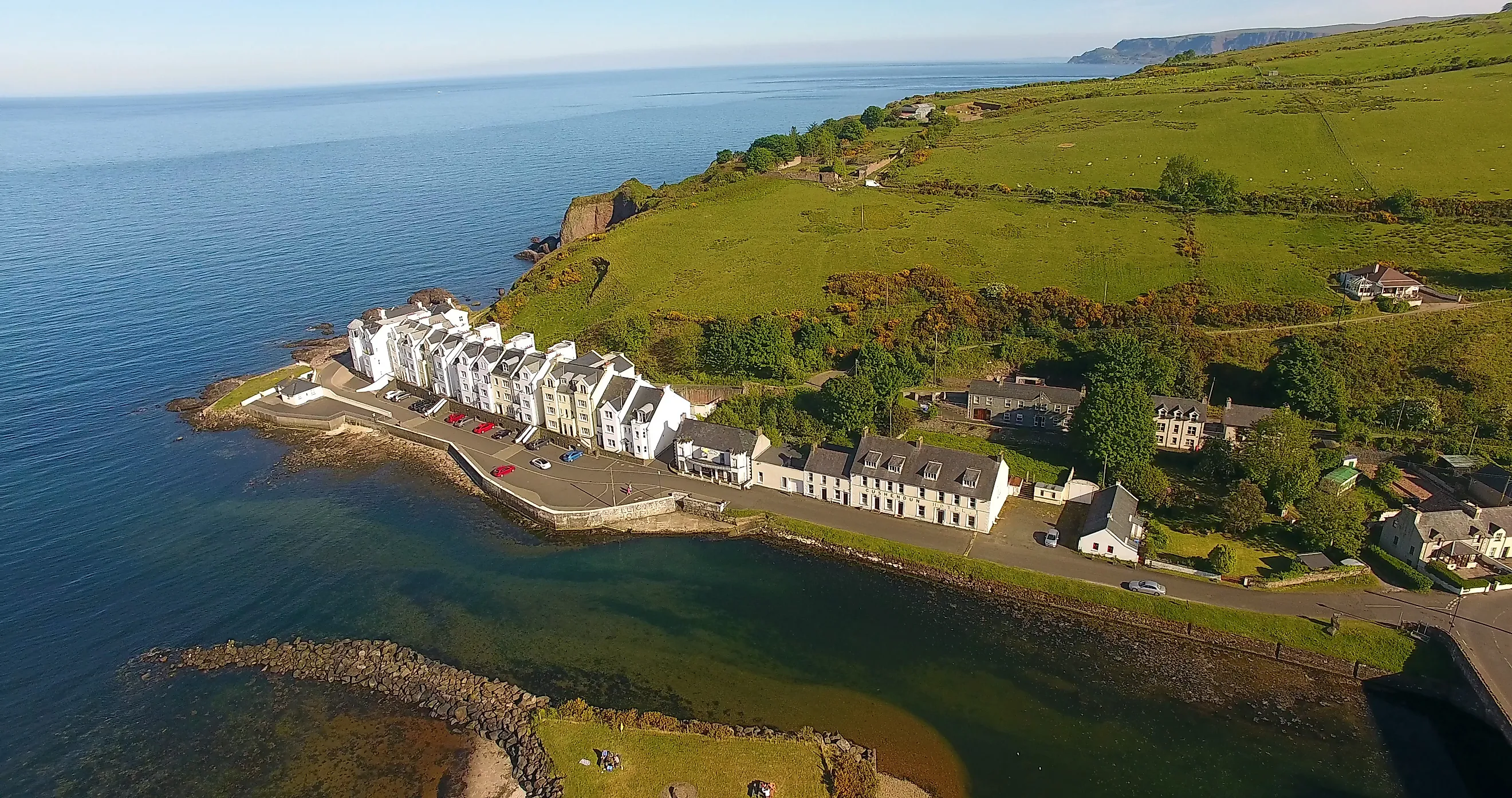
Not to be confused with its neighbor, Cushendall, the village of Cushendun wouldn’t look out of place in Cornwall, England. Located at the mouth of the River Dun in Glendun, one of the famous Glens of Antrim, this tiny community of around 150 people was redesigned in 1912 in the style of Penzance, a pretty Cornish seaside settlement, by the local landowner.
Gone were the traditional gray stone abodes typical of Ireland, and instead, whitewashed cottages, grey slate roofs, and neat Georgian windows were the order of the day (the same designer went on to help create the Italianate village of Portmeirion in Wales). Now a National Trust property, its whitewashed Maud’s Cottages overlook the small harbor in what is undoubtedly one of the prettiest settings in the country.
Other attractions include the Cushendun Caves at the southern end of the village beach. These sea-carved rock formations date back some 400 million years and became famous as a filming location for Game of Thrones. The beach itself, a sheltered crescent of sand facing the North Channel, is calm and uncrowded.
Mary McBride’s Bar, one of the world’s smallest pubs, is a must-visit and serves pints and a seasonal food menu in a space that’s not much bigger than a living room. The Village Tearooms is another treat and serves up an excellent afternoon tea.
Sion Mills, County Tyrone

Laid out in the 1800s around a linen factory on the River Mourne, Sion Mills’ tree-lined streets and public spaces were designed with the welfare of mill workers uppermost in mind. In addition to housing, recreational facilities such as the Working Men's Institute were all built using locally quarried stone.
These and other notable structures in the village can be visited today as part of a very pleasant walking tour of this charming village. You’ll also pass the Church of the Good Shepherd, built in 1909 and extremely easy on the eye. Another place of worship, the Sion Mills Presbyterian Church, dates to 1879 and is located next to the community’s old schoolhouse and war memorial. You’ll also get some great views of the original Herdman's Flax Mill building by following the delightful Mourneside Riverwalk.
Bessbrook, County Armagh

Tiny Bessbrook is unique among Irish villages for what it doesn’t have: pubs. Established in 1845 by a Quaker textile merchant, the village was built on a philosophy that’s still known as the "Three P’s": no pubs, no pawn shops, and no police. The logic was simple enough. Remove the temptation of alcohol, the first “P,” and the other two wouldn’t be needed. And it worked. A poll of villagers in the 1870s affirmed the fact that most residents supported the policy, and to this day, the village remains dry.
Considered one of the UK’s first planned villages and an inspiration for company towns like Bournville, built by the Cadbury family near Birmingham in England, it’s a delight to explore on foot. Two large squares, Charlemont Square and College Square, emphasize the idea of open spaces at a time when most industrial towns were choked with overcrowded tenements.
Guided tours of this unique model village can be arranged in advance, and include a visit to No. 6 College Square East, a restored worker’s house furnished in period style. Nearby attractions include the Craigmore Viaduct, known locally as the Eighteen Arches, and built in 1851 to carry the railway across the valley of the Camlough River. It’s still in use, and its arches, each about 60 feet high, provide a stunning backdrop to the village.
Gilford, County Down

With a history that dates to the mid-1600s, the village of Gilford was once an important crossing point on the River Bann. Originally just a handful of houses clustered near a crossing point on the river, the village textile mill, massively expanded in 1872, became so successful that it employed over 2,000 workers. Housing for workers was added as the town grew, with many of them still standing.
While the impressive six-story factory closed in 1986, you can still get a sense of its scale with a walk along the Gilford Riverside Trail. This easy, 1.5-mile trail runs beside the old factory complex with close-up views of the main building and its tall chimney (the views over the river are also good). Bring a picnic and a fishing rod with you, and can cast a line in the River Bann, popular for its trout fishing.
For a top-notch holiday, investigate a stay at the classy Gilford Castle. Set on the grounds of a sprawling estate on the outskirts of the village, this mid-19th-century manor offers fishing, whiskey tasting, and trails to explore. From here, you can easily walk into town to see the mill and other landmarks such as the pretty Saint Paul's Church of Ireland.
The Quiet Side Of Northern Ireland
Forgo the tour buses and the major tourist traps, and you’ll find a more authentic version of Northern Ireland in its tiny off-grid villages and towns. What these quaint communities lack in big-ticket attractions, they more than make up for by providing a genuine sense that you’re somewhere unique and enjoying something few other tourists will have experienced. For travelers willing to venture off the main road and slow down a little, these six towns show a side to Northern Ireland that’s all too often overlooked.