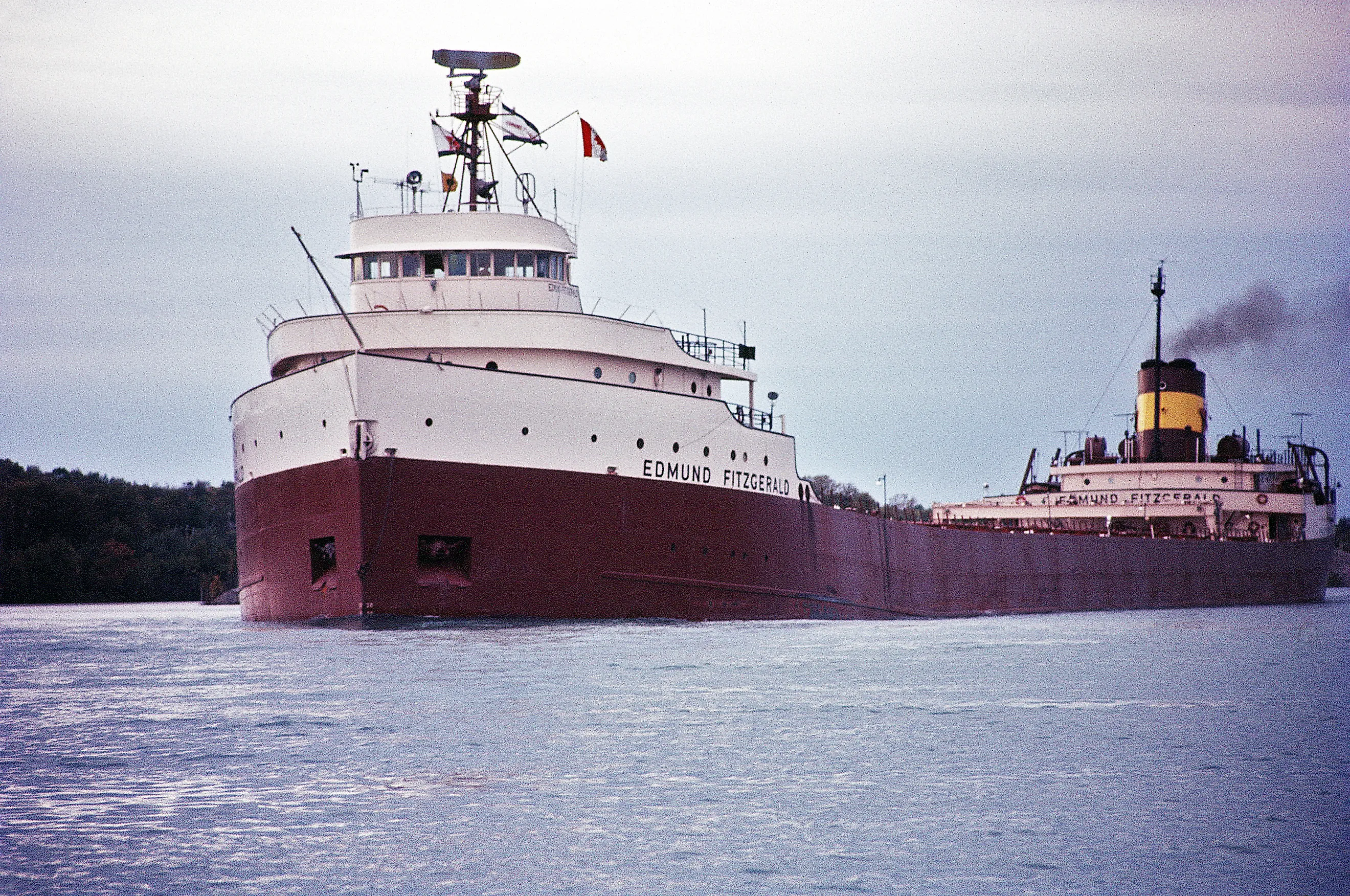
Why The Edmund Fitzgerald Was Never Raised
Fifty-one years after the Edmund Fitzgerald went down in a November storm on Lake Superior, a 200-pound bronze bell is the only thing anyone has brought up from the wreck. The rest of the 729-foot freighter, along with the iron ore pellets it was carrying, sits about 17 miles off Whitefish Point, Michigan, in Canadian waters less than a third of a mile north of the US border.
All 29 men aboard died on November 10, 1975, and their remains were never recovered. In July 1994, a team diving in a two-man submarine found one of them at the wreck, still wearing a life vest, and many of the crew's relatives were upset that anyone had gone down there at all.
The reasons the ship has stayed on the lake floor start with the shape it was in when it reached the bottom, 530 feet below the surface.
Raising It Would Take Two Lifts From 530 Feet Down

Investigators got their first clear look at the Fitzgerald in May 1976, when an unmanned submersible called CURV III surveyed the wreck. The bow section sits upright on the lake floor. The stern section lies upside down and tilted about 10 degrees, and at the time of that survey the two pieces were roughly 170 feet apart at their closest point, with scattered debris around both and a layer of mud over much of the wreckage.
With the hull in two pieces, any salvage would have had to bring up each section on its own, and the stern would have to be lifted while resting on its deck. The holds had been loaded with 26,116 long tons of taconite pellets, a processed iron ore, which comes to about 29,250 standard U.S. tons, and pellets could still be made out in the wreckage during the 1976 survey. All of it lies 530 feet down, a depth about 25 feet short of the height of the Washington Monument.
Investigators Got Their Evidence From Cameras on the Bottom

Reaching 530 feet with a camera was well within CURV III's range. The vehicle was rated for depths to 7,000 feet, more than 13 times deeper than the wreck, and between May 20 and May 28, 1976, it made 12 dives and recorded 895 color photographs along with more than eight miles of videotape.
The Coast Guard's Marine Board studied that footage for its investigation, so the questions about the sinking could be pursued without bringing any part of the ship to the surface. The name Edmund Fitzgerald was clearly visible on both the bow and the stern, which settled the wreck's identity. In all those hours of video, no bodies were seen, and no items turned up that could be identified as personal effects of the crew.
The Wreck Is the Crew's Grave

Lake Superior's deep water stays near 39 degrees Fahrenheit all year, cold enough that the bacteria that would normally fill a body with gas barely function, so a body that sinks there stays on the bottom. That cold explains how one of the Fitzgerald's crew was still at the wreck almost 19 years after the sinking.
Businessman Frederick Shannon led the expedition that found him, spending about $75,000 to lease a two-man submarine for seven dives in late July 1994. His team found the body of a crewman, wearing a life vest, among the wreckage. Relatives who had objected to the dives were more upset still when Shannon announced that a body could be seen. After 1994, relatives objected to additional expeditions to the wreck.
The Families Asked for the Bell and Wanted the Rest Left Alone

Recovering anything from 530 feet took special equipment. The diver who went down in 1995 wore a Newt Suit, a hard-shelled atmospheric diving suit that let him get close enough to recover the ship's 200-pound bronze bell. The recovery took place on July 4, 1995, in a joint expedition led by the Great Lakes Shipwreck Historical Society that included the Canadian Navy, and it was made at the request of many of the crew's families.
Ruth Hudson, whose son Bruce was a deckhand on the Fitzgerald, described what the day meant to the relatives who never had a body to bury. "Finally, we had our own funeral. It's a grave now," she said. A replica bell engraved with the names of all 29 men was placed on the wreck.
Removing Any Part of the Wreck Requires an Ontario License

The families had wanted the site declared a gravesite, and after the bell recovery they worked with the Canadian government toward that goal. Under Ontario's Heritage Act, a regulation filed in January 2006 lists the Edmund Fitzgerald as one of three protected shipwreck sites and sets a 500-meter radius, about 1,640 feet, around the wreck. Diving there or operating a submersible requires a site-specific license from the province, and violations can bring fines of up to CA$1 million. The act also forbids altering or removing artifacts from a marine archaeological site without a license, which covers any piece of the hull.
Family representatives Cheryl Rozman and Ruth Hudson welcomed the rule in a statement released at the time. "We are thankful that the site is protected from unauthorized visits," they said. The 1995 bell recovery remains the last expedition to the Fitzgerald to receive approval.
The Families Remember the Crew With the Bell on Shore

The original bell is on display at the Great Lakes Shipwreck Museum at Whitefish Point, about 17 miles from the wreck, as a memorial to the crew. Since 1996, it has been rung at the museum's memorial each November 10, once for each of the 29 men and once more for all the sailors who have died on the Great Lakes. About 3,000 people gathered there for the 50th anniversary in 2025, and the families held a separate private service the same day. This year's ceremony is set for 7 p.m. on Tuesday, November 10, 2026, with no daytime event. In Detroit, the bell at Mariners' Church is rung 29 times at the church's annual memorial service.
Two discoveries, 18 years apart, explain why the Fitzgerald is still on the bottom. The 1976 survey found a hull in two sections, one of them upside down, 530 feet below the surface, close enough for cameras to study and possible to raise only in two separate lifts. The 1994 dives showed that the cold water around those sections had kept at least one of the crew with the ship for almost 19 years. After that discovery, the families asked for the bell to come up, and the replica left on the wreck carries all 29 names. Since 2006, a license has been required for any dive or submersible at the site, and the 1995 recovery is still the last approved expedition. On November 10, the bell that came up will be rung at Whitefish Point, about 17 miles from the copy on the lake floor.