How Tall Hoover Dam Is Compared To The Empire State Building
Despite having a more than 4,000 km distance and a drastic height difference, the Empire State Building and Hoover Dam have a lot more in common than you would think.
For instance, the two structures were both envisioned in the 1920's and constucted in the 1930's to make lives better for their respective residents during a rocky time. They became more than just structures and buildings, they became symbols of hope for the future.
Hoover Dam vs Empire State Building dimensions

The Hoover Dam sits on the border between Arizona and Nevada, within the Black Canyon of the Colorado River, measuring in at 726.4 feet tall by 1,244 feet long, made up of 3.25 million cubic yards of concrete. The concrete itself was made up of sand and crushed rock, water, and Portland cement.
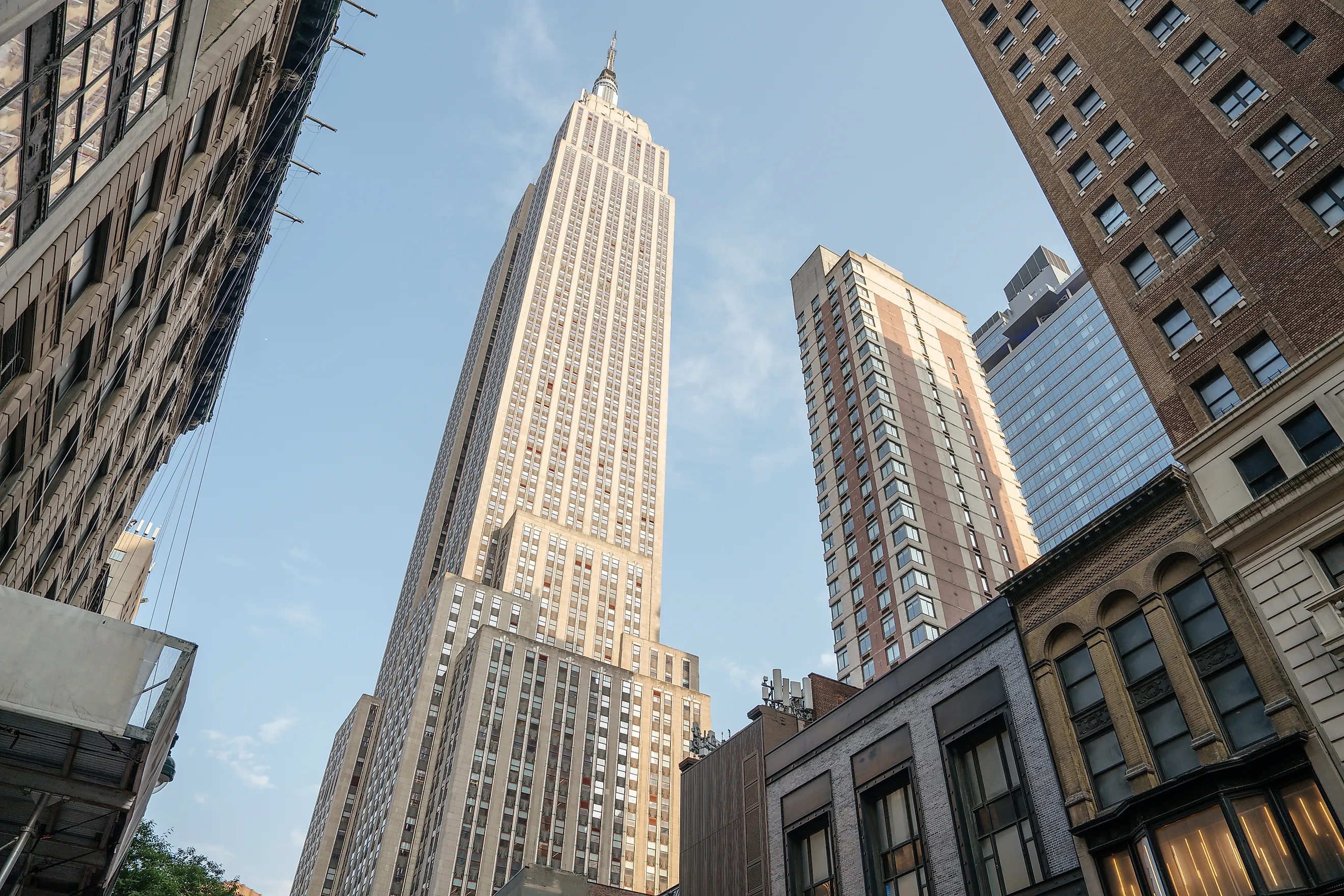
The Empire State Building, meanwhile, is 1,454 feet with the 103 floors, roof extensions, and antenna.
Made up of a variety of materials, including 200,000 cubic feet of Indiana limestone and granite, 730 tons of aluminum and steel, and ten million bricks. There are 6,514 windows to stare out of as one goes up the tower, including the 86th and 102nd floor observation areas.

When compared against each other, the Hoover Dam is 727.6 feet shorter than the Empire State Building's total height. However, if one were to flip the Dam on its side, it would only be 210 feet shorter than the Empire State Building.
Another way to compare the two structures is the number of stairs. Hoover Dam has 700 stairs, sometimes referred to as the Stairway to Heaven, and is primarily used for workers. The Empire State Building has more than doubled that number at 1,860 stairs to its 102nd floor.
Hoover Dam history

The Hoover Dam was the latest in a series of projects to take advantage of the Colorado River to provide water for agriculture, drinking water, and hydroelectric power in the American Southwest.
At 1,450 miles long, the Colorado River carries an estimated 4.5 trillion gallons of water a year toward the Gulf of California in Mexico through very dry environments, including canyons and mesas. Almost none of it arrives, since the flow is diverted upstream long before the delta.
One such early effort was to construct a dam in California to redirect water into the fertile yet dry Imperial Valley. However, between 1905 and 1907, unusually high levels of rain caused the Colorado River to flood over a cut ditch. This event created the Salton Sea, which still exists to this day.

A larger project was first proposed in 1922 by the U.S. Bureau of Reclamation in the Black Canyon. The project took a while to get off the ground due to concerns that California would benefit the most from it, along with the estimated $165 million cost.
Herbert Hoover, then Secretary of Commerce, helped draft the 1922 Colorado River Compact to ensure all seven states in the river gained access to the water equally. However, it wouldn't be until six years later that President Calvin Coolidge signed off on the Boulder Canyon Project.
Construction began in 1930 at the beginning of the Great Depression, with the contract for the 60-story arch dam structure itself awarded to Six Companies in March 1931.
The dam was built in stages, first through blasting in the canyon wall for four diversion tunnels, where heat could reach 140°F. Secondly, the canyon walls had to be cleared with 44-pound jackhammers and metal poles for the dam itself.
When these were complete, 20-ton cableways were used to hoist cement blocks gradually onto the canyon floor. Architect Gordon Kaufmann aimed to keep the dam surface mostly free of any decoration, although 30-foot-tall Art Deco statues known as Winged Figures of the Republic were placed next to the dam, designed by Norwegian immigrant Oskar J.W. Hansen.
After five years of work, the dam was completed in 1935, and President Franklin D. Roosevelt held an opening ceremony on September 30 of that year. In total, the cost to construct the dam was $49 million, with an aditional $71 million spent on hydroelectric generators that were added in 1937.
Empire State Building history

The Empire State Building project also had its roots in the 1920s. At the time, the Waldorf-Astoria Hotel was sitting on the site of 350 Fifth Avenue in Manhattan. But what was once a premier hotel had fallen on hard times, as it was outcompeted by other hotel spaces. It was sold to developers, who formed the Empire State Inc. company in 1929.
The hotel space was demolished, and work began on March 17, 1930. The Great Depression made no impact on the building schedule, as workers utilized an assembly line structure to continually move up steel beams, building the framework by 4.5 stories per week.
In May 1931, just a year and 45 days later, the Empire State Building was opened, with New York Governor Franklin D. Roosevelt in attendance.

But at the time of its opening, the vast majority of its office space was empty, as the Great Depression had severely impacted the economy. The head of Empire State Inc., Al Smith, made several appeals to fill up the skyscraper, from asking now-President Franklin D. Roosevelt to relocate government offices in the building in 1933 to hosting massive parties.
For example, when the Prohibition ended in 1933, Smith brought in six Clydesdale horses to deliver beer, and he would regularly host heads of state from other countries such as the King of Siam (Thailand).
Folks at the time joked that it was the Empty State Building, but its reputation would slowly change, as a symbol of resilience in the midst of the Great Depression and World War II. It wouldn't pick up as a major office space until the end of World War II, as the postwar economic boom encouraged investment.
Both are symbols of American resilience in the face of hardships
The fact that Americans built these structures during a time when the GDP collapsed by 29 percent and a third of banks failed is proof of American resilience and willingness to move forward even in the face of hardships.
Sometimes during tumultuous times, people need symbols of hope that can inspire them to keep a sliver of optimism. The Hoover Dam and Empire State Building are more than just a practical dam and an office space; they have become embedded as central features in the American consciousness of what is possible with a big plan and a lot of elbow grease.