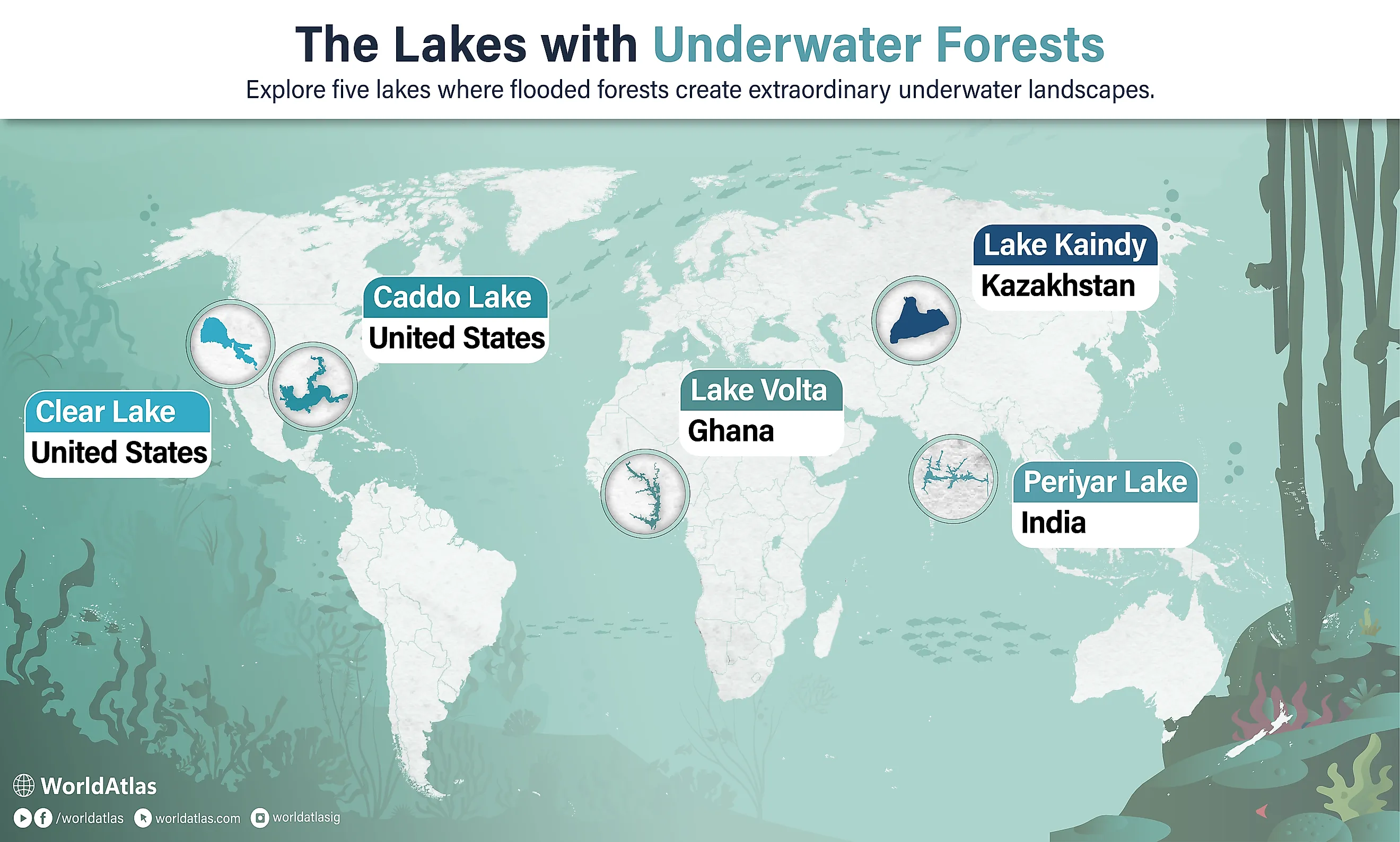
The Lakes With Underwater Forests
Three thousand years ago, a lava flow buried a stand of Oregon trees under a mountain lake. Cold water kept the wood whole. The trees still stand upright on the lake bed and stay visible through the surface on a clear day.
Submerged forests like this one turn up across three continents and form in wildly different ways. Some drowned slowly under natural dams built by lava or landslides. Others went under in a single decade when engineers flooded a valley for hydroelectric power. Cold temperatures and dissolved minerals preserve the sunken wood for decades or millennia. Each of the five lakes below holds a drowned forest and a very different account of how it got there.
Clear Lake, United States

Clear Lake sits within Willamette National Forest as the result of an ancient lava flow from the High Cascades. After solidifying, lava flows from the Sand Mountain volcanic field formed a natural dam, creating Clear Lake, which is now the source of the McKenzie River. Slowly but surely, the forest beneath the dam became submerged under the rising waters, and 3000 years later, Clear Lake had a full forest submerged under 120 feet (about 36 meters) of water.
With about 148 acres of water while sitting at an elevation of 3000 feet (914m), Clear Lake is vast and impressive. The waters are also like their name: crystal clear so that the remnants of ancient, rooted trees can be seen from just below the surface. The water's iciness, however, makes the lake far better suited for canoeing and fishing than for swimming. For those willing to shoulder the cold, an ancient world and a forest filled with cutthroat and rainbow trout await. Indeed, since a national forest surrounds the lake, the area's popularity continues to grow, and the lava fields that created the lake have proven important for scientific inquiry.
Lake Volta, Ghana

Unlike the traditional image of an ancient forest frozen in time by water, Lake Volta in Ghana is actually a recent artificial lake created by the Akosombo Dam in 1965. Its water comes mainly from the Black and White Volta rivers, and it covers a staggering 2.1 million acres. It is nearly 250 miles (402km) long and accounts for 3.6 percent of the country's area. With its impressive scope, however, comes a tumultuous history, and Lake Volta was created by severe flooding that destroyed 740 villages and displaced 80,000 people. As a result, entire forests were swallowed up by the water. Now partially fossilized, the very tops of hardwood trees are visible in certain spots around the lake, in a rare instance of underwater forests created by human hands.
Today, the lake serves as a trade route and a prime location for the fishing industry, and the lake that once held a variety of fish is slowly becoming more homogeneous. Tilapia are abundant, and the number of bottom-feeders, such as catfish, is known to have increased. Overall, the aquatic habitat of Lake Volta remains impressive despite the human activity on the lake. The presence of the fishing industry has also caused two main points of contention: child trafficking and the ecological impact of the industry on the area. Conservationists believe the lake should be mostly left as is, while the rise of the fishing industry has also excited the timber industry, which is using some of its underwater forests for profit. The Kete Krachi Timber Recovery (KKTR) already has plans for the 14 million m³ of hardwood.
At the moment, the wonderful forests of Lake Volta are the subject of a battle between conservationists and big business, and it's unclear what their future holds. Whatever the case, the significance of Lake Volta lies in its environmental features and biodiversity, its very real historical creation, and its status as an economic lifeline for the country, and that is perhaps why it is a center of attention and chaos.
Lake Kaindy, Kazakhstan

The story of Lake Kaindy begins in the early 1900s. The nearby Tian Shan Mountains experienced an earthquake that triggered a powerful landslide, transforming the surrounding area. After the 1911 Kebin earthquake triggered a landslide that dammed the gorge, mountain water filled the basin and submerged the spruce forest. Lake Kaindy was thus formed, but its trees never sank beneath the water and remain upright, like perfectly preserved swords.
Lake Kaindy's value is in its rare, almost alpine aesthetics, and photos do not do the 1300-foot-long (400m) lake justice. The waters of the lake itself are so clear that the sunken forest below is visible from the surface. With a chilly resting temperature of 43° Fahrenheit (6°C), the cold waters do well to ensure that the spruces, submerged for more than a century, remain intact, almost as if they are dormant and not dead.
What adds to the mystique of Lake Kaindy is its seasonal changes and the way the land is used. While it's true the lake isn't very popular, winter sees an uptick in visitors due to ice fishing. Trout is the main fish of note, but the 98-foot deep lake (30 meters) also invites the more adventurous for ice diving.
Lake Periyar, India

In the southern part of Kerala, the Periyar Wildlife Sanctuary is located. Apart from being a famous destination for tiger viewing (from the safety of a boat), the other eye-catchers are in the green plains and rolling hills with pockets of woodland scattered throughout the valley. Flowing through the famous sanctuary and park is the artificially created Lake Periyar. With the completion of the Mullaperiyar Dam in the late 19th century, flooding ensued, and sections of the valley were engulfed by the rushing waters of the region's largest river (Periyar River), leaving only the spear-tipped, crooked trees barely breaching the surface.
Spanning nearly 12 sq miles, the trees of the lake are made up of a healthy variety of sandalwood, rosewood, teak, and mango. The boats used to travel the lake are usually on the smaller side, and navigating around the remnants of the tall trees is thrilling. Aside from seeing larger-than-life animals like elephants hanging around the woodlands and by the lake, travelers are quick to note that when they traverse the waterways, they are crossing the topside of another wild, drowned forest. The water is usually pale blue and reflective, and one might need to peer into it to see the sunken trees below. However, that is hardly a detriment to one of India's most popular parks, which, as a tiger preserve, gets plenty of attention (India's tigers have been endangered for quite some time).
Caddo Lake, United States

At the edge of Texas lies a gigantic 26,810-acre lake with more than 70 species of fish in the middle of the swamp. Caddo Lake, within a park named after it, offers hiking, fishing, geocaching, and canoeing. The swampland sights of alligators and cypress trees with Spanish moss have allured people to the lake since the 1800s, and in 2024, a supernatural thriller named after the lake used its eerie, moss-hung waters as a backdrop. Apart from the mysticism, however, the real strangeness is in its gigantic cypress trees with aerial roots (pneumatophores) that grow upward and siphon oxygen from the air (at least, that is the leading theory).
If other underwater forests are typically preserved but dead, Caddo Lake's large collection of cypress trees is a living, growing, dynamic underwater forest. Contributing to the thriving swamp around it, the lake is home to numerous species of birds (such as the Cooper's Hawk), mammals (such as the bobcat), and plants (such as the Redshank). There is a trade-off, however. And what the underwater forest of Caddo Lake makes up for in novelty and life, it loses one of its most important elements. The cypresses are impressive, but if the focus is on how they grow underwater, the sediment and mud make it very difficult to see the trees for all that they are. And while an underwater forest is there, it cannot be experienced as if Caddo Lake had clear waters. Nonetheless, the lake remains a popular and protected spot that rightly deserves all the attention it receives.
Why These Underwater Forests?
There is something wondrous about a rare phenomenon like sunken forests, and these underwater beauties were chosen because, while they fall under the same category, they could not be more different in their developmental histories, whether young or ancient, natural or artificial. They serve as reminders that the world is always changing in sudden and unexpected ways. Even an earthquake or a landslide can transform the land, giving birth to a lake that was once green woodland. Each site has what makes it special, and each is a boon to experience, always teaching something new, whether in its history and story, its well of scientific knowledge, or its plain and simple beauty.