The 10 Largest Underground Lakes in the World
The largest underground lakes in the world sit hidden inside caves, sinkholes, and ice sheets. Many form in karst terrain, where limestone or other soluble rock dissolves away over thousands of years, leaving open chambers that slowly fill with rainwater, groundwater, or meltwater from above. Some of the largest in the world sit beneath easily accessible caves reachable by a short staircase, while others hide beneath thousands of feet of Antarctic ice.
Scientists study these isolated bodies of water for a myriad of reasons, including searching for clues about ancient microbial life, collecting indicators of groundwater health, and researching climate change impacts.
Ranked by known surface area, ten underground lakes stand out as the largest on record, including both subglacial lakes hidden beneath Antarctica and lakes inside natural cave systems.
Lake Vostok, Antarctica

Lake Vostok is by far the largest known subglacial underground lake on the planet. It spans 4,830 square miles (12,500 square kilometers), and sits approximately 13,100 feet (4,000 meters) beneath the East Antarctic ice sheet. The lake, about the size of Lake Ontario, has stayed sealed off from the atmosphere for an estimated 14 to 15 million years.
In a 2013 study, researchers analyzing ice that had frozen onto the lake's surface identified 3,507 unique gene sequences. Roughly 94 percent were from bacteria and six percent from eukarya, including species related to those living in the intestines of fish and near hydrothermal vents. This discovery suggested that the lake may once have connected to the ocean. Russia's Vostok Station is positioned directly above it, and scientists continue drilling to sample the water. As they do so, researchers are careful to avoid contamination, since introducing outside bacteria or drilling fluid into water sealed off for millions of years could make it impossible to tell whether any microbial life they find is truly native to the lake or just hitched a ride down on the drill.
90°E Lake, Antarctica

90°E Lake ranks as the second-largest known subglacial lake in Antarctica, covering around 770 square miles (2,000 square kilometers). NASA and Columbia University researchers published the first detailed description of the lake's size, depth, and origin in 2006. They named it for its location along the 90th meridian east. Buried more than two miles (3.2 kilometers) beneath the East Antarctic ice sheet, the lake stays in a liquid form thanks to geothermal heat rising from below combined with the insulating weight of the ice above it.
Researchers first traced the lake's outline using satellite ice-surface elevation data from NASA's Ice, Cloud, and Land Elevation Satellite (ICESat), which revealed a telltale depression over the lake's upstream shoreline and a slight ridge over its downstream edge. This is a signature that scientists now use to identify other buried lakes from space.
Sovetskaya Lake, Antarctica

Sovetskaya Lake covers approximately 620 square miles (1,600 square kilometers), roughly 1.2 miles (two kilometers) beneath Sovetskaya Research Station in central East Antarctica. Scientists recorded the first hint of a subglacial lake anywhere on Earth at this exact location back in 1969. Airborne radio-echo sounding picked up flat, continuously bright radar reflections consistent with deep liquid water beneath the ice.
That early radar method worked because ice absorbs radio waves so consistently that any sudden, mirror-like reflection points to a boundary between ice and water rather than ice and bedrock. This is a principle that still underlines most subglacial lake surveys today. Because the technique cannot measure how deep a lake actually is, only that water exists, Sovetskaya's water depth remains far less understood than its surface area.
It would take decades of improved satellite and radar technology before researchers could confirm the true sizes of Sovetskaya Lake and the neighboring 90°E Lake, publishing the first detailed descriptions of both in 2006. Sovetskaya sits close enough to Lake Vostok that researchers consider all three lakes part of the same East Antarctic subglacial lake cluster.
Mercer Subglacial Lake, Antarctica

Mercer Subglacial Lake expands across 62 square miles (160 square kilometers) beneath about 3,500 feet (1,067 meters) of ice in West Antarctica. Glaciologists with the Scripps Institution of Oceanography discovered the lake in 2007 using satellite laser altimetry while searching for a glacier's grounding line. They named this lake after the Mercer Ice Stream flowing above it.
In December 2018, the Subglacial Antarctic Lakes Scientific Access (SALA) project drilled through the ice using a hot-water drill fitted with filters that remove 99.9 percent of bacteria. This was followed by UV light exposure, ensuring they could reach the lake without contaminating it. That expedition recovered water, sediment, and basal ice samples that had likely gone without sunlight for thousands, possibly hundreds of thousands, of years.
In 2025, an international research team led the Korea Polar Research Institute published findings describing entirely new microbial communities recovered from the lake. This discovery added to the evidence that isolated subglacial environments can sustain life far removed from Earth's surface.
Lake Whillans, Antarctica

Lake Whillans measures about 23 square miles (60 square kilometers) beneath 2,600 feet (800 meters) of ice on the Whillans Ice Stream in West Antarctica. In January 2013, the WISSARD science team drilled into the lake using a sterilized hot-water drilling system, making it the first Antarctic subglacial lake ever directly sampled by researchers.
Analysis of the water and sediment revealed a bacterially dominated microbial community that was compositionally distinct from anything found in the drilling equipment itself, confirming the organisms were native to the lake rather than surface contaminants. Sediment core samples revealed two different histories by depth: the upper layers of the lake consisted primarily of glacial till deposited during past subglacial floods, and the deepest layers carried chemical signatures of ancient seawater. These chemical signatures provided evidence that the ocean once reached this part of West Antarctica before the ice sheet advanced over it.
Unlike Vostok's ancient isolation, Whillans is an active lake that has filled and drained at least three times since 2003. It releases water through subglacial channels that travel about 62 miles (100 kilometers) before draining into the ocean cavity beneath the Ross Ice Shelf.
Dragon's Breath Cave, Namibia
Dragon's Breath Cave holds the title of the largest known non-subglacial underground lake on Earth, spanning 215,278 square feet (2 hectares). Located in the Otjozondjupa region of Namibia's Kalahari Desert, the lake exists behind an entrance shaft that drops 196 feet (60 meters) below the surface. The lake itself has been measured to a depth of 866 feet (264 meters).
A team from the South Africa Speleological Association found the cave in 1986 after noticing warm, humid air rising from a hole in the ground, hence the cave's name. The lake supports a species found nowhere else. The endemic, sightless white shrimp, Troglolelupia dracospiritus, whose name translates into "spirit of the dragon" in Latin. They survive by feeding on bat guano that falls from the cave's upper reaches in permanent darkness. Ichthyologists have also had to correct an old misconception about the cave's fauna. For years, the rare blind catfish, Clarias cavernicola, was widely reported to live in Dragon's Breath's waters, but follow-up research established that this species is only found in the nearby Aigamas Cave.
Hydrogeologists studying Namibia's karst aquifers classify the cave's water as part of the Otavi Dolomite Aquifer, a confined, fractured limestone system that recharges extremely slowly in the region's arid climate. This research makes the lake a useful reference point for understanding how groundwater moves through similar karst formations across northern Namibia.
The Lost Sea, Tennessee

The Lost Sea measures at least 176,000 square feet within Craighead Caverns between Sweetwater and Madisonville, Tennessee. It ranks as the second largest non-subglacial underground lake in the world and is positioned about 140 feet below ground. The full expanse of the lake has yet to be mapped. It is recognized by the US Department of the Interior as a Registered National Natural Landmark. The Cherokee people living in the region had known of and used Craighead Caverns for centuries. In 1905, the Lost Sea became known to European settlers after a 13-year-old boy, named Ben Sands, wriggled through a small opening that led to the massive chamber containing the subterranean lake.
The cave contains roughly half of the world's known anthodites, rare spiky crystal formations sometimes called cave flowers that occur in only a handful of caves worldwide. Its water and surrounding passages are also home to cave crayfish. These small, pale crustaceans have reduced pigmentation and eyes that have adapted over generations to life in permanent darkness. In 1939, explorers found the fossilized remains of a Pleistocene-era Jaguar, whose bones are now displayed at the American Museum of Natural History in New York.
Seegrotte, Austria

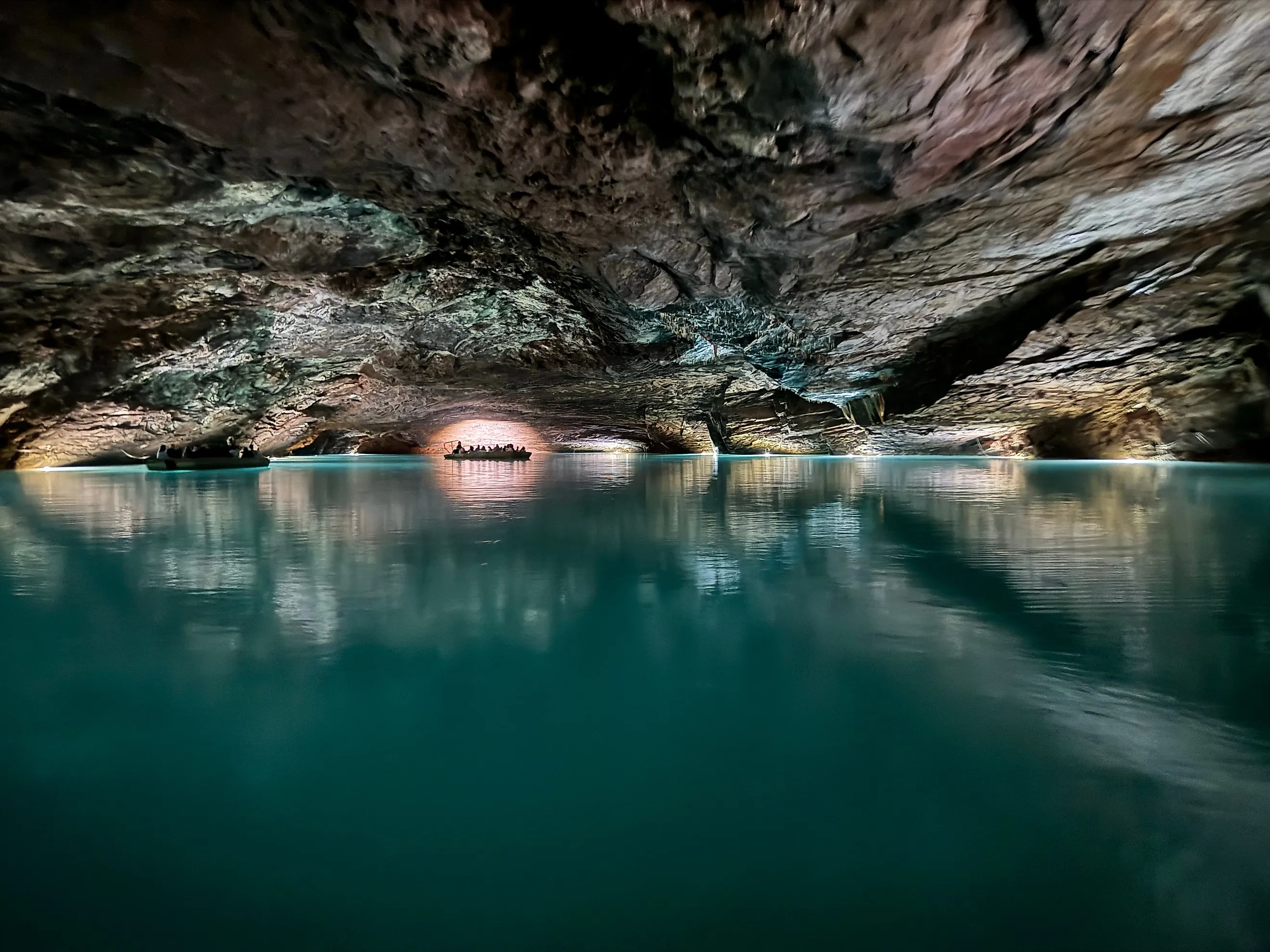
Seegrotte, near the village of Hinterbühl outside Vienna, Austria, holds Europe's largest underground man-made lake by total surface area, spanning 66,736 square feet (6,200 square meters). In 1912, a mining detonation at the site's former gypsum mine went wrong and flooded the lower gallery, sending roughly 20 million liters of water into the area and putting an end to mining there for good.
The lake is located about 196 feet (60 meters) below ground, has no natural drainage, and is fed by seven springs that have sent water into the lake since the explosion. An estimated 50 to 60 cubic meters of water must be pumped out daily just to keep the water level low enough for boat tours, which have run since the site opened to visitors in 1930. Despite its size, the water is kept shallow, at a navigable depth of only about four feet (1.2 meters). Its exceptional clarity comes from natural filtration through the surrounding gypsum bedrock, which lets visitors see submerged rock formations from the boats gliding overhead.
Saint-Léonard Underground Lake, Switzerland

Saint-Léonard holds the title of the largest naturally formed underground lake in Europe. It stretches about 985 feet (300 meters) long and covers 64,584 square feet (6,000 square meters). This subterranean giant is situated between the Swiss towns of Sion and Sierre. Speleologist Jean-Jacques Pittard led its first scientific exploration in 1943. In 1946, a 5.6 magnitude earthquake widened openings to the cave that allowed boat tours to begin in 1949.
Decades of erosion eventually forced a three-year closure in the early 2000s so crews could stabilize the ceiling with about 5,000 support bolts. Boats now cross the lake again beneath the reinforced roof. Recently, researchers used 16S and 18S rRNA gene sequencing to study the cave's water and sediment. They uncovered a rich and diverse community of bacteria, archaea, and microscopic eukaryotes living in the lake. These species are distinct from the microbial life found in the soils above it.
Lake Neuron, Albania

Discovered by Czech researchers in 2021 and fully measured in 2024 using 3D lidar technology, Lake Neuron holds the title of the world's largest underground thermal lake. Its surface area measures 62,387 square feet (5,796 square meters). The scientists who discovered the enormous thermal lake named it after the research foundation that funded their work, Neuron Foundation. Hidden deep within a cave system in the Vromoner Valley of southern Albania, near the town of Leskovik, the lake sits at the bottom of an abyss over 330 feet deep (100 meters), which the team named Atmos.
The water is saturated with hydrogen sulfide, which oxidizes on contact with air and forms sulfuric acid that gradually converts the surrounding limestone into gypsum. This process is called sulfuric acid speleogenesis, which carves the cave from below rather than from surface erosion. Tracer tests conducted by a research team in 2025 found that water from Lake Neuron polyfurcates, splitting and feeding into nearly every thermal spring in the valley except one, tying the lake directly into the region's broader hydrological network. The expedition team hopes future studies of the lake will reveal how its geothermal, sulfur-rich environment supports microbial life.
A World of Water Below
Whether reached by drilling through thousands of feet of Antarctic ice or by a short staircase outside Vienna, each of these lakes reflects the complexities of environments that can exist far from the light of day. Some, like Dragon's Breath and Lake Vostok, have revealed unique life forms adapted to their isolated and dark environments. Others, like Lake Neuron, tell the story of how active geothermal and sulfur chemistry can shape subterranean landscapes. Together, they show how much environmental variation exists beneath the Earth, and how much still remains to be studied, hidden beneath mountains, deserts, cities, and glaciers around the world.