The Great Lakes Ranked By Water Clarity
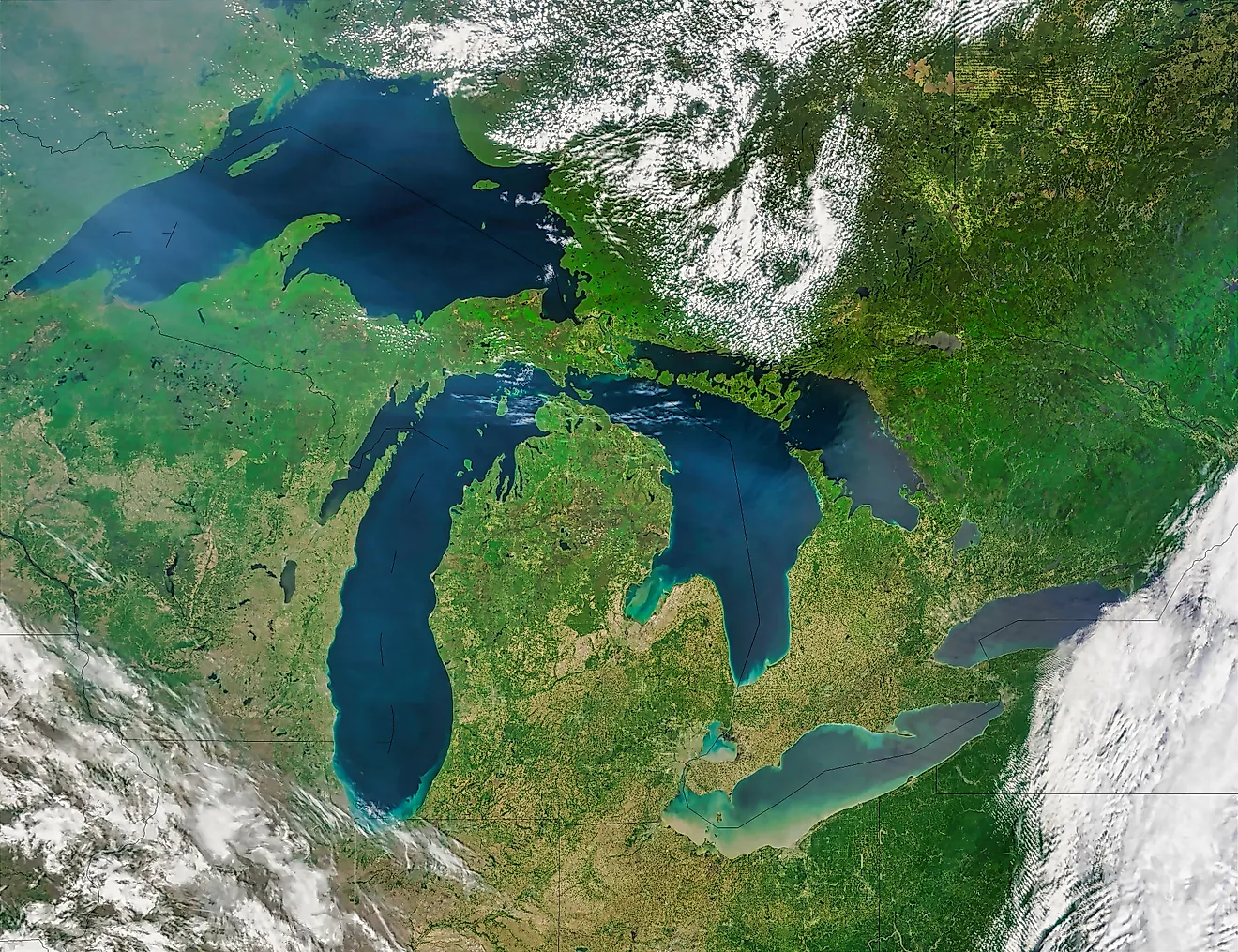
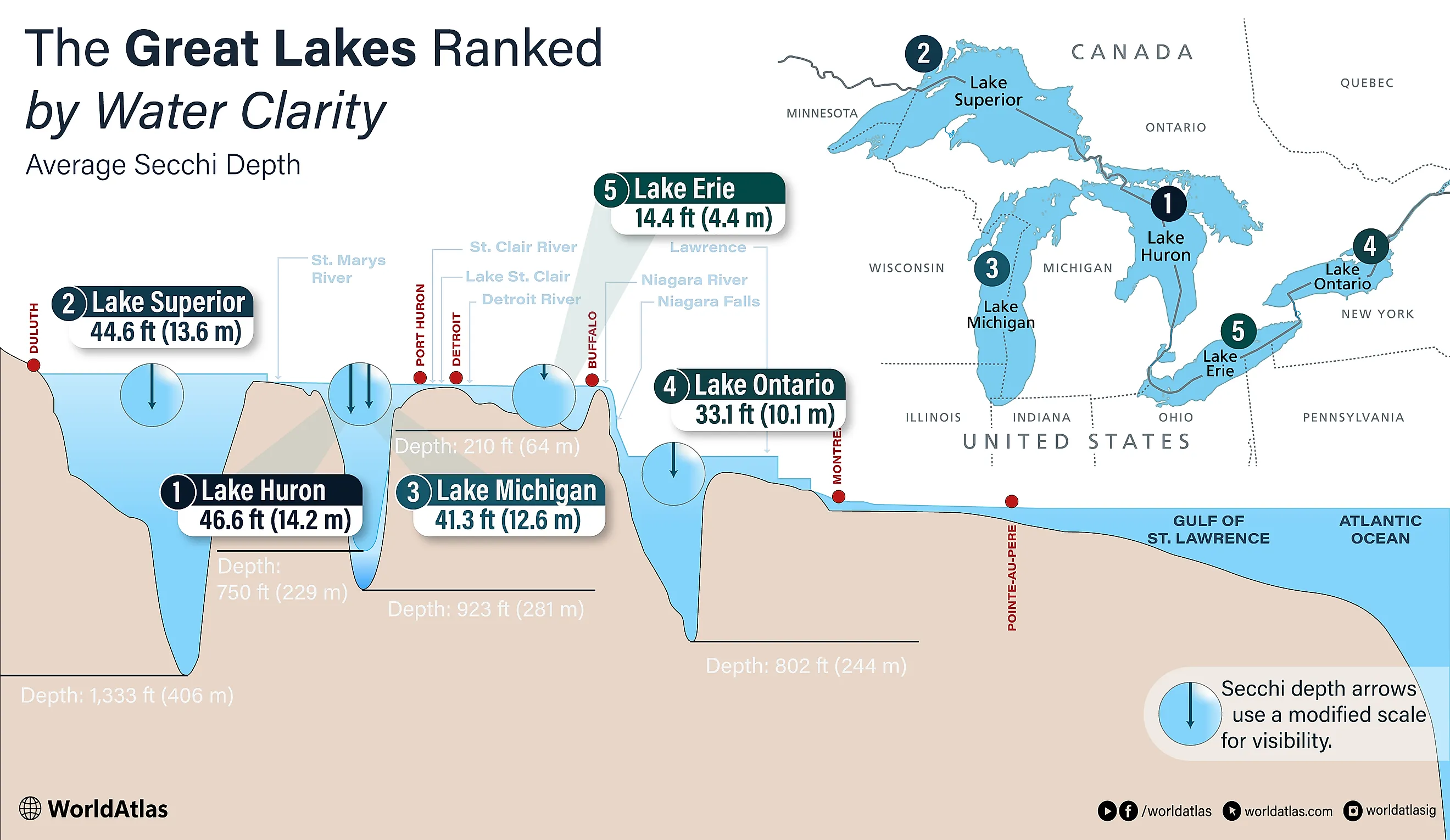
The clearest Great Lake is not Lake Superior, and the reason it is not says more about ecological upheaval than about clean water. Clarity is ranked here by Secchi depth, a standard freshwater measurement in which a black-and-white disk is lowered into the water until it disappears from sight. By that measure, Lake Huron now edges out Superior for the top spot, with Michigan close behind and Erie far below the rest. Much of that clarity is recent and unnatural: invasive zebra and quagga mussels have filtered so much plankton from the upper lakes that sunlight reaches far deeper than it did a generation ago. The ranking below compares the approximate average of spring and summer offshore measurements, the fairest way to line up five lakes whose transparency shifts with season, weather, and location.
1. Lake Huron - 14.2 m

Lake Huron ranks as the clearest Great Lake overall when comparable spring and summer measurements are considered together. Average offshore Secchi depth reaches about 13.3 meters in spring and 15.0 meters in summer, producing an approximate two-season average of 14.2 meters. Its offshore waters contain very low concentrations of nutrients and phytoplankton, allowing sunlight to penetrate unusually far below the surface. During particularly clear periods, visibility can extend well beyond the depths commonly recorded in most large freshwater lakes.
Huron's remarkable modern transparency is partly the result of ecological changes. Invasive zebra and quagga mussels filter enormous quantities of water, removing phytoplankton and suspended particles that would otherwise reduce visibility. As these mussels expanded throughout the lake, offshore waters became noticeably clearer. Satellite observations have also shown major increases in transparency since the late 1990s. The result is a lake that can now equal or even surpass traditionally clearer Lake Superior during parts of the year, particularly in summer.
2. Lake Superior - 13.6 m

Lake Superior is often described as the clearest Great Lake, and it remains the leader during spring. Its average spring Secchi depth is approximately 15.0 meters, the deepest spring measurement among the five lakes, while summer clarity averages about 12.1 meters. Together, those figures produce an approximate two-season average of 13.6 meters. Superior contains relatively few nutrients compared with most large lakes, resulting in low phytoplankton concentrations and exceptionally transparent offshore water.
Unlike Huron and Michigan, Superior's transparency has not depended as heavily on recent invasive mussel-driven changes. Its water has been naturally clear for decades, giving it a strong claim to being the most consistently transparent Great Lake. Its immense depth also limits the influence of bottom sediments across much of the open lake. Some recent observations suggest modest declines in clarity during certain periods, but Superior remains firmly within the clearest group of the Great Lakes.
3. Lake Michigan - 12.6 m

Lake Michigan ranks third, although its transparency is now remarkably close to that of Huron and Superior. Average offshore Secchi depth is approximately 13.2 meters in spring and 11.9 meters in summer, producing an approximate two-season average of 12.6 meters. These values place it firmly within the clearest group of Great Lakes. Lake Michigan's offshore waters contain relatively low nutrient levels, particularly compared with historical conditions, allowing sunlight to penetrate much farther than it did several decades ago.
The increase in clarity has been dramatic. Offshore measurements from the late twentieth century frequently showed visibility of only several meters, while some modern observations have recorded Secchi depths approaching or exceeding 15 meters. Quagga mussels are a major reason for this transformation because they continuously filter particles and phytoplankton from the water. However, clarity varies substantially by location. Nearshore areas affected by rivers, runoff, waves, and suspended sediment can appear much murkier than the exceptionally transparent offshore portions of the lake.
4. Lake Ontario - 10.1 m

Lake Ontario ranks fourth because its transparency changes much more dramatically between seasons. Spring conditions can be exceptional, with an average Secchi depth of about 13.7 meters. That is greater than the spring average of either Huron or Michigan. By summer, however, average Secchi depth falls to roughly 6.4 meters. Averaging those two seasonal values gives Lake Ontario an approximate clarity score of 10.1 meters.
Biological activity is one important reason for the seasonal difference. Phytoplankton growth increases during warmer months and reduces the amount of light that can pass through the water. Lake Ontario can also experience calcium carbonate precipitation events that temporarily make the water appear cloudier. Despite these seasonal effects, the lake has become significantly clearer over recent decades. Reduced nutrient concentrations and invasive mussel filtration have increased offshore transparency, particularly during spring, when parts of Lake Ontario can rival some of the clearest waters in the entire Great Lakes system.
5. Lake Erie - 4.4 m

Lake Erie is by far the least clear of the Great Lakes on a lakewide basis. Average Secchi depth is approximately 3.4 meters in spring and 5.3 meters in summer, giving it an approximate two-season average of 4.4 meters. These measurements are substantially lower than those recorded in Huron, Superior, Michigan, or Ontario. Erie is also the shallowest Great Lake, with an average depth of only about 19 meters. Its shallow water allows wind and waves to disturb bottom sediments much more easily, sending fine particles back into the water column and reducing visibility.
Conditions vary enormously across the lake. The shallow western basin can have spring Secchi depths close to only 1.2 meters, while the deeper eastern basin can exceed 8 meters during the same season. The western basin receives heavy sediment and nutrient inputs from surrounding watersheds and frequently experiences large cyanobacterial blooms. These factors make parts of western Lake Erie extremely turbid. The eastern basin is considerably clearer, but not enough to raise Erie's overall transparency above any of the other Great Lakes.
Why Water Clarity Differs Across The Great Lakes
Water clarity depends on far more than whether a lake is clean or polluted. Nutrient concentrations influence how much algae and phytoplankton can grow, while rivers introduce sediment and organic material. Shallow lakes are more vulnerable to sediment being stirred up by waves. Seasonal plankton cycles can cause transparency to change substantially between spring and summer, and storms can temporarily make even naturally clear shorelines appear cloudy.
Invasive mussels have also transformed the Great Lakes. Zebra and quagga mussels remove microscopic organisms and suspended particles while feeding, dramatically increasing water transparency in several lakes. This means that clearer water does not automatically indicate a healthier ecosystem. Extremely clear water can reflect major changes to the food web because nutrients and biological production are being shifted away from the open water and toward the lake bottom.
The Takeaway
The differences between the top three are small enough that their order can change depending on season and location. Superior remains the clearest during spring, while Huron achieves the strongest summer transparency. Michigan has also become dramatically clearer in recent decades. For scientific purposes, this ranking is best treated as a comparison of typical offshore transparency rather than a permanent description of every shoreline, basin, or season within each Great Lake.