The First Lake To Freeze Each Year In The Lower 48
Nobody knows, and the reason is that nobody is checking. There is no federal agency, no university program and no volunteer network tracking which body of water in the contiguous United States ices over first each autumn, which means the honest answer to this question is an unnamed alpine pond somewhere above 11,000 feet that froze in late September while the nearest human being was forty miles away. Minnesota keeps meticulous records going back to 1874 and cannot help you, because Minnesota is flat and the winner is almost certainly in Colorado. What we can do is work out roughly where it is, what kind of lake it must be, and why the states that care most about lake ice are guaranteed to lose this particular contest. The honest version of the answer is more interesting than a name would be.
Somewhere, A Lake Freezes In August

NOAA's climate data for first fall freeze contains a line that reads like a misprint. In some high mountain and northern latitude locations, the agency notes, the first freeze can occur earlier than August 31. That is not a typo and it is not Alaska.
That is air temperature rather than lake ice, and one freezing night will not lock up a lake. It does establish the search area, though. If the air above the Colorado high country is dropping below freezing in August, then the small shallow water bodies up there are getting a head start on the rest of the country by roughly two months.
NOAA puts the first freeze for Colorado, Utah, Nevada, northern Arizona and New Mexico somewhere in the September to November window, and the mountain states are where that window opens earliest.
What The Winner Must Look Like

You can describe the champion without knowing its name, because the physics narrows the field considerably. It has to be shallow, because a deep lake holds an enormous amount of stored heat and has to give all of it up before the surface can freeze. It has to be small, because a big surface area catches wind. It needs no meaningful stream or spring feeding it, since moving water and groundwater both delay freezing. And it needs to be high, because temperature falls reliably with elevation.
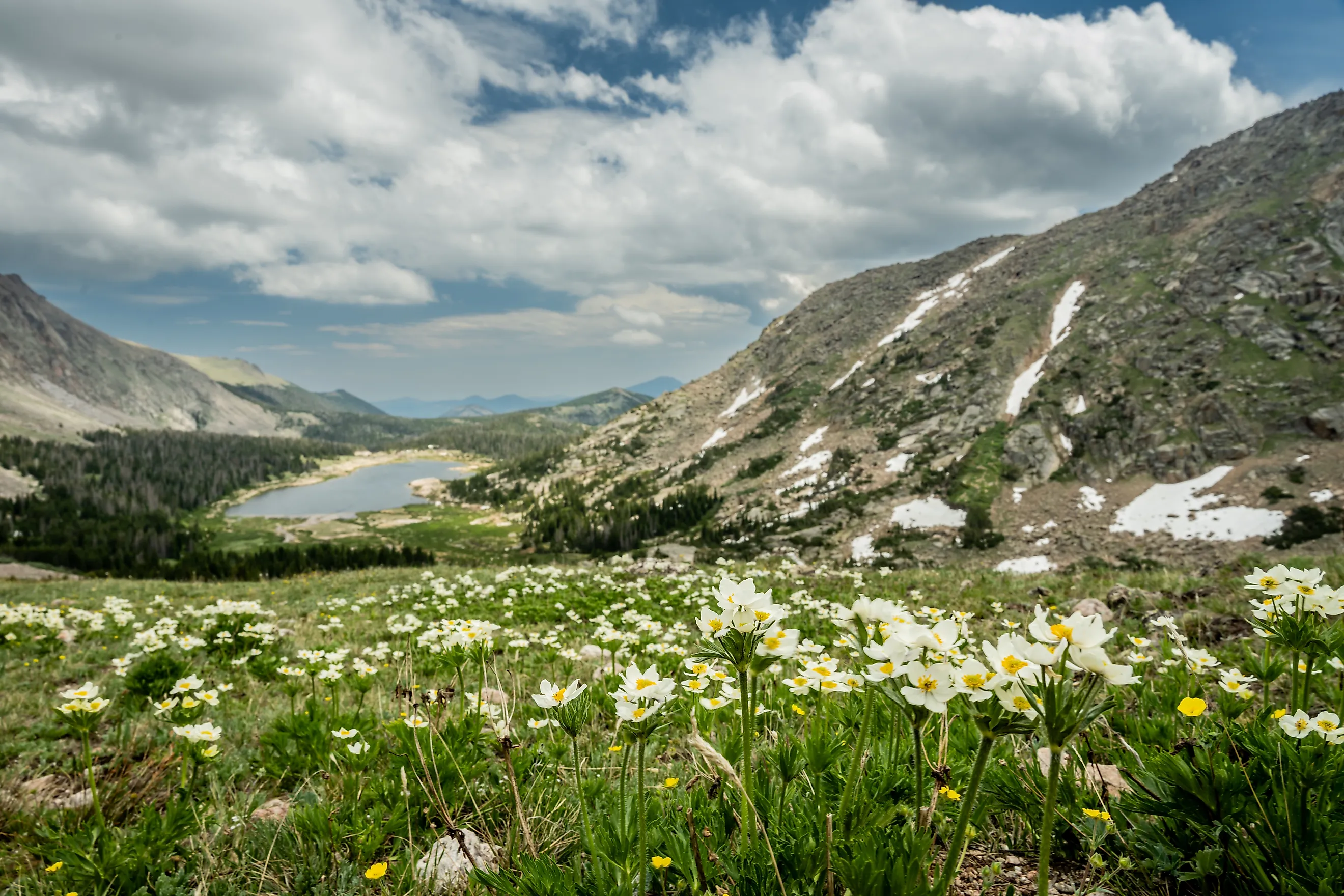
Put those together and you get a tarn: a shallow rock basin left behind by a glacier, sitting in a cirque above treeline, holding a few feet of water over stone. There are thousands of them across the Rockies and the Sierra, most of them unnamed, and one of them freezes before all the others every year.
Water Is Annoyingly Good At Holding Heat
The reason lakes lag behind the air is a property of water itself, and it explains why your local lake is still open in November when the ground outside has been frozen solid for weeks.
Water has an unusually high specific heat capacity, meaning it takes a lot of energy to change its temperature in either direction. A lake spends the autumn slowly bleeding out the heat it absorbed all summer, and only once the whole accessible column has cooled toward freezing can a skin of ice form on top.
A lake with a high volume-to-surface-area ratio is doing that with a much bigger reservoir of stored warmth, which is why the deep ones freeze last and sometimes not at all.
The Spring-Fed Exception
One category of lake cheats, and it does so with a number worth remembering. Groundwater emerges at roughly 52 degrees Fahrenheit year-round, because it has equilibrated with the rock rather than the air. A lake with significant spring input is therefore having warm water pumped into it continuously through the winter, and its freeze date can lag comparable lakes nearby by weeks.
It is a small, quiet, permanent advantage. Two lakes of identical size and depth sitting a mile apart can ice over weeks apart purely because one of them happens to sit on a spring.
Wind Ruins Everything

The most unpredictable variable here is the one nobody can forecast three weeks out. Ice forms as water molecules lock into a growing crystal lattice, and that process needs a reasonably calm surface. Wind keeps stirring the top layer, breaking up forming crystals and mixing warmer water up from below, and a big open lake with a good fetch can stay liquid through a cold snap purely because it will not sit still.
This is why a sheltered mountain tarn ringed by rock walls has such an advantage. It is small, it is cold, it is high, and nothing is blowing across it.
Minnesota Is The Only State Really Counting

If anywhere were going to win this on paperwork alone it would be Minnesota, where tracking ice-in and ice-out dates is described by the state's own climatologist as a quintessentially Minnesota ritual with a big following.
The Department of Natural Resources maintains historical ice-in maps, enlists citizen observers to report when their lake goes over, and publishes color-coded results. Four lakes in the state have records reaching back to 1878, and Clear Lake in Waseca County has data going back to 1874, which is a longer continuous record than most countries keep on anything.
And none of it helps. Minnesota lakes typically freeze in November and December, a full two months after some alpine pond in Colorado has quietly sealed itself over without telling anybody, which is the fate of every well-documented lake in this contest.
Even The Definition Is Negotiable
Before anyone tries to settle this with data, it is worth knowing how soft the data actually is. The Minnesota DNR states plainly that the definition of lake ice-in can vary from lake to lake. On some lakes it means complete coverage, on others something looser, and the reports come from volunteers applying their own consistent criteria rather than from instruments.
The agency also restricts its historical median calculations to 1950 onward specifically to achieve lake-to-lake consistency, which is a polite way of saying the older records were collected by whoever happened to be looking out of the window.
They Will Not Tell You In Real Time
There is one more obstacle to settling this, and it is entirely reasonable. The DNR does not post current-year ice-in dates as they happen, for two stated reasons: safety, and the fact that early ice cover often is not permanent. A lake can freeze in November, reopen a week later, and freeze again in December.
That second point is genuinely awkward for our question. If a high tarn freezes on September 20, thaws on September 28 and refreezes on October 5, which date counts? Nobody has ruled on it, because nobody has been asked.
People Do Bet On This

The absence of an official national answer has not stopped anyone turning freeze dates into a competitive sport locally. Madison runs a Mendota Freeze Contest where people submit guesses for the date Lake Mendota ices over. Minnesota's climatologists field a steady stream of public interest in the maps. When Lake Waconia set a record for the latest freeze in eighty years of data, a state climatologist described the season as horrible and then noted that he and his colleagues were probably the only people excited about it.
It is a strange thing to be enthusiastic about and a genuinely useful long-term climate record at the same time, which is roughly the story of all citizen science.
So Where Is It
The best available answer is a high cirque tarn in Colorado, which holds more terrain above 11,000 feet than any other state in the Lower 48 and therefore fields the most candidates.
Wyoming's Wind River Range is a serious contender and so is the high Sierra, though California's alpine basins run slightly warmer and sit further south. Montana and Idaho have the latitude but not the extreme elevation, which turns out to matter more.
Whichever pond wins, it is almost certainly unnamed, probably under three feet deep, and very likely frozen by the last week of September in an ordinary year. Nobody will be there to see it.
The Answer Nobody Can Give You

The first lake to freeze in the Lower 48 each year is a puddle on a rock shelf that nobody visits, nobody measures and nobody has bothered to name. It has probably been doing this on roughly the same date for several thousand years without a single witness.
The lakes we do track are the ones people live beside, fish on and drive past, which means the national ice record is a record of where Americans happen to be standing rather than where the ice actually is. That is a perfectly good reason to keep it. It is just not going to answer this question.