How Long Would It Take To Refill Lake Oroville?
About six months, and California has the receipts. In September 2021 Lake Oroville fell to 628.63 feet, only 22 percent of capacity and the lowest it has ever been. By June 2023 it was full. The Department of Water Resources measured the gain at more than 2.5 million acre-feet between the first of December and the following summer, which is roughly 70 percent of the entire reservoir arriving in a single wet season. That is a completely different answer from the one you get for Lake Mead or Lake Powell, and the reasons are worth understanding, because they explain why some American reservoirs recover and others do not.
The short version is that Oroville is small, its watershed is steep and wet, and when an atmospheric river parks over the Sierra the inflow figures stop looking like hydrology and start looking like a typo.
The Size Of The Job
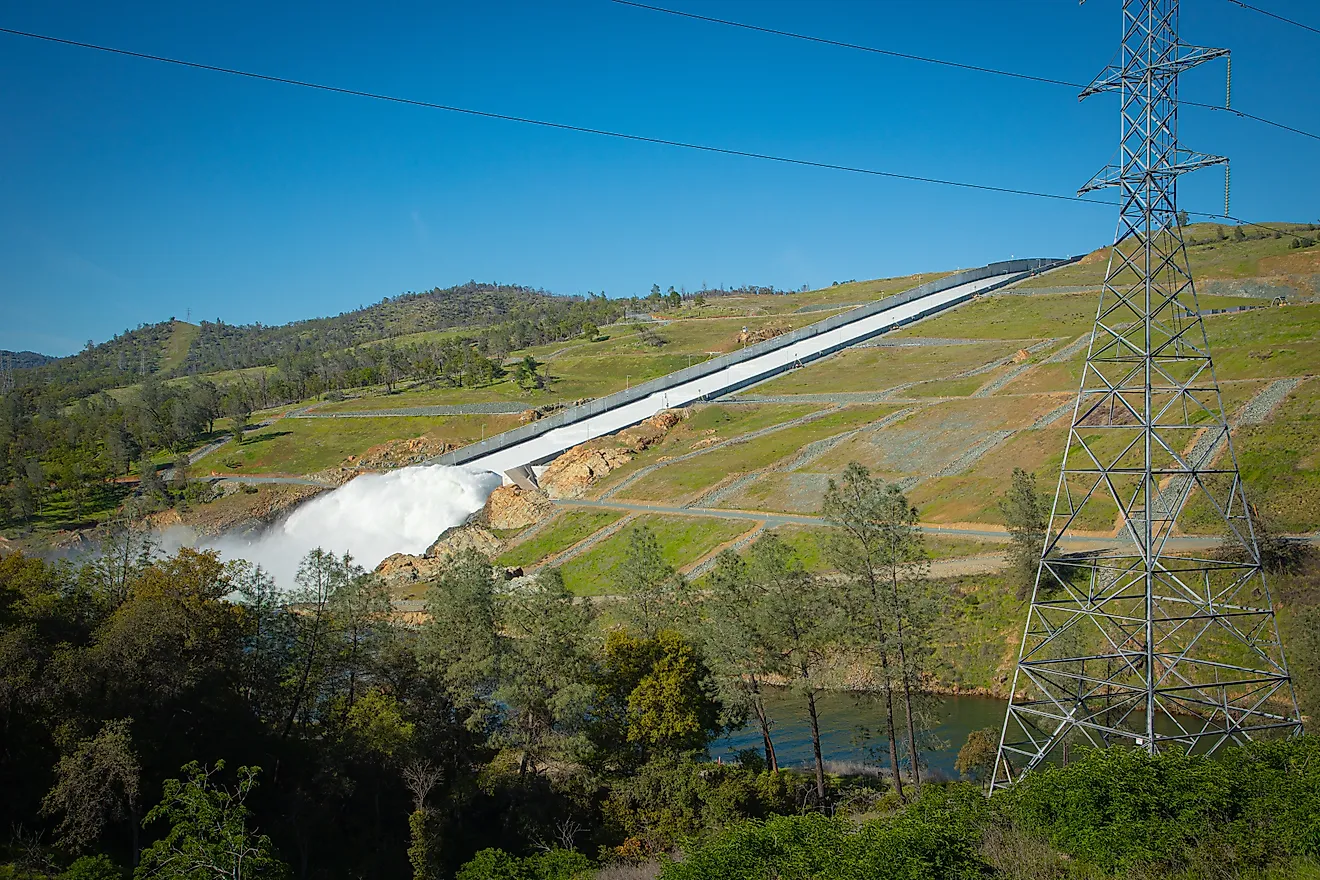
Lake Oroville holds 3,537,577 acre-feet at full pool, which it reaches at an elevation of 900 feet, marked on the shoreline by the tree line. It is the largest storage facility in California's State Water Project and it supports water deliveries to 27 million Californians and 750,000 acres of farmland, sitting behind the tallest dam in the United States at 770.5 feet.
At the September 2021 low the reservoir held roughly 778,000 acre-feet. Filling it from there meant finding about 2.76 million acre-feet, which is a serious volume of water by any measure. Oroville found it in one winter.
What Actually Happened In 2023

The winter of 2022 into 2023 delivered one atmospheric river after another, and the reservoir responded faster than almost anyone expected. Winter storms and spring snowmelt filled Lake Oroville to capacity, and DWR put the increase at more than 2.5 million acre-feet since December 1.
By July 7, 2023, the lake sat at 897 feet with about 3.49 million acre-feet in storage, 99 percent of total capacity and 133 percent of its historical average for the date. Then it did it again. DWR reported Lake Oroville reaching full capacity for the second consecutive year in May 2024, at 899 feet and 100 percent.
The Inflow Numbers Are Absurd

Here is the figure that explains everything else. During severe atmospheric river storms, inflows into Lake Oroville can exceed 250,000 cubic feet per second, a rate that makes the reservoir look small rather than the storm look large.
Run that out and it comes to roughly 495,000 acre-feet per day. At that rate the entire reservoir, all 3.5 million acre-feet of it, would fill in about seven days, and the 2021 deficit would be erased in under six. Storms do not sustain that rate for a week, obviously, but a handful of days at a fraction of it moves an enormous amount of water, and that is precisely what a wet California winter delivers.
Why The Watershed Matters More Than The Weather

The Upper Feather River watershed above Oroville Dam covers 3,607 square miles of steep Sierra Nevada terrain, and the relationship between that catchment and the reservoir behind it is the whole story. Oroville is not a large reservoir sitting on a modest river. It is a modest reservoir sitting under a catchment that can deliver more water in a week than the reservoir can hold.
Steep ground helps too. Runoff in the Feather basin reaches the reservoir quickly rather than soaking into flat terrain along the way, so precipitation converts to storage at a high rate compared with the slow, absorbent basins of the interior West.
The Comparison With Lake Mead

Lake Mead holds about 28.9 million acre-feet, which makes it more than eight times the size of Oroville, and the Colorado River's natural flow has averaged around 12.3 million acre-feet a year since 2000. Even if nobody took a drop, filling Mead from empty would take multiple years of above-average flow, and in practice the entire river is allocated before it gets there.
Oroville's ratio runs the other way. Its capacity is about 12 percent of Mead's, and its watershed can deliver a substantial fraction of that capacity inside a single storm sequence. One reservoir is small relative to its river and the other is enormous relative to its river, which is the entire difference between a six-month recovery and one that may never happen.
The Water Is Not The Constraint

This is the part that surprises people, and it is the real answer to how long a refill takes. Between mid-September and roughly May or June, DWR is legally required to keep part of Lake Oroville empty.
Federal Water Control Manual guidelines set by the US Army Corps of Engineers mandate flood storage space through the wet season, so that the reservoir has room to absorb exactly the atmospheric river inflows that would otherwise fill it. Downstream communities along the Feather River depend on that space existing. In practice it means Oroville is not permitted to reach full pool in January no matter how much water is available, and the filling has to wait for the flood curve to relax in spring.
So the honest answer to the question is that Oroville refills as fast as the Corps allows rather than as fast as the sky delivers. In a wet year the water arrives long before the calendar permits it to be kept.
How Fast It Can Empty

The flip side of a reservoir that fills in months is a reservoir that empties in months, and Oroville has demonstrated both. It fell from 38 percent in May 2021 to 22 percent by that September, and the drop was severe enough that the Edward Hyatt Powerplant, the fourth largest in the country, shut down for the first time since it opened in 1967.
A small reservoir under a variable watershed swings hard in both directions. Oroville's recovery speed is not a sign of resilience so much as a sign of low inertia, and the same characteristic that let it refill in 2023 is what let it crater in 2021.
Where It Stands In 2026
The current water year has been a middling one and the numbers track that. In January 2026 Lake Oroville held 2,450,621 acre-feet, about 72 percent of capacity, with DWR running required flood control releases through the main spillway while reducing outflows because runoff was down.
By late March the lake was at 89 percent and 875 feet, and by early May it had reached 97 percent at 893 feet, with DWR conserving water and encroaching into flood space with Corps approval because the Feather watershed snowpack was thin. That is a reservoir close to full in a year that was not especially generous, which is itself an answer to the headline question.
The Answer, In Three Versions

From a record low with a genuinely wet winter, about six months, which is exactly what happened between December 2022 and June 2023. From a normal starting point in a normal year, a single spring runoff season is usually enough, as 2026 has shown. And in pure hydrological terms, ignoring every rule and constraint, a sustained atmospheric river could theoretically do it in about a week.
None of those is the number that governs operations, though. Oroville is a flood control reservoir first and a storage reservoir second, and the Corps decides when it is allowed to be full. Which makes Lake Oroville the rare Western reservoir where the limiting factor on refilling is not a shortage of water but a requirement to leave room for more of it.