How Lake Victoria Compares To All Five Great Lakes
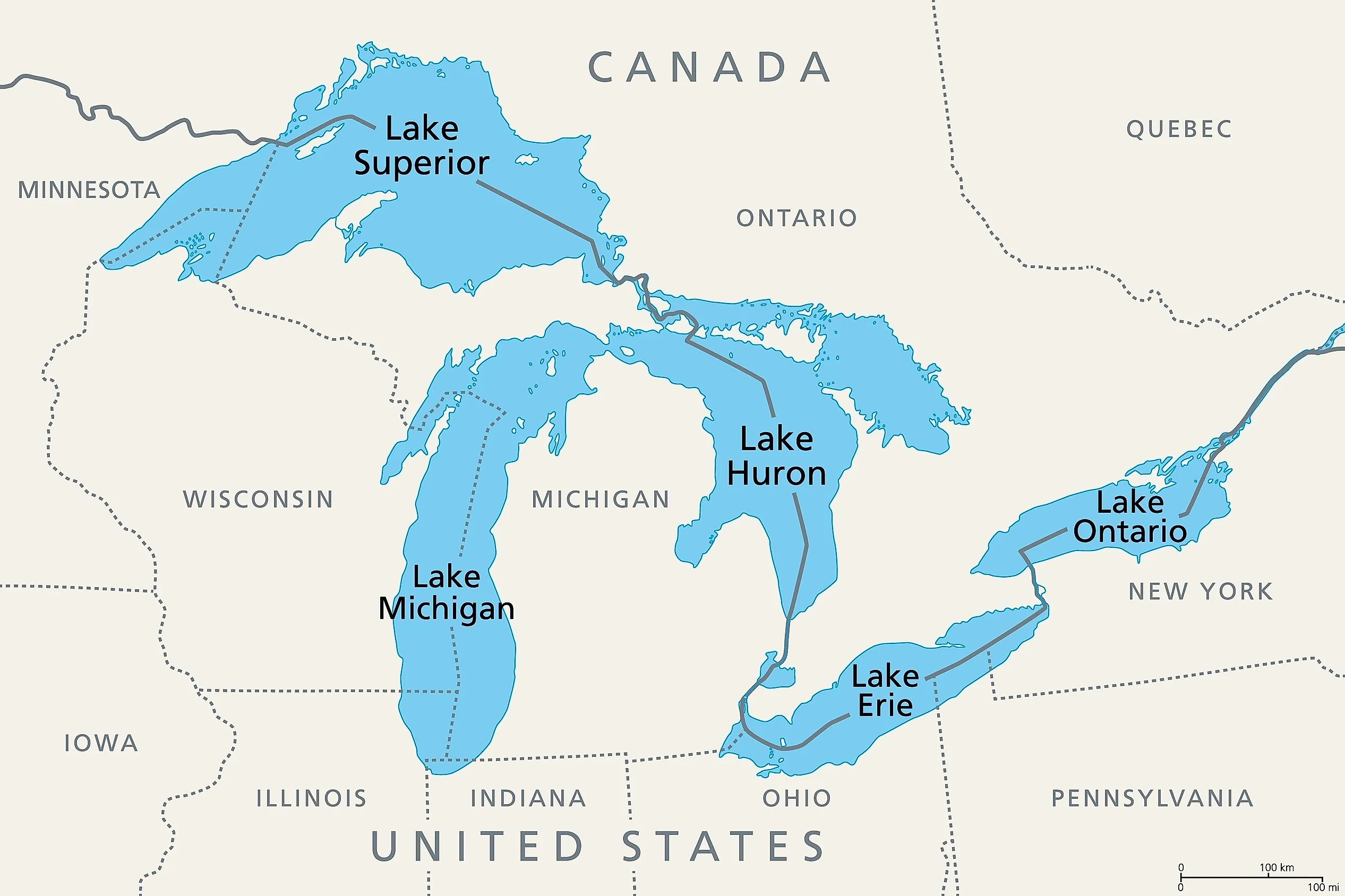
Lake Victoria is the second largest freshwater lake on Earth by surface area, behind only Lake Superior, which sets up a comparison that goes very differently depending on which number you measure. By area, Victoria is roughly a quarter of all five Great Lakes combined and effectively the same size as Lake Huron. By volume it is not in the same conversation, holding about a tenth of the Great Lakes' water, with Superior alone containing five times more than Victoria does. The reason is depth: Victoria's deepest point is around 80 meters and Superior's is 406. One is a vast tropical puddle and the other is a flooded rift.
Here is the comparison run across every measure, including a surface area figure that reference sources cannot agree on.
The Surface Area Is Genuinely Disputed

Before any comparison, this has to be flagged, because the discrepancy is about 15 percent and it changes several answers.
Wikipedia gives Lake Victoria a surface area of 59,947 square kilometers, though its own citation is flagged as incomplete. The African Center for Aquatic Research and Education, along with several standard references, gives 68,800. Britannica's figure is close to the higher one.
Both numbers appear in serious sources. The comparisons below use the lower figure where a single number is needed and note the higher one where it changes the result, which it does more than once.
Victoria Against Lake Superior

Superior covers 82,100 square kilometers, which makes it the largest freshwater lake in the world by area and the only one ahead of Victoria.
On the lower Victoria figure, Victoria is 73 percent of Superior's surface. On the higher figure it is about 84 percent. Either way the two are close enough that Victoria's status as second largest is secure and its distance from first is real.
That is where the similarity ends. Superior's average depth is 147 meters against Victoria's 40, and its maximum is 406 meters against Victoria's 80 or so. Superior is roughly five times deeper at its deepest point.
Victoria Against Lake Huron
This is the comparison worth remembering, because on the lower figure the two are almost identical.
Huron covers 59,600 square kilometers. Victoria, at 59,947, is 100.6 percent of that. A difference of 347 square kilometers between two lakes of that size is close enough to a tie that neither can meaningfully claim the win.
On the higher Victoria figure of 68,800 the picture changes and Victoria is about 15 percent larger. Which is a good illustration of why the disputed number matters rather than being a footnote.
Victoria Against Michigan, Erie And Ontario
Below Huron the Great Lakes drop off quickly and Victoria clears all three comfortably.
Lake Michigan covers 58,000 square kilometers, so Victoria beats it on either figure. Lake Erie is 25,700, less than half of Victoria. Lake Ontario is 18,960, under a third.
Put another way, Victoria is larger than Erie and Ontario combined with room left over.
Victoria Against All Five Together

The Great Lakes together cover about 244,106 square kilometers, which Britannica describes as the largest surface of fresh water in the world.
Victoria is 24.6 percent of that on the lower figure and 28.2 percent on the higher one. So one African lake covers between a quarter and a little over a quarter of the surface area of all five Great Lakes.
For a single lake competing against a system of five, that is a remarkable share, and it is the strongest version of the comparison for Victoria.
Volume Is Where It Collapses

Every flattering number above is a surface measurement, and surface area tells you almost nothing about how much water a lake contains.
Victoria holds about 2,424 cubic kilometers, with some sources giving 2,760. The Great Lakes together hold roughly 22,671. That puts Victoria at somewhere between 10.7 and 12.2 percent of the Great Lakes' water while covering a quarter of their surface.
The single-lake comparison is starker. Superior alone holds about 12,100 cubic kilometers, which is roughly five times Victoria's volume. The lake that Victoria nearly matches on area contains five times as much water.
Globally, Victoria ranks second by surface area and around ninth by volume, which is the whole story in two rankings.
Why Victoria Is So Shallow

The two lakes were made by completely different processes, and it shows in the cross-section.
The Great Lakes sit in basins gouged out by continental ice sheets, which scraped deep troughs into bedrock and left behind reservoirs with steep sides and enormous depth. Superior's floor is well below sea level in places.
Victoria was not carved. It sits in a shallow depression on a plateau between the two arms of the East African Rift, formed when uplift on either side blocked westward-flowing rivers and ponded them into a basin roughly 400,000 years ago. Nothing dug it out. Water simply had nowhere to go.
That is also why Victoria has dried up completely at least once, most recently around 17,000 years ago. A lake averaging 40 meters deep has far less margin than one averaging 147.
The Comparison That Is Closest
Set aside the water and compare what the two systems support, and the numbers converge.
Roughly 30 million people live in the Great Lakes basin. Estimates for the Lake Victoria basin run from 30 million to over 40 million across Kenya, Uganda, Tanzania, Rwanda and Burundi. Both are among the most heavily populated freshwater basins on Earth.
The difference is what the water does for them. The Great Lakes basin runs on industry, shipping and municipal supply. Victoria supports one of the largest inland fisheries in the world, and a much higher share of the people around it depend on the lake directly for protein and income.
One Drains To The Atlantic, One To The Mediterranean
Both are the headwaters of something much larger than themselves, which is a genuine similarity worth ending on.
The Great Lakes discharge through the St. Lawrence to the Atlantic, a journey of roughly 2,000 miles from the western end of Superior. Victoria discharges at Jinja in Uganda into the White Nile, which runs some 4,000 miles north to the Mediterranean.
Victoria sits at 1,135 meters above sea level, so its water begins that trip more than a kilometer up. Superior's surface is at 183 meters.
The Honest Summary

By surface area, Lake Victoria is second in the world, roughly the size of Lake Huron, larger than Michigan, Erie and Ontario individually, and about a quarter of all five Great Lakes combined.
By volume it holds around a tenth of the Great Lakes' water and Superior alone beats it five to one.
Which makes the honest version of the comparison a lesson in how misleading a map is. Two lakes can occupy the same footprint and differ by a factor of five in what they actually contain, and the only way to know is to look at the depth.