10 Largest Lakes In Europe
Forget the Alpine postcards. Europe's real giants sit up in the cold northeast, where Russia, Finland, and Sweden hoard almost every one of them. Some are glacial scars left over from the last Ice Age. The rest are Soviet reservoirs built so big that locals just call them "seas." Here are the ten largest, natural and man-made, ranked by surface area.
10 Largest Lakes In Europe
- Lake Ladoga, Russia
- Lake Onega, Russia
- Kuybyshev Reservoir, Russia
- Lake Vänern, Sweden
- Rybinsk Reservoir, Russia
- Lake Saimaa, Finland
- Lake Peipus, Estonia/Russia
- Volgograd Reservoir, Russia
- Tsimlyansk Reservoir, Russia
- Kremenchuk Reservoir, Ukraine
1. Lake Ladoga, Russia - 17,700 km2

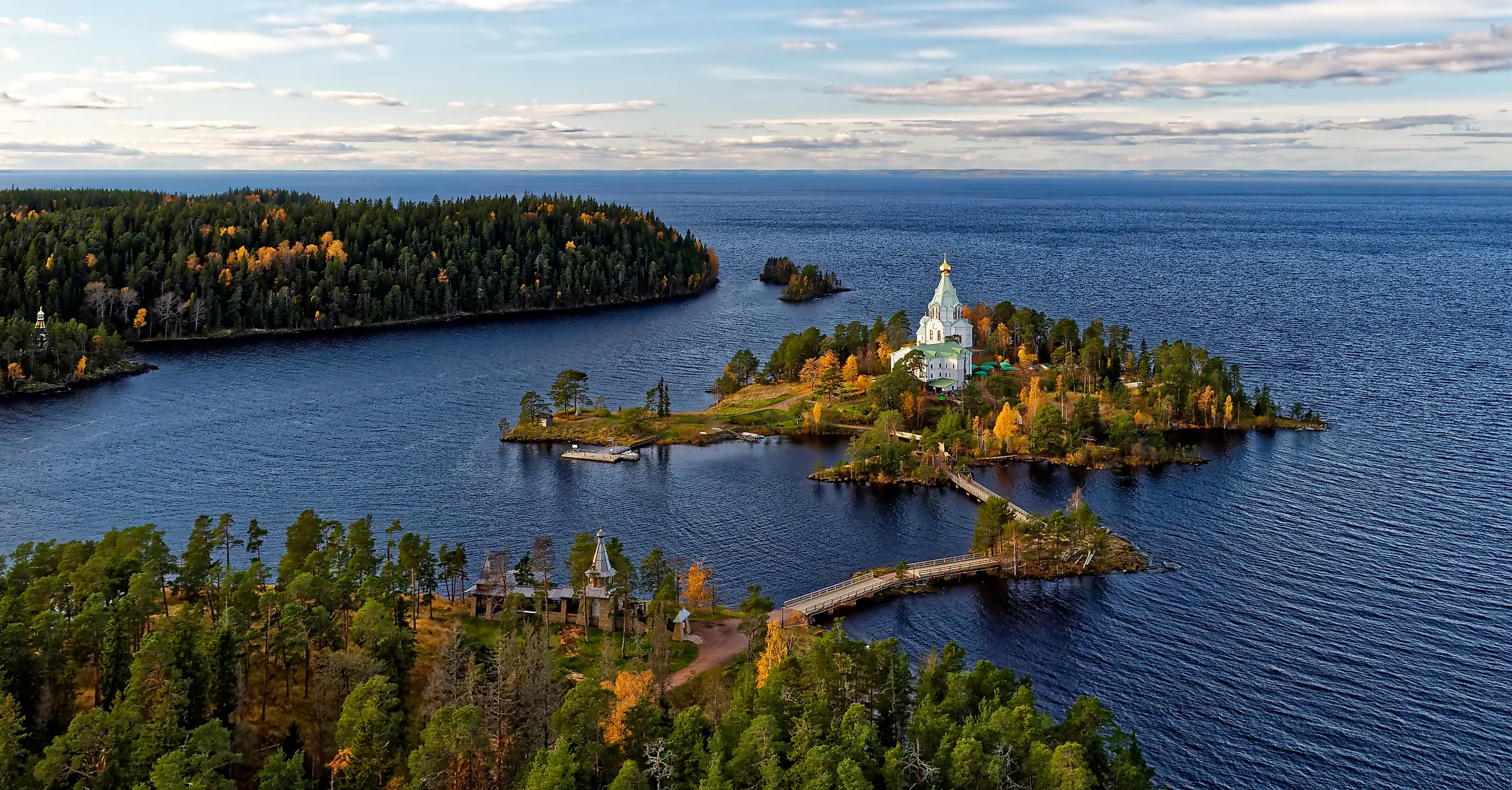
Lake Ladoga is the biggest lake in Europe, no contest. It holds 17,700 km2 just east of St. Petersburg, between Karelia and Leningrad Oblast, and runs 219 km long, 83 km wide, and 230 m deep at its lowest point. It even comes with its own seal. The endemic Ladoga seal has been stranded here since the last Ice Age, sharing the water with smelt, ruffe, bream, and Arctic char. Most people outside Russia could not point to it on a map, which is their loss.
2. Lake Onega, Russia - 9,894 km2

Onega is the runner-up at 9,894 km2, sitting just east of Ladoga in the same cold corner of Karelia, Vologda, and Leningrad Oblast. Dozens of rivers pour in, the Shuya, Suna, Vodla, and Vytegra among them, and roughly 1,650 islands dot the surface. One of them, Kizhi, is the reason people come. Its Kizhi Pogost is a cluster of wooden churches raised in 1714 without a single nail, a UNESCO World Heritage Site that has outlasted three centuries of Russian winters on carpentry alone.
3. Kuybyshev Reservoir, Russia - 6,450 km2
Kuybyshev Reservoir, also called the Samara Reservoir, is the largest reservoir in Europe: a 6,450 km2 inland sea on the Volga holding 58 cubic kilometers of water. The Soviets flooded it between 1955 and 1957 behind the Zhiguli Hydroelectric Station dam, and it now stretches past Kazan, Ulyanovsk, and Tolyatti across five Russian republics and oblasts. Seventy years on, it still does exactly what it was built to do, which for a Soviet megaproject counts as its own kind of achievement.
4. Lake Vänern, Sweden - 5,655 km2

Vänern is Sweden's largest lake and the biggest in the entire European Union, 5,655 km2 spread across the provinces of Värmland, Västergötland, and Dalsland. Fed by the Klarälven, Byälven, and Norsälven, it averages a modest 27 m deep and has bankrolled the towns on its shores for centuries, hauling timber and cargo and serving up salmon, trout, whitefish, and vendace. Then overfishing thinned the catch, and Sweden had to step in with limits before the lake gave up its best fish for good.
5. Rybinsk Reservoir, Russia - 4,580 km2

Locals call it the Rybinsk Sea, which tells you plenty. Built on the Volga behind the Rybinsk Hydroelectric Station and fed by the Sheksna and Mologa rivers, this 4,580 km2 reservoir took six years to fill, 1941 to 1947, and for a stretch afterward it was the largest artificial lake on Earth. Filling it also meant drowning the town of Mologa and moving everyone out first, a blunt reminder that these Soviet "seas" were carved out of somewhere that used to be dry.
6. Lake Saimaa, Finland - 4,377 km2

Saimaa is Finland's largest lake at 4,377 km2, the fourth-largest natural lake in Europe, or sixth once the Russian reservoirs muscle in ahead of it. It is less a lake than a maze: thousands of islands and a snarl of canals stitching smaller lakes together across eastern Finland, with the Saimaa Canal running down to the Gulf of Finland to float out timber, minerals, and metal. It also keeps its own seal, the endangered Saimaa ringed seal, one of the rarest on Earth, alongside a landlocked salmon found nowhere else.
7. Lake Peipus, Estonia/Russia - 3,555 km2

Lake Peipus is Europe's largest cross-border lake, straddling the line between Estonia and Russia at 3,555 km2. It is really three lakes in one: broad Peipsi in the north, smaller Pihkva in the south, and the narrow Lämmijärv strait knotting them together. Its claim to fame is a fight. In 1242, Alexander Nevsky's forces routed the Teutonic Knights on its frozen surface in the Battle of the Ice. It is quieter now, good for whitefish, perch, bream, and roach, though decades of Soviet farm runoff left the water the worse for wear.
8. Volgograd Reservoir, Russia - 3,117 km2
Volgograd Reservoir is the one the old rankings kept forgetting. At 3,117 km2 it is the third-largest reservoir on the Volga, behind only Kuybyshev and Rybinsk, and bigger than several lakes that used to bump it off the list. It runs an improbable 540 km down the river through the Volgograd and Saratov Oblasts, pinned in place by the Volga Hydroelectric Station dam, finished in 1961. Long, skinny, and easy to miss on a map, it is still one of the ten biggest bodies of water in Europe.
9. Tsimlyansk Reservoir, Russia - 2,702 km2

Tsimlyansk is the odd one out, parked on the Don instead of the Volga or the Dnieper. Filled in 1952 and covering 2,702 km2 across the Rostov and Volgograd Oblasts, it was built to spin turbines and, just as crucially, to water the dry steppe. That water turned bare steppe into serious farm country, now heavy with wheat, rice, cotton, maize, and grapes.
10. Kremenchuk Reservoir, Ukraine - 2,250 km2

Kremenchuk closes out the list as the largest reservoir on the Dnieper in Ukraine, 2,250 km2 doing the work of irrigation, flood control, fishing, and shipping, with busy ports at Cherkasy and Svitlovodsk. It is worth saying who used to hold tenth place. The Kakhovka Reservoir, farther down the Dnieper, made every earlier version of this list until June 2023, when its dam was destroyed during the war and the reservoir drained almost completely within days. What was a 2,155 km2 lake is now a slowly reforesting river valley, which is why this ranking no longer looks the way it used to.
Why Europe's Giants Cluster In The Cold
One pattern ties the list together. The natural giants, Ladoga, Onega, Vänern, Saimaa, and Peipus, are glacial scars gouged out by retreating ice and left to fill, which is why they bunch up in the frozen northeast. The rest are 20th-century engineering, Soviet reservoirs sized like seas, plus a couple of Ukrainian ones and a lone Swedish holdout. Between them they make the point that Europe's biggest lakes owe as much to dams and bulldozers as to the Ice Age, and that the rankings, as the lower Dnieper just showed, are far less permanent than a tidy table makes them look.
| Rank | Lake Name | Country | Area in km2 |
|---|---|---|---|
| 1 | Ladoga | Russia | 17,700 |
| 2 | Onega | Russia | 9,894 |
| 3 | Kuybyshev | Russia | 6,450 |
| 4 | Vänern | Sweden | 5,655 |
| 5 | Rybinsk | Russia | 4,580 |
| 6 | Saimaa | Finland | 4,377 |
| 7 | Peipus | Estonia, Russia | 3,555 |
| 8 | Volgograd | Russia | 3,117 |
| 9 | Tsimlyansk | Russia | 2,702 |
| 10 | Kremenchuk | Ukraine | 2,250 |
| 11 | Cheboksary | Russia | 2,190 |
| 12 | Vättern | Sweden | 1,893 |
| 13 | Saratov | Russia | 1,831 |
| 14 | Gorky | Russia | 1,591 |
| 15 | Suur-Saimaa | Finland | 1,377 |
| 16 | Beloye | Russia | 1,290 |
| 17 | Vygozero | Russia | 1,250 |
| 18 | Mälaren | Sweden | 1,140 |
| 19 | IJsselmeer | Netherlands | 1,100 |
| 20 | Päijänne | Finland | 1,081 |
| 21 | Inari | Finland | 1,040 |
| 22 | Kiev | Ukraine | 992 |
| 23 | Topozero | Russia | 986 |
| 24 | Ilmen | Russia | 982 |
| 25 | Lake Sevan | Armenia | 940 |
| 26 | Segozero | Russia | 906 |
| 27 | Pielinen | Finland | 894 |
| 28 | Oulujärvi | Finland | 887 |
| 29 | Imandra | Russia | 876 |
| 30 | Pihlajavesi | Finland | 713 |
| 31 | Pihkva | Estonia, Russia | 710 |
| 32 | Markermeer | Netherlands | 700 |
| 33 | Iron Gates | Romania/Serbia | 700 |
| 34 | Kaniv | Ukraine | 675 |
| 35 | Pyaozero | Russia | 659 |
| 36 | Kovdozero | Russia | 608 |
| 37 | Mingachevir | Azerbaijan | 605 |
| 38 | Orivesi | Finland | 601 |
| 39 | Balaton | Hungary | 592 |
| 40 | Geneva | Switzerland, France | 581 |
| 41 | Dniprodzerzhynsk | Ukraine | 567 |
| 42 | Haukivesi | Finland | 562 |
| 43 | Constance | Germany, Switzerland, Austria | 541 |
| 44 | Keitele | Finland | 494 |
| 45 | Hjälmaren | Sweden | 485 |
| 46 | Kallavesi | Finland | 473 |
| 47 | Storsjön | Sweden | 464 |
| 48 | Puruvesi | Finland | 421 |
| 49 | Vozhe | Russia | 416 |
| 50 | Razelm | Romania | 415 |