Where the World's Critical Minerals Come From
Lithium from Australia, cobalt from the Democratic Republic of the Congo, rare earth elements from China, and nickel from Indonesia help power everything from smartphones and electric vehicles to wind turbines and military equipment. These and other critical minerals are essential to modern economies, yet their production is concentrated in a relatively small number of countries. As demand for advanced technologies and clean energy systems grows, the nations that supply the world's critical minerals have become increasingly important to global trade, industry, and geopolitics.
⤷ Jump to a table of the most critical minerals in the world and why each one matters.
What Are Critical Minerals?

A mineral is considered critical when it is essential to a nation's economy or security and its supply is at risk of disruption. In the United States, the Energy Act of 2020 defines critical minerals as non-fuel minerals vital to economic and national security with vulnerable supply chains. The official US critical minerals list was updated in 2025 to include 60 minerals, reflecting the growing importance of materials such as copper, uranium, silicon, potash, phosphate, and silver. Lithium, cobalt, nickel, and graphite power electric vehicle batteries and energy storage. Rare earth elements such as neodymium, praseodymium, dysprosium, and terbium are used in permanent magnets for wind turbines, electric motors, and defense systems; indium enables touchscreens and displays. Others underpin medical imaging, telecommunications, aerospace, and advanced electronics. No single country "has the most" critical minerals, because reserves, mining, and refining are concentrated in different places. Dozens of countries produce critical minerals, but a handful dominate supply.
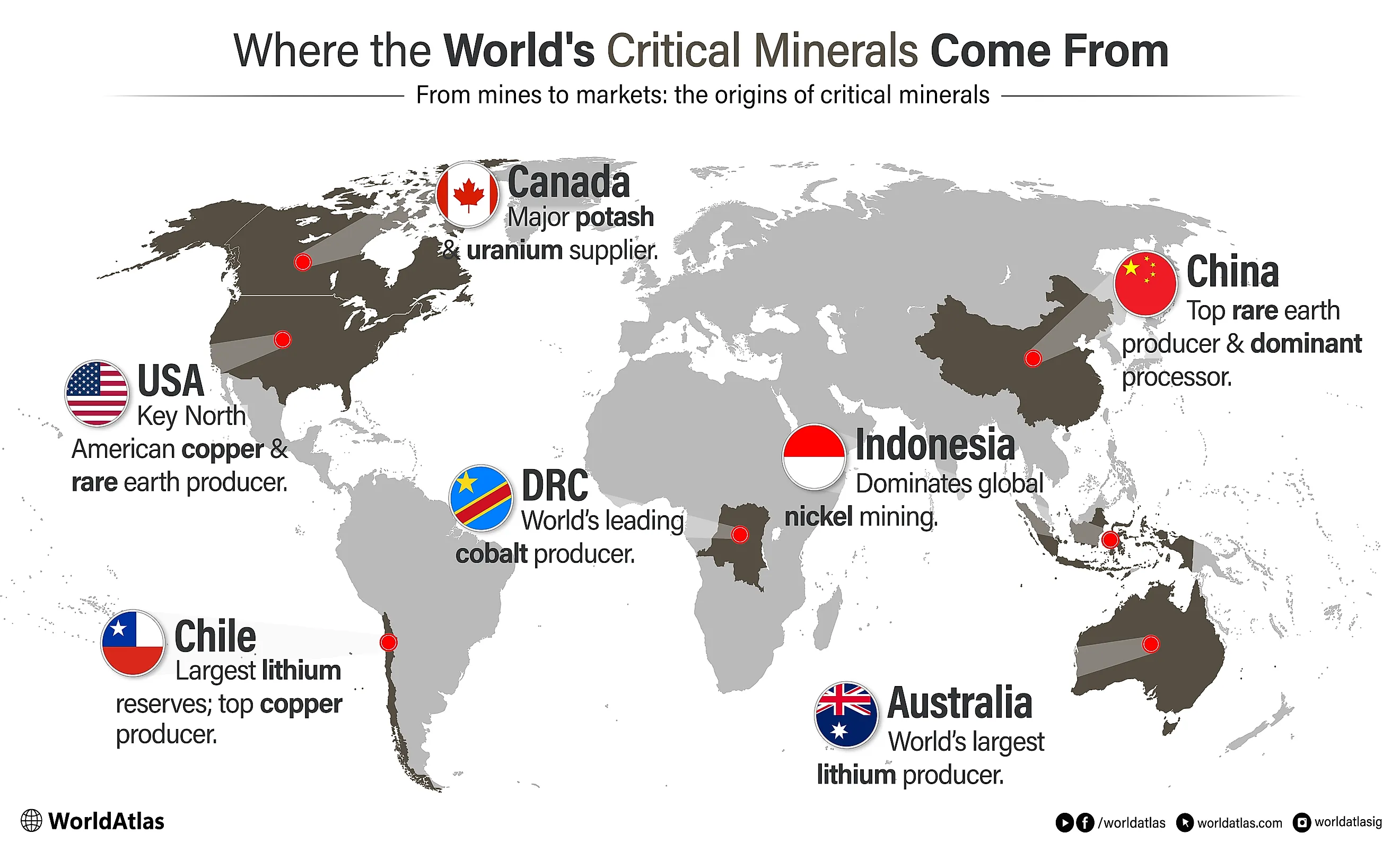
China leads global processing and produces several key materials outright. Australia remains the world's largest lithium producer, Indonesia dominates nickel mining, and the Democratic Republic of the Congo dominates cobalt mining. Chile holds the world's largest reported lithium reserves and remains one of the most important lithium suppliers. The United States and Canada are investing in domestic mining, refining, and battery supply chains to reduce reliance on concentrated overseas supply chains.
China

Key minerals: rare earths, natural graphite, gallium, tungsten, antimony, germanium, bismuth, and vanadium; also refined cobalt
China is the world's leading critical minerals power, thanks to its dominance in both production and processing. The country is a major producer of antimony, bismuth, gallium, germanium, natural graphite, tellurium, tin, tungsten, and vanadium, and Chinese companies have invested heavily in mining projects around the world. China's influence extends even further through refining, where it processes much of the world's rare earth elements and serves as the leading processor of graphite and the largest refiner of cobalt. Its extensive processing infrastructure transforms raw materials from countries such as the Democratic Republic of the Congo, Australia, and Chile into battery materials, magnets, and industrial components used in advanced technologies.
Australia

Key minerals: lithium, rare earths, copper, nickel, cobalt, and uranium
Australia is one of the world's most important critical mineral producers, especially for lithium. It is the world's largest lithium producer and also has important rare earth, nickel, and cobalt resources. In 2025, Australia produced approximately 92,000 metric tons of lithium content, according to USGS estimates. Although its refining sector remains smaller than its mining industry, Australia has invested in expanding domestic processing capacity. Lynas Rare Earths operates one of the most important rare earth supply chains outside China, including mining in Australia and processing capacity in Malaysia and Australia.
Indonesia

Key minerals: nickel and cobalt; also battery-material processing
Indonesia has become a critical minerals powerhouse through its dominance in nickel production. According to the US Geological Survey, the country produced approximately 2.6 million metric tons of nickel in 2025, accounting for about two-thirds of global mine output. Indonesia has also expanded its cobalt industry and invested heavily in domestic processing facilities, allowing it to move beyond raw mineral exports and become an important supplier of battery materials. These investments have strengthened Indonesia's position in global electric vehicle and energy storage supply chains.
Democratic Republic of the Congo

Key minerals: cobalt and copper
The Democratic Republic of the Congo (DRC) is the world's leading cobalt producer and one of the most important countries in the global critical minerals supply chain. The country accounted for roughly 73% of global cobalt mine production in 2025, making it a key supplier for batteries, electronics, and renewable energy technologies. Despite its mining dominance, the DRC has limited domestic refining capacity, and much of its cobalt is exported for processing, particularly in China. The country's cobalt industry has also faced scrutiny over issues such as artisanal mining, child labor, and supply-chain traceability, prompting governments and manufacturers to strengthen sourcing standards and due diligence requirements.
Chile

Key minerals: lithium, copper, and molybdenum
Chile holds the world's largest reported lithium reserves and remains one of the world's top lithium producers. Its extensive deposits in the Atacama Desert have made the country one of the most important suppliers of lithium for batteries, energy storage systems, and electric vehicles. Although China has recently overtaken Chile in annual lithium mine production, Chile's vast reserves ensure it remains a critical player in the global transition to cleaner energy technologies.
Canada and the United States

Key minerals: (Canada) potash, uranium, nickel, and cobalt; (United States) copper, rare earth mineral concentrates, beryllium, and molybdenum
Canada and the United States are working to strengthen North American critical mineral supply chains through mining, processing, and manufacturing partnerships. Canada is an important producer of nickel and cobalt and is developing lithium, rare earth, refining, and battery manufacturing capacity. The United States is a significant producer of rare earth mineral concentrates and copper, but it remains a small lithium producer compared with Australia, China, and Chile. Both countries are investing in domestic processing facilities to reduce reliance on concentrated overseas supply chains. Together, Canada and the United States are expanding their roles in critical mineral production and refining as part of broader efforts to diversify global supply chains.
Critical minerals have become essential to modern economies, powering everything from smartphones and electric vehicles to renewable energy systems and defense technologies. Countries such as Australia, Indonesia, the Democratic Republic of the Congo, Chile, and China supply many of the minerals needed for these technologies, while China remains the dominant force in refining and processing. As demand grows, governments and manufacturers are racing to secure reliable sources of these materials and build processing capacity closer to home. Understanding where critical minerals come from and where they are processed will remain an important factor in global trade, energy security, and technological development.
The Most Critical Minerals in the World
| Mineral / group | Why it matters |
|---|---|
| Lithium |
EV batteries, grid storage, portable electronics |
| Cobalt |
Battery cathodes, superalloys, defense/aerospace
|
| Nickel |
Batteries, stainless steel, high-performance alloys
|
| Graphite |
Battery anodes; China-dominated processing
|
| Copper |
Power grids, transmission lines, EVs, electronics
|
| Rare earth elements, especially neodymium, praseodymium, dysprosium, terbium |
Permanent magnets for EV motors, wind turbines, robotics, defense systems
|
| Manganese |
Steelmaking and some battery chemistries
|
| Gallium |
Semiconductors, LEDs, defense electronics
|
| Germanium |
Fiber optics, infrared/night-vision systems, semiconductors
|
| Tungsten |
Hard metals, cutting tools, aerospace, defense
|
| Antimony |
Flame retardants, batteries, ammunition, defense supply chains
|
| Platinum-group metals, platinum, palladium, rhodium, iridium, ruthenium |
Catalysts, hydrogen technologies, electronics, automotive systems
|
| Uranium |
Nuclear power and strategic energy security
|
| Aluminium, silicon, zinc, titanium |
High-volume industrial, energy, aerospace and semiconductor uses
|