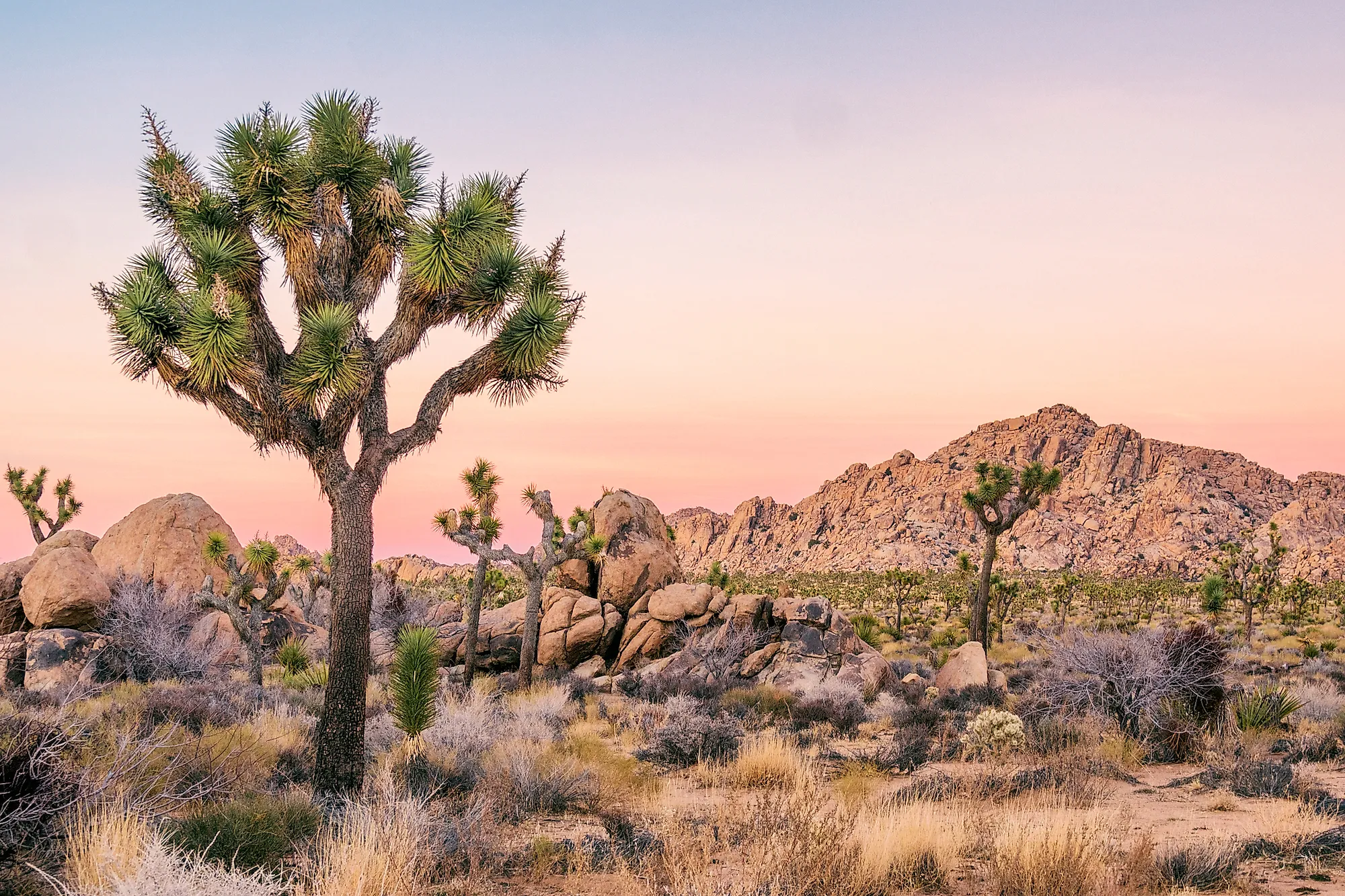
Why Joshua Trees Grow In Only One Desert
Joshua trees are large, tree-like yuccas native mainly to the Mojave Desert and nearby transition zones of the American Southwest. Their distribution is closely tied to cold winters, hot summers, low rainfall, and suitable habitat. Joshua trees also depend on highly specialized yucca moths for pollination. Western and eastern Joshua trees each have their own primary moth partner, creating an unusually close relationship between plant and pollinator. Natural stands are concentrated in the Mojave, although Joshua trees also reach adjoining desert and transitional environments.
Characteristics Of The Joshua Tree

Joshua trees are perennial evergreen monocots. Recent taxonomic work often recognizes two closely related species, the western Joshua tree (Yucca brevifolia) and eastern Joshua tree (Yucca jaegeriana), although some authorities still treat them as varieties of Y. brevifolia. Both belong to the family Asparagaceae and the subfamily Agavoideae. As monocots, Joshua trees are more closely related to grasses and orchids than to familiar broadleaf trees such as oaks.
Their trunks are fibrous and do not form conventional annual growth rings, which makes precise aging difficult. Western Joshua trees can reach about 40 feet tall, with rare individuals approaching 50 feet. Eastern Joshua trees are generally shorter. Western Joshua trees usually begin branching after flowering, while eastern Joshua trees often branch closer to the ground. Growth is slow. The National Park Service estimates an average Joshua tree lifespan of about 150 years, although some individuals may exceed 300 years.
What Caused Its Range To Shrink?

Joshua trees were more widely distributed during the late Pleistocene. Fossil evidence shows they occupied areas farther south and at lower elevations than many present-day populations. As the climate rapidly warmed around 11,700 years ago at the beginning of the Holocene, the southern portion of the Joshua tree's range contracted. Today, natural populations occur primarily in California, Nevada, Arizona, and Utah. Botanical authorities also record western Joshua trees in northwestern Mexico.
The end of the last Ice Age may have affected Joshua tree dispersal in another way. Fossil dung confirms that the extinct Shasta ground sloth ate Joshua tree fruit, and researchers have proposed that these large mammals may once have carried seeds over considerable distances. Their exact importance as seed dispersers remains uncertain. Today, rodents are major dispersers of Joshua tree seeds. They remove seeds from fruits and bury them in caches, some of which serve as suitable germination sites.
Where Joshua Trees Grow Today

Most Joshua trees occur within the Mojave Desert and adjoining transition zones. Eastern Joshua trees occupy portions of southern Nevada, western Arizona, southwestern Utah, and eastern California. Western Joshua trees are concentrated in California and Nevada. Joshua trees also occur along ecotones adjoining the Great Basin Desert and the Sonoran Desert. Some populations also reach environments associated with the southern Colorado Plateau.
How High Ground Helps Them Grow

Joshua trees occur across a broad range of elevations within their natural range. U.S. Forest Service research places them at elevations ranging from roughly 1,000 feet to more than 7,000 feet above sea level, depending on location. Within Joshua Tree National Park, the National Park Service reports them mainly between about 2,800 and 5,800 feet. They grow on dry flats, mesas, and gentle slopes. Temperature and precipitation help determine where populations can persist.
Higher elevations can provide cooler conditions and more precipitation, which is why some upland areas are expected to serve as important refuges as the region warms. Winter cold is also associated with flowering. The National Park Service reports that blooms are most likely the result of well-timed rainfall and a winter freeze. Scientists think freezing damage to branch tips can help trigger flowering and new branch growth. Water availability also influences whether Joshua trees bloom and successfully produce new plants.
Specialist Pollinators

Joshua trees depend on yucca moths for pollination. Outside a narrow hybrid zone in Nevada, western and eastern Joshua trees are associated with different specialized moth species. A female moth collects pollen and deliberately transfers it to another Joshua tree flower while laying eggs inside the flower's ovary. This pollinates the flower and allows seeds to develop.
After the eggs hatch, the moth larvae consume some of the developing seeds. Enough seeds generally remain for the tree to reproduce. Animals later open or remove the fruits, and seed-caching rodents carry many of the seeds away from the parent plant. The Joshua tree therefore depends on different animals at separate stages of reproduction, with moths providing pollination and rodents playing an important role in seed dispersal.
The Risk Of Habitat Loss

Climate change, drought, wildfire, and development all pose challenges for Joshua trees. A 2019 study published in Ecosphere modelled future habitat around Joshua Tree National Park. Under two mitigation scenarios, only about 14% to 19% of the historically suitable area remained as end-of-century refugia. Under the study's highest-emissions scenario, suitable habitat around the park was almost completely eliminated.
Newer research provides a broader view. A 2025 Ecosphere study covering western and eastern Joshua trees projected that up to 80% of current habitat could become unsuitable by 2100 under the highest-emissions scenario. The study also identified areas where suitable habitat could persist. Many of these potential refuges are at higher elevations within the current range. Increasing wildfire frequency was identified as the greatest rangewide threat to future suitable habitat in the study.
Wildfire risk in the Mojave is intensified by invasive annual grasses such as cheatgrass and red brome. These plants can create continuous dry fuel between native desert plants, allowing fires to travel through areas that historically burned less often. Joshua trees are generally poorly adapted to frequent or severe fire. Mature trees can sometimes survive lower-intensity burns, and some plants can resprout after damage. Severe fires can still kill large numbers of Joshua trees, with younger plants particularly vulnerable.
Protecting Western Joshua Trees

California enacted the Western Joshua Tree Conservation Act in 2023. The law applies specifically to the western Joshua tree and regulates activities, including removing or otherwise taking protected trees without authorization. It also created the Western Joshua Tree Conservation Fund. Money collected through the program can support land acquisition, conservation, restoration, monitoring, and management of western Joshua tree habitat.
Research and wildfire prevention are also underway in California's state parks. The 2020 Lake Fire burned 55 acres of Arthur B. Ripley Desert Woodland State Park, damaging mature Joshua trees and other native vegetation. Beginning in 2021, California State Parks monitored more than 700 young Joshua tree sprouts in the burned area. A later survey found that almost half of those sprouts had survived, while more than 400 additional sprouts were identified.
California State Parks Foundation has helped fund that work. In 2024, the nonprofit provided a grant for a fuels-reduction project at Arthur B. Ripley Desert Woodland State Park. The project included removing invasive plants to reduce the risk of another severe wildfire. The research also gives managers more information about how western Joshua trees recover after fire.
Joshua Tree National Park

Joshua Tree National Park is one of the best-known places to see western Joshua trees. The National Park Service estimates that about 870,000 Joshua trees grow within the park. The park recorded 2,932,644 recreation visits in 2025. Its largest stands of Joshua trees occur in the higher Mojave Desert section of the park.
Park Boulevard passes extensive Joshua tree stands and prominent rock formations. Pullouts and trailheads along the road provide several opportunities for short walks. The Cap Rock Trail is a 0.4-mile loop through Joshua tree habitat and monzogranite formations. Farther west, the Hi-View Trail and West Side Loop provide longer routes through Joshua tree woodland with broad views across the surrounding mountains.
More Than An Oddity

Joshua trees are an important part of desert ecosystems. Their trunks and branches provide shelter and nesting sites for wildlife, while specialized insects depend on the plants for food and reproduction. The yucca moth relationship is especially important because Joshua trees rely on these insects for pollination. Rodents provide another ecological connection by dispersing and caching their seeds.
Joshua trees can be cultivated outside their natural range, but maintaining wild populations requires a suitable climate, pollinators, and successful seed dispersal. Current research projects substantial habitat losses under warmer future conditions while also identifying areas where Joshua trees may persist. Protecting those refuges from severe wildfire and habitat development will be important to the long-term conservation of these distinctive desert plants.


_(14045508389).jpg)
