Why Saguaro Cactus Grow In Only One Desert
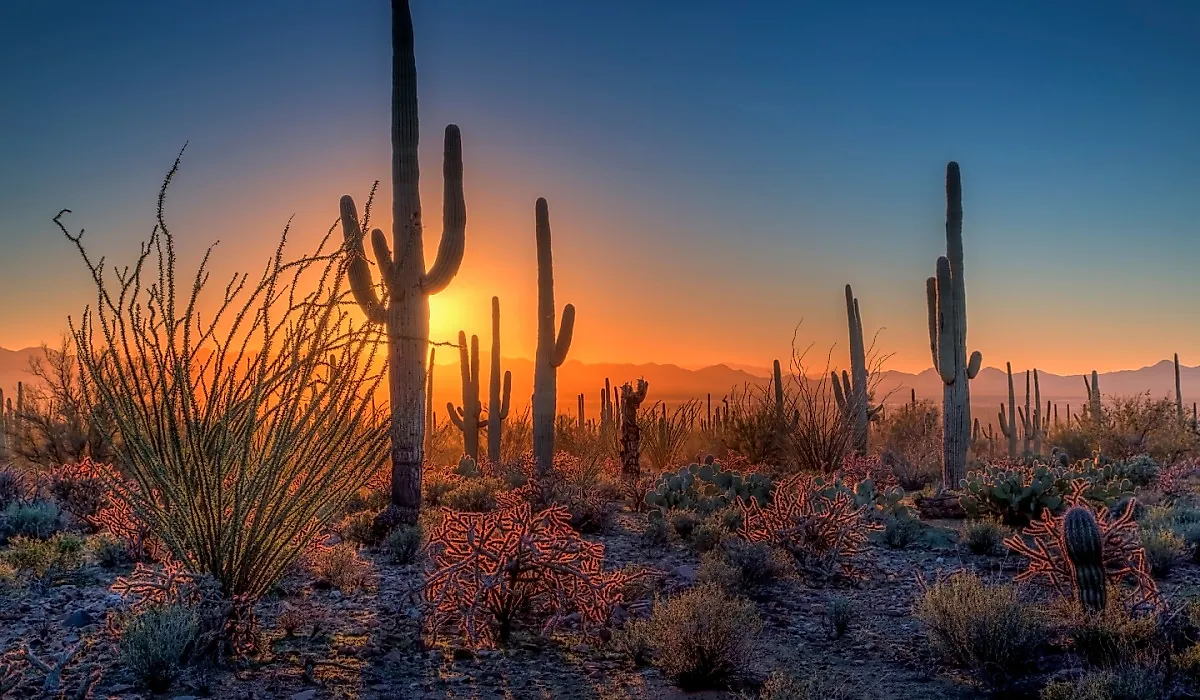
Ask someone to draw a desert and they will almost certainly sketch a saguaro, the towering, many-armed cactus that defines the landscape in a thousand Westerns. So it comes as a surprise to learn that this famous giant grows naturally in only one place on Earth: the Sonoran Desert of Arizona and northwestern Mexico. It is absent from the Mojave, the Chihuahuan, and the Great Basin, the three other North American deserts, even though all four exist within Arizona alone. The saguaro, it turns out, is an extraordinarily picky plant, and its narrow range comes down to a few very specific demands that only the Sonoran can meet. Here is why.
The One Desert Where It Belongs

The saguaro's entire wild range sits inside the Sonoran Desert, which covers roughly 100,000 square miles across southern Arizona, the Mexican state of Sonora, and a sliver of southeastern California near the Gulf of California. Within that zone, the cactus is so characteristic that biologists treat it as a signature species, a living marker of exactly where Sonoran conditions prevail. Arizona is the only U.S. state to contain all four North American deserts, and yet you will not find a wild saguaro in its Mojave, Chihuahuan, or Great Basin portions. The plant stops precisely where the Sonoran Desert stops. To understand that hard boundary, you have to look at what makes this one desert different, starting with its rain.
It Needs Two Rainy Seasons

The Sonoran is often called the wettest desert in the world, and more importantly, it is the only North American desert with two distinct rainy seasons. Gentle frontal storms drift in from the Pacific between December and March, and then, from July into mid-September, the summer monsoon delivers sudden, drenching thunderstorms. This bimodal rainfall is the saguaro's lifeline, supplying moisture at two separate points in the year that align with flowering, fruiting, and seed germination. The neighboring deserts each get only a single wet season, with the Mojave leaning on winter rain and the Chihuahuan on summer storms. For a plant whose survival depends on catching water at just the right moments, that one-season shortfall is a dealbreaker.
It Cannot Survive a Hard Freeze

Cold is the saguaro's mortal enemy. The cactus stores enormous amounts of water in its pleated trunk, and when that water freezes for too long, the plant's tissue ruptures and it can die. Mature saguaros can shrug off a brief, light frost, but sustained temperatures below about 28 degrees Fahrenheit are dangerous, and young seedlings are especially fragile. The Sonoran Desert suits them because it sits low and warm, with mild winters where hard freezes are rare. The Great Basin and higher-elevation deserts, by contrast, endure genuine winters with snow and prolonged cold that no saguaro could survive. This is also why the cactus keeps to elevations below roughly 4,000 feet, where the killing frosts of the high country cannot reach it.
It Needs a Nurse to Get Started

Even within the Sonoran Desert, a baby saguaro faces long odds, and it usually survives only with help. A saguaro seed is tiny, and the seedling that sprouts from it is delicate, vulnerable to blistering sun, hungry animals, and exactly the kind of frost that threatens the adults. To make it through those first fragile years, the seedling almost always germinates in the shade of a "nurse plant," typically a palo verde, mesquite, or ironwood tree. The nurse shelters the young cactus from sun and cold until it is large enough to fend for itself, sometimes long enough that the saguaro eventually outgrows and outlives the very tree that protected it. Those particular nurse trees are themselves Sonoran Desert specialists, so the saguaro's support system exists only where the saguaro does.
A Giant Tuned to a Single Place

Put those requirements together and you have a plant exquisitely calibrated to one desert and one desert only. It needs the Sonoran's double dose of rain, its warm and largely frost-free winters, its low elevation, and its particular community of nurse trees, a combination found nowhere else. That fussiness is all the more remarkable given how the saguaro rewards it, growing for 150 to 200 years, rising 40 feet or more, weighing several tons when swollen with water, and often waiting three-quarters of a century before sprouting its first arm. Along the way it becomes a whole ecosystem, its flesh hollowed into nesting cavities for gila woodpeckers and tiny elf owls. The saguaro is not just a plant that happens to live in the Sonoran Desert. It is the living proof of where that desert begins and ends.