The Petrified Forests Turned To Stone
Petrified wood is a tree trunk turned to stone. Burial has to be quick, before decay reaches the wood, after which mineral-rich groundwater replaces the organic material cell by cell, usually with silica. A petrified forest is what remains when that happens to a whole stand of trees at once, or to a raft of logs dropped in one place by a flood.
Petrified wood turns up in every state, but only a handful of sites hold it in the concentration that makes a fossil forest, most of them in the arid West where erosion keeps stripping the cover rock away. Six stand out here. Arizona's Painted Desert holds one of the largest and most colorful concentrations in the world, Yellowstone's Specimen Ridge stacks at least 27 Eocene forests one above the next, and Montana's Gallatin Petrified Forest is the only one where a permit allows a piece to be carried home. These six record how a landscape turns to stone, and how each one came to be.
Petrified Forest National Park, Arizona
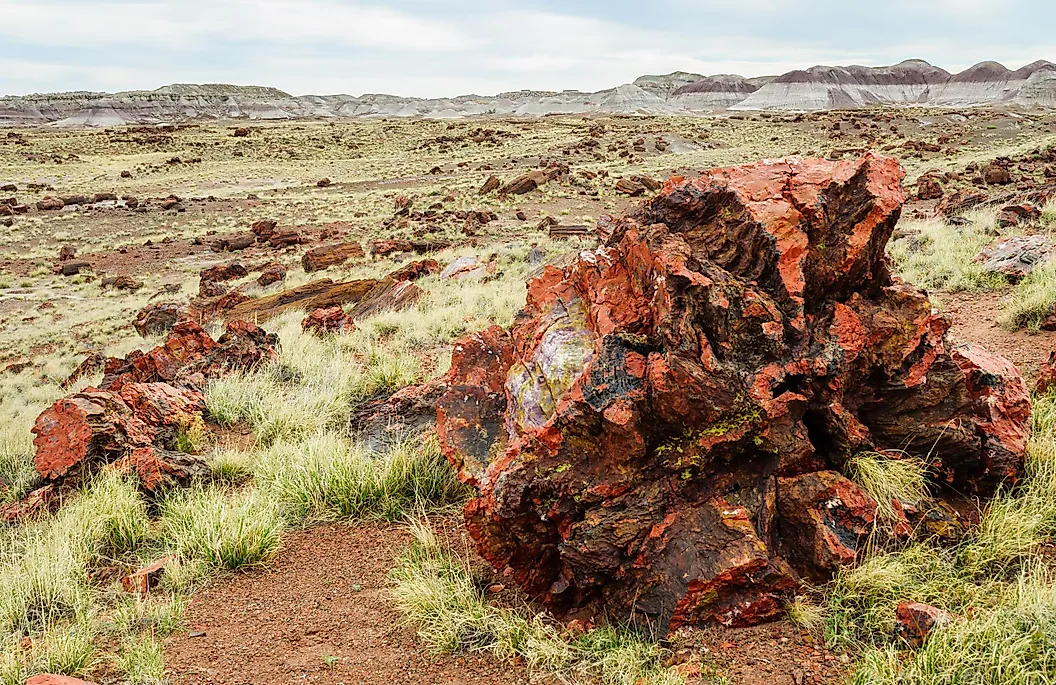
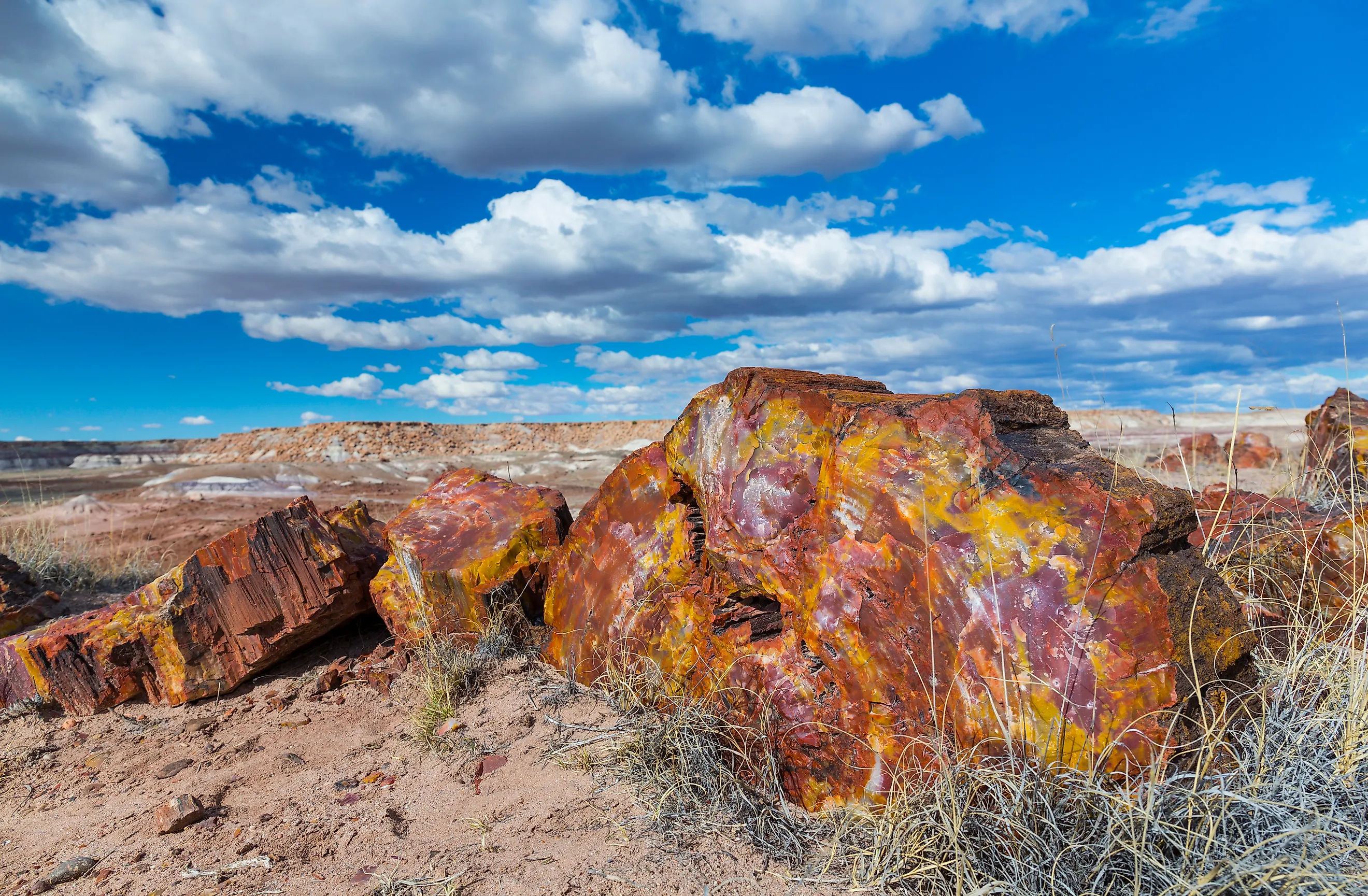
The Petrified Forest holds one of the largest and most colorful concentrations of mineralized fossil wood in the world, according to the Park Service, with some logs exceeding 190 feet in length. The wood in the Arizona park weathers from the Late Triassic Chinle Formation and dates to between 223 and 208 million years ago.
Many of the trees were carried by ancient rivers and trapped in log jams before being buried beneath sediment. Silica dissolved out of volcanic ash later replaced the wood's organic material while preserving its cellular structure. Most of the fossil logs belong to an extinct conifer, Araucarioxylon arizonicum, which grew up to nine feet in diameter and nearly 200 feet tall.
Erosion eventually exposed the logs, leaving them scattered across colorful badlands and desert terrain. Short trails such as Crystal Forest, Giant Logs, and Long Logs offer the best chances to see them up close. The vivid reds, yellows, and purples come from trace minerals within the fossilized material. Removing any of it is illegal, and the park displays pieces that visitors have mailed back.
Yellowstone's Fossil Forests, Wyoming

Yellowstone is known for geysers and hot springs, but the volcanic rock along Specimen Ridge preserves at least 27 individual Eocene forests, one stacked above the next. The trees are about 50 million years old and include sequoia, fir, and numerous deciduous species, with some trunks eight feet in diameter. Volcanic debris flows called lahars, fed by the Absaroka volcanoes along what is now the park's northern and eastern edge, buried these forests repeatedly and separated them with layers of rock and other plant fossils. Erling Dorf of Princeton counted 27 levels in the Amethyst Mountain section in the 1960s, and the Park Service still cites that figure for the Specimen Ridge rocks.
Around 1900, F. H. Knowlton proposed that the trees had been petrified where they grew, an interpretation that held through most of the twentieth century. Later work argued that many were uprooted and carried downslope by debris flows before being deposited upright, a mechanism observed directly after the 1980 eruption of Mount St. Helens. The distinction changes what the deposit records: a series of standing forests, or repeated transport off the flanks of a volcano. An upright petrified redwood stump is fenced at Petrified Tree, a roadside stop near Tower Junction. Specimen Ridge holds far more, although reaching its fossil forest takes a strenuous climb. Nothing may be collected anywhere in the park.
Gallatin Petrified Forest, Montana

The Gallatin Petrified Forest lies in the Custer Gallatin National Forest in Montana, just north of Yellowstone, and it is the only site here where a visitor can legally take a piece home. The Forest Service describes stacked fossil forest layers totaling more than 2,000 vertical feet, preserved largely as upright trees dating back nearly 50 million years. The deposits formed during the Eocene, when volcanoes covered parts of southwestern Montana and northwestern Wyoming with ash, lava, and mudflows. Fossilized seeds, leaves, and cones survived alongside the wood. These are the same Absaroka eruptions that buried the Yellowstone forests a few miles south, so the two deposits are largely one geological story split across an agency boundary.
National forests are managed by the USDA Forest Service under a multiple-use mandate that permits limited personal collecting, while national parks are managed by the Park Service for preservation. A free permit from a Custer Gallatin ranger district allows a small amount of petrified wood to be gathered inside the Gallatin Petrified Forest Special Management Zone, for personal use only, and the permit expires at the end of the calendar year in which it is issued. The interpretive trail into the deposit climbs from a campground at the head of the Tom Miner Basin.
Theodore Roosevelt National Park, North Dakota

The Park Service ranks the Petrified Forest at Theodore Roosevelt National Park third in the country for concentration of petrified wood, behind Petrified Forest and Yellowstone. That is unexpected in a park better known for badlands, bison, and prairie dogs. The fossil wood in North Dakota comes out of Paleocene rock, roughly 60 million years old, deposited a few million years after the extinction of the dinosaurs.
The region was a flat, swampy delta then, supporting sequoia, bald cypress, and magnolia. Sediment washing down the rising Rocky Mountains buried the trees before they could decompose, and minerals gradually replaced their organic material. Some stumps in the Sentinel Butte Formation still stand where the trees grew, and the largest reach 12 feet in diameter. The fossil beds sit at the remote western edge of the South Unit, reached by gravel road and a hike of several miles across open grassland and eroded hills. Directions to the trailhead changed in 2025, so current park information is worth checking before the drive. Collecting is prohibited by law.
Ginkgo Petrified Forest, Washington

Ginkgo Petrified Forest State Park, on the west bank of the Columbia River near Vantage, preserves one of the most diverse petrified wood assemblages in North America, with more than 50 tree species identified. The site in central Washington was designated a National Natural Landmark in 1965. About 15 million years ago, the ground here was warm swampland growing elm, sycamore, walnut, and ginkgo, a tree no longer native to North America. Basalt flows of the Columbia River Basalt Group then flooded the lowland. Where the Ginkgo Flow met standing water it chilled into bulbous masses called pillow lava, sealing waterlogged logs away from the air, and silica released by the cooling basalt slowly replaced the wood cell by cell.
Petrified ginkgo was identified here in the early 1930s by George Beck, a geologist at what is now Central Washington University, and the find drove the campaign that created the park. The Trees of Stone Interpretive Trail passes roughly 20 logs in their original setting, while the interpretive center above the Columbia River displays polished specimens of petrified wood, which is the Washington state gem. Camping and river access are at the nearby Wanapum Recreation Area.
Mississippi Petrified Forest, Mississippi

The Mississippi Petrified Forest near Flora is one of only two petrified forests in the eastern United States, the other being the Gilboa fossil site in New York. Massive logs, identified largely as fir and maple, washed down an ancient river channel about 36 million years ago and came to rest in what is now the Forest Hill Formation, a bed of sand and clay in Mississippi's Madison County. The site is private. Bob and Shirl Schabilion bought the land in 1962, after roughly a century of unchecked collecting had carried off tons of wood, and opened it to visitors the following year. The forest was designated a National Natural Landmark in 1965 for its value in illustrating the natural history of the country, and nothing may be removed from the grounds.
A short nature trail passes the largest logs, and an earth science museum on the property displays petrified plant material gathered from across the country alongside other fossils and fossil casts. The setting is the sharpest contrast with the western sites, since these stone logs sit in humid southern woodland rather than desert or badlands.
A Record of Ancient Landscapes
Petrified forests are more than a collection of unusual rocks. Each fossilized trunk records something about the environment around it, including which species grew there and how the region changed afterward. The differences between these sites are as informative as the similarities. A forest buried by volcanic debris preserves a different sequence of events from one carried downstream and dropped in a logjam, and the resulting fossil beds look nothing alike in the field.
Land status adds a second layer. The same Eocene deposit yields strictly protected fossils inside Yellowstone and permitted specimens a few miles away in the Custer Gallatin, and the Mississippi logs survived mainly because one family fenced them. What each site preserves is a forest that no longer exists. What each one allows is a separate question, settled by whichever agency or owner holds the ground.