The Biggest Tree East Of The Mississippi
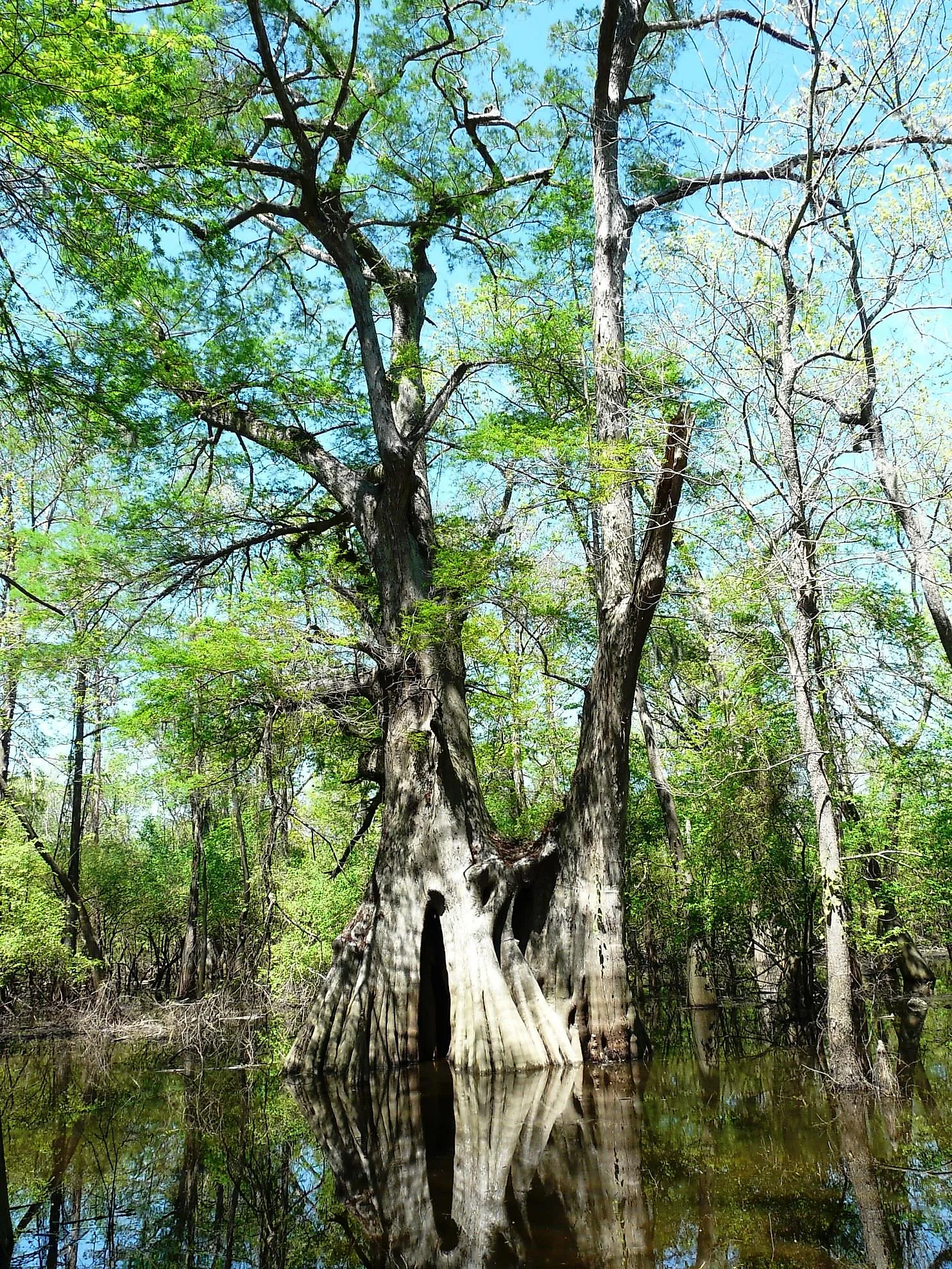
The biggest tree east of the Mississippi River is a hollow bald cypress in a Louisiana swamp. It grows on Cat Island National Wildlife Refuge in West Feliciana Parish, and it holds the national champion title for its species. Loggers who worked the surrounding bottomland left it behind because its hollow trunk was useless as timber. The record comes from a point score rather than from volume, so the word "biggest" needs a definition. The record's history also runs through a North Carolina national forest, a Tennessee state park, and a Florida county park where an ancient cypress burned.
The Champion Cypress At Cat Island

Seventeen feet of trunk separate one side of the Cat Island cypress from the other. Federal sources and refuge signage agree on that diameter, and they put the girth above 50 feet and the height above 80. The national champion register scored the tree at 739 points at its 2017 measurement.
Refuge signage goes further and calls it the largest tree of any kind east of the Sierra Nevada. Age estimates range from roughly a millennium to 1,500 years.
A wildlife refuge is neither a national forest nor a national park. The tree grows under the US Fish and Wildlife Service, not the Forest Service or the National Park Service. Cat Island is not a true island either. Federal descriptions call it a peninsula of bottomland between the Tunica Hills and the Mississippi River. Those hills mark the southern end of the loess bluffs along the east bank of the Mississippi.
How A Tree Earns The Word "Biggest"

Under the national champion program, size is a sum. Each tree earns one point per inch of trunk circumference and one point per foot of height, while crown spread adds a quarter point per foot. The University of Tennessee has run the program since 2023.
Girth dominates the arithmetic. At Cat Island, the trunk alone supplies 626 of the cypress's 739 points.
Points and volume are different records. The volume title belongs to a giant sequoia in California. The General Sherman Tree in Sequoia National Park measures 52,508 cubic feet in trunk volume, according to the National Park Service. Age is a third record again. Great Basin bristlecone pines rank as the oldest non-clonal species on the planet. In the East, the title rests on points.
The Swamp The Loggers Passed Over

More than a century ago, loggers worked through the Cat Island bottomland, but the champion survived because its trunk was hollow and had no commercial value. Several other ancient cypresses on the refuge escaped for the same reason.
A 2000 House committee report described Cat Island as holding one of the highest densities of old-growth bald cypress in the United States. Many of those trees run between 500 and 1,000 years old. The land was privately owned until the refuge took it over that year.
Nobody ever built a levee here. The report called Cat Island the southernmost unleveed stretch of the Mississippi River, and the river still spills across it. The refuge typically floods from December to June. Access becomes questionable once the rising river reaches 20 feet on the Baton Rouge gauge. A flat 0.75-mile round trip on the Big Cypress Trail reaches the tree from a trailhead 4.6 miles past the main gate.
The Bedford County Tuliptree, Virginia

Bedford County, Virginia, shares the national champion tuliptree title in an old-growth cove forest. The register lists a second Virginia tuliptree, in Chesapeake, at the same 521 points. At 139 feet, it beats the Louisiana champion in height by more than 40 feet. Its trunk measures 362 inches around against 626 at Cat Island, and the register scored it at 521 points in 2021.
The tree carries significant cavities but shows no signs of deterioration, according to its champion listing. Steep ground and the root flare made it hard to measure, so the measurers averaged readings taken from several positions around the slope. The tree is not open to the public.
Joyce Kilmer Memorial Forest, North Carolina

No logging crew cut the cove hardwoods of Joyce Kilmer Memorial Forest. The Forest Service bought the tract in 1936 for $28 an acre, when land around it sold for $3 to $4. The agency's own history credits the survival of the old growth to its recognized rarity and to the economic depression after 1929.
The tuliptree goes by tulip poplar here, and some of these trees measure more than 20 feet around. They reach 100 feet tall, and the oldest trees in the forest are as old as 450 years. The memorial forest honors Joyce Kilmer, author of the poem "Trees," who was killed in action in France during World War I.
The memorial forest is part of the Nantahala National Forest in North Carolina, and the Cheoah Ranger District looks after it. Visitors see it only on foot. A 2-mile figure-eight trail loops through the old growth, and its upper loop passes through Poplar Cove.
The Giants That Fell

Lightning ended an earlier claim in July 1976. The Tennessee Titan was a Weakley County bald cypress. Tennessee natural areas officials describe it as the largest known tree east of the Mississippi River in its day. The tree was an estimated 1,350 years old. Big Cypress Tree State Park still carries the tree's name.
Fire took a second giant. The Senator, a Seminole County bald cypress in Florida, burned in January 2012. County estimates put its age at about 3,500 years.
Its neighbor survived. Lady Liberty still grows in Big Tree Park in Longwood, and the county estimates its age at about 2,000 years.
What Kept The Giant Standing
Size alone did not decide which eastern giants survived. Lightning took the Tennessee Titan, and fire took The Senator. The Depression helped spare the tulip poplars of Joyce Kilmer Memorial Forest, where some trees have stood for about 450 years. At Cat Island, a hollow trunk turned the loggers away. The Mississippi still floods the refuge most winters and springs, and no levee has ever held it back from the champion's swamp.