UK's 11 Most Laid-Back Towns
Life slows down naturally in the United Kingdom's small coastal and countryside towns, where the pace is dictated by tides and ferry crossings, rather than rush-hour traffic. On Shetland's Mainland, Brae sits on Busta Voe, near Mavis Grind, at the meeting of the North Sea and the Atlantic Ocean. In Portaferry, you can cross Strangford Lough or climb Windmill Hill for views of the Isle of Man on a clear day. Near Marloes, take your time exploring more than a mile of golden sand and rock pools at low tide. In Horton-in-Ribblesdale, you can set out on the Three Peaks Walk or take the gentler path to Hull Pot, a massive collapsed cavern on the slopes of Pen-y-ghent. These 11 laid-back towns, spread across Scotland, Wales, Northern Ireland, and England, feature the quiet harbours and rolling landscapes that make the UK an easy place to kick back and relax.
Brae, Scotland

On the north shore of Busta Voe on the island of Mainland in Shetland, Brae is a tiny fishing village surrounded by wide open spaces. A short jaunt west of town leads to Mavis Grind, a narrow isthmus that brings the North Sea and the open Atlantic Ocean within 100 meters of each other, and reveals signs of its past as a prehistoric magma chamber. Then, to the south-west, the Hams of Muckle Roe Circular trail reveals rugged red granite sea stacks and sea caves along the shore. And for anyone hoping to chart their path at sea, Brae's own marina at Busta Voe is a handy launch point for boating excursions.
Set between Brae's central village and Muckle Roe, Busta House Hotel might just be the perfect place to unwind in Shetland. This 16th-century historic home now operates as a boutique hotel with a restaurant and a lounge stocked with over 250 malt whiskies.
Portmahomack, Scotland

Venturing over to the Easter Ross peninsula of mainland Scotland, Portmahomack sets an easygoing pace on the Scottish Highlands' East Coast. Right in town, Portmahomack Beach is good for easy strolls on the sand. Shifting north, the Tarbat Ness Lighthouse is the tallest on the Scottish mainland and a good place to spot seabirds like gannets, kittiwakes, and auks.
And for some more change in scenery, folks can book an appointment to tour the Tarbat Discovery Center, itself an 18th-century church, and a present-day museum that houses ancient and early medieval Pictish cultural artifacts. Back near the main beach and the town harbour, The Castle Hotel is a locally owned and managed establishment featuring cozy accommodations alongside a seafood restaurant.
Dunvegan, Scotland

Turning to the Inner Hebrides off Scotland's West Coast, Dunvegan makes a good base for exploring the Isle of Skye. A major highlight here is the remains of the 17th-century St. Mary's Church, an open-air museum chronicling much of the town's past, including the curious Duirinish Stone, which looks like a Neolithic monument but was actually erected to mark the coming of the new millennium in 2000. Heading north, Dùn Fiadhairt is an Iron Age broch set in a largely undisturbed hiking area.
For another curious corner of local lore, it's worth calling ahead to see inside the Giant Angus MacAskill Museum, a thatch-roofed and whitewashed cottage that's now dedicated to the memory of Angus MacAskill, a native Scotsman who was often considered the tallest non-pathological giant in recorded history at 7 feet 9 inches, or 2.36 metres, and was declared the world's strongest man by the Guinness Book of World Records in 1981. After a long day exploring many of the Isle of Skye's tall tales, Skye Lodge Dunvegan provides a relaxing place to stay, where guests can enjoy a full Scottish breakfast served in the morning.
St Andrews, Scotland

Whether one's an avid golfer or an avid explorer, a lovely Scottish coastal holiday awaits north-east of Edinburgh in St Andrews. At the campus of Scotland's oldest university, the University of St Andrews, the Wardlaw Museum has four galleries and draws on a university collection of around 115,000 objects spanning history, art, and science. A short stroll west, West Sands Beach extends for over two miles of open dunes where the famous beach-running scene in the 1981 film Chariots of Fire was filmed.
Of course, no visit to St Andrews feels complete without a pilgrimage to St Andrews Links, a collection of award-winning golf courses that includes the Old Course, where golf has been played since the early 15th century. Staying by the Old Course, the Old Course Hotel is one of Europe's best-known luxury resorts. It offers the easiest access to St Andrews Links, along with the Kohler Waters Spa.
Caergybi/Holyhead, Wales

Caergybi, known in English as Holyhead, sits on Ynys Gybi, or Holy Island, directly west of the larger Isle of Anglesey. Not only does the town stand on historic ground, but it is also Wales' busiest ferry port. At the Holyhead Maritime Museum, folks can explore Wales' oldest lifeboat station, see a World War II air raid shelter, and learn more about the region's unique relationship with the Irish Sea.
Heading west, it's hard to miss Holyhead Mountain, known in Welsh as Mynydd Twr, where hikers can trek up to the 220-metre summit, take in the panoramic harbour and Irish Sea views, and even find a group of Iron Age circular hut formations near the mountain's foot. And a little farther west, the South Stack Lighthouse anchors the island's west coast and has been guiding ships toward safe harbour since 1809. Steps from Holyhead's historic harbour, The Haven Guest House is a warm, friendly, family-owned establishment.
Marloes, Wales

Turning to the coast of South West Wales, Marloes makes a good base for exploring the southern reaches of Pembrokeshire Coast National Park. The best-known attraction around here is Marloes Sands, a stretch of golden coastline that goes on for over a mile during low tide and is lined with rock pools along the shore. Even closer to town is Musselwick Beach, a secluded golden sand beach that only comes into full view during low tide, so check the tide schedule before heading there.
And at the western tip of the Marloes Peninsula, Deer Park may not have any wild deer roaming about, but it does have the remains of an Iron Age fort, and it is a great place to spot seals and seabirds such as puffins, Manx shearwaters, petrels, and gulls in their natural habitat. Over near Musselwick Sands and the Pembrokeshire Coast Path, Musselwick Farm Cottages offers five farmhouses turned luxury holiday cottages.
Portstewart, Northern Ireland

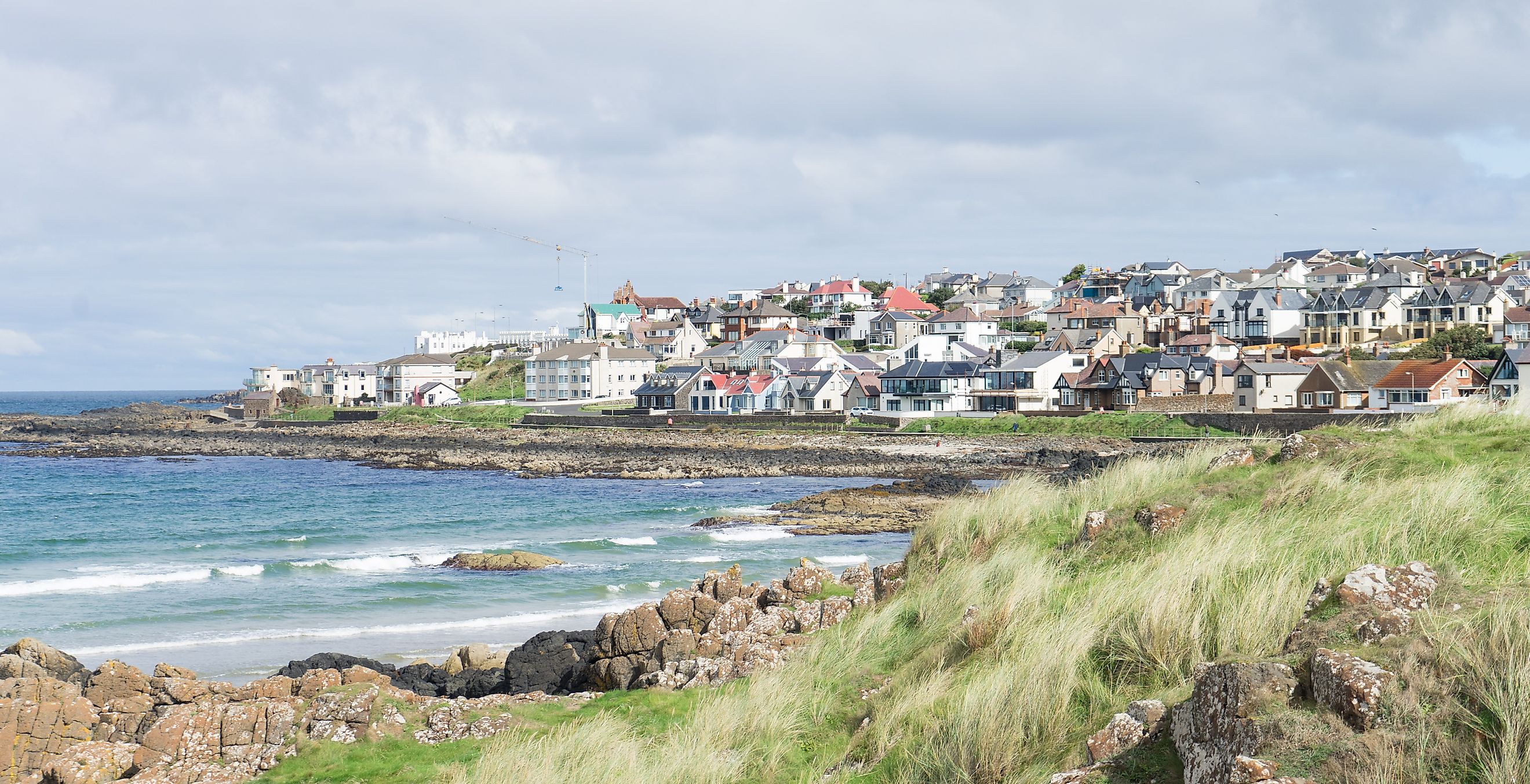
On the Causeway Coast of County Londonderry in Northern Ireland, Portstewart is a seaside resort that first drew Victorian holidaymakers and still revolves around its crescent-shaped Promenade and small harbour. At the western end of the Promenade, the Gothic-style Dominican College, built in 1834 and originally known as O'Hara's Castle, sits on the cliff edge, and a cliff path beneath it runs along the coast toward the beach. That beach, Portstewart Strand, is a two-mile stretch of golden sand cared for by the National Trust, backed by 6,000-year-old dunes with waymarked trails that lead toward the estuary of the River Bann. Golfers can also tee off at Portstewart Golf Club, whose championship Strand course threads through those same dunes.
Back on the Promenade, Morelli's ice cream parlour is a family-run institution that marked its centenary in 2011 with a Guinness World Records entry, when 2,728 people ate its ice cream at the same time. Its double cream vanilla has also been named National Supreme Champion by the Ice Cream Alliance, so a cone in hand is the natural way to finish a walk along the seafront.
Portaferry, Northern Ireland

At the southern tip of the Ards Peninsula in County Down, Portaferry looks out over the narrows near the mouth of Strangford Lough. By the water, Exploris Aquarium and Seal Sanctuary is Northern Ireland's only aquarium, introducing visitors to the lough's native marine life before widening out to species from around the world, while its seal sanctuary takes in seals for rehabilitation. A short walk away, Portaferry Castle is a 16th-century tower house built by the Savage family, and the Georgian Market House, completed in 1752, still anchors the town square.
For the best view in town, head up Windmill Hill, where the stump of an old windmill overlooks Strangford Lough and, on a clear day, the Isle of Man. Right on the waterfront, The Portaferry Hotel faces Strangford Lough beside the ferry slip, with views straight across the water. It makes an easy base for hopping over to Strangford village on the car ferry, which runs back and forth across the lough throughout the day.
Horton-in-Ribblesdale, England

Sitting near the famed Yorkshire Three Peaks of Yorkshire Dales National Park, Horton-in-Ribblesdale is a base for hill walking in the North of England. Traditionally, the town marks the starting point of the Three Peaks Walk that provides a combined 1,585 metres, or 5,200 feet, of ascent while traversing the mountains of Pen-y-ghent, Ingleborough and Whernside.
A less strenuous walk into the wilderness can be found along the Hull Pot path, which leads up the western side of Pen-y-ghent and reveals a massive collapsed cavern. When the itinerary calls for refreshment and refueling, the Blindbeck Tea Room is a good place to stop for a bite. And just down the road from Blindbeck, The Rowe House is a country house with a small campsite for tents, as well as en suite rooms.
Bradford on Avon, England

Bradford on Avon lets visitors time travel through the town's medieval history and riverside scenery. At the center of town sits the Town Bridge & Lock-up, a 13th-century bridge that doubled as a local jail during the 18th and 19th centuries. A short trek west leads to Barton Farm Country Park, a 30-acre green space that is one of the area's largest and the home of the Tithe Barn, which remains well-preserved for a 14th-century structure with a timber cruck roof.
To the south of town, Farleigh Hungerford Castle was founded by Sir Thomas Hungerford, England's first recorded Speaker of the House of Commons, late in the 14th century, and continues to offer a glimpse into life in medieval England. To enjoy modern creature comforts, Widbrook Barns offers a warm welcome. Guests can choose between a glamping wagon and an indoor room, and every stay includes a full breakfast.
Penzance, England

On the Cornwall coast of the South West of England, Penzance is a longtime market town that also serves as a lively artists' hub. Penlee House showcases key works by Newlyn School artists inside, and it maintains a lush subtropical garden outside. A few blocks east, Cornwall Contemporary displays contemporary paintings, sculpture, and ceramics by local and internationally known artists.
And for a more refreshing take on life in Penzance, visitors can head down to the Jubilee Pool, where the sea pool is filled with natural Celtic Sea water, then warm up in the heated geothermal pool and sweat it out in the sauna. Located right by Penzance Harbour, the historic Dolphin Tavern continues to function as a traditional public tavern where diners can feast on dishes made with locally sourced produce and seafood. The tavern also has a few cozy guest rooms upstairs.
Ease Into a Good Time in the UK
Throughout the UK, there are a number of attractive options for a relaxing getaway. Brae provides an inviting launchpad for exciting excursions on Shetland's Mainland, while St Andrews welcomes visitors to Scotland's home of golf. In Wales, Holyhead pairs a busy ferry port with Iron Age remains and enduring natural beauty, and Marloes makes a natural base for exploring the shores of Pembrokeshire Coast National Park. And in England, Horton-in-Ribblesdale marks the path to the famed Three Peaks of Yorkshire Dales National Park, while Penzance stands out as an artsy resort town on the Cornwall coast.