Why Bristlecone Pines Only Grow Where Nothing Else Will
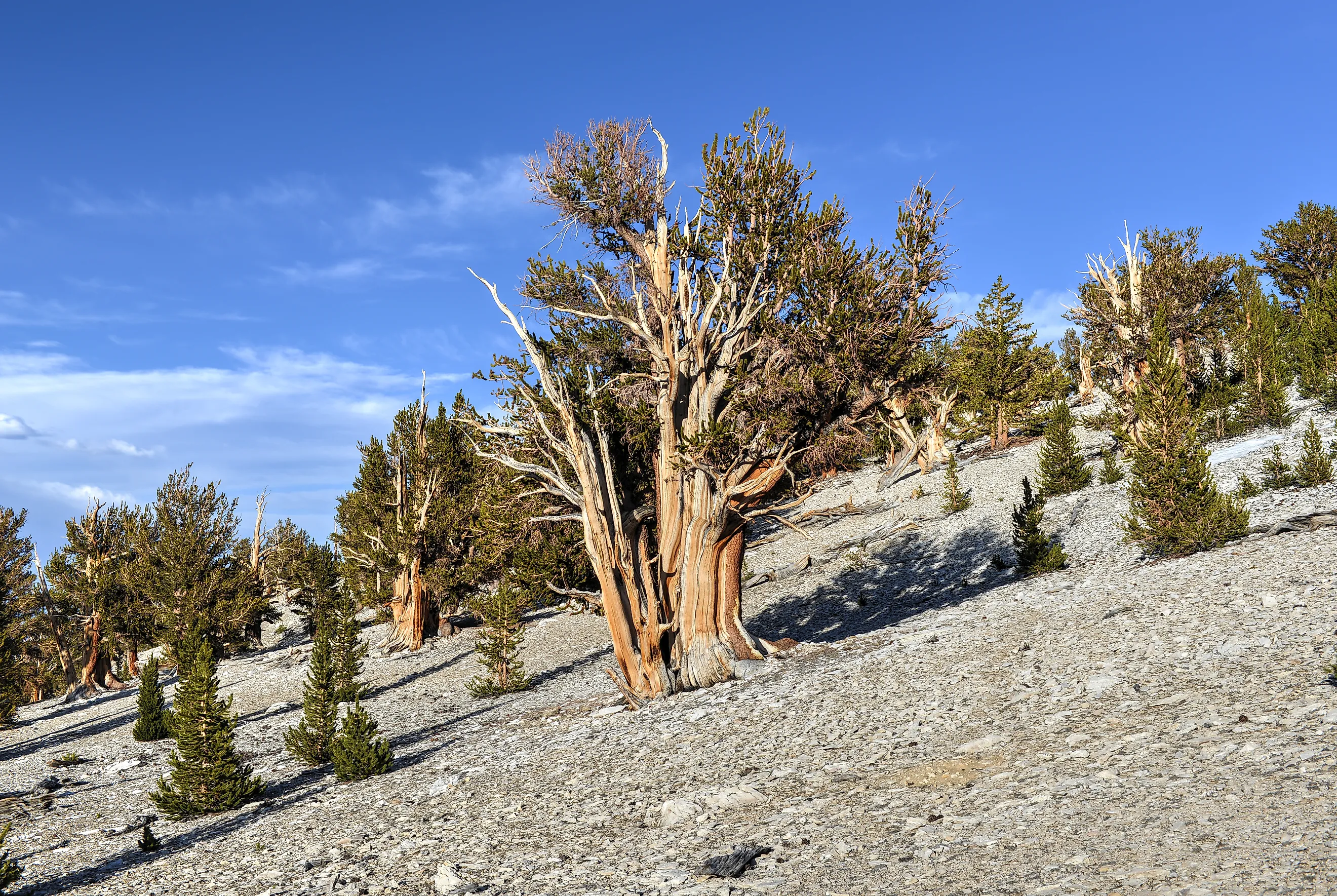
Great Basin bristlecone pines are the oldest non-clonal organisms on Earth, thriving in some of the most extreme environments. These trees grow above 10,000 feet in the White Mountains of California, as well as in select Nevada and Utah ranges, on thin, white, gravelly soil that is so alkaline and deficient in phosphorus that most plants cannot establish themselves. Despite these harsh conditions, some trees here are aged four to five thousand years. In contrast, a few hundred yards away on richer ground with deeper soil and more nutrients, bristlecones are absent, replaced by limber pines and sagebrush that flourish much better. The clear conclusion is that tough environments produce tough trees, although this explanation is only partly correct.
What is actually going on involves a specific rock, a trade-off that most trees cannot afford, and a scientific consensus that has shifted in the last decade.
The Rock Is Doing Most Of The Work

The substrate consists of dolomite, a carbonate rock similar to limestone. In the White Mountains, bristlecone pines mainly grow on it above about 10,000 feet. Dolomite soils are alkaline, with an average pH of around 8.1, rich in calcium and magnesium but very low in phosphorus. This combination makes nutrient absorption difficult, often preventing other plant species from thriving, as noted by the US Forest Service. Additionally, the soil contains over 50% rock, leaving very little actual soil.
Two additional properties are important and have opposite effects. Dolomite's pale color reflects sunlight instead of absorbing it, helping to keep the surface cooler. Moreover, studies dating back to the 1960s show that dolomite retains moisture more effectively than nearby granite and quartzite. As a result, on a dry mountain, the roughest-looking terrain is often the dampest and coolest.
The Story Everyone Tells, And Why It Changed

Ecologists initially regarded bristlecones in the White Mountains as refugees, reasoning that these trees could thrive on better soils but were outcompeted, leaving them to survive only on dolomite where other plants could not establish. However, more recent research challenges this view. Studies now show that bristlecone pines actually perform better on dolomite than on quartzite or granite, indicating that their presence there is likely a genuine preference rather than just exile. Instead of merely surviving poor soil, the trees seem to flourish on it.

An additional complication makes the overall picture even more unusual. When researchers planted limber pine seeds in all three soil types, they found the highest germination and survival rates on dolomite soil, despite adult limber pines being rarely found there. This suggests that factors limiting competition occur later in the tree's life cycle rather than at the seedling stage, a phenomenon that is not yet fully understood. Thus, the honest answer to the question posed in the title is that both conditions are true: the soil is hostile enough to reduce competition, and bristlecones tend to thrive in these conditions.
Sagebrush Loses On A Technicality

The competition side operates based on a unique mechanism discovered through clever mid-century experiments. Sagebrush, being more drought-tolerant than bristlecone pine, might seem like the likely winner. However, it cannot survive on dolomite, as its shallow roots are a significant limitation. In high-pH soils where nutrients are unavailable, a shallow-rooted plant struggles against a deep-rooted pine.
The reverse is true for granite and sandstone. On these substrates, bristlecone seedlings grow much slower than sagebrush seedlings, leading to shading out before they can establish. Each species thrives on its preferred substrate but struggles on the other, resulting in a sharply defined boundary visible even from afar.
Slow Growth Is The Whole Bargain

The age of a bristlecone is rooted in its slow growth, dictated by its environment. Its annual rings are extremely narrow, often less than a hundredth of an inch. This results in very dense, resin-rich wood that resists decay, fungi, and insects much better than typical timber. Instead of rotting, dead bristlecone wood erodes slowly and can remain intact for thousands of years.
As trees age, they exhibit a unique characteristic: root damage typically affects only the bark and cambium connected to the roots, leaving the rest of the tree alive. For example, an ancient bristlecone often appears mostly dead wood with a single living ribbon running up its length, explaining its distinctive appearance. Additionally, the site’s sparse, widely spaced trees on bare rock contribute to this resilience; there's very little fuel available, so fires rarely spread through these stands.
What That Buys Them

Methuselah, located in the White Mountains of Inyo National Forest, is approximately 4,850 years old. The Forest Service keeps the specific identity of the tree confidential, a decision that became clear in 1964. That year, a graduate student working on Wheeler Peak in eastern Nevada experienced a corer break while sampling trees. The tree was cut down with permission to retrieve the sample, and it was later named Prometheus. It was found to be around 4,900 years old, making it the oldest known living organism at the time of its felling. The grove from which it came is now protected by Great Basin National Park, established in 1986.
The true scientific significance lies in the data they contain. Overlapping ring patterns from both living trees and preserved deadwood have created a continuous bristlecone chronology dating back about 9,000 years. This chronology has been instrumental in refining radiocarbon dating and revising much of the archaeological timeline.
The Thing That Could Undo It

The strategy has a clear vulnerability: a species that succeeds by occupying areas inaccessible to competitors faces problems when those competitors adapt and can follow. Currently, limber pine is establishing above the bristlecone treeline in the Great Basin, even on dolomite, and in greater numbers than bristlecone pine. Additionally, warmer conditions are enabling mountain pine beetle and white pine blister rust to reach higher elevations that were previously inaccessible to them.

Slow growth offers little protection against rapid threats. A tree that takes a century to reach reproductive maturity cannot escape dangers, reflecting the trade-off that made it old in the first place.