12 Standout Main Streets In Pennsylvania
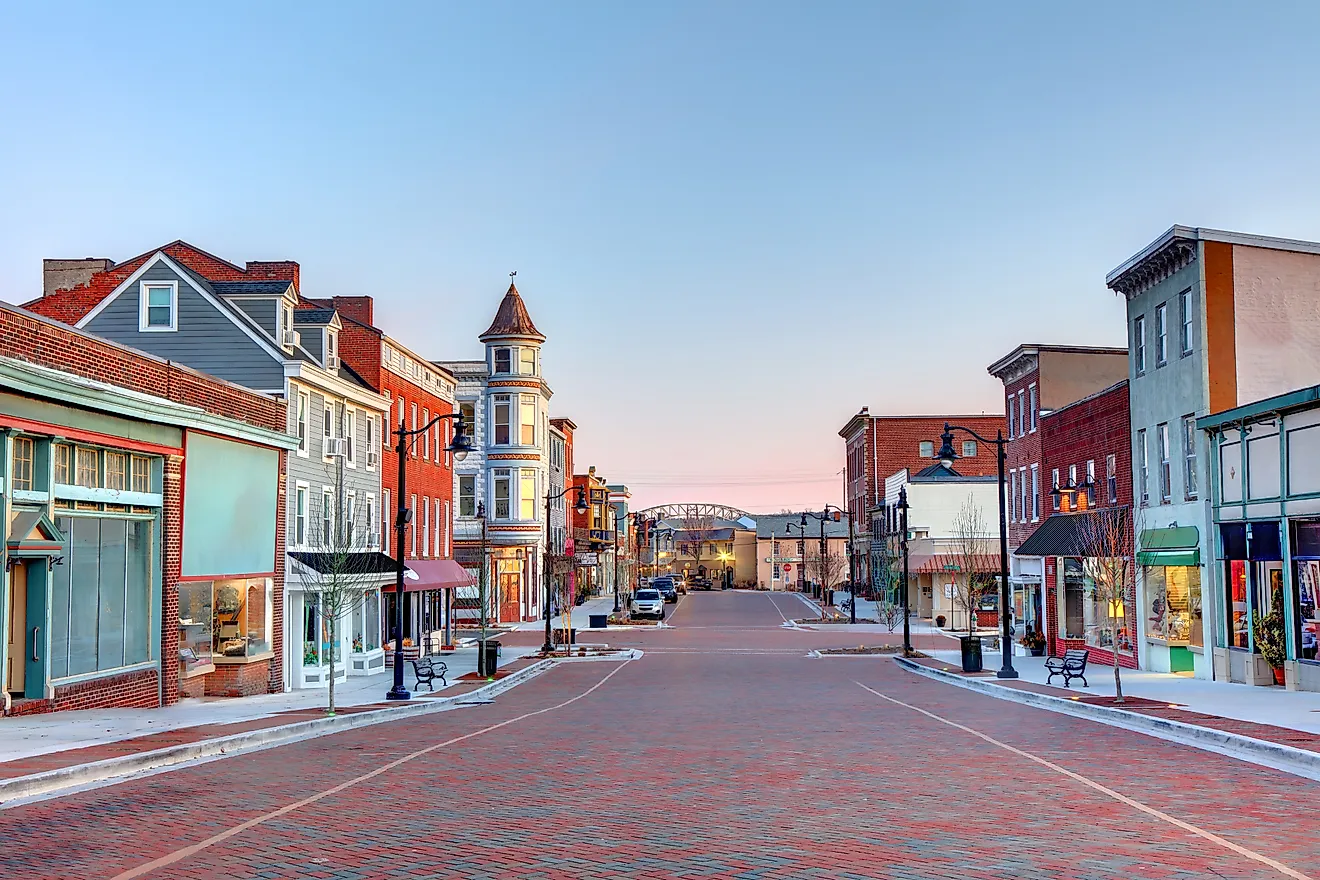
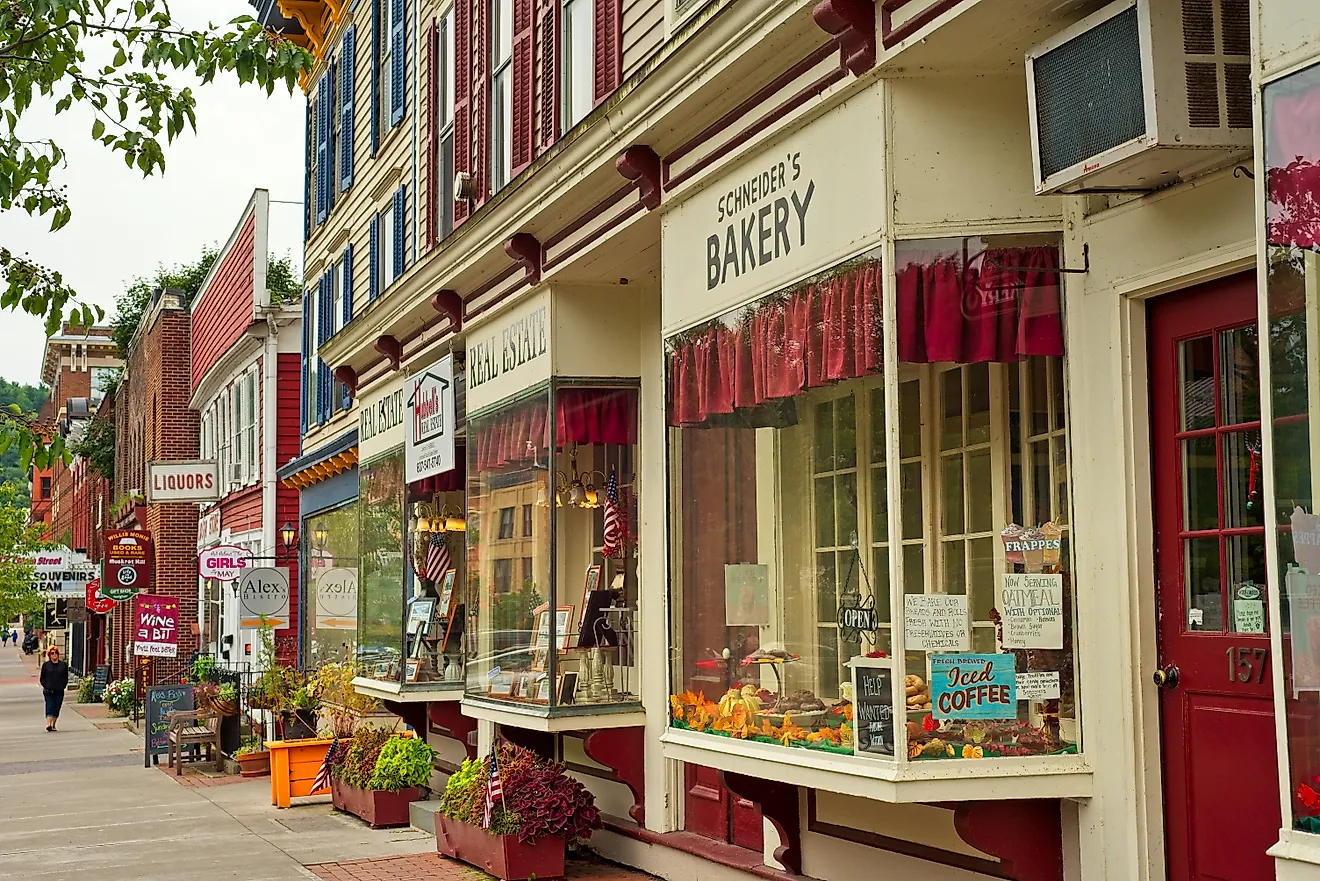
The gas lamps on Wellsboro's Main Street burn day and night, decades after the rest of America tore its own out, and nobody in town would dream of switching them off. That is the stubbornness this list celebrates. In Media, a trolley still rolls down the middle of State Street; in Jim Thorpe, a tourist train still boards below a street of Victorian rooftops; in Doylestown, a 1938 movie palace lights its blue neon every single evening. Pennsylvania built hundreds of main streets, but only a handful still work exactly as designed, as the place where a town eats, shops, argues, and shows off. These 12 do, and each one can be read from a single corner.
Doylestown

Doylestown's main street earns its place the straightforward way: State and Main Streets cross at the center of a walkable grid, and the County Theater, a restored 1938 Art Deco cinema, still glows blue neon above East State Street with indie films showing nightly. A block over, Nonno's Italian Coffee Parlor pours espresso and scoops gelato, while HONEY on Shewell Avenue serves a shareable, modern American menu, keeping the evening traffic on foot.
What sets the backdrop apart is that this is one of the only small towns in America with three castles built by the same man. Henry Chapman Mercer, archaeologist and collector, poured his obsessions into concrete: the Mercer Museum, a six-story vault of pre-industrial tools a short walk from the theater, and Fonthill Castle across town, a concrete mansion with 44 rooms and 200 windows. In the heart of town, the James A. Michener Art Museum rounds out the circuit, exhibiting the region's Pennsylvania impressionists inside the high stone walls of a former county jail.
West Chester

West Chester announces itself with the red-brick courthouse clock tower rising over High Street, a classical gesture in a busy modern borough. A town of fewer than 20,000 residents, West Chester keeps its 18th-century bones in plain sight, with street names like Matlack, Chestnut, and Church recalling its Quaker roots. That historic frame holds Gay and High Streets, which hum with civic purpose: council meetings, protests, farmers markets, parades.

On Gay Street, Stove & Tap does buttermilk fried chicken and biscuits, and a few doors away Gryphon Coffee Co. pulls shots and bakes pastries. Around the corner, the Chester County History Center anchors High Street with archives and exhibits, and evenings cluster at Limoncello Ristorante on North Walnut. A block up High, the Uptown! Knauer Performing Arts Center stages plays and concerts, while Marshall Square Park to the northeast and Everhart Park to the southwest frame the downtown grid with easy walking greens.
Phoenixville

Phoenixville greets arrivals with the steel arches spanning Bridge Street, relics of the mill era that drove the town's 19th-century growth. The old foundries, canals, and rail infrastructure shaped Bridge Street into a corridor of industrial afterlives, repurposed into galleries, breweries, and theaters, so the iron greets you before the storefronts do.

Along Bridge Street, the Colonial Theatre, a restored vaudeville house, programs classic films year-round and hosts Blobfest each summer, celebrating the theater's star turn in the 1958 horror classic The Blob, panicked run-out reenactment included. Root Down Brewing Co. pours house IPAs and lagers inside a former firehouse, with tacos and pub plates from the taproom kitchen. A few doors away, Stable 12 Brewing Company runs a full kitchen beside its brewhouse, while Steel City Coffeehouse & Brewery a block east pairs live music with espresso and beer. On Saturdays, the Phoenixville Farmers Market sets up along French Creek under the Gay Street Bridge. Just off the main drag, the Schuylkill River Trail crosses toward Mont Clare, linking town to the river towns beyond for walkers and cyclists.
Media

Media draws notice as America's first Fair Trade Town, a title earned in 2006, and as one of the last places in the country where a trolley still runs down the middle of the main street. SEPTA's Route 101 rumbles along State Street through the heart of downtown, threading cafes, shops, and civic energy into a compact stretch.
State Street houses the Media Theatre, a restored 1927 vaudeville house now showing musicals, film, and concerts, with coffee roasters and cafes filling the storefronts across the way. In a red-brick building close by, the Delaware County Institute of Science, founded in 1833, exhibits natural history and local artifacts, and independent shops and booksellers fill the blocks between State and the side streets. North of downtown, Rose Tree Park spans roughly 120 acres with walking paths, picnic lawns, and an amphitheater for the county's Summer Festival.
Ephrata

Ephrata's Main Street runs through the middle of one of America's oldest planned communities. The town grew up around the Ephrata Cloister, the austere religious settlement founded in 1732 by Conrad Beissel, whose steep-roofed, medieval-style German buildings still stand at the edge of town as a National Historic Landmark. The borough that spread out from it filled Main and State Streets with the brick storefronts, bakeries, and shops that serve Lancaster County's northern end today.
The commercial heartbeat moves outdoors on Fridays, when the Green Dragon Farmers Market, a county institution since 1932, packs its sprawling grounds just north of downtown with produce stands, auctioneers, and Pennsylvania Dutch food by the trayful. For the slower hours, the Warwick to Ephrata Rail-Trail rolls straight out of the borough on an old rail bed, and the Cloister's grounds reward a quiet walk through three centuries of history.
Gettysburg

Gettysburg is a small town built around a turning point. In July 1863, three days of battle unfolded on fields within marching distance of today's Chambersburg Street, Baltimore Street, and the courthouse square, and President Lincoln delivered his address at the cemetery that November. Tourism and memory, commerce and graves: that uneasy adjacency gives Gettysburg's main streets a persistent duality, with tour buses and Civil War reenactors mingling at corners where flags fly beside bed-and-breakfasts and bookstores.

On Baltimore Street, the Dobbin House Tavern, built in 1776, welcomes diners into stone rooms once used as an Underground Railroad station. A block toward the square, the Lincoln Diner on Carlisle Street serves all-day breakfasts in a stainless railcar. The Gettysburg National Military Park Museum & Visitor Center holds original artifacts and the restored Gettysburg Cyclorama, the massive 1884 painting-in-the-round of Pickett's Charge. Lincoln Square hosts ghost walks at dusk, where guides narrate spectral stories outside the Shriver House and the Farnsworth House Inn, and Chambersburg Street carries plaque markers of troop movements between souvenir shops and galleries.
Wellsboro

Wellsboro is the town where the gas lamps never went out, with authentic gaslights still burning along Main Street past a cluster of Victorian storefronts surrounding The Green. The town sits at the meeting of Routes 6 and 660 in Tioga County, and just west lies Pine Creek Gorge, often called the "Grand Canyon of Pennsylvania," giving Wellsboro a foot in the wilderness and a foot on a classic small-town sidewalk.
Main Street carries the frontage of the Arcadia Theatre, a 1921 house restored as a cinema showing new releases and retrospectives. Directly across, the Deane Center for the Performing Arts maintains gallery exhibitions and local concerts. On a corner block, Cafe 1905 inside Dunham's Department Store pours coffee and serves pastries, while the Wellsboro House Restaurant & Brewery offers broiled trout, prime rib, and hand-cut fries in wood-paneled rooms. Behind The Green, the Tioga County Historical Society museum preserves regional artifacts, including quilts, lumber-mill tools, and archival photographs. A few blocks off, the Pine Creek Rail Trail carries cyclists and walkers over trestles and through pine-shrouded gaps.
Ligonier

Ligonier centers on The Diamond, a streetside bandstand in the heart of town framed by a square of red-brick buildings and gas lamps. The town lies in the Laurel Highlands, minutes from Ohiopyle and Idlewild Park, but The Diamond gives Ligonier its social engine, the fixed point around which shops, cafes, and galleries align. The name carries history: General Forbes built Fort Ligonier nearby during the French and Indian War campaigns of 1758, and that heritage lives on in reenactments and markers.
East Main Street opens with Abigail's Coffeehouse, where espresso meets house-baked pastries. The Ligonier Valley Railroad Museum sits just downhill, preserving station history and rolling stock. The Kitchen on Main turns out American bistro plates for lunch and dinner just off the square, and on West Main, the Toy Soldier Gallery displays model soldiers, miniatures, and military figures. A block off Main, the Fort Ligonier site preserves reconstructed ramparts, interpretive exhibits, and cannon displays.
Honesdale

Honesdale's Main Street has a claim no other street in America can make: the railroad era began beside it. On August 8, 1829, the Stourbridge Lion made the first run of a commercial locomotive on American rails here, hauling out of a town built as the terminus of the Delaware & Hudson Canal, where Pocono anthracite met the boats bound for New York. A full-size replica of the Lion sits with the Wayne County Historical Society on Main Street, a museum-piece anchor most downtowns would trade their clock towers for.
The street around it holds up its end, with a long run of colorful 19th-century commercial blocks housing cafes, galleries, and shops below ornate cornices. The railroad still earns its keep too: the Stourbridge Line runs excursion trains from the downtown station along the Lackawaxen River, pairing fall foliage and holiday specials with the oldest railroading pedigree in the country.
New Hope

New Hope meets its neighbor mid-river, joined to Lambertville, New Jersey, by a narrow bridge that serves as a daily reminder of two-state neighborliness. The town grew around canal trade and ferry crossings in the 18th century, and those roots still govern the way the streets converge at the river's edge, where Bridge Street deposits you among tight storefronts, gallery windows, and old brick.
Bridge Street hosts the Bucks County Playhouse, where live theater dates to the 1930s and draws audiences from both sides of the river. Nearby, the Logan Inn offers historic dining in timber-beamed rooms, and clustered studios along the main blocks show portraits, abstracts, and sculpture. To the east, the towpath of the Delaware Canal lines the riverbank, where visitors walk past old lockhouses among canal-side benches.
Jim Thorpe

Jim Thorpe clings to the Lehigh River and slopes upward into switchback hills built by coal and carved by rail. Originally named Mauch Chunk, the town renamed itself in 1954 after Olympic athlete Jim Thorpe, whose remains are buried in a mausoleum near the edge of town. The name change was partly a publicity stunt, but the results stuck: Broadway and West Broadway now wind past steeples, rail depots, and ridgeline houses that resemble an Alpine village laid over anthracite roots.
The Lehigh Gorge Scenic Railway departs from the old Central Railroad of New Jersey station on Susquehanna Street, running north through tunnels and canyon walls. On West Broadway, the Mauch Chunk Opera House hosts touring bands and local theater in an 1881 building once used for vaudeville. A short walk uphill leads to the Asa Packer Mansion, a preserved Italianate estate built by the Lehigh Valley Railroad founder in 1861, furnished with original chandeliers, silk wallpaper, and oil portraits. Molly Maguire's Pub & Steakhouse on Broadway pours Guinness and serves shepherd's pie in a stone-walled room below street level.
Lititz

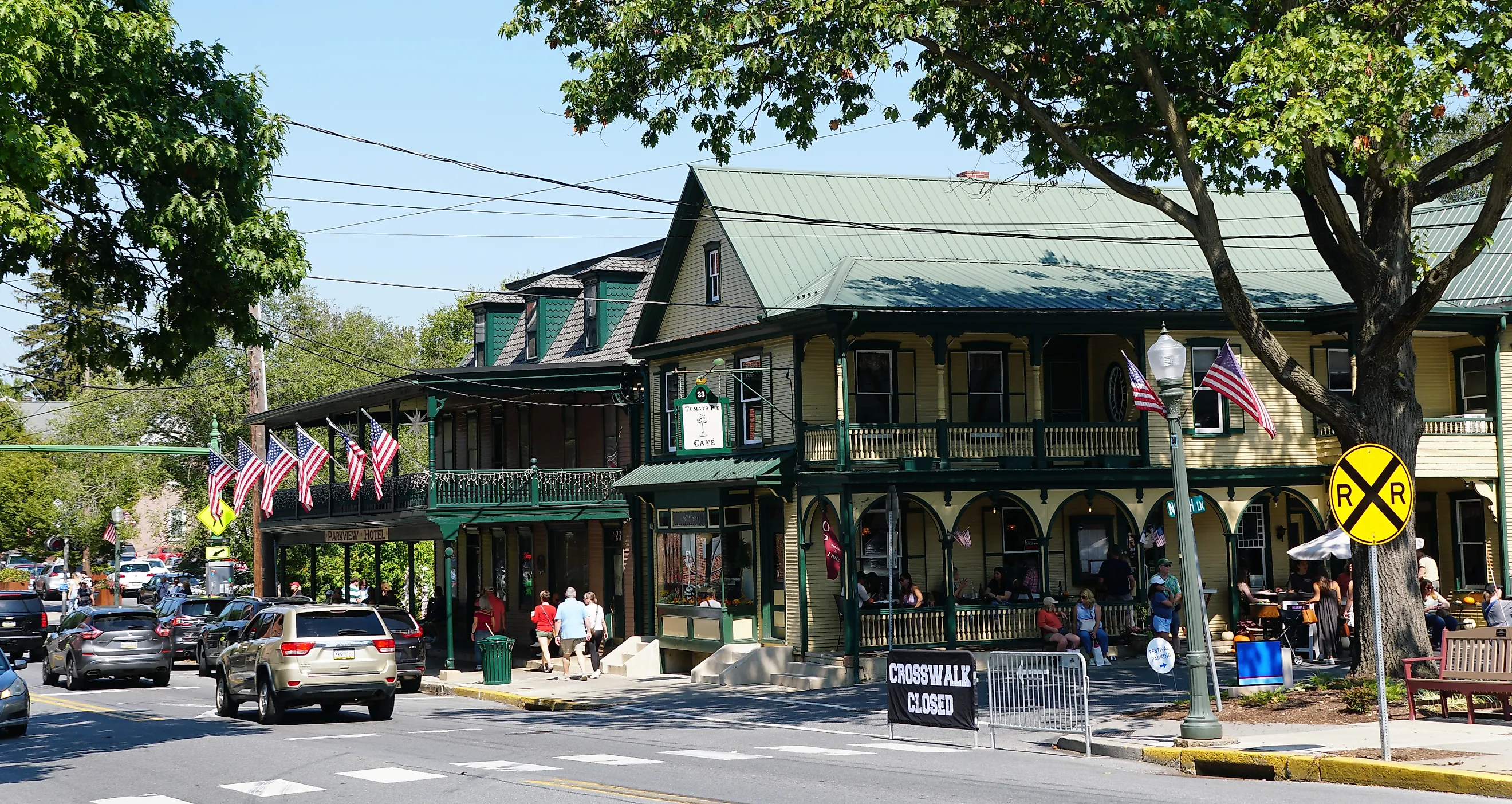
Lititz keeps time by the clock face on the Moravian Church tower, its hands turning above Broad and East Main. The town traces to 1756 as a Moravian settlement, and that communal planning still shapes its layout, with hidden gardens and walking alleys clinging close behind the storefronts. The sense of design and intention is what distinguishes Main Street here.

Along Main, the Julius Sturgis Pretzel Bakery, the first commercial pretzel bakery in America, holds tight to its heritage: customers still watch dough twisted by hand just as it was in 1861. A few doors down, Wilbur Chocolate's retail store sells the historic Wilbur Buds and vintage candy jars. Behind Main lies Lititz Springs Park, with a spring-fed creek, cast-iron fountain, and footbridges over Lititz Run. At the corner of Main and South Broad, the General Sutter Inn sits above the Bulls Head Public House, whose cask ales and pub fare anchor the square, and the Lititz Museum, in a restored 19th-century building beside the park, exhibits farmhouse tools, spinning wheels, and historical portraits.
Where The Lights Stay On
Pennsylvania's best main streets are not museum sets; they are working corridors. Each of these 12 mixes a stage, a story, a staple, and a stroll into daily habit, whether that means the trolley-wired State Street in Media, gas-lit Wellsboro, or rail-born Jim Thorpe. The result is legibility: theaters that book shows, bakeries that open early, parks and squares that hold the center. Follow the lights; the state's heart beats downtown.