The Counties Named After People Who Never Existed
Most American counties are named for people who turn up in the historical record, such as generals, presidents, territorial governors, and whoever happened to settle the ground first. A small number are not. Scattered across the map are counties that bear the names of characters invented by poets and novelists, figures conjured from legend, and, in two Michigan cases, words a federal agent coined and submitted to the state legislature. Every one of them has a courthouse, a tax roll, and a permanent line in the Census Bureau's files. These are the American counties named after people who never existed.
El Dorado County, California

This gold rush county east of Sacramento takes its name from one of the most seductive lies in the history of exploration. El Dorado, Spanish for "the gilded one," began in 16th-century Spanish accounts as a description of a South American ruler who was said to coat his body in gold dust and rinse it off in a sacred lake. The conquistadors turned that single figure into a golden king, then into an entire city of gold, and spent the next two centuries hunting a kingdom that was never there. When James W. Marshall struck real gold at Coloma in January 1848, the name latched onto the diggings, and in 1850, the mythical golden man lent his title to one of California's original 27 counties. About 191,000 people lived in the county at the 2020 census. The gilded king remains as fictional as ever.
Evangeline Parish, Louisiana

Louisiana has no counties. It has parishes, which the U.S. Census Bureau classifies as county equivalents, so Evangeline is a county in every practical sense except the label. The name honors Evangeline, the Acadian heroine of Henry Wadsworth Longfellow's 1847 narrative poem "Evangeline: A Tale of Acadie." She is entirely a literary invention. Separated from her love, Gabriel, during the 1755 expulsion of the Acadians, she searches for him across a lifetime and finds him only as he lies dying. The poem made Longfellow the most famous writer in America and turned Evangeline into a lasting symbol of Acadian endurance. The state legislature carved the parish out of St. Landry in 1910, and it was organized the following January. The parish seat is Ville Platte. A fictional bride now holds down a very real corner of Cajun country.
Attala County, Mississippi

In the heart of Mississippi sits a county named for a heroine who lived only inside a French novel. Attala takes its name from Atala, the title character of François-René de Chateaubriand's 1801 novella Atala, a tragic romance between a Christian Native American woman and her beloved in the Southern wilderness. The book was a sensation on both sides of the Atlantic, and Colonel Gordon D. Boyd, who would become the county's first state senator, admired it enough to propose the name. The county was established on December 23, 1833, on land ceded by the Choctaw Nation under the 1830 Treaty of Dancing Rabbit Creek. The county seat carries its own borrowed glory in Kosciusko, named for the Polish general Tadeusz Kosciuszko. About 17,900 people lived in Attala County at the 2020 census, every one of them a resident of a place named after a woman who existed only in print.
Aurora County, South Dakota

More than 40 of South Dakota's 66 counties honor the practical men who built the Dakota Territory, including legislators, governors, and military officers. One county, on the plains west of Sioux Falls, strays from the norm and honors a Roman goddess instead. Aurora County is named for Aurora, the goddess of the dawn, who in classical mythology renews herself each morning and rides across the sky to announce the coming of the sun. When the territorial legislature created the county in 1879 out of the former Cragin and Wetmore counties, it reached past its own roster of politicians and chose a deity who greets each new day, a fitting emblem for settlers staking everything on hope and a fresh start. The county seat is Plankinton, and the county was formally organized in 1881. About 2,750 people lived across its 708 square miles at the 2020 census, roughly four per square mile. Aurora rises every morning in the sky, yet has never once existed on the ground.
Iosco County, Michigan

Michigan holds one of the strangest cases of all, because here a single man invented the namesakes on purpose. Henry Rowe Schoolcraft, a 19th-century geographer and United States Indian agent, had a habit of coining pseudo-Native American names by splicing together syllables of Ojibwe, Latin, and Arabic, then hanging them on the state map. Iosco County is named for Iosco, a heroic character Schoolcraft used for young men in his invented legends, a word he claimed meant "water of light." The county had first been called Kanotin, a name usually traced to an Odawa chief, before the legislature swapped a genuine person for a fictional one in 1843. The county seat is Tawas City. Iosco has been a place on the map for more than 180 years. Iosco the hero was never anything but a legend.
Leelanau County, Michigan

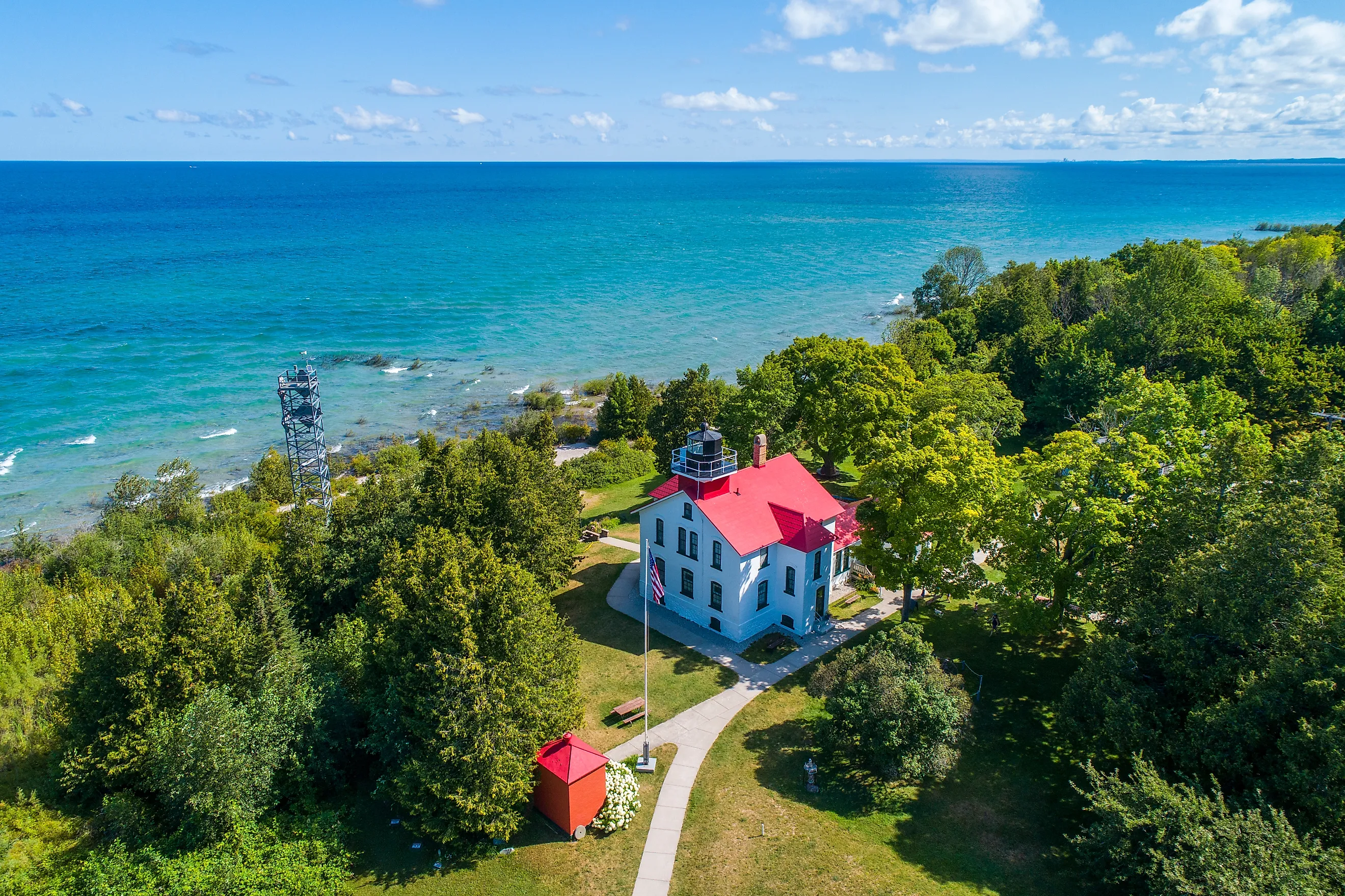
The same Henry Schoolcraft is responsible for Leelanau, the "little finger" peninsula county on Lake Michigan. He gave the name Leelinau to Native American heroines in his tales, including the tragic "Leelinau, the Lost Daughter" from his 1839 collection "Algic Researches," then submitted a revised spelling, Leelanau, to the Michigan legislature for the county in 1840. There is an honest wrinkle worth noting. Leelinau also began as a real pen name, used by Schoolcraft's wife, the Ojibwe writer Jane Johnston Schoolcraft, in the family magazine they produced in the 1820s. But the figure the county name conjures, the lost daughter of the legend, is pure fiction. As with Iosco, the same pattern played out across Michigan, where Schoolcraft's invented names displaced earlier ones drawn from real Native chiefs. A good deal of the Michigan map, it turns out, honors people who lived only in his imagination.
Myths Made Official
These six names survive because of when they were assigned. All of them were fixed to the map between 1833 and 1910, during the decades when legislatures were drawing thousands of new county lines and needed names faster than local history could supply them. A popular novel, a Spanish legend, a classical goddess, and a government mapmaker's neologisms all counted as legitimate sources at that moment, and once a name was entered in a statute, it stopped being literature and started being an address. The Choctaw cession that produced Attala and the Odawa chief displaced by Iosco are reminders that these inventions frequently went in where real names had been. Fiction is not usually the sort of thing that acquires a sheriff and a budget, and yet in six places it did.



.jpg)
