9 Offbeat South Dakota Towns To Visit In 2026
Small town life in South Dakota can be an adventure in itself. It can be quirky roadside attractions, a taste of the Old Wild West, or laid-back communities that are as welcoming as they are offbeat. Wall, a town near the Badlands National Park, is famous for its historic Wall Drug Store. It is also home to the National Grasslands Visitor Center, the nation's only center dedicated to all federally managed grasslands.. In Pringle, visitors can marvel at a quirky bicycle sculpture and enjoy horseback rides through the prairies landscape. Meanwhile, Montrose offers its own unusual attraction. It features a park laden with metal sculptures, including a fire-breathing dragon. These and other South Dakota towns on the list are worth visting for their unique charm and distinctive travel experiences.
Midland

Midland is a small and historic town located between the Missouri and Cheyenne Rivers. The landscape consists of prairie grasslands, with many livestock farms. Midland started as a railroad community servicing farmers and ranchers. Agriculture, mainly cattle and grain, is still the biggest part of the town’s economy. Midland is a great base for exploring the Badlands National Park which is within an hour's drive from the town. Midland sits in an open landscape, giving visitors a sense of the region's quiet expanse. Road trips along the I-90 give visitors a feel for the South Dakota landscapes.
Two of the town’s biggest attractions are the Skeleton Man Walking Skeleton Dinosaur and the 1880 Town. Skeleton Man is a famous roadside attraction, a sculpture consisting of a human skeleton “walking” the skeleton of a Tyrannosaurus rex. 1880 Town is a recreated Old West town off the I-90, which brings alive frontier life and cowboy history. Key daytrip destinations include the Minuteman Missile National Historic Site, a decommissioned nuclear missile silo open for tours. Just west of Midland is Wall Drug Store, a roadside attraction with massive gift shops, restaurants, and famously, free ice water.
Deadwood

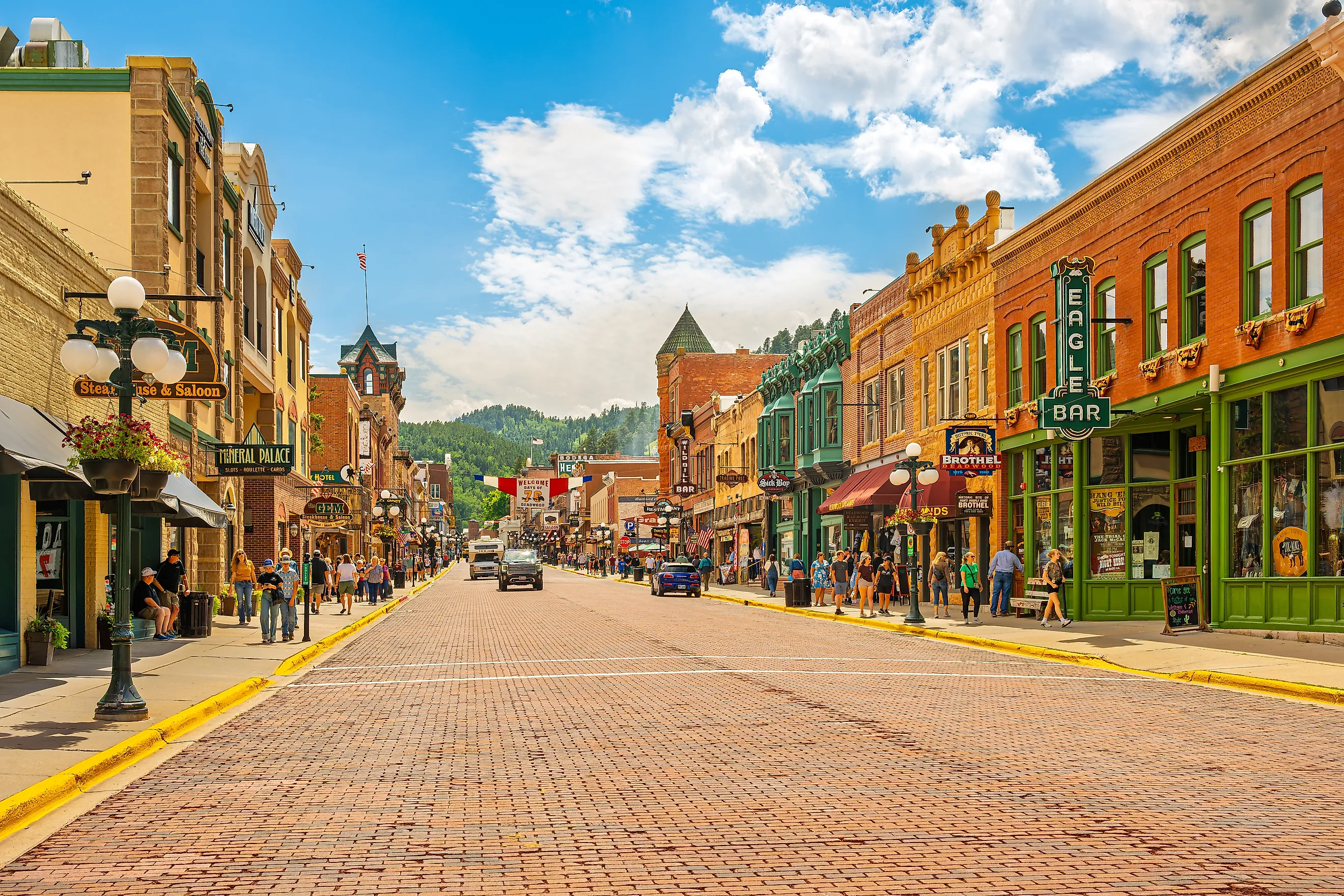
This historic Wild West town gave rise to the legends of Wild Bill Hickok and Calamity Jane. The town today is a living-history experience, where visitors can take in Old West saloons, explore gold mines, and walk through a real Wild West boomtown. The town is a National Historic Landmark, worth visiting for the preserved buildings on their own. Deadwood is also a key gateway to the Black Hills. The Adams Museum is the oldest in Deadwood, and exhibits the area's history, including Gold Rush artefacts. Get some first-hand Wild West saloon experience at Saloon No. 10, still serving drinks and providing an opportunity to do some real gambling.
To get a real sense of the history of the region and its fabled inhabitants, Mount Moriah Cemetery is a historic, and somewhat eerie, final resting place for legends who actually lived in Deadwood and the surrounding region, such as marshal and gambler Wild Bill Hickok, frontierswoman Calamity Jane, Seth Bullock, Deadwood’s first sheriff and a US Marshal, and Potato Creek Johnny, famoius prospector. The cemetery also once contained the remains of Chinese immigrants who had come to Deadwood during the Gold Rush, although many were later disinterred and sent back to China. Visitors can also try their hand at panning for gold at Broken Boot Gold Mine, which provides tours of a real underground gold mine.
Montrose

Montrose, located off the I-90 and west of Sioux Falls, is a small town known for its roadside attractions. As part of an I-90 road trip, Montrose is an essential stop, but it is worth staying a bit longer to take in some of the outdoor activities in the open prairies. Founded in the 1880s with the coming of the railroad, Montrose is known for its small-town atmosphere and is rich in agricultural history. The key attraction of Montrose is the Porter Sculpture Park, just off the I-90. This park features over 60 recycled metal sculptures created by artist Wayne Porter. The collection includes a 60-foot bull’s head and a fire-breathing dragon.
For some outdoor activities, the Lake Vermillion Recreation Area provides opportunities for boating, fishing, camping, or hiking along the Vermillion River. Day trips from Montrose include The World's Only Corn Palace, just west of town, which features the famous Corn Palace, with murals made from corn and grain. Just east of Montrose is Falls Park. Located in Sioux Falls, the park provides views of the famous waterfalls, plus ruins of the Queen Bee Mill.
Philip

Philip is a small town on the plains of western South Dakota. It is a key service hub for the area’s agricultural communities. The town was named for Scottish-American rancher James “Scotty” Philip, known for his efforts to save the American bison from extinction. Every August, Scotty Philip Days takes place as a major celebration of the town’s namesake. Philip is also an important gateway to the Badlands. The town is also known for its roadside attractions, particularly oversized animals, including the famous Giant Prairie Dog statue.
Other attractions include the Prairie Homestead Historic Site. A 1909 dirt-sod dugout, the site provides visitors with a chance to look back at pioneer history, including dressing in period clothing, and opportunities to interact with farm animals, as well as the area’s white prairie dogs. In town, you can take in the Gem Theatre, a historic theater, one of only two still operating between Rapid City and Pierre, and offering low-cost viewings. Philip is also famous for the Philip Match Bronc Ride, an annual event held at the Rodeo Grounds, celebrating the town’s cowboy heritage.
Lemmon

This quirky town is famed for its frontier history, dinosaur fossils, scrap-metal sculptures, and the world's largest petrified wood park. This town in northwestern South Dakota is located near the North Dakota border. Lemmon is the regional hub for agriculture, ranching, and rural tourism, and is surrounded by prairie landscapes, featuring a lively local art culture. Petrified Wood Park is the world's largest petrified wood park, the size of a full city block. There is an on-site museum, and the petrified wood is embedded with real dinosaur and mammoth fossils.
Explore the Old West and Native American culture at the Grand River Museum. Admission is free, and the museum also features a collection of local dinosaur fossils. The town’s cowboy heritage is celebrated every July during the Boss Cowman Celebration, with rodeos, parades, and art. Downtown Lemmon is also the location of many of sculptor John Lopez’s scrap-metal sculptures. Shadehill Recreation Area is just south of town. A massive reservoir spans nearly 5,000 acres and is an ideal spot for swimming, boating, fishing, and camping.
Scenic

Sitting on the edge of the Badlands National Park, this sparsely populated town in southwest South Dakota is a gateway to many outdoor adventures. It also provides its own thrills; with its many abandoned old buildings, Scenic at times feels like a ghost town. Yet, there is a community here, going back to the early 20th century. Scenic began as a service hub for ranchers and for travelers heading west along the plains just outside the Black Hills. As a frontier town, it featured a post office, saloon, dance hall, and general store. By the late 20th century, there were only a handful of residents left.
Just to the east of town, the Badlands Loop State Scenic Byway is a 39-mile drive along Highway 240. This takes visitors through some spectacular landscapes, often described as lunar, filled with unusual rock formations and ancient fossil beds. A somewhat advanced hike. The Notch Trail is a 1.5-mile trail that takes you up a wooden ladder for elevated views of the White River Valley. Southwest of Scenic is the Wildlife Loop Road, an 18-mile scenic drive winding through the hills and prairies that offers close viewing of wild bison, bighorn sheep, and the famous begging burros of Custer State Park, a herd of feral donkeys that descend from pack animals used by early-20th century miners and trail riders. The donkeys, despite being wild, are friendly and will approach passing cars looking for snacks.
Pringle

Pringle is sometimes called the Elk Capital of South Dakota, for the area’s thriving population of hundreds of wild elk. A quiet town with a small population (around 109), it can be described as a semi-ghost town. The town started as a stagecoach station on the Sidney-Custer Trail, a route connecting the southern Black Hills with Nebraska. With the arrival of the railroad, Pringle was a crucial depot and storage for local ranchers and travelers. Today, Pringle is a gateway to outdoor pursuits and heritage tourism.
A main attraction for the area around Pringle is the Four Mile Old West Town, a collection of preserved buildings and old west memorabilia. Guided horseback tours are available through local stables such as Sage Meadow Ranch, taking riders through the ponderosa pines and the prairies of the Black Hills. A famed roadside attraction, the Quirky Bicycle Sculpture is a piece of folk art sculpture located on Highway 385. Although the town is small, there are social events in town, mostly centered around the Hitch Rail Bar, a 60-year-old cowboy bar serving brisket and burgers. Just north of Pringle, the Crazy Horse Memorial is an ongoing mountain carving, with a welcome center and museums dedicated to local Indigenous art and history.
Sisseton

Sisseton’s most famous site is the Sica Hollow State Park. Nearby to the park is Nicollet Tower, offering sweeping views of three states. The town is rich in Native American heritage, as well as pioneer history, and outdoor activities. Located on the Coteau des Prairies, Sisseton is the regional hub for education, culture, and business, and is part of the Lake Traverse Reservation area. As of 2026, nearly 49% of the town’s 2,411 people are Native American.
The town’s location on Highway 10 makes it an ideal base and gateway for exploration of northeast South Dakota. Sica Hollow State Park is a heavily wooded park with hiking and horse riding trails, and is exceptional with the fall colors. Just northwest of the town is Fort Sisseton Historic State Park, a fully restored 1864 frontier army post, where a three-day Historical Festival is held in early June each year. For more local history, the Stavig House Museum is a restored 1917 home where visitors learn about the pioneer and mercantile history of Sisseton's early Norwegian settlers.
Wall

Wall is most famous for Wall Drug Store, a historic roadside attraction. The town itself shares the drug store’s esthetic of kitschy Americana and is located near the Badlands National Park. An early railroad town along the Chicago and North Western line, Wall’s name comes from the vertical wall of rock of the Badlands escarpment. The community grew as an agricultural and service center for ranchers and travelers crossing the Great Plains.
In addition to Wall Drug, Wall is a base for anyone wanting to explore Badlands National Park and the Black Hills. Located in town, the National Grasslands Visitor Center is the only center dedicated to the federally-managed grasslands of the United States. The center features exhibits on local ecology and the Dust Bowl. Dahl's Chainsaw Art features wood sculptures made on-site. From the I-90, a famed roadside attraction can be found, the 80-foot Green Dinosaur. The dinosaur is two-toned in color and has lightbulbs for eyes. Nearby, the Jackalope is a 42-foot-tall mythical rabbit with antelope horns.
Off The Beaten Track In South Dakota
There's more to South Dakota than Mount Rushmore. The wild, open spaces of the prairies and the rugged badlands call out to the adventurous. A visitor can spend a day here or make it a road trip, but either way, there are unique sights in many of the small towns of South Dakota.