Where People Are Moving To In Alabama In 2026
Alabama gained 167,651 residents since 2020, and every bit of that growth came from people moving in. Plenty of the movers were Alabamians who just changed counties. In one tax year, 5,207 Jefferson County residents moved to Shelby County. Your new neighbor in Calera may well be your old one from Birmingham. Another 1,830 people left Mobile County for Baldwin County across the bay. Here is where Alabamians are moving in 2026.
Madison

No Alabama city added more people last year than Madison. It gained 4,157 residents between July 2024 and July 2025, lifting the total from a 2020 base of 56,910 to 67,968. Madison grew 19.4% in five years, close to six times the rate Alabama posted over the same period. Madison County took in 36,161 net domestic movers over the same stretch. Some 1,974 people crossed from Limestone County in a single year of tax filings, the largest such flow into Madison County from any other county in Alabama.
Madison has been growing into Limestone for years, and its schools went with it. Madison City Schools serves roughly 13,000 children and is among Alabama's fastest-growing school systems. The district put its eighth elementary school, Russell Branch, on the Limestone side of the line, where better than a quarter of its enrollment now lives. Planners there work to a figure of about 350 additional students a year.
Springville

Springville landed a $3.8 million state grant in January 2026 to clear and prepare a rail-served commerce park off Interstate 59. The city assembled the money with the St. Clair County Commission, the county Industrial Development Board, the State of Alabama, and Norfolk Southern. The town it will serve has grown 17.2% over five years, from 4,776 residents to 5,597, more than five times Alabama's growth.
Those arrivals are overwhelmingly local. Three-quarters of those reaching St. Clair are from within Alabama, and Jefferson County alone sent 2,090 of them during a single tax year. Birmingham has shed 4,333 residents this decade. Interstate 59 runs less than a mile southeast of town, close enough that the new park will sit beside it. The Presley Store was built in 1902 by two brothers running a general store, and it has the only cast-iron facade in St. Clair County. Down the street, Big Spring Park keeps a small lake fed by the spring that gave the town its name.
Calera

Jefferson County empties in two directions, and Calera catches the southbound half. Three exits on Interstate 65, two railroads, and the Shelby County Airport all serve this city of 18,992. Growth has run at 15.2% over five years, compared with 3.3% for Alabama as a whole, adding 2,509 people to a 2020 figure of 16,483. Shelby County absorbed 10,287 more arrivals than departures across five years, and the tax data is blunt about the source. Some 5,207 individuals reached it from Jefferson County over twelve months of returns, roughly three-fifths of everyone coming from elsewhere in the state.
Calera markets a 1,500-acre megasite to manufacturers, and the city carries both Norfolk Southern and CSX rail access. Four city parks fill out the rest, along with Corbin Farms Winery and Ozan Winery. The Heart of Dixie Railroad Museum, Alabama's official state railroad museum, occupies a downtown location and runs standard-gauge trains out of two restored depots.
Opelika

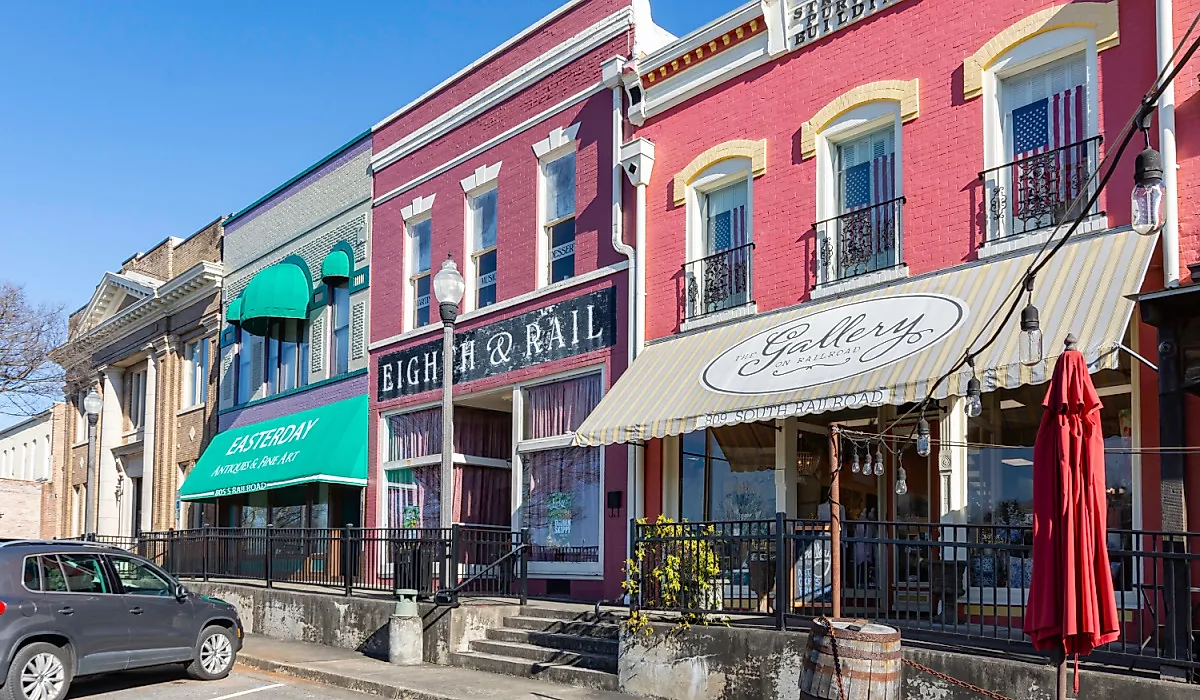
Miele picked Opelika for its first production site in the United States. The German appliance maker joins an expanding automotive cluster, and Car Tech has committed $21.5 million and 40 new jobs on top of that. Opelika itself has grown 15.3% since 2020, adding 4,747 residents at roughly five times the state's pace. Lee County's domestic migration ran to a net of 8,057 since the last census. Its largest in-state supplier is Russell County, with 1,144 individuals, followed by Chambers County and Montgomery County. Alabamians make up nearly half of everyone the county takes in. Fire took the wooden business district in 1868. What replaced it along Railroad Avenue was brick, one- and two-story, massed in solid blocks, and most of it went up between the 1880s and the 1920s, while the Lee County Courthouse still stands in the center of town.
Pike Road

Residents of the Glynlakes, Bean, Barnes, and Meriwether Road communities voted in 1997 to incorporate as Pike Road. The measure carried with 97% support. The city has grown by 26.1% since 2020, from 9,436 residents to 11,899, which is eight times the state's growth. Its county went the other way. Montgomery County has surrendered 9,526 residents to domestic migration this decade, while Montgomery itself shed about 500 over the past year.
Pike Road settled its boundary with Montgomery in 2010 and opened a town hall the same year. County Road 40 cuts across the city from east to west, while State Highway 231 runs along the western edge. The Pike Road Arts and Crafts Fair has taken place on the first Saturday in November since 1966. It fills the grounds of the Marks House, which dates from the mid-1820s and is listed on the Alabama Register of Landmarks and Heritage.
Semmes

Semmes became Alabama's 461st municipality on May 2, 2011, after residents voted by nearly three to one to incorporate. A probate judge certified the new city, with a population of 2,897. It has since grown 21%, from a base of 5,174 to 6,259, well clear of the 3.3% Alabama managed. Mobile County has lost residents through these same years. The city of Mobile has declined in each of the past five years, falling from 206,485 in 2020 to 200,824 in 2025. The city covers roughly 9,360 acres near the center of the county, with Big Creek Lake along its western edge and Citronelle to the north. Nurseries built the local economy once the timber trade faded, and the area now supplies azaleas and camellias across the country. Growers and collectors fill the Semmes Camellia Show every January, an event sponsored by the alumni and friends of Semmes School.
Spanish Fort

Spanish Fort faces Mobile Bay from the Baldwin County side. Tax records counted 1,830 people moving out of Mobile County and into Baldwin in one filing year. No other part of Alabama sent Baldwin more. The county drew 14,151 arrivals from around the country that year, about a third of them Alabamians. Mobile County's net domestic loss came to 5,157 this decade. Spanish Fort went up 11.6%, from 10,041 people to 11,203, more than triple what Alabama managed.
Retail for the eastern shore runs through two centers inside the city limits, the Eastern Shore Centre and Spanish Fort Town Center. Historic Blakeley State Park covers 3,800 acres along the Tensaw River near town. It ranks among the largest sites on the National Register of Historic Places east of the Mississippi. A boardwalk reaches out over the water, and boat tours run from the park into the Mobile-Tensaw Delta.
Silverhill

A Chicago outfit called the Svea Land Company went looking for farmland in the south in 1890, hoping to plant a colony of Swedish farmers there. Oscar Johnson laid out Silverhill six years later. No Alabama municipality has grown faster since 2020. The town went from 768 residents to 2,529, more than tripling in a state that grew 3.3%, with 499 of that gain coming within the past 12 months.
Baldwin County, which also includes Spanish Fort, added 34,523 residents through domestic migration alone over the five years, second only to Madison County statewide. Baldwin County Public Schools has opened a new Silverhill Elementary. Alabama Highway 104 crosses Baldwin County Road 55 in a town center barely a mile away. The town credits that junction for its run of new subdivisions and businesses.
What The Next Census Will Show
Alabama is not filling up so much as rearranging itself, because births no longer cover deaths and the whole gain since 2020 came from people moving. Jefferson, Montgomery, and Mobile counties gave up more than 31,000 residents to domestic migration over that span. The places taking them in are the ones now opening new schools and clearing ground for commerce parks. The next census will count a bigger Alabama, and a good deal of it living somewhere new.